

Figuring out how much to feed a puppy feels straightforward until you’re standing in a pet store holding a 15 kg bag with a feeding chart that makes no sense for your specific dog. I often see new Golden Retriever owners come in with puppies that are either visibly too lean – all ribs and angles – or already rounding out at 10 weeks because the bag said one thing and instinct said another.
How much to feed a puppy is genuinely more nuanced than most new owners are prepared for. The puppy food amount isn’t fixed – it changes every few weeks, responds to actual body weight rather than age alone, and looks completely different depending on the caloric density of the food you’re using.
For Golden Retrievers specifically, getting the puppy food amount right is more than a weight management issue. This breed carries a strong genetic predisposition to joint problems that are directly worsened by overfeeding in the growth phase. The amount going into the bowl in the first twelve months shapes the joints your dog will rely on for the next twelve years.
This guide gives you a precise, breed-specific answer to how much to feed a puppy at every stage – backed by clinical reasoning, not just charts.
Contents
- 1 Why Puppy Food Amount Affects More Than Weight in Golden Retrievers
- 2 How to Calculate the Right Puppy Food Amount.
- 3 How Much to Feed a Puppy: Complete Golden Retriever Chart by Age and Weight.
- 4 How Much to Feed a Puppy at Each Key Growth Stage.
- 5 Puppy Food Amount Adjustments: When to Go Up, When to Pull Back.
- 6 9 Vet-Backed Rules for Getting Puppy Food Amount Right in Golden Retrievers.
- 6.1 1. Always calculate from kcal/cup, not cups alone.
- 6.2 2. Recalculate every 3 – 4 weeks.
- 6.3 3. Subtract treat calories from the daily kibble total.
- 6.4 4. Use a kitchen scale at least once per calibration cycle.
- 6.5 5. Validate every chart with hands-on BCS.
- 6.6 6. Use large-breed puppy formula – not adult, not all-breed.
- 6.7 7. Do not accelerate meal frequency reductions.
- 6.8 8. Account for food changes immediately.
- 6.9 9. Do not use the puppy’s enthusiasm as a portion gauge.
- 7 Vet Experiences.
- 7.1 How much to feed a puppy per day?
- 7.2 What is the right puppy food amount for a Golden Retriever?
- 7.3 How much to feed a puppy at 8 weeks?
- 7.4 How much to feed a puppy at 3 months?
- 7.5 How much to feed a puppy at 6 months?
- 7.6 Should I follow the puppy food amount guide on the bag?
- 7.7 How do I know if my puppy food amount is correct?
- 7.8 Can giving too much puppy food cause joint problems?
- 7.9 How much to feed a puppy if I use wet food instead of dry?
- 7.10 How often should I adjust the puppy food amount?
- 7.11 Do treats count toward the puppy food amount?
- 7.12 What is the right puppy food amount after spaying or neutering?
- 7.13 How much to feed a puppy that always seems hungry?
- 7.14 When should I transition from puppy food to adult food amounts?
- 7.15 Is a large-breed puppy formula necessary, or can I use regular puppy food?
- 8 Conclusion.
Why Puppy Food Amount Affects More Than Weight in Golden Retrievers
The puppy food amount decision carries consequences that extend well beyond the scale. In large breeds, caloric intake during the growth phase is one of the most controllable risk factors for developmental joint disease.
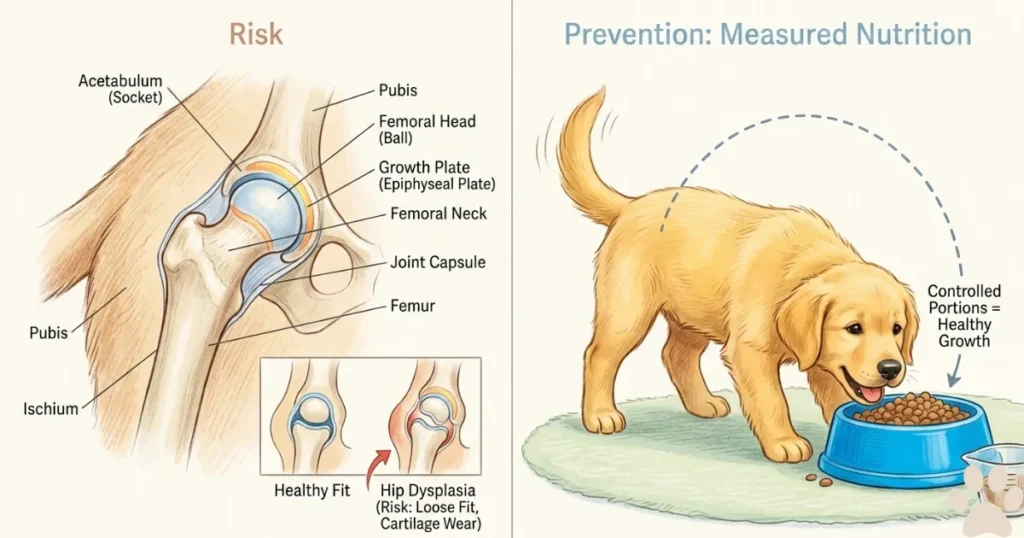
The mechanism in canine orthopaedics:
When a puppy consumes more energy than controlled growth requires, bone formation accelerates. In large-breed puppies, this accelerated rate creates a mismatch – bone grows faster than the cartilage and connective tissue meant to support it. The structural result is joints that form under mechanical stress they weren’t designed to handle.
For Golden Retrievers – already genetically loaded for hip dysplasia, elbow dysplasia, and osteochondrosis – excessive puppy food amounts don’t just cause weight gain. They activate a developmental cascade that no amount of adult management fully reverses.
What getting puppy food amount right actually protects:
- Hip joint formation during the 3 – 7 month rapid growth window
- Elbow joint integrity through closure of growth plates (12 – 18 months).
- Healthy cartilage development at all major joints.
- A lean, muscular adult body composition rather than a fat-padded one.
Understanding how much to feed a puppy in a large breed is, at its core, a joint protection strategy.
How to Calculate the Right Puppy Food Amount.
Rather than relying on bag charts alone, the most accurate way to determine how much to feed a puppy is to use the Resting Energy Requirement (RER) formula adjusted for growth stage.
Step 1: Calculate RER.
RER (kcal/day) = 70 × (body weight in kg) ^ 0.75.
Step 2: Apply the Growth Multiplier.
| Puppy Age | Multiplier |
| 8–16 weeks | 3.0 |
| 4–12 months | 2.0 |
Step 3: Convert to Cups.
Daily cups = Daily kcal need ÷ kcal/cup (from your food label).
Worked example – 12 kg puppy at 5 months:
- RER = 70 × (12) ^ 0.75 = 70 × 6.47 = | 453 kcal.
- With 2.0 multiplier: 453 × 2.0 = | 906 kcal/day.
- Food at 375 kcal/cup: 906 ÷ 375 = | 2.4 cups/day.
Recalculate every 3 – 4 weeks using your puppy’s current body weight. The number changes faster than most owners expect during the growth phase.
Vet’s Tip: The single most reliable indicator that your current dog food amount needs adjustment is not body weight on a scale – its rib palpation. If you can feel ribs clearly with light fingertip pressure but cannot see them, the puppy food amount is correct. If ribs require firm pressure to locate, reduce by 10% and recheck in two weeks.
How Much to Feed a Puppy: Complete Golden Retriever Chart by Age and Weight.
All figures below are based on a quality large-breed puppy dry kibble at 375 kcal/cup. Always verify and adjust using the kcal/cup printed on your specific food’s packaging.
Master Puppy Food Amount Chart – Golden Retriever.
| Age | Typical Weight | Daily Caloric Need | Daily Total | Meals/Day | Per Meal |
| 8–10 weeks | 3–5 kg | 480–660 kcal | 1.3–1.8 cups | 4 | ⅓–½ cup |
| 10–12 weeks | 5–7 kg | 640–800 kcal | 1.7–2.1 cups | 4 | ~½ cup |
| 3 months | 7–10 kg | 760–900 kcal | 2.0–2.4 cups | 3 | ⅔–¾ cup |
| 4 months | 10–13 kg | 860–1,000 kcal | 2.3–2.7 cups | 3 | ¾–1 cup |
| 5 months | 13–17 kg | 990–1,140 kcal | 2.6–3.0 cups | 3 | ⅞–1 cup |
| 6 months | 17–21 kg | 1,080–1,260 kcal | 2.9–3.4 cups | 2–3 | 1–1.7 cups |
| 7–8 months | 20–25 kg | 1,180–1,380 kcal | 3.1–3.7 cups | 2 | 1.5–1.9 cups |
| 9–10 months | 23–27 kg | 1,280–1,460 kcal | 3.4–3.9 cups | 2 | 1.7–2.0 cups |
| 11–12 months | 25–30 kg | 1,340–1,560 kcal | 3.6–4.2 cups | 2 | 1.8–2.1 cups |
Recalculate every 3 – 4 weeks using the actual current weight. Adjust if your food’s kcal/cup differs from 375.
How Much to Feed a Puppy at Each Key Growth Stage.
8 to 12 Weeks: Tiny Stomach, Four Meals, Small Amounts.
At 8 weeks, the correct puppy food amount is smaller than most new owners expect. A Golden Retriever puppy at this age weighs 3 – 5 kg and has a stomach capacity of roughly one cupped handful.
Puppy food amount at 8 – 12 weeks:
1.3 – 2.1 cups per day, split across four meals.
Sample daily plan – 8 to 12 weeks:
| Meal | Time | Portion |
| Meal 1 | 7:00 AM | ⅓–½ cup |
| Meal 2 | 12:00 PM | ⅓–½ cup |
| Meal 3 | 5:00 PM | ⅓–½ cup |
| Meal 4 | 9:00 PM | ⅓–½ cup |
What NOT to do:
Do not combine meals to reduce feeding occasions. At this age, four small meals protect against hypoglycaemia and prevent GI overload. Convenience should not override developmental need.
3 to 4 Months: Rapid Growth, Increasing Amounts, Three Meals.
Between 3 and 4 months, a Golden Retriever puppy is entering its most visible growth phase. Body weight increases by 2 – 3 kg per month. How much to feed a puppy at this stage must pace that growth – enough to fuel it, not enough to accelerate it beyond structural limits.
Puppy food amount at 3 – 4 months:
2.0 – 2.7 cups per day, across three meals.
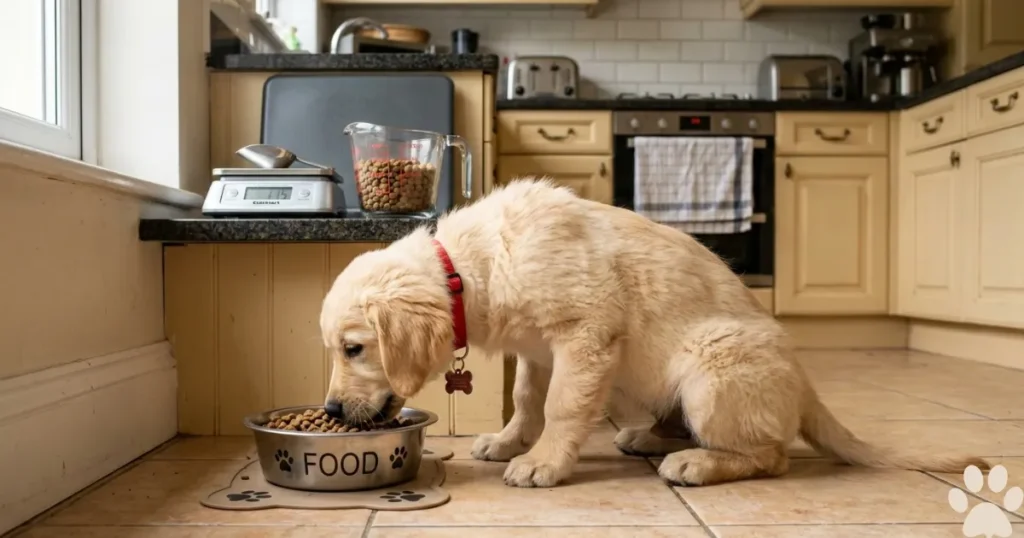
Over the years, I’ve noticed that the 3 – 4 month window is precisely when owners stop measuring and start estimating. It happens gradually – a slightly fuller scoop here, an extra handful there. Within six weeks, the actual puppy food amount being delivered can be 25 – 35% above target without the owner being aware of the drift. Monthly weight checks and fresh portion calculations prevent this consistently.
Weight-based portion reference – 3 to 4 months:
| Weight | Daily Total | Per Meal (3 meals) |
| 7–9 kg | 2.0–2.2 cups | ~⅔–¾ cup |
| 9–11 kg | 2.2–2.5 cups | ~¾–⅞ cup |
| 11–13 kg | 2.5–2.7 cups | ~⅞–1 cup |
5 to 6 Months: Peak Energy Demand, Approaching the Transition.
At 5- 6 months, many Golden Retriever puppies are approaching half their adult body weight. Caloric demand is at or near its peak relative to body size. This is also the window where transitioning from three meals to two becomes appropriate for most puppies.
Puppy food amount at 5 – 6 months:
2.6 – 3.4 cups per day.
Three-meal to two-meal transition guide:
| Stage | Daily Total | Per Meal |
| Three meals (5–6 months) | 2.6–3.0 cups | ⅞–1 cup |
| Transitioning (6 months) | 2.9–3.4 cups | 1.45–1.7 cups (2 meals) |
Move from three meals to two gradually over 7- 10 days. Reduce the midday meal progressively, redistributing its portion equally between morning and evening. An abrupt switch from three to two meals frequently causes bile vomiting in the early morning – a sign that the overnight gap is longer than the puppy’s digestion is ready for.
Decision checkpoint:
If your puppy shows bile vomiting (yellow foam before the morning meal) after shifting to two meals, either maintain three meals for another 4 – 6 weeks or add a small late-evening snack to bridge the overnight gap.
7 to 12 Months: Converging Toward Adult Amounts.
Between 7 and 12 months, a Golden Retriever puppy is completing skeletal growth and transitioning toward adult energy needs. How much to feed a puppy in this window begins to plateau as growth rate slows – caloric need per kg of body weight decreases even as total body weight increases.
Puppy food amount at 7 – 12 months:
3.1 – 4.2 cups per day on a twice-daily schedule.
Key shift at 12 months:
Transition from large-breed puppy formula to an adult or all-life-stages formula. The higher calcium and phosphorus levels in puppy formulas are no longer needed once growth plates close. Continue calculating portions based on current body weight and the new food’s kcal/cup.
7 to 12-month portion reference:
| Age | Weight | Daily Total | Per Meal (2 meals) |
| 7–8 months | 20–25 kg | 3.1–3.7 cups | ~1.5–1.9 cups |
| 9–10 months | 23–27 kg | 3.4–3.9 cups | ~1.7–2.0 cups |
| 11–12 months | 25–30 kg | 3.6–4.2 cups | ~1.8–2.1 cups |
Puppy Food Amount Adjustments: When to Go Up, When to Pull Back.
How much to feed a puppy is not a set-and-forget calculation. These are the conditions that require an upward or downward adjustment to the daily puppy food amount:
When to Increase Puppy Food Amount.
- Ribs clearly visible under the coat without touching.
- BCS falls below 4 on the 9-point scale.
- Energy level consistently low despite no illness.
- Puppy not reaching expected weight milestones (verified against breed growth curves).
- Significantly increased daily activity (longer walks, more play sessions).
How much to increase:
10% of the current daily total. Recheck BCS after 2 weeks before increasing further.
When to Reduce Puppy Food Amount.
- Ribs difficult to locate with light finger pressure.
- BCS at 6 or above – no visible waist from above.
- Loose stools persisting beyond 3 – 5 days without other cause.
- Swapping to a higher-calorie food brand without recalculating.
How much to reduce:
10% of the current daily total. Recheck BCS after 2 weeks before adjusting further.
9 Vet-Backed Rules for Getting Puppy Food Amount Right in Golden Retrievers.
1. Always calculate from kcal/cup, not cups alone.
Two foods can require completely different cup amounts to deliver the same daily caloric target. The number on the bag only means something when divided by your puppy’s daily kcal needs.
2. Recalculate every 3 – 4 weeks.
A Golden Retriever puppy’s body weight changes fast enough that a correct portion at month 3 is meaningfully wrong by month 5. Set a calendar reminder – it takes two minutes per month.
3. Subtract treat calories from the daily kibble total.
Training treats are not extras – they are part of the daily puppy food amount. For a puppy needing 900 kcal/day, 10 small treats can represent 100 – 150 kcal, reducing the appropriate kibble portion by roughly 1/4 to 1/3 cup.
4. Use a kitchen scale at least once per calibration cycle.
Scooped volumes drift over time. Weigh your puppy’s daily food in grams at least once a month to confirm cup measurements are still accurate.
5. Validate every chart with hands-on BCS.
No chart accounts for individual metabolic variation. BCS palpation is the ground truth – it confirms whether the calculated puppy food amount is landing correctly in your specific dog.
6. Use large-breed puppy formula – not adult, not all-breed.
Large-breed puppy formulas are specifically formulated to deliver controlled calcium-to-phosphorus ratios that support regulated bone growth. This is not a marketing claim – it is a documented nutritional variable in developmental orthopaedic disease prevention.
7. Do not accelerate meal frequency reductions.
Moving a 4-month puppy straight to twice-daily feeding because it’s more convenient skips a developmental transition the GI system isn’t ready for. Follow the age-appropriate meal frequency alongside the puppy food amount.
8. Account for food changes immediately.
Switching brands mid-growth means starting the portion calculation fresh. Carry-over cup amounts from a previous food are rarely accurate – caloric density differences between brands can be 20- 40%.
9. Do not use the puppy’s enthusiasm as a portion gauge.
Golden Retrievers are constitutionally food-motivated. A puppy that finishes meals in 30 seconds and stares at you for more has not told you anything about whether the puppy food amount was insufficient – only that it was a Golden Retriever.

Vet Experiences.
How much to feed a puppy in a large breed like a Golden Retriever must be calculated from the puppy’s current body weight and the caloric density of the specific food – not from age-based bag charts, which are averages that do not account for individual growth rates.
The correct puppy food amount for a Golden Retriever increases every 3 – 4 weeks throughout the first year of life, as body weight rises and daily caloric requirements rise proportionally until growth rate begins to plateau at 7 – 9 months.
In canine developmental nutrition, excess puppy food amount is a controllable risk factor for hip and elbow dysplasia in Golden Retrievers – overfeeding accelerates skeletal growth faster than cartilage and connective tissue can structurally support.
Treat calories must be factored into the total daily puppy food amount – for a puppy with a 900 kcal/day target, standard training treats can reduce the appropriate kibble portion by up to 1/4 cup per day.
In veterinary practice, rib palpation using the Body Condition Score scale is the most reliable tool for validating whether a puppy food amount is correct – a BCS of 4- 5 on a 9-point scale confirms appropriate intake regardless of what a chart suggests.
How much to feed a puppy per day?
A Golden Retriever puppy needs 1.3 – 1.8 cups at 8 weeks up to 4.2 cups at 11 – 12 months. Puppy food amount must be recalculated from actual body weight every 3 – 4 weeks – growth is fast enough that fixed amounts quickly become inaccurate.
What is the right puppy food amount for a Golden Retriever?
It depends on the puppy’s current weight and the caloric density of the food. Use the RER formula (70 × kg ^ 0.75), apply the growth multiplier (3.0 under 4 months, 2.0 from 4 – 12 months), then divide by kcal/cup on the food label.
How much to feed a puppy at 8 weeks?
At 8 weeks, a Golden Retriever puppy needs approximately 1.3 – 1.8 cups of large-breed puppy formula daily, divided across four meals – roughly 1/3 to 1/2 cup per sitting.
How much to feed a puppy at 3 months?
At 3 months, the puppy food amount is approximately 2.0 – 2.4 cups daily across three meals. Exact amounts depend on the puppy’s current weight – recalculate if the puppy has grown significantly since the last measurement.
How much to feed a puppy at 6 months?
At 6 months, most Golden Retriever puppies need 2.9 – 3.4 cups daily. This is also the stage where transitioning from three meals to two becomes appropriate for most dogs – the daily total stays the same, redistributed into two larger servings.
Should I follow the puppy food amount guide on the bag?
Use it as a starting reference only. Bag guidelines are averages that don’t account for your puppy’s individual metabolism, activity level, or the specific caloric density of that formula. Validate with the BCS assessment every two weeks.
How do I know if my puppy food amount is correct?
Perform a hands-on BCS check every two weeks. Run both hands firmly along the ribcage – ribs should be palpable with light pressure but not visible. A visible waist from above and a slight abdominal tuck from the side confirm a BCS of 4 – 5, which is correct for a growing puppy.
Can giving too much puppy food cause joint problems?
Yes. In large breeds like Golden Retrievers, excessive puppy food amounts accelerate skeletal growth beyond what supporting tissue can structurally match. This raises the lifetime risk of hip dysplasia, elbow dysplasia, and osteochondrosis – conditions already common in this breed genetically.
How much to feed a puppy if I use wet food instead of dry?
Wet food has much lower caloric density – typically 90- 130 kcal per 100g compared to 330- 480 kcal per 100g for dry kibble. Calculate daily intake by calories, not volume, using the kcal figure on the wet food label.
How often should I adjust the puppy food amount?
Every 3 – 4 weeks during the first 6 months, and every 4 – 6 weeks from 6 – 12 months as the growth rate slows. Recalculate immediately any time you change food brands, since caloric density varies significantly between formulas.
Do treats count toward the puppy food amount?
Yes. All treats contribute calories that must be subtracted from daily kibble. For a puppy needing 900 kcal/day, 10 standard training treats can account for 100 – 150 kcal – reducing the daily kibble portion by approximately 1/4 cup.
What is the right puppy food amount after spaying or neutering?
Spaying or neutering reduces metabolic rate by roughly 20- 30%. Reduce the daily puppy food amount by approximately 15 – 20% within 4 – 6 weeks of surgery, then recalculate fresh from body weight and the new caloric need.
How much to feed a puppy that always seems hungry?
Validate with BCS before increasing. Golden Retriever puppies are food-motivated by breed temperament – appearing hungry between correctly portioned meals is normal behaviour, not evidence of underfeeding. If BCS is 4 – 5, the current puppy food amount is appropriate.
When should I transition from puppy food to adult food amounts?
At 12 months for most Golden Retrievers. Switch to an adult formula and recalculate daily portions based on adult energy needs – the puppy growth multiplier no longer applies, so daily caloric targets typically decrease slightly even as the dog reaches adult weight.
Is a large-breed puppy formula necessary, or can I use regular puppy food?
Large-breed puppy formulas are specifically designed to deliver controlled calcium-to-phosphorus ratios and moderate caloric density – both of which reduce developmental orthopaedic disease risk in fast-growing large breeds. Standard puppy food is often too calorie-dense and mineral-rich for Golden Retrievers.
Conclusion.
How much to feed a puppy is one of the few decisions in Golden Retriever ownership that affects the dog’s structural health for its entire adult life. Getting the puppy food amount right in the first twelve months isn’t just about maintaining a healthy weight – it’s about giving joints the best possible developmental environment while bone and cartilage are still forming.
The right puppy food amount starts with an accurate calculation from the current body weight and the actual food caloric density. It gets validated every two weeks with a hands-on BCS check. And it gets updated every 3 – 4 weeks as the puppy grows – because the same amount that was correct last month will not be correct next month.
Golden Retriever puppies are charming, food-enthusiastic, and exceptionally good at convincing their owners that they are underfed. They rarely are. Trust the calculation, trust the BCS, and resist the instinct to add a little more.
If you’re unsure whether the current puppy food amount is right for your specific dog, a brief body condition check at your next wellness visit will give you a concrete, breed-specific answer in under five minutes.
How did you work out the right food amount for your Golden Retriever puppy?
Did you use the bag chart, calculate from scratch, or discover through trial and error that your puppy needed more – or less – than expected?
Whether your approach was methodical or instinctive, your experience helps other owners skip the guesswork. Share what worked for your dog below.

Dr. Nabeel A.
Hi, I’m Dr. Nabeel Akram – a farm management professional by trade and a passionate Golden Retriever enthusiast at heart. With years of experience in animal science and livestock care, I’ve built a career around understanding animals—how they live, thrive, and bring value to our lives. This blog is a personal project born from that same passion, focusing on one of the most loyal and lovable breeds out there: the Golden Retriever. Whether I’m managing farm operations or sharing insights on canine health, behavior, and care, it all ties back to one core belief—animals deserve thoughtful, informed, and compassionate attention. Welcome to a space where professional expertise meets genuine love for dogs.
Facebook |
Links will be automatically removed from comments.