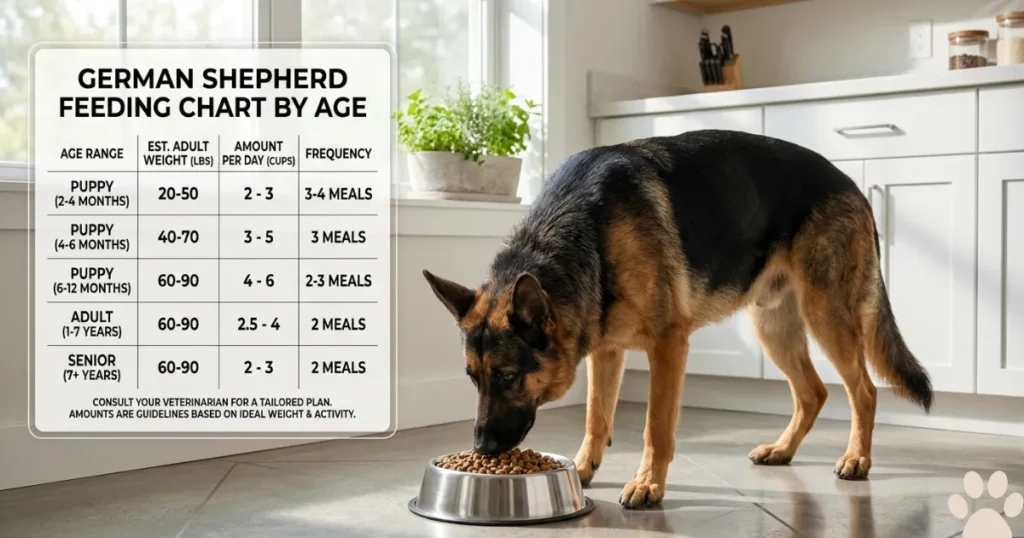
I often see German Shepherd owners doing one of two things: feeding by feel – scooping what looks right – or following the feeding guide on the dog food bag without adjusting for their specific dog’s age, weight, and activity level. Both approaches produce the same result over time: a dog that is either underweight and nutritionally under-supported, or overweight and heading toward the joint, cardiac, and metabolic problems that define poor long-term outcomes in this breed.
A German Shepherd feeding chart by age exists precisely because nutritional requirements shift dramatically between a 10-week-old puppy and a 9-year-old senior. The caloric needs, protein requirements, calcium-to-phosphorus ratios, and meal frequency appropriate at each stage are genuinely different – not marginally different. Using puppy portions for an adult, or adult portions for a senior, creates cumulative nutritional mismatches that compound over the years.
German Shepherds are large, active, working-line dogs with a documented predisposition to hip and elbow dysplasia, degenerative myelopathy, exocrine pancreatic insufficiency, and bloat. Each of these conditions has a nutritional dimension. Getting feeding amounts right by age is the foundation that everything else builds on.
Contents
- 1 German Shepherd Feeding Chart by Age: The Complete Reference Table
- 2 German Shepherd Puppy Feeding Chart: 8 Weeks to 12 Months
- 3 Adult German Shepherd Feeding Chart: 1 to 7 Years
- 4 Senior German Shepherd Feeding Chart: 7 Years and Older
- 5 How to Read a German Shepherd Feeding Chart Correctly
- 6 7 German Shepherd Feeding Mistakes That Undermine the Feeding Chart
- 6.1 1. Using the Bag’s Feeding Guide without Adjustment.
- 6.2 2. Feeding By Cup Rather Than By Calorie.
- 6.3 3. Not Adjusting After Spaying or Neutering.
- 6.4 4. Feeding Once Daily To Simplify the Schedule.
- 6.5 5. Extending Puppy Food Past 15 Months.
- 6.6 6. Reducing Protein in Senior Dogs.
- 6.7 7. Ignoring Body Condition in Favor Of Chart Adherence.
- 7 Feeding Plans and Products for German Shepherds by Age
- 8 8 Signs Your German Shepherd Feeding Chart Needs Adjustment
- 9 9 Vet-Backed Tips for Using a German Shepherd Feeding Chart by Age
- 9.1 How much should I feed my German Shepherd puppy?
- 9.2 How much food does an adult German Shepherd need per day?
- 9.3 When should I switch my German Shepherd from puppy to adult food?
- 9.4 How many times a day should I feed my German Shepherd?
- 9.5 How much should I feed a senior German Shepherd?
- 9.6 Do German Shepherds need large-breed specific food?
- 9.7 How do I know if I’m feeding my German Shepherd the right amount?
- 9.8 Should I reduce protein for my senior German Shepherd?
- 9.9 9. How much should I feed a working German Shepherd?
- 9.10 How do I use a German Shepherd feeding chart correctly?
- 9.11 Can I free feed my German Shepherd?
- 9.12 How much should I feed my German Shepherd after spaying or neutering?
- 9.13 Does a German Shepherd feeding chart change with activity level?
- 9.14 What should I do if my German Shepherd is losing weight despite eating normally?
- 9.15 How do I transition between life stages on the German Shepherd feeding chart?
- 10 Conclusion
German Shepherd Feeding Chart by Age: The Complete Reference Table
A German Shepherd feeding chart by age should account for body weight, activity level, food caloric density, and life stage – not just age alone – because two German Shepherds of the same age can have caloric needs that differ by 30- 40% based on these variables.
The amounts below are based on a moderately active German Shepherd eating a standard-quality kibble at approximately 350 – 380 kcal per cup. Adjust proportionally for higher-calorie or lower-calorie foods using the kcal/cup figure on your food’s packaging.
| Age | Weight Range | Daily Food Amount | Meals Per Day | Key Nutritional Focus |
| 8–12 weeks | 8–17 lbs | 1 – 1.75 cups | 3–4 | DHA, controlled calcium, protein |
| 3–4 months | 17–30 lbs | 1.5 – 2.25 cups | 3 | Skeletal development, omega-3s |
| 5–6 months | 30–45 lbs | 2 – 3 cups | 3 | Growth peak, large-breed formula |
| 7–9 months | 45–65 lbs | 2.5 – 3.5 cups | 2–3 | Transition to adult frequency |
| 10–12 months | 55–75 lbs | 2.5 – 3.5 cups | 2 | Controlled calorie, joint support |
| Adult (1–5 years) | 50–90 lbs | 2.5 – 4 cups | 2 | Maintenance, activity-adjusted |
| Active/working adult | 60–90 lbs | 3.5 – 5 cups | 2 | High protein, increased fat |
| Adult (spayed/neutered) | 50–85 lbs | 2 – 3 cups | 2 | Reduced calorie, weight control |
| Senior (7–9 years) | 55–85 lbs | 2 – 3 cups | 2 | High protein, joint support |
| Senior (9+ years) | 50–80 lbs | 1.75 – 2.75 cups | 2–3 | Digestive support, lean protein |
How to use this chart:
Find your dog’s current age and approximate weight. Cross-reference with activity level. If your German Shepherd is highly active – working, competing in sport, or exercising 2+ hours daily – increase portions toward the upper range. If sedentary or recovering from surgery, reduce toward the lower range. Reassess every 4 – 6 weeks using body condition scoring, not the scale alone.
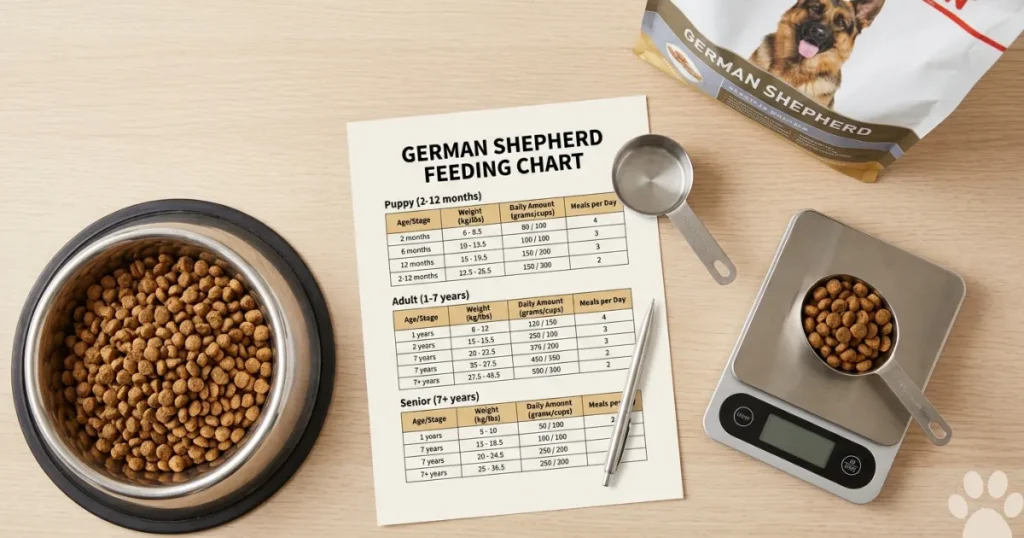
German Shepherd Puppy Feeding Chart: 8 Weeks to 12 Months
The puppy phase of the German Shepherd feeding chart by age is the most consequential period for long-term health. Nutritional decisions made between 8 weeks and 12 months directly influence skeletal integrity, joint development, immune calibration, and neurological maturation – all of which have lasting effects.
8 to 16 Weeks: Foundation Feeding
Feed 3 – 4 times daily at consistent intervals. At this age, stomach capacity is small, and blood glucose stability is essential. Portion sizes of approximately 1/3 to 1/2 cup per meal, three to four times daily, are appropriate depending on food caloric density and individual size.
Critical At This Stage:
Use a large-breed puppy formula with controlled calcium (1.0 – 1.8% dry matter) and phosphorus. Excess calcium during rapid bone growth causes uneven skeletal development that predisposes German Shepherds to the orthopedic conditions they are already genetically vulnerable to. More calcium is not better – calibrated calcium is better.
4 to 6 Months: Peak Growth Phase
This is the most rapid growth period in the German Shepherd feeding chart by age. Daily food requirements increase significantly – often doubling from 8-week amounts – while meal frequency remains at three times daily.
Monitor body condition weekly during this phase. German Shepherd puppies should be lean-athletic, not visibly ribby and not padded. Rapid weight gain during this window accelerates bone growth unevenly and increases dysplasia risk in a breed already predisposed to it.
In German Shepherd puppies, overfeeding during the 4- 6 month peak growth phase is more damaging to long-term joint health than underfeeding – excess caloric intake accelerates skeletal growth beyond what the musculoskeletal system can support.
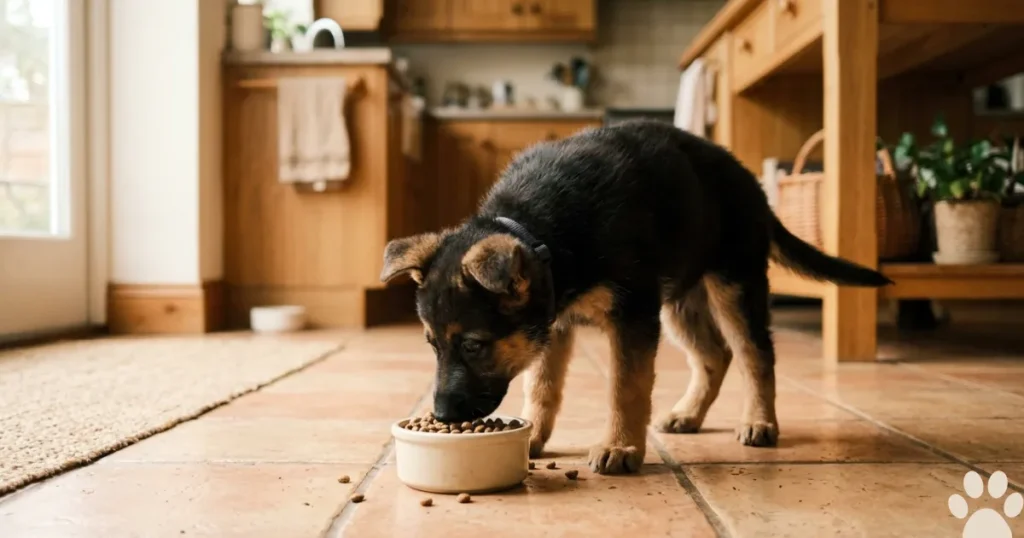
7 to 12 Months: Transitioning Toward Adult Feeding
Reduce from three meals to two between 6 and 9 months, gradually over 1 – 2 weeks. Total daily intake may plateau or slightly decrease as growth rate slows. Transition from large-breed puppy food to a large-breed adult formula at 12- 15 months – German Shepherds reach skeletal maturity later than smaller breeds and should not be transitioned too early.
Adult German Shepherd Feeding Chart: 1 to 7 Years
How Much Should An Adult German Shepherd Eat Per Day?
An adult German Shepherd at a healthy weight typically needs 1,500 – 2,100 calories daily, translating to approximately 2.5 – 4 cups of standard kibble split across two meals. Activity level is the primary variable – a working or sport dog may need 30- 50% more than a companion dog of the same weight.
The adult phase of the German Shepherd feeding chart by age is where activity-based adjustment matters most. Using a static amount year-round for a dog whose activity fluctuates seasonally leads to gradual weight gain in lower-activity periods that compounds over the years.
Body Condition Scoring Is The Most Reliable Adult Feeding Guide.
At a healthy weight, you should be able to feel – but not see – your German Shepherd’s ribs with light pressure. A visible waist from above and a tucked abdomen from the side are the visual confirmations. If the ribs are invisible under fat or the waist has disappeared, reduce portions by 10% and reassess in 3 weeks.
Spayed and Neutered Adult German Shepherds
It require approximately 20- 30% fewer calories than intact dogs of the same weight. Failing to adjust portions within 4- 6 weeks of the procedure is the most common cause of post-surgical weight gain in this breed. Reduce portions proactively – do not wait for visible weight gain to begin the adjustment.
Over the years, I’ve noticed that German Shepherds fed at consistent times twice daily maintain more stable body condition scores across seasons than those on irregular feeding schedules, even when total calories are nominally equivalent. Timing consistency supports metabolic regularity in ways that matter for this breed’s digestive sensitivity.
Senior German Shepherd Feeding Chart: 7 Years and Older
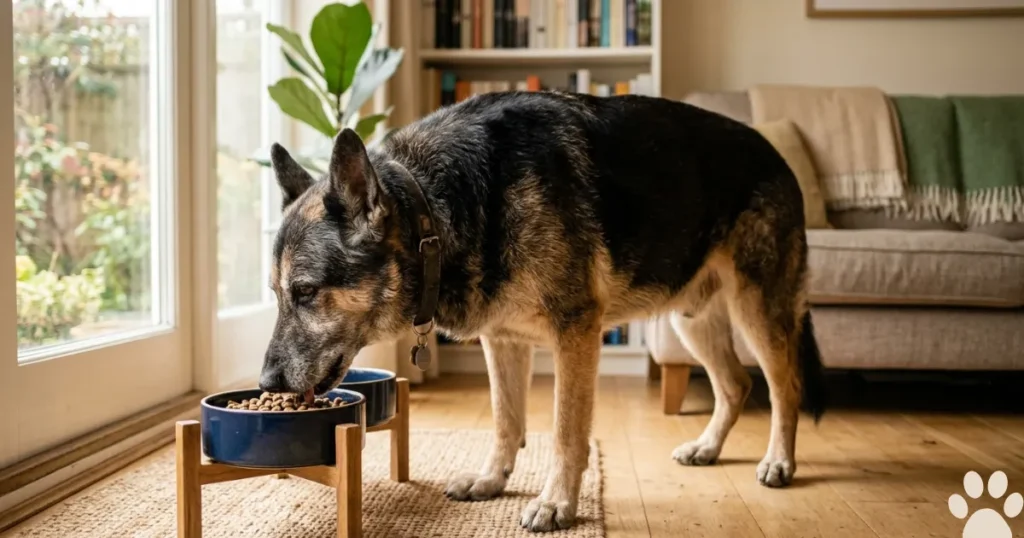
The senior section of the German Shepherd feeding chart by age requires a counterintuitive adjustment that most owners get wrong: protein should increase, not decrease, in aging German Shepherds.
In veterinary geriatric nutrition, senior dogs require higher dietary protein than middle-aged adults – not lower – to counteract age-related muscle loss (sarcopenia). Reducing protein in healthy senior German Shepherds accelerates muscle wasting without providing any health benefit.
Caloric density, however, should decrease for most seniors. A senior German Shepherd with reduced activity needs fewer total calories to maintain a healthy weight. Still, those calories should come from high-quality protein and controlled fat rather than increased carbohydrate.
Key Senior Feeding Adjustments:
- Reduce total daily calories by 10 – 20% compared to peak adult intake unless the dog is underweight or highly active
- Maintain or increase protein percentage – aim for 25- 30% dry matter protein from named animal sources
- Add joint-supportive nutrients: glucosamine, chondroitin, and omega-3 fatty acids become clinically relevant in a breed with high dysplasia rates
- Consider 3 smaller meals daily for seniors showing digestive sensitivity, post-meal bloating, or reduced appetite on twice-daily feeding
- Reassess body condition monthly – muscle loss and fat gain can occur simultaneously in senior dogs, making scale weight alone misleading
If Your Senior German Shepherd is Losing Weight Despite Consistent Intake:
Schedule a veterinary exam before adjusting food. Weight loss in a senior German Shepherd warrants investigation for exocrine pancreatic insufficiency, hypothyroidism, dental pain, or cancer before attributing it to aging or food preference.
Vet’s Tip: The German Shepherd feeding chart by age on commercial packaging assumes an intact, moderately active dog of average metabolism. It does not account for spay/neuter status, individual metabolic variation, activity level, or climate. Treat packaging guidelines as a starting point only – reassess your specific dog’s body condition every 4 weeks and adjust in 10% increments. Most German Shepherds need 15 – 25% less than the bag suggests.
How to Read a German Shepherd Feeding Chart Correctly
Most German Shepherd feeding chart by age errors come not from the chart itself but from how owners apply it. These distinctions determine whether the chart serves as a useful guide or produces systematically wrong portions.
Caloric Density Varies Significantly Between Foods.
A cup of food at 280 kcal and a cup of food at 420 kcal are not equivalent, yet feeding charts typically list cup amounts. Always convert to calories using the kcal/cup figure on your specific food’s packaging before applying any German Shepherd feeding chart by age.
Dry Matter Basis Matters For Wet Food Comparisons.
If feeding a mix of wet and dry food, you cannot add cups directly – the moisture content makes the caloric density incomparable at face value. Use the kcal/serving figure for both products and calculate the total daily caloric target first, then divide across meal types.
Body Weight in The Chart Refers To Ideal Weight, Not Current Weight.
If your German Shepherd is overweight, feeding to their current weight perpetuates the overweight state. Feed to the target healthy weight for their frame – which may be 10- 15 lbs below the current weight for an obese dog.
Activity Multipliers are Not Optional.
A working German Shepherd and a companion German Shepherd of identical weight have genuinely different caloric needs. Applying a sedentary amount to an active dog creates a nutritional deficit; applying a working-dog amount to a sedentary dog creates obesity.
7 German Shepherd Feeding Mistakes That Undermine the Feeding Chart
1. Using the Bag’s Feeding Guide without Adjustment.
Packaging guidelines overestimate portions for most companion German Shepherds. They are written for moderately active intact dogs and do not account for the 20- 30% caloric reduction appropriate for spayed or neutered dogs.
2. Feeding By Cup Rather Than By Calorie.
Cup measurements assume consistent kibble density. Different foods, different bag sizes, and even humidity affect how much actually goes into a scoop. Weighing food with a kitchen scale is the only accurate method.
3. Not Adjusting After Spaying or Neutering.
Metabolic rate decreases by 20 – 30% post-procedure. Owners who continue pre-surgery portions produce rapid weight gain within weeks. Adjust portions proactively at the time of the procedure.
4. Feeding Once Daily To Simplify the Schedule.
Once-daily feeding increases gastric distension per meal – a bloat risk factor in a deep-chested large breed. It also drives food-obsessive behavior and blood glucose instability. Twice daily is the minimum for adult German Shepherds.
5. Extending Puppy Food Past 15 Months.
Large-breed puppy food is calorie-dense and calcium-calibrated for growth. Continuing past skeletal maturity provides excess calories and no additional benefit – driving weight gain in young adults.
6. Reducing Protein in Senior Dogs.
Older German Shepherds need more dietary protein, not less, to preserve muscle mass against age-related sarcopenia. Switching to low-protein senior formulas accelerates the muscle loss they are intended to prevent.
7. Ignoring Body Condition in Favor Of Chart Adherence.
A feeding chart is a starting estimate. If body condition – not the chart – shows your dog is gaining or losing weight inappropriately, adjust portions. The chart informs; body condition confirms.
Feeding Plans and Products for German Shepherds by Age
| Life Stage | Recommended Product Type | Vet’s Pick | Key Reason |
| Puppy 8–16 weeks | Large-breed puppy kibble | Purina Pro Plan Large Breed Puppy | AAFCO feeding trial data; controlled calcium; DHA from fish oil |
| Puppy 4–12 months | Large-breed puppy kibble | Royal Canin German Shepherd Puppy | Breed-specific formula; digestive support; joint-calibrated minerals |
| Adult 1–5 years | Large-breed adult kibble | Purina Pro Plan Large Breed Adult | Highest feeding trial validation; glucosamine included; widely available |
| Active/working adult | Performance formula | Orijen Original or Sport | High animal protein; elevated fat for energy demands of working dogs |
| Spayed/neutered adult | Weight management formula | Hill’s Science Diet Perfect Weight | Clinically studied caloric reduction; maintains satiety; high fiber |
| Senior 7+ years | Senior large-breed formula | Hill’s Science Diet Large Breed Senior | Controlled calories; joint support; antioxidant blend for aging immunity |
| Senior with EPI | Highly digestible formula | Royal Canin Gastrointestinal | Veterinary prescription; enzyme-supportive; critical for EPI management |
Owner’s Choice for Daily Feeding Accuracy:
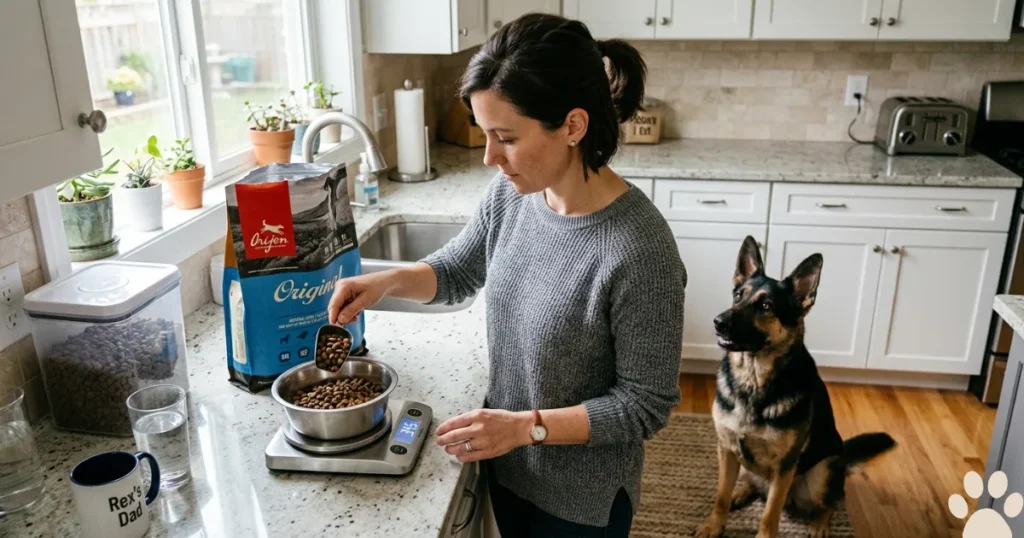
A digital kitchen scale (OXO Good Grips 11lb Food Scale) used with any of the above formulas eliminates the most common source of German Shepherd feeding chart error – inconsistent cup measurement. Weighing food costs nothing additional and immediately improves portion accuracy.
8 Signs Your German Shepherd Feeding Chart Needs Adjustment
If your German Shepherd shows any of the following, the current feeding amount – regardless of what the chart suggests – requires recalibration:
- Ribs visible without touching – underfed; increase daily amount by 10% and reassess in 3 weeks.
- Cannot feel ribs without firm pressure – overfed; reduce daily amount by 10% and reassess in 3 weeks.
- Waist absent when viewed from above – body condition score indicates overweight; reduce portions and add structured exercise.
- Consistent post-meal vomiting of undigested food – meal size too large; split daily amount into an additional meal rather than reducing total intake.
- Loose stools persisting beyond 2 weeks on a stable food – may indicate overfeeding or food sensitivity; reduce portions by 10% before investigating food change.
- Significant weight loss despite consistent feeding – warrants veterinary investigation before dietary adjustment; not a feeding chart problem in isolation.
- Extreme hunger between meals with stable weight – food may be low in satiety fiber or protein; evaluate food quality before increasing quantity.
- Coat dullness alongside weight change – often reflects both caloric and omega-3 insufficiency; assess total diet quality alongside quantity.
9 Vet-Backed Tips for Using a German Shepherd Feeding Chart by Age
- Convert your food’s kcal/cup figure to a daily caloric target before applying any German Shepherd feeding chart by age – cup amounts without caloric context are unreliable across different foods.
- Weigh food with a kitchen scale for the first 4 weeks on any new food or new life stage to calibrate actual portions against chart recommendations.
- Reassess body condition every 4 weeks – not every 6 months. Gradual weight drift in either direction is easier to correct early than after months of incorrect feeding.
- Reduce portions by 20 – 25% within 4 weeks of spaying or neutering – do not wait for visible weight gain before making this adjustment.
- Transition from large-breed puppy food to adult food at 12- 15 months, not at 12 months automatically. Larger-framed German Shepherds benefit from the additional growth-phase nutrition through 15 months.
- Feed twice daily at consistent times 10 – 12 hours apart for adult and senior dogs. Consistent meal timing supports digestive enzyme secretion and reduces bloat risk in this deep-chested breed.
- Allow 30 – 60 minutes of rest before and after meals. German Shepherds are among the large breeds with documented gastric dilatation-volvulus risk – meal timing around exercise is a meaningful preventive measure.
- For working or sport German Shepherds, increase portions during high-activity periods and reduce during rest periods – do not maintain a single static amount year-round for a dog with variable activity demands.
- Review the feeding chart at every veterinary exam. Life stage transitions, health diagnoses, medication changes, and activity shifts all warrant portion reassessment that the original chart does not automatically account for.
The most accurate German Shepherd feeding chart by age is one calibrated to the individual dog’s current body condition score, activity level, food caloric density, and health status – not one applied uniformly from a generic table without ongoing adjustment.
How much should I feed my German Shepherd puppy?
German Shepherd puppies need 1 – 3.5 cups of large-breed puppy food daily, depending on age and weight, split across 3 – 4 meals. At 8- 12 weeks, approximately 1- 1.75 cups daily; at 5- 6 months, 2- 3 cups daily as growth accelerates.
How much food does an adult German Shepherd need per day?
Most adult German Shepherds need 2.5 – 4 cups of standard kibble daily, split across two meals. Active or working dogs may need up to 5 cups. Spayed or neutered adults typically need 20 – 30% less than intact dogs.
When should I switch my German Shepherd from puppy to adult food?
Transition at 12 – 15 months. German Shepherds reach skeletal maturity later than smaller breeds – transitioning before 12 months removes important growth-phase nutritional support. Larger-framed dogs benefit from puppy food through 15 months.
How many times a day should I feed my German Shepherd?
Puppies 8 – 16 weeks: 3 – 4 times daily.
Puppies 4 – 6 months: 3 times daily.
Adults and seniors: twice daily, 10-12 hours apart.
Some seniors with GI sensitivity benefit from 3 smaller meals daily.
How much should I feed a senior German Shepherd?
Senior German Shepherds typically need 1.75 – 3 cups daily, depending on weight and activity, with reduced total calories but maintained or increased protein. Feed twice daily; consider three smaller meals if digestive sensitivity develops after age 7.
Do German Shepherds need large-breed specific food?
Yes, particularly as puppies. Large-breed formulas control calcium and phosphorus ratios critical for healthy skeletal development in a breed predisposed to hip and elbow dysplasia. This distinction is clinically meaningful, not just marketing.
How do I know if I’m feeding my German Shepherd the right amount?
Use body condition scoring rather than scale weight alone. You should feel – but not see – your dog’s ribs with light pressure. A visible waist from above and a tucked abdomen from the side confirm a healthy weight.
Should I reduce protein for my senior German Shepherd?
No. Senior German Shepherds need more dietary protein, not less, to counteract age-related muscle loss. Switching to low-protein senior formulas accelerates sarcopenia. Choose a senior food with 25- 30% dry matter protein from named animal sources.
9. How much should I feed a working German Shepherd?
Working and sport German Shepherds may need 30 – 50% more calories than companion dogs of identical weight, often 3.5 – 5 cups of standard kibble daily. Use a performance formula with higher protein and fat to meet the energy demands of sustained activity.
How do I use a German Shepherd feeding chart correctly?
Identify your dog’s ideal weight (not current weight if overweight), check your food’s kcal/cup, calculate a daily caloric target, and convert to cups. Reassess body condition every 4 weeks and adjust in 10% increments as needed.
Can I free feed my German Shepherd?
No. German Shepherds have variable self-regulation around food and are predisposed to bloat. Free feeding removes portion control, eliminates appetite monitoring as a health indicator, and increases GDV risk. Structured meal feeding is essential.
How much should I feed my German Shepherd after spaying or neutering?
Reduce portions by 20 – 30% within 4 weeks of the procedure. Metabolic rate decreases significantly post-surgery. Waiting for visible weight gain before adjusting allows preventable obesity to develop.
Does a German Shepherd feeding chart change with activity level?
Yes, significantly. Activity level is the primary variable in adult German Shepherd caloric needs. A working dog may need 30 – 50% more than a sedentary dog of the same weight. Use a single static chart amount only as a starting point.
What should I do if my German Shepherd is losing weight despite eating normally?
Schedule a veterinary exam before adjusting food. Weight loss despite consistent intake in German Shepherds warrants investigation for exocrine pancreatic insufficiency, hypothyroidism, dental issues, or other conditions before dietary adjustment.
How do I transition between life stages on the German Shepherd feeding chart?
Change both the food type and the portion amount gradually over 7-10 days. Increase the proportion of the new food by 25% every 2- 3 days. Abrupt transitions – even between appropriate formulas – cause digestive upset in German Shepherds with sensitive GI tracts.
Conclusion
A German Shepherd feeding chart by age is a starting framework, not a fixed prescription. The chart gives you an evidence-based starting point calibrated to life stage, body weight, and activity level – but your dog’s body condition score, assessed every 4 weeks, is the only reliable ongoing confirmation that the amounts are right.
Based on years of working with large breeds, the owners who produce the healthiest long-term outcomes are not those who follow feeding charts most rigidly, they are those who use the chart to start, observe body condition consistently, and adjust proactively in small increments before problems become significant.
Get the puppy phase right with a large-breed formula and controlled calcium. Adjust adult portions for activity and spay/neuter status. Maintain protein in the senior years while reducing caloric density. These three principles, applied consistently across the German Shepherd feeding chart by age, produce measurably better health outcomes than any single food or supplement decision.
Reassess your feeding approach every 6 months or at any significant life change. The chart evolves with the dog.
Every German Shepherd owner finds their feeding rhythm through a mix of charts, observation, and adjustment – and your real-world experience adds something no chart can.
- What feeding schedule and portions work for your German Shepherd at their current age?
- Have you had to adjust significantly from what the bag or chart recommended?
Share your approach in the comments – it helps other owners calibrate more confidently for their own dogs.

Dr. Nabeel A.
Hi, I’m Dr. Nabeel Akram – a farm management professional by trade and a passionate Golden Retriever enthusiast at heart. With years of experience in animal science and livestock care, I’ve built a career around understanding animals—how they live, thrive, and bring value to our lives. This blog is a personal project born from that same passion, focusing on one of the most loyal and lovable breeds out there: the Golden Retriever. Whether I’m managing farm operations or sharing insights on canine health, behavior, and care, it all ties back to one core belief—animals deserve thoughtful, informed, and compassionate attention. Welcome to a space where professional expertise meets genuine love for dogs.
Facebook |
Links will be automatically removed from comments.