
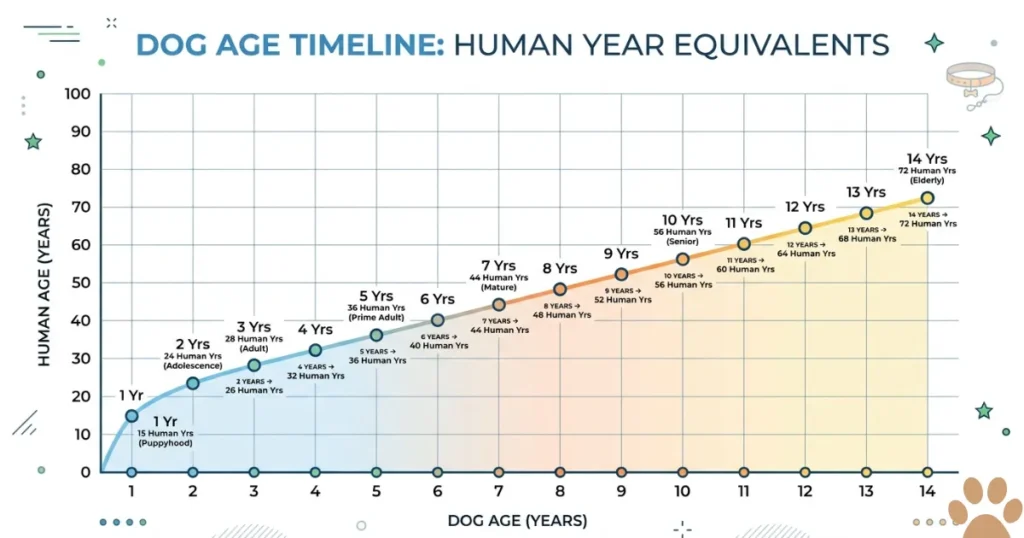
Dog years to human years on a curve, not a flat ×7. A dog’s first year equals roughly 15 human years; the second adds about 9 more, and each later year adds about 4–5 for small and medium dogs or 6–7 for large breeds like the Golden Retriever. So a golden age is fastest early, then steady, reaching senior status around age 7 to 8.
People ask me how old their dog is in human years more than almost any other question, and the honest answer is that the old “multiply by 7” rule gets it wrong. Dogs don’t age in a straight line. Your Golden packs an enormous amount of growth into the first two years, then the pace settles. The AKC and the UC Davis School of Veterinary Medicine both put the first year of a medium-sized dog at about 15 human years, the second at roughly 9 more.
In my practice, the golden owners who get blindsided are the ones who trusted ×7. A 5 years old Golden isn’t “35 and barely middle-aged.” For a large breed, that dog is already easing toward the second half of life, which changes what I screen for. Getting the real number right is how you catch problems while they’re still cheap and treatable.
Contents
- 1 Why “multiply by 7” quietly misleads Golden owners
- 2 Two science-backed ways to calculate dog years to human years
- 3 Why Golden Retrievers age faster than smaller dogs
- 4 Your Golden’s human age by life stage
- 5 What dog-age calculators get wrong for Goldens
- 6 The Golden Age-Check Framework
- 6.1 Dual-method Golden age table (forward, dog → human):
- 6.2 How do you convert dog years to human years?
- 6.3 How old is a 5 years old dog in human years?
- 6.4 Is one dog year really seven human years?
- 6.5 What is the dog age calculator formula?
- 6.6 How accurate is a dog age chart?
- 6.7 How do dog to human years differ by size?
- 6.8 At what age is a dog considered senior?
- 6.9 Why do larger dogs age faster than small dogs?
- 6.10 Can I calculate my dog’s age if I don’t know its birthday?
- 6.11 What’s the most accurate way to calculate dog years?
- 6.12 Can Golden Retrievers live longer than 12 years?
- 6.13 Why do Golden Retrievers age faster than I expect?
- 6.14 Is the UCSD formula reliable for Golden Retrievers?
- 6.15 What health risks rise as a Golden Retriever ages?
- 6.16 When should I call the vet about my senior Golden’s age-related changes?
- 7 Conclusion
Why “multiply by 7” quietly misleads Golden owners
The seven-year rule is tidy, memorable, and wrong. It most likely came from simple division: people lived to about 70, dogs to about 10, so someone split the difference. A Kansas State University veterinarian told the Wall Street Journal it was probably a marketing nudge to get owners to book yearly checkups, as reported by the AKC.
The problem is biological. Dogs sprint through early development. By her first birthday, your Golden has hit puberty and full juvenile growth, which lines up closer to a 15 years old human than a 7 years old child. A flat multiplier can’t capture that front-loaded curve, then the slower later years.
Here’s what I tell owners. Don’t reach for one number you multiply forever. Use a method that bends with age, because that bend is exactly where Golden-specific care decisions live. If you want the precise figure for a single age, our reverse human to dog calculator runs the math the other direction too.
Two science-backed ways to calculate dog years to human years
There are two methods I trust, and they answer slightly different questions. Knowing both keeps you from being thrown when an online tool spits out a surprising number.
The AVMA life-stage method (the practical one)
This is the developmental estimate, and it’s the one most owners want. The first year counts as about 15 human years; the second adds about 9 (so a 2 years old dog is roughly 24), and after that you add about 4–5 human years per year for small and medium dogs, or 6–7 for large breeds. The AVMA and AKC publish this as a general guideline, per the UC Davis veterinary school.
The UCSD epigenetic formula (the molecular one)
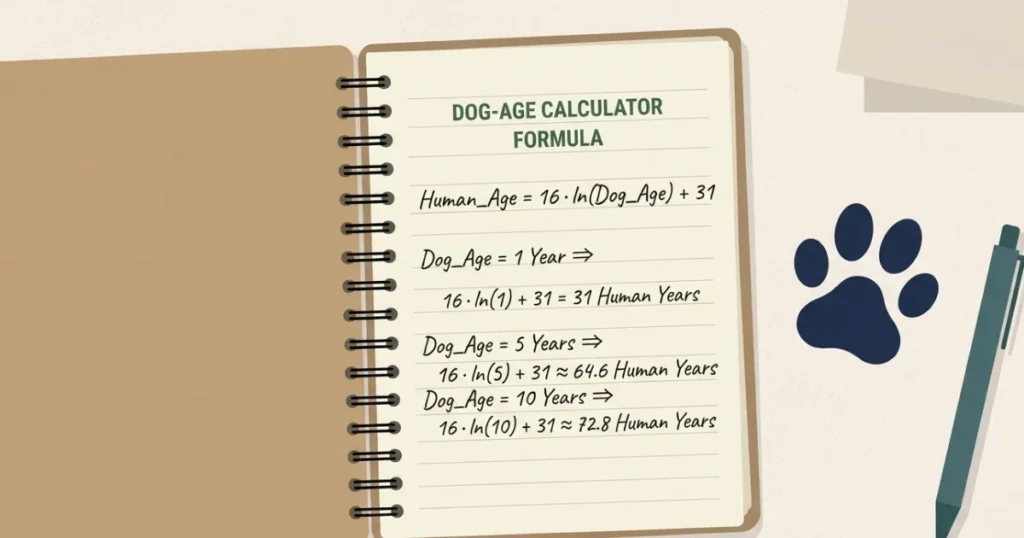
In 2019, researchers at the University of California, San Diego, measured DNA methylation, the methyl groups that attach to DNA as both dogs and people age, and built this equation: human age = 16 × ln(dog age) + 31. A 2 years old dog comes out near 42, a 5 years old near 57, and a 10 years old near 68. They studied 104 Labrador retrievers, as confirmed by the AKC.
Why does that matter for you specifically? The study used Labradors, a large retriever built almost exactly like a Golden. Most breeds have to treat this formula with caution because it came from a single breed. Goldens are the lucky exception. The formula’s source dog is your dog’s close cousin, so the molecular estimate maps to Goldens better than to a Chihuahua or a Great Dane.
Why Golden Retrievers age faster than smaller dogs
Size drives canine aging, and Goldens are firmly on the large-breed side of that line. Large dogs mature a touch more slowly as puppies but age faster as adults. Researchers have estimated that every extra 4.4 pounds of body mass shaves roughly a month off life expectancy, a pattern the AKC has covered in its aging coverage.
For your Golden, the practical translation is this: seniorhood arrives early. Small breeds may not be “senior” until age 10, but vets generally start treating Goldens as seniors around age 7 to 8. That’s when I shift to twice-yearly exams and start watching harder for the breed’s specific risks.
Those risks are real and worth naming. The Morris Animal Foundation’s Golden Retriever Lifetime Study, tracking more than 3,000 Goldens since 2012, has found cancer to be the leading cause of death in the breed, with hemangiosarcoma and lymphoma among the most common forms.
The average Golden lifespan sits around 10 to 12 years per the AKC breed profile. None of this is meant to frighten you. It’s the reason knowing your dog’s true age matters more for a golden than for a terrier.
Your Golden’s human age by life stage
Numbers are useful, but life stage is what actually changes your routine. Here’s how a Golden’s years map out.
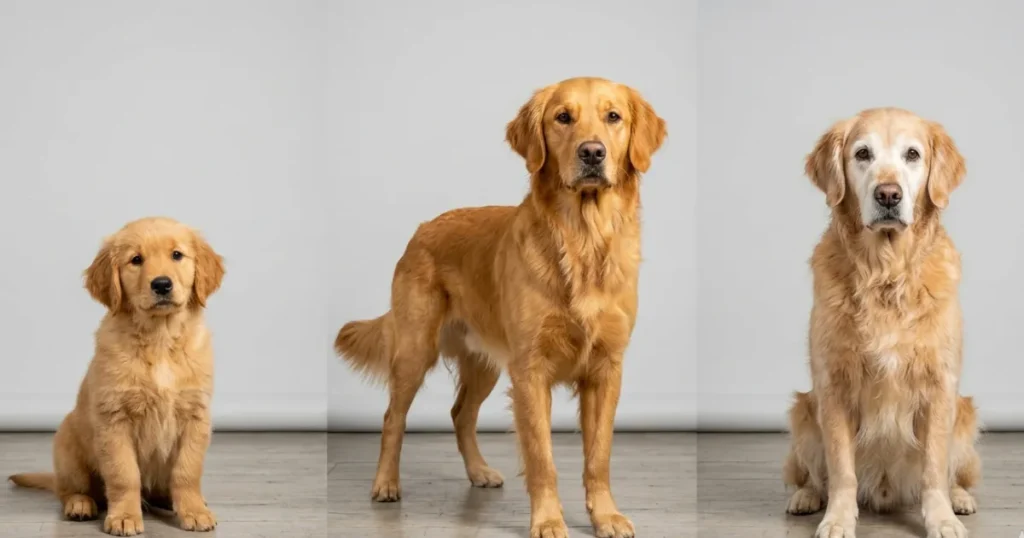
Puppy (8 weeks to ~18 months).
Explosive growth. Your Golden hits sexual maturity before her first birthday and keeps filling out through about 18 months. Nutrition and joint protection during this window set up the rest of life. The puppy timeline gets its own deep dive in our puppy age chart.
Adult (2 to 7 years).
Prime years. Physically and mentally mature, high energy, generally healthy. This is your baseline-building window: get bloodwork on file so later changes are easy to spot. The numbers behind the common adult ages are broken down into what 2, 3, and 4 mean in dog years.
Senior (8+).
For a Golden, the senior switch flips earlier than the medium-dog charts suggest. Metabolism slows, joints stiffen, and cancer surveillance becomes central. Senior-formula diets with glucosamine, chondroitin, and omega-3 fatty acids and twice-yearly vet visits earn their keep here. We cover this fully in what a 10 years old Golden’s age signals.

What dog-age calculators get wrong for Goldens
Most calculators you’ll find default to a “medium dog” setting. The Old Farmer’s Almanac says so plainly about its own tool, and it’s the quiet default behind many others. For a 50 to 75-pound golden, “medium” undercounts the later years.
The most common mistake I see is an owner reading a generic calculator, getting a comfortable mid-30s number for their 5 years old, and assuming there’s no rush on senior screening. Understandable, because the tool looked authoritative. But in a large breed, that’s exactly when I want a baseline so I can catch the breed’s cancers early, when outcomes are far better.
The fix is simple. Use a tool or chart that lets you pick a large breed, or lean on the UCSD formula, which (because it came from Labradors) already reflects large-retriever aging.
When the chart and the formula disagree, treat the gap as a reminder that no single number is exact, and let the earlier of the two ages guide your screening caution. To pinpoint your own dog against both methods, our how old is my dog guide walks through it step by step.

The Golden Age-Check Framework
Here’s the simple decision tool I give Golden owners so the math turns into action. Run it once a year on your dog’s birthday.
The Golden Age-Check Framework
If your Golden is under 2:
Focus on growth and joints. Then feed a large-breed puppy nutrition and avoid over-exercising soft joints. Call your vet if you see limping that lasts more than a few days.
If your Golden is 2 to 6:
Lock in a baseline. Then get annual bloodwork and a recorded healthy weight. Call your vet if appetite, energy, or weight shifts without a reason.
If your Golden is 7 or older, treat it as a senior:
Then move to twice-yearly exams and add cancer-aware screening. Call your vet immediately for any new lump that’s growing, sudden weakness, or pale gums, which can signal hemangiosarcoma.
This framework isn’t a diagnosis. It’s a way to make sure your dog’s real age, not a flattering ×7 number, is the one steering the care.
Dual-method Golden age table (forward, dog → human):
| Golden’s age | AVMA life-stage estimate (large breed) | UCSD epigenetic estimate: 16·ln(age)+31 | Life stage |
| 1 yr | ~15 | ~31* | Puppy |
| 2 yr | ~24 | ~42 | Young adult |
| 3 yr | ~30 | ~49 | Adult |
| 4 yr | ~36 | ~53 | Adult |
| 5 yr | ~40 | ~57 | Adult / early-mid |
| 7 yr | ~50 | ~62 | Entering senior |
| 10 yr | ~66 | ~68 | Senior |
| 12 yr | ~77 | ~71 | Senior |
| 14 yr | ~88 | ~73 | Geriatric |
The UCSD formula is least reliable in the first year; the AVMA “~15” is the better puppy-year estimate. The two methods converge in the senior years, which is part of why this table is more honest than a single number.
How do you convert dog years to human years?
Count year one as about 15 human years, year two as about 9 more, and then roughly 4–5 per year for small or medium dogs and 6–7 for large breeds. This curve replaces the inaccurate ×7 rule.
How old is a 5 years old dog in human years?
About 40 for a large breed by the AVMA method, or roughly 57 by the UCSD epigenetic formula. A 5 years old golden is in early to mid-middle age, not its youth.
Is one dog year really seven human years?
No. The ×7 rule is a debunked oversimplification. Dogs age much faster in their first two years, so a 1 years old dog resembles a 15 years old human, not a 7 years old.
What is the dog age calculator formula?
The peer-reviewed UCSD formula is human age = 16 × ln (dog age) + 31. Multiply the natural log of your dog’s age by 16, then add 31.
How accurate is a dog age chart?
A dog age chart is a solid estimate, not a precise figure. Accuracy improves when the chart accounts for size, since large breeds like Goldens age faster than small dogs after age two.
How do dog to human years differ by size?
Small dogs add about 4 human years annually after age two; large dogs, about 6–7. So, same-aged dogs of different sizes land at different human ages.
At what age is a dog considered senior?
It depends on size. Small dogs reach senior status near 10, medium dogs around 7, and large or giant breeds as early as 5–7. Goldens are typically senior by 7–8.
Why do larger dogs age faster than small dogs?
Larger dogs grow rapidly and appear to accumulate age-related cellular damage sooner. Researchers estimate each extra 4.4 pounds of body mass costs roughly a month of life expectancy.
Can I calculate my dog’s age if I don’t know its birthday?
Yes, approximately. Vets estimate age from teeth, coat, eyes, and muscle tone. By 7 months, a dog usually has all permanent teeth, and wear increases with age.
What’s the most accurate way to calculate dog years?
Use a size-adjusted chart plus the UCSD formula together. When they disagree, treat the gap as normal and let the earlier age guide preventive care.
Can Golden Retrievers live longer than 12 years?
Yes. The average Golden lifespan is 10–12 years per the AKC, but lean body weight, regular exercise, and early cancer screening help many Goldens reach their teens.
Why do Golden Retrievers age faster than I expect?
Because Goldens are a large breed. They reach senior status around 7–8, earlier than the medium-dog charts most calculators default to, which makes them seem to “age suddenly.”
Is the UCSD formula reliable for Golden Retrievers?
More than for most breeds. The formula came from Labrador Retrievers, a large retriever built like a golden, so it maps to goldens better than it does to very small or giant breeds.
What health risks rise as a Golden Retriever ages?
Cancer leads, with hemangiosarcoma and lymphoma being most common in the breed per the Golden Retriever Lifetime Study. Joint disease and heart conditions like subvalvular aortic stenosis also matter.
Call immediately for a fast-growing lump, sudden weakness, or pale gums. Monitor at home for 24 hours for mild, gradual stiffness, then book a routine senior exam.
Conclusion
Dog years to human years isn’t a flat multiplier; it’s a curve, and for a golden retriever, that curve runs faster than the medium-dog charts admit. Year one is about 15; year two, about 24; then 6–7 a year, with senior status arriving near 7 to 8.
The one takeaway worth acting on today: figure out your Golden’s real age, then match the vet schedule to it, twice yearly once you cross into senior territory, because early cancer detection is where Goldens win back years.
How old is your Golden in dog years, and did the real human-age number surprise you? Tell me in the comments what life stage your dog is in and whether your vet’s screening schedule changed once they hit 7 or 8. Real owner stories help the next worried Golden parent more than any chart.

Dr. Nabeel A.
Hi, I’m Dr. Nabeel Akram – a farm management professional by trade and a passionate Golden Retriever enthusiast at heart. With years of experience in animal science and livestock care, I’ve built a career around understanding animals—how they live, thrive, and bring value to our lives. This blog is a personal project born from that same passion, focusing on one of the most loyal and lovable breeds out there: the Golden Retriever. Whether I’m managing farm operations or sharing insights on canine health, behavior, and care, it all ties back to one core belief—animals deserve thoughtful, informed, and compassionate attention. Welcome to a space where professional expertise meets genuine love for dogs.
Facebook |
Links will be automatically removed from comments.