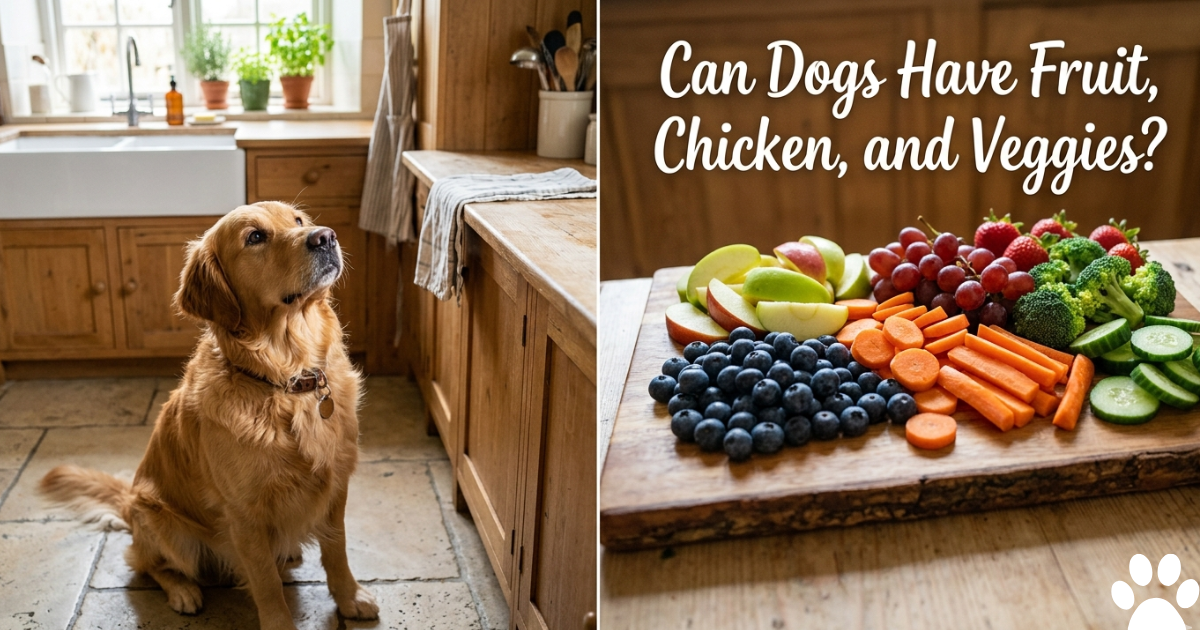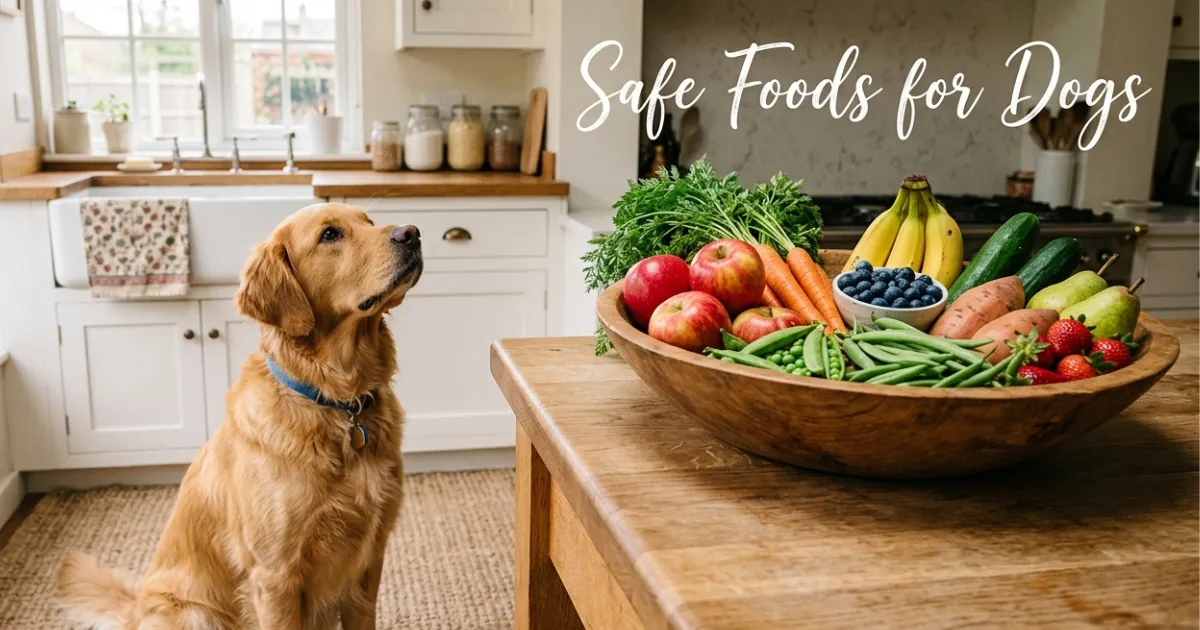
Most Golden Retriever owners arrive at this topic from one of two places: their dog has already eaten part of an apple, and they want to know if it is a problem, or they are standing in the kitchen wondering whether the apple is a treat worth offering. Dogs and apples sit in genuinely safe territory – but the version of that statement that circulates on generic pet sites skips the details that actually matter for this breed.
Dogs and apples are compatible when the fruit is prepared correctly – flesh only, seeds removed, core discarded, sliced to an appropriate size for a fast-eating dog. Apple flesh provides vitamin C, vitamin A, dietary fiber, and quercetin, a flavonoid with documented anti-inflammatory properties in mammalian models. A medium apple contains approximately 95 calories and 19 grams of natural fructose – benign in a controlled serving but meaningful for a breed with documented hypothyroid and weight management predispositions.
In working with Golden Retrievers, the consistent error is not overfeeding apples. It is owners treating preparation as optional – handing over a partially cored apple with seeds still attached because the dog seems fine and the fruit seems harmless. The preparation is the point.
Are Apples Bad for Dogs – or Is the Question Aimed at the Wrong Target?
Are apples bad for dogs is the wrong question directed at the wrong part of the fruit? Apple flesh is not bad for dogs. Two specific components are.
Apple seeds contain amygdalin, a cyanogenic glycoside that the body converts to hydrogen cyanide during digestion. The mechanism is cumulative rather than acute – a single seed in a healthy 65-pound Golden Retriever does not deliver enough hydrogen cyanide to cause observable poisoning. The problem is repetition. An owner handing over apple slices without removing seeds across weeks of regular feeding accumulates a low but consistent cyanide exposure that carries a risk entirely preventable with a ten-second preparation step.
The apple core is a different category of concern – mechanical rather than chemical. Apple cores are dense, compressible, and large enough to create obstruction risk in the esophagus or gastrointestinal tract of a fast-eating dog. Golden Retrievers are anatomically and behaviorally predisposed to this risk. Their swallowing behavior means they compress soft-to-medium-density food and swallow it with minimal chewing. A core a human would spit out is a core a Golden Retriever will swallow in one or two bites.
Apple skin, by contrast, is not a problem for most dogs. It adds fiber and polyphenol content without a meaningful toxicity risk. The only exception is Golden Retrievers with a documented history of gastrointestinal sensitivity, where the skin’s concentrated fiber can tip stool consistency toward loose. Peeling resolves that variable without eliminating apples from the diet.
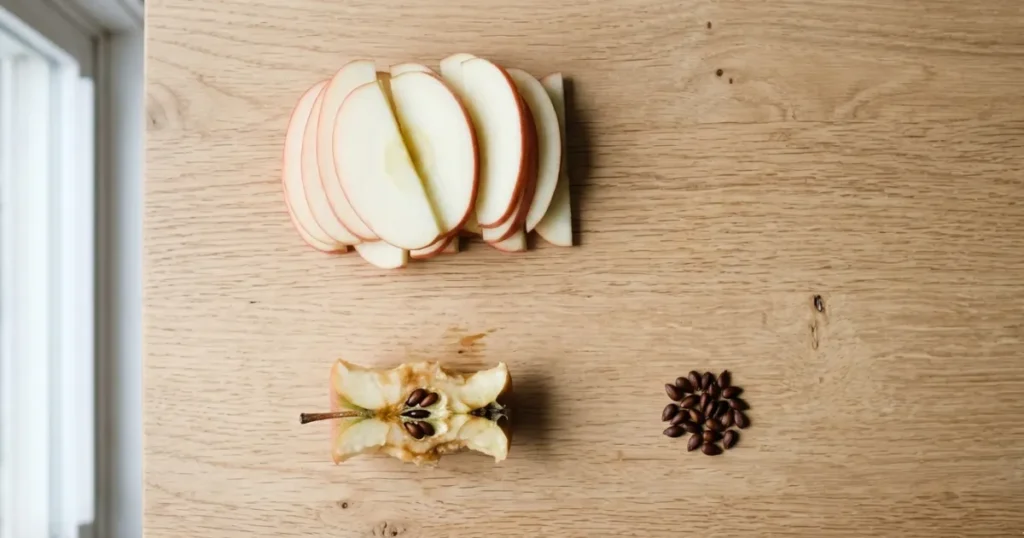
So, are apples bad for dogs? No. Seeds and cores are bad for dogs. The distinction matters because conflating the two leads owners either to avoid apple entirely or to prepare it carelessly – and neither outcome serves the dog. For the full picture of safe and unsafe fruit options, see our guide to the best fruits and vegetables for dogs.
What Dogs and Apples Look Like for This Breed Specifically
Generic apple-and-dogs content treats the topic as settled and breed-neutral. Three Golden Retriever-specific variables change the practical picture in ways that no general guidance addresses.
The first is hypothyroid predisposition. Golden Retrievers develop hypothyroidism at above-average rates. Hypothyroidism slows metabolic rate and increases the body’s tendency to store dietary energy as fat. Apple’s fructose content is not alarming in isolation. Still, for a hypothyroid Golden on a calorie-managed diet, fruit treats carry a sugar cost that owners consistently underestimate because fruit reads as healthy rather than as a caloric event. Apple is not off-limits – it belongs in the daily treat budget, not outside it.
The second variable is cancer incidence. Golden Retrievers have a well-documented elevated cancer rate relative to other breeds. No direct causal link exists between apple consumption and cancer risk. What Apple offers in this context is quercetin and chlorogenic acid – two polyphenols present in the flesh and skin with studied antioxidative properties. The canine-specific research base is not advanced enough to support clinical claims. Still, apple is not a nutritionally hollow treat choice for a breed where systemic inflammation is a genuine concern.
The third variable is eating speed. Golden Retrievers are among the most food-motivated breeds and eat fast. Thumbnail-sized pieces are the right unit for puppies and for any adult Golden that finishes treats in under three seconds. A full apple slice large enough for a human to take a single bite from is large enough for a fast-eating Golden to swallow without meaningful chewing, which is how soft dog foods become choking events.
Feeding Dogs Apples – The Serving Framework by Life Stage
Feeding dogs apples correctly requires a different calculation at each life stage, because a Golden Retriever puppy’s digestive maturity and a senior’s metabolic rate are not the same variable.
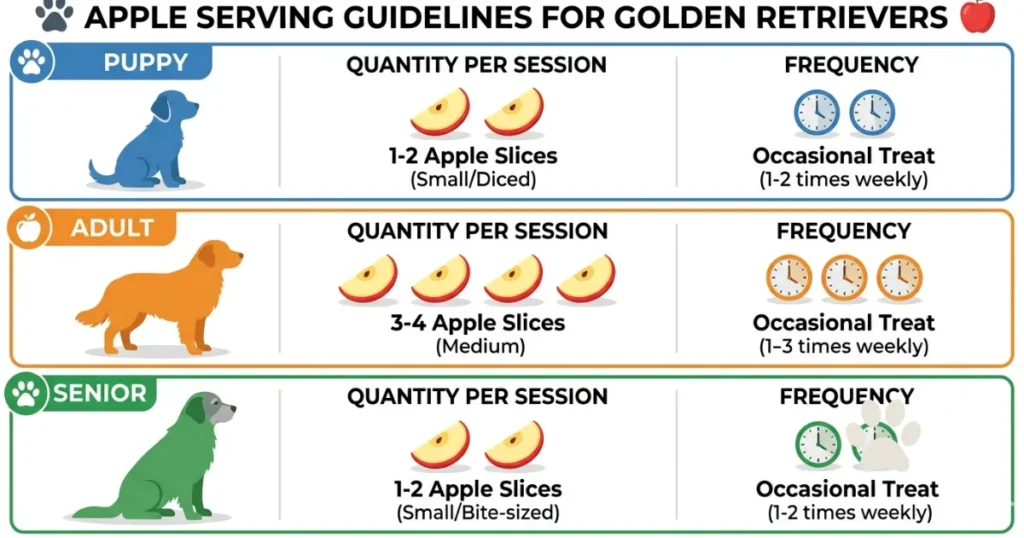
Puppy – under 12 months
Golden Retriever puppies can have apple from around eight weeks, but the digestive system is still developing its microbial composition through the first year. Introducing high-fiber fruit too aggressively disrupts the gut environment being established during this period. One to two thumbnail-sized pieces of peeled apple flesh, two to three times per week, is the appropriate starting point. Peel the apple for all puppies regardless of GI history – skin fiber is too variable a factor for a developing system. Introduce once, observe stool for 24 hours, and continue only if output stays firm.
Adult – 1 to 7 years
A healthy adult Golden Retriever at a normal weight handles three to five small slices, three to four times per week, without metabolic disruption. Skin-on is acceptable unless GI sensitivity is documented. Count apple slices in the daily treat budget – the 10% rule applies, meaning all treats combined should not exceed 10% of daily caloric intake. For most adult Goldens eating 1,300 to 1,600 calories per day, three to five small apple slices fit within that ceiling comfortably.
Senior – 8 years and older
Senior Goldens process glucose more slowly and experience reduced digestive efficiency. Peeling is the default for all seniors regardless of prior GI history, and frequency drops to two to three times per week. Senior dogs with active diagnoses – kidney disease, diabetes, or pancreatitis – require individualized guidance before Apple enters the treat rotation.
| Life Stage | Approx. Weight | Max Per Session | Frequency | Peel? |
| Puppy (under 12 months) | 20–55 lbs | 1–2 thumbnail pieces | 2–3x per week | Always |
| Adult (1–7 years) | 55–75 lbs | 3–5 small slices | 3–4x per week | Optional |
| Senior (8+ years) | 55–80 lbs | 2–3 small slices | 2–3x per week | Always |
Dogs Eat Apples – Which Forms Work and Which to Avoid
How dogs eat apples determines as much of the safety profile as what they eat.

Fresh slices are the simplest option.
Cut around the core column rather than through it – this ensures no seed fragments attach to any slice. Slice to thumbnail size for puppies and fast-eating adults.
Frozen slices are a valid enrichment option.
Freezing slows consumption, moderating the speed at which fructose reaches the bloodstream. Frozen apples also extend the treat experience for Golden Retrievers that finish room-temperature treats in seconds.
Mashed into a Kong or on a lick mat
One tablespoon of fresh mashed apple or plain unsweetened applesauce, verified xylitol-free, works well for portioning and enrichment. The lick mat format slows consumption without increasing the volume served.
Commercial apple-flavored products
They require a full label read before use. Apple-flavored does not mean real apple, and many commercial flavored treats contain artificial sweeteners. Any product listing xylitol is off-limits without exception. Xylitol triggers a rapid and dangerous insulin release in dogs – blood glucose can crash within 10 to 60 minutes – via a mechanism that does not occur in humans.
Apple juice and dried apple snacks
Do not belong in the treatment rotation. Apple juice concentrates fructose with none of the fiber that moderates sugar absorption in whole fruit. Commercial dried apple chips are typically fried, salted, or sugar-coated, and dehydration concentrates natural sugars dramatically per gram relative to a fresh apple.
As confirmed by the ASPCA Animal Poison Control Center, apple seeds, stems, and leaves are toxic to dogs due to cyanide content. In contrast, the apple fruit itself is non-toxic, which makes preparation the critical variable, not the fruit.
Decision Framework: Should Your Golden Retriever Have Apple?
- If your Golden is a healthy adult at a normal weight → three to five small seedless, coreless slices up to four times per week is within safe parameters. Skin-on is fine with no GI sensitivity history.
- If your Golden is overweight or calorie-restricted → apple is a better treat choice than most commercial options, given its low fat content and high water volume. Limit to three slices per session and count them in the daily treat budget without exception.
- If your Golden is a puppy under 12 months → one to two pieces of peeled apple flesh, two to three times per week. Introduce once, observe stool for 24 hours, and continue only if output stays firm.
- If your Golden is a senior with no active diagnosis → apply reduced adult serving. Peel as default. Frozen slices work well for seniors with dental sensitivity.
- If your Golden has diabetes → apple fructose affects blood glucose and requires individualized management. Do not introduce apple without confirming the appropriate serving size with your vet relative to the insulin protocol in place.
- If your Golden has a pancreatitis history → apple flesh is low in fat and broadly compatible with low-fat dietary protocols in remission. Confirm with your vet for dogs in active recovery before adding it to the rotation.
- If your Golden just ate seeds or a full core → no emergency for a healthy adult who consumed a small quantity. Monitor for vomiting, lethargy, abdominal bloating, and appetite loss over 12 to 24 hours. If a puppy consumed multiple seeds or if any dog shows distress, call your vet the same day.

Golden Retrievers have a jaw structure that promotes plaque accumulation along the posterior molars – the area brushing most often misses and where tartar builds fastest. The malic acid in apple flesh creates a mildly acidic oral environment that disrupts bacterial biofilm at the tooth surface. This does not replace a dental care routine, but it is a real, named mechanism with specific anatomical relevance for this breed – not found in any generic treat recommendation.
When to Call the Vet
| URGENT — Call Immediately | MONITOR — Watch at Home 24 hrs |
| Dog ate any product listing xylitol — in any quantity | Dog ate three to five seedless slices, has soft stool but is alert and eating normally |
| Puppy consumed multiple seeds or swallowed a full core | Single vomiting episode within two hours, no blood, dog behaving normally afterward |
| Any dog showing trembling, disorientation, or collapse after an apple-based product | Mild gas or abdominal gurgling within four hours, resolving without intervention |
| Dog retching repeatedly or showing abdominal rigidity within two hours of core ingestion | Loose stool under 24 hours, no blood or mucus, appetite intact at next meal |

Are Apples Bad for Dogs With Health Conditions?
Obesity:
Apple is one of the more appropriate treat choices for overweight Golden Retrievers. The flesh is low in fat, approximately 86% water by weight, and delivers a saturation signal at a low caloric cost. The constraint is tracking – apple slices count in the daily budget, not outside it.
Diabetes:
Apple fructose interacts with an insulin protocol in ways specific to the individual dog’s dosing and blood glucose targets. Apple is not automatically excluded for diabetic Goldens, but serving size and frequency require direct input from the managing veterinarian.
Kidney disease:
Apple flesh is relatively low in phosphorus and potassium compared to fruits like bananas, making it a more compatible treat option for dogs with mild-to-moderate chronic kidney disease. Late-stage CKD requires individualized management – confirm with your vet before offering any fruit.
Pancreatitis:
Apple flesh is low in fat, which aligns with pancreatitis dietary management. For dogs in long-term remission, a small apple serving is generally compatible. For dogs in active recovery, confirm with your vet before introducing any new food item.
Sensitive GI tract:
Peel the apple and start with a single small piece. The fiber in apple skin is the most common trigger for loose stools in GI-sensitive Golden Retrievers. Flesh without skin is a lower-fiber option most sensitive dogs tolerate without incident.
Are dogs and apples actually safe together?
Dogs and apples are safe when the apple is prepared correctly – flesh only, seeds and core fully removed, sliced to an appropriate size. Apple flesh is non-toxic and provides fiber, vitamin C, and quercetin. The toxicity risk comes from seeds and cores, not the fruit itself. Prepared correctly, apple is one of the more nutritionally relevant fruit treats for Golden Retrievers.
How often can dogs and apples be part of the same treat routine?
For healthy adult Golden Retrievers, apple works well three to four times per week, at three to five small slices per session. Daily apple is not recommended – the cumulative fructose load adds more metabolic cost than the nutritional benefit justifies. Rotating apples with other low-sugar treats distributes sugar intake more effectively across the week.
What does feeding dogs apples correctly actually involve?
Feeding dogs apples correctly means washing the apple, cutting around the core to avoid seeds, slicing to thumbnail size for fast eaters, and confirming no additives are present if using applesauce. Peel for puppies and seniors. Serve fresh, frozen, or mashed into a Kong. The preparation takes under two minutes and removes the primary risk variables entirely.
Is feeding dogs apples smart for an overweight Golden Retriever?
Yes. Apple flesh is low in fat, approximately 86% water by weight, and creates a saturation signal at a low caloric cost per slice. Count the slices against the daily treat budget rather than treating them as free calories. Limit to three slices per session for calorie-restricted dogs and skip all commercial apple-flavored products.
Should dogs eat apples with the skin on or peeled?
Dogs eat apples safely either way in most cases. Skin-on adds fiber and polyphenols for healthy adults with no GI sensitivity. The exception is dogs with documented GI sensitivity – skin fiber can trigger loose stools in those individuals. Peel as a default for all puppies and seniors, regardless of GI history.
How many apple slices should dogs eat in one sitting?
Dogs eat apples most safely at three to five small slices per session for healthy adult Golden Retrievers, one to two pieces for puppies, and two to three slices for seniors. All treat calories, including apple count toward the 10% daily treat ceiling – for most adult Goldens that sits at 130 to 160 treat calories per day.
Can dogs have apples from the ground or off an apple tree?
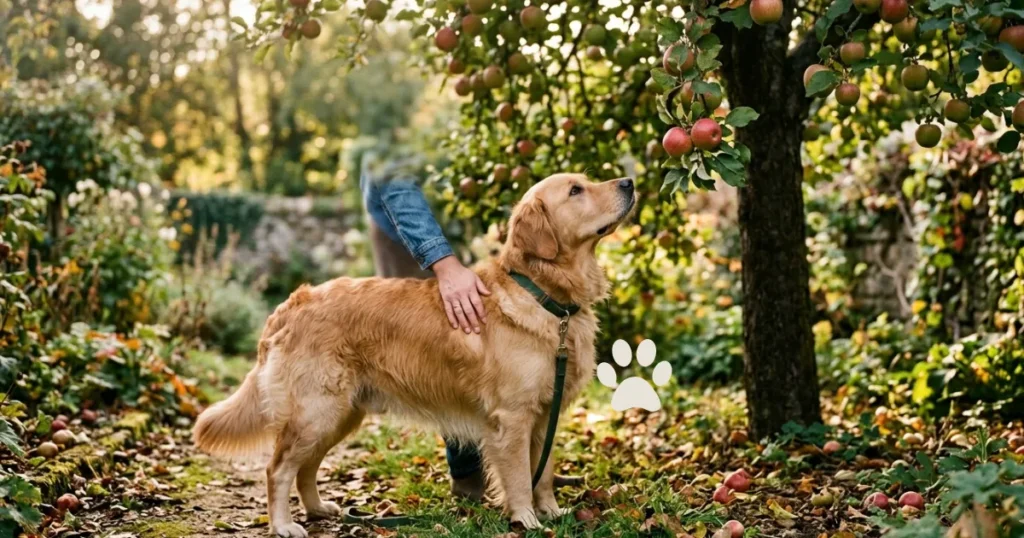
Dogs should not eat wind fallen apples without owner preparation. Fallen apples ferment quickly, and fermented fruit contains ethanol. A Golden Retriever consuming a meaningful quantity can experience ethanol intoxication – disorientation, vomiting, and loss of coordination are observable signs. Windfalls also contain intact seeds. Remove them from reach or prepare them as you would a fresh apple.
Can dogs have apples if they have a sensitive stomach?
Dogs have apples safely even with a sensitive stomach when the apple is peeled and served as a single small piece first. Observe stool for 24 hours before continuing. Peeled apple flesh is a lower-fiber option most GI-sensitive Golden Retrievers tolerate without incident. Apple skin is the variable most likely to trigger loose stools – removing it resolves the issue for the majority.
Are apples bad for dogs with diabetes?
Are apples bad for dogs with diabetes is not answerable with a general guideline? Apple contains natural fructose that affects blood glucose, and the appropriate serving size depends on the individual dog’s insulin protocol. Apple is not universally excluded for diabetic Golden Retrievers, but serving size and frequency require direct input from the managing veterinarian.
Are apples bad for dogs with kidney disease?
Not inherently. Apple flesh is relatively low in phosphorus and potassium compared to higher-risk fruits, making it more compatible for dogs with mild-to-moderate chronic kidney disease. Late-stage CKD requires individualized dietary management. Confirm appropriateness with your vet before offering any fruit treat to a Golden with a formal kidney diagnosis.
What happens if my Golden Retriever eats apple leaves or stems?
Apple leaves and stems contain amygdalin in higher concentrations than the fruit flesh. If your Golden chewed through a significant quantity of apple leaves, monitor for vomiting, lethargy, and labored breathing. A large quantity warrants a call to your vet or ASPCA Animal Poison Control at 888-426-4435 rather than home observation alone. One or two leaves accidentally ingested are unlikely to cause clinical signs in a healthy adult.
Is applesauce safe for Golden Retrievers?
Plain, unsweetened applesauce with no additives is safe in small amounts – one tablespoon as a Kong filler or lick mat ingredient. Most commercial applesauce contains added sugar or corn syrup and is not appropriate. Diet varieties carry a higher xylitol risk. Read the full ingredient list before using any packaged applesauce. If xylitol appears anywhere in the ingredients, do not use it.
What happens if my Golden Retriever eats an apple core?
An apple core is both a choking and obstruction risk and a seed delivery vehicle. For a healthy adult who swallowed a core without immediate distress, monitor for vomiting, repeated retching, abdominal bloating, loss of appetite, and lethargy over 12 to 24 hours. If retching produces nothing, bloating is visible, or abdominal rigidity develops, call your vet the same day rather than continuing to monitor.
Are green apples or red apples better for Golden Retrievers?
Both are safe. Green apple varieties such as Granny Smith are lower in sugar and higher in malic acid than red varieties. For a Golden on a weight management protocol or with blood glucose sensitivity, green apple is the marginally better choice per gram of sugar. Preparation rules and serving sizes are identical regardless of variety.
What happens if my dog eats apple seeds regularly over time?
Regular apple seed ingestion delivers a cumulative amygdalin load converted to hydrogen cyanide with each exposure. A healthy adult Golden is unlikely to reach acute toxicity from small isolated seed exposures. The concern is accumulation across repeated feedings – consistent low-dose cyanide exposure with no nutritional benefit and no justification when removal takes seconds. Treat seed removal as a fixed preparation step, not an emergency precaution.
Conclusion
Dogs and apples are a compatible combination when the preparation is correct, and the portion fits the individual dog’s life stage and health status. Remove seeds and core every time – not as an occasional precaution, but as a fixed preparation habit. For healthy adult Golden Retrievers, three to five small slices a few times per week is the practical framework. Puppies and seniors get less, more carefully. Dogs with active health conditions get individualized guidance before Apple enters the rotation at all. Build the preparation habit once, and it becomes automatic. That habit is the entire difference between feeding dogs and apples well and creating a repeating exposure risk across weeks of careless serving.
Has your Golden developed a firm opinion about apple – enthusiastic, suspicious, or completely indifferent to it? And has one ever gotten to a whole apple before you could intervene? Tell me exactly what they consumed, how they handled the next 24 hours, and whether the experience changed how you approach fruit treats for your dog.
Dogs and apples seem like a simple combination, but the reality in Golden Retriever households tends to be messier than any guide anticipates. Whether your dog has helped themselves to a whole apple off the counter before you could intervene, developed an unexpectedly strong opinion about frozen apple slices, or reacted in a way you were not expecting after their first taste – share the specifics. What did they eat, how much, and what did the next 24 hours look like? Real outcomes from Golden Retriever owners are more useful here than anything general.