How much food should a puppy eat is one of the first questions new Golden Retriever owners ask – and one of the most consequential ones to get right. Puppyhood is the window where overfeeding does its most lasting damage, yet it is also the stage where most owners, operating on instinct and an endearing desire to keep a puppy happy, err on the side of too much.
I often see Golden Retriever puppies come in for early wellness checks already carrying excess weight – not because their owners were neglectful, but because no one gave them breed-specific guidance on how much a puppy should eat at each stage of growth. The bag guidelines were followed loosely, treats were generous, and a puppy who seemed hungry was always given a little more.
In large breeds like Golden Retrievers, overfeeding during puppyhood doesn’t just cause short-term weight gain. It accelerates skeletal development in ways that compound joint risk over a lifetime.
This guide gives you precise, Golden Retriever-specific answers to how much food a puppy should eat from 8 weeks through 12 months – with weight-based charts, age-by-age portions, and the clinical reasoning behind every recommendation.
Why Puppy Portion Size Matters More in Large Breeds
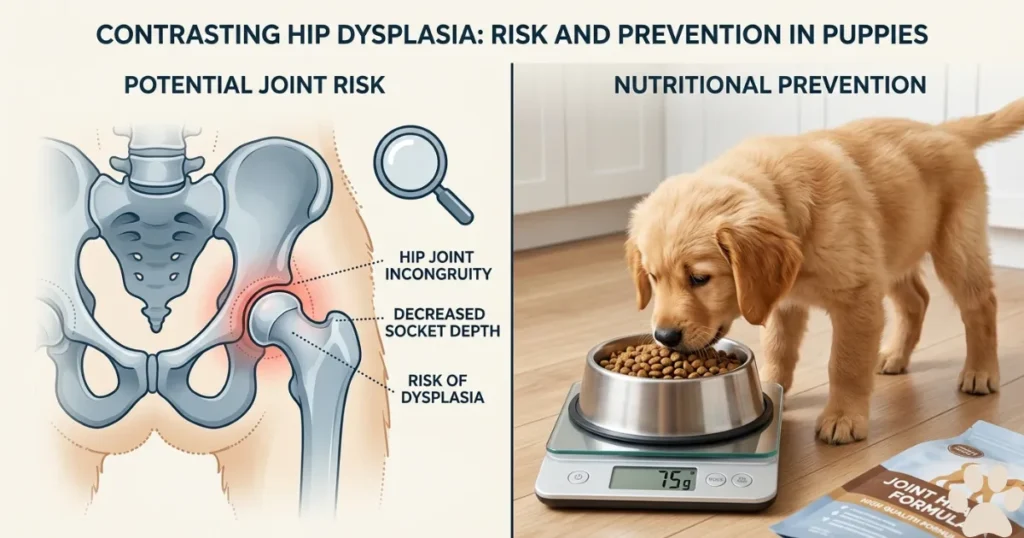
How much a puppy should eat is a more consequential question for Golden Retrievers than for small or medium breeds. The reason is developmental orthopedic disease (DOD) – a group of skeletal conditions directly linked to nutritional excess during the growth phase.
In canine orthopedics, overfeeding large-breed puppies creates a specific problem, excess energy accelerates bone and cartilage growth faster than the structural integrity of those tissues can keep pace. The result is an elevated risk of:
- Hip dysplasia – abnormal joint development driven partly by growth-rate excess
- Elbow dysplasia – one of the most common orthopaedic diagnoses in Golden Retrievers
- Osteochondrosis dissecans (OCD) – cartilage lesions linked to accelerated growth in high-calorie-fed large-breed puppies
- Panosteitis – painful bone inflammation associated with rapid growth, more common in overfed large-breed puppies
Golden Retrievers are already genetically predisposed to hip and elbow dysplasia. Overfeeding amplifies that predisposition into a near-certainty in some dogs. Understanding how much food a puppy should eat is therefore not just about weight management – it is joint protection from day one.
How Much Should a Puppy Eat? The Calculation Framework
How much a puppy should eat is calculated differently from that of an adult dog. Puppies have higher energy needs per kilogram of body weight – but the risk of excess caps is higher.
The standard formula for large-breed puppy energy needs:
Resting Energy Requirement (RER) = 70 × (body weight in kg) ^ 0.75.
Multiplied by a puppy growth factor:
- Under 4 months: RER × 3.0.
- 4 – 12 months: RER × 2.0.
Worked example – 10 kg puppy at 4 months: RER = 70 × (10) ^ 0.75 = 70 × 5.62 =|394 kcal
With multiplier: 394 × 2.0 =|788 kcal/day.
Then divide by the kcal/cup on your specific food label: 788 ÷ 370 kcal/cup =|2.1 cups/day.
This calculation gives a starting point. It must be recalculated every 3 – 4 weeks as the puppy’s body weight increases.
Vet’s Tip: How much food a puppy should eat changes faster than most owners realise – body weight in a Golden Retriever puppy can increase by 2- 3 kg per month during the 3- 6 month growth window. An amount that was correct at month 3 will be meaningfully low by month 5. Monthly weight checks and portion recalculation are more important than any fixed chart.
How Much Food Should a Puppy Eat by Age? Complete Golden Retriever Chart.
All figures below are based on a quality large-breed puppy dry kibble at approximately 370 kcal/cup. Verify and adjust based on your specific food’s caloric density.
Age-by-Age Golden Retriever Puppy Feeding Chart.
| Age | Typical Weight | Daily Caloric Need | Daily Total | Meals/Day | Per Meal |
| 8–10 weeks | 3–5 kg | 450–600 kcal | 1.2–1.6 cups | 4 | ¼–⅓ cup |
| 10–12 weeks | 5–7 kg | 580–720 kcal | 1.6–2 cups | 4 | ⅓–½ cup |
| 3 months | 7–10 kg | 700–850 kcal | 1.9–2.3 cups | 3 | ⅔–¾ cup |
| 4 months | 10–13 kg | 780–950 kcal | 2.1–2.6 cups | 3 | ¾–⅞ cup |
| 5 months | 13–17 kg | 920–1,100 kcal | 2.5–3 cups | 3 | ¾–1 cup |
| 6 months | 17–21 kg | 1,050–1,250 kcal | 2.8–3.4 cups | 2–3 | ~1–1.1 cups |
| 7–8 months | 20–25 kg | 1,150–1,350 kcal | 3.1–3.6 cups | 2 | ~1.5–1.8 cups |
| 9–10 months | 23–27 kg | 1,250–1,450 kcal | 3.4–3.9 cups | 2 | ~1.7–2 cups |
| 11–12 months | 25–30 kg | 1,300–1,550 kcal | 3.5–4.2 cups | 2 | ~1.75–2.1 cups |
Figures are estimates. Individual metabolic variation, activity level, and food density all affect actual needs. Always validate with Body Condition Score assessment.
How Much Food Should a Puppy Eat at 8 Weeks?
How much a puppy should eat at 8 weeks is smaller than most new owners expect. At this age, a Golden Retriever puppy weighs approximately 3- 5 kg and has a stomach roughly the size of a walnut.
The correct answer:
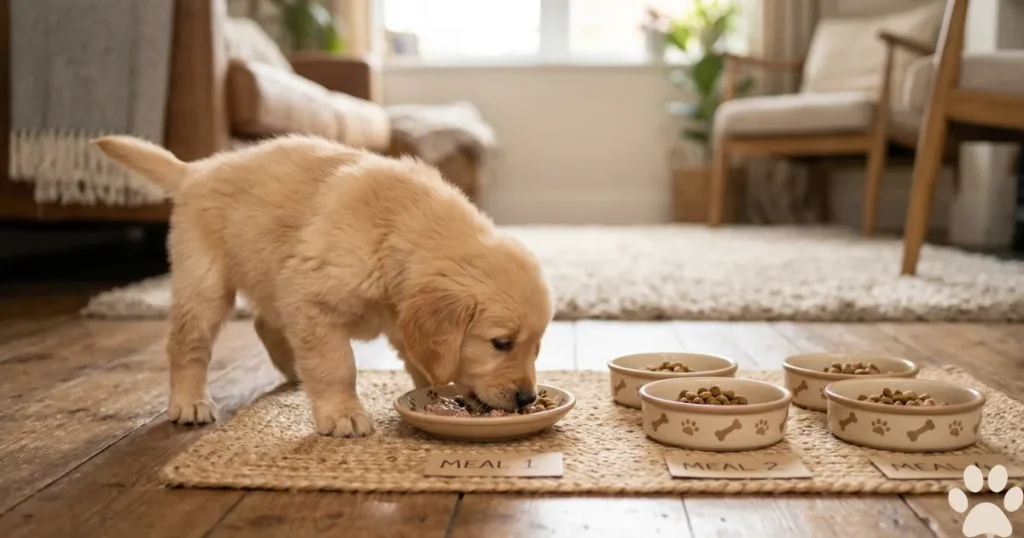
1.2 – 1.6 cups of large-breed puppy formula per day, divided across 4 meals – approximately 1/4 to 1/3 cup per sitting.
What this looks like in practice:
| Meal | Time | Portion |
| Meal 1 | 7:00 AM | ¼–⅓ cup |
| Meal 2 | 12:00 PM | ¼–⅓ cup |
| Meal 3 | 5:00 PM | ¼–⅓ cup |
| Meal 4 | 9:00 PM | ¼–⅓ cup |
What NOT to do:
Do not use the adult feeding chart on the bag. Most adult-oriented charts overestimate the amounts appropriate for an 8-week puppy. Always look specifically for large-breed puppy feeding guidelines – and verify them against kcal/cup rather than relying on cup volumes alone.
How Much Food Should a Puppy Eat at 3 – 4 Months?
At 3- 4 months, a Golden Retriever puppy is in an accelerated growth phase. Body weight typically increases by 1.5 – 3 kg per month. How much a puppy should eat in this window must keep pace with that growth – but must not overshoot it.
The correct answer: 1.9 – 2.6 cups of large-breed puppy formula per day, divided across 3 meals.
Over the years, I’ve noticed that the 3 – 4 month stage is where most Golden Retriever owners begin free-pouring rather than measuring. The puppy is growing visibly, seems perpetually hungry, and its measurements feel overly rigid. What happens is a gradual, undocumented increase in daily intake that – over two to three months – can push the puppy 20-30% above appropriate caloric intake without the owner noticing the shift.
Weight-Based Portion Reference – 3 – 4 Month Puppy.
| Puppy Weight | Daily Total | Per Meal (3 meals) |
| 7–9 kg | 1.9–2.1 cups | ~⅔ cup |
| 9–11 kg | 2.1–2.4 cups | ~¾ cup |
| 11–13 kg | 2.4–2.6 cups | ~⅞ cup |
How Much Food Should a Puppy Eat at 5 – 6 Months?
The 5- 6 month window is the most physically demanding growth period for a Golden Retriever. Puppies at this stage are approaching half their adult body weight and burning significant energy through play, exploration, and ongoing skeletal development.
The correct answer: 2.5-3.4 cups per day across 3 meals (transitioning to 2 meals from 6 months based on readiness).
At 6 months, most Golden Retriever puppies are ready to begin moving toward twice-daily feeding. How much a puppy should eat per meal increases as meal frequency decreases – the daily total stays consistent, redistributed into fewer, larger servings.
Transitional Portion Guide – 5 – 6 Months.
| Age | Daily Total | 3 Meals | 2 Meals |
| 5 months | 2.5–3 cups | ~¾–1 cup | N/A |
| 6 months | 2.8–3.4 cups | ~1–1.1 cups | ~1.4–1.7 cups |
If moving to 2 meals at 6 months, transition gradually over 7 – 10 days by progressively redistributing the midday meal into morning and evening portions.
How Much Food Should a Puppy Eat at 7- 12 Months?
Between 7 and 12 months, a Golden Retriever puppy is completing skeletal growth and approaching adult body weight. How much a puppy should eat in this stage begins to converge toward adult maintenance levels – though puppies are not technically adults until 12-18 months.
The correct answer:
3.1-4.2 cups per day on a twice-daily schedule, increasing gradually as the dog gains weight, then plateauing as the dog approaches its adult size.
Key shifts in this window:
- Switch from large-breed puppy formula to adult or all-life-stages formula at 12 months (or per your vet’s recommendation).
- Caloric needs per kg of body weight begin to decrease as growth rate slows.
- Body condition monitoring becomes more important than any chart – use BCS 4- 5 on a 9-point scale as the target.
7 – 12 Month Portion Reference Chart.
| Age | Weight Range | Daily Total | Per Meal (2 meals) |
| 7–8 months | 20–25 kg | 3.1–3.6 cups | ~1.5–1.8 cups |
| 9–10 months | 23–27 kg | 3.4–3.9 cups | ~1.7–2 cups |
| 11–12 months | 25–30 kg | 3.5–4.2 cups | ~1.75–2.1 cups |
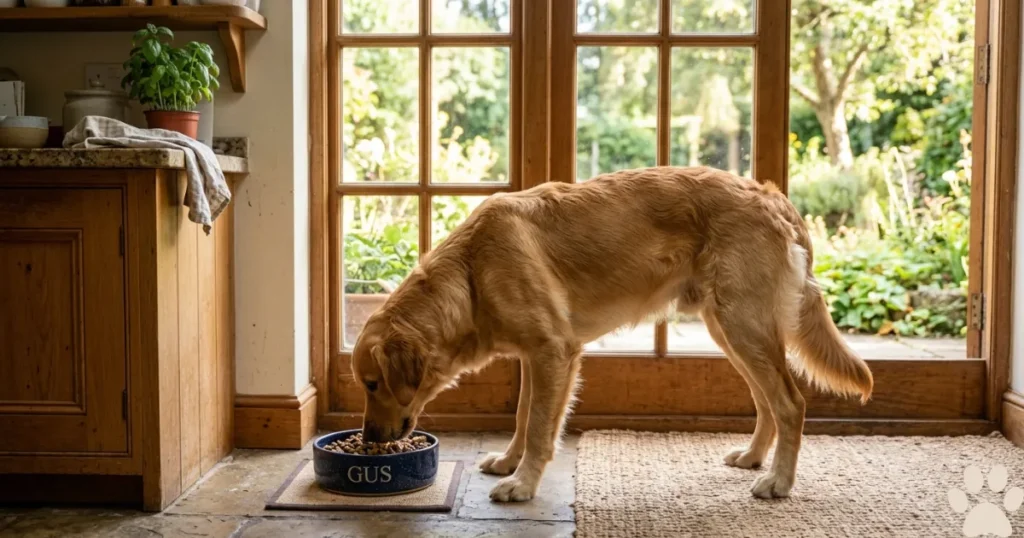
The Body Condition Score: How to Validate How Much a Puppy Should Eat.
No chart fully replaces hands-on assessment. In veterinary practice, the Body Condition Score (BCS) is the most reliable tool for confirming whether a puppy’s food intake is appropriate.
BCS 9-point scale – target for a growing Golden Retriever puppy: 4 – 5.
| BCS | Description | Action |
| 1–3 | Ribs, spine, hip bones visible with no fat covering | Increase portions by 10–15% |
| 4–5 | Ribs palpable with light pressure; visible waist from above; slight abdominal tuck | Correct – maintain current intake |
| 6–7 | Ribs require firm pressure to feel; waist barely visible | Reduce portions by 10% |
| 8–9 | Ribs not palpable under fat; no waist; fat deposits at neck and tail base | Reduce portions by 15–20%; vet check advised |
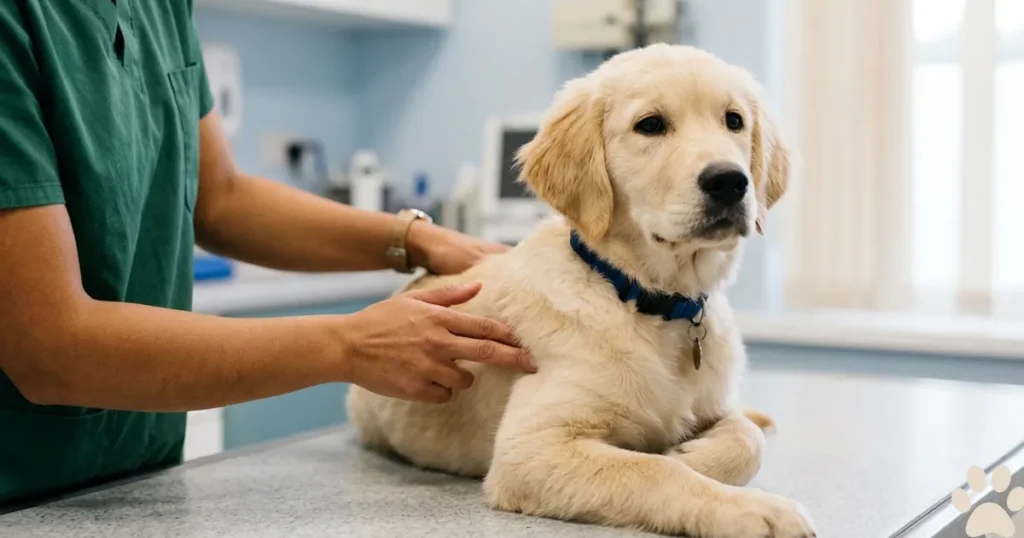
How to assess your Golden Retriever puppy:
- Place both hands on the ribcage, thumbs along the spine.
- Apply light pressure – you should feel ribs without pressing firmly.
- View from directly above – a slight waist indentation should be visible.
- View from the side – a gentle upward tuck behind the ribcage should be present.
Assess every 2 weeks during the growth phase and adjust portions in 10% increments based on what you find.
8 Puppy Feeding Mistakes That Affect How Much a Golden Retriever Should Eat.
1. Using adult feeding charts for a puppy.
Adult maintenance guidelines underestimate puppy caloric needs at young ages and sometimes overestimate them at older puppy stages. Use a large-breed puppy-specific chart and verify against kcal/cup.
2. Not adjusting portions as the puppy grows.
How much a puppy should eat must increase every 3 – 4 weeks during the first 6 months. A fixed portion set at 8 weeks will result in meaningful underfeeding for a 5-month-old puppy from the same dog.
3. Feeding a high-calorie adult or performance formula.
High-protein, high-fat adult kibbles are not appropriate for large-breed puppies. Excess energy density accelerates skeletal growth beyond the capacity of connective tissue to support.
4. Treating puppies as adults at 6 months.
Most Golden Retrievers continue growing until 12- 18 months. Switching to adult food and adult portions at 6 months removes nutrients specifically formulated to support controlled large-breed skeletal development.
5. Not accounting for treat calories.
Puppies in training receive frequent treats. For a puppy needing 850 kcal/day, even 10 small training treats can account for 100-150 kcal – roughly 12-18% of the daily total. Reduce kibble proportionally.
6. Topping up whenever the bowl is empty.
Bowl emptying is not a signal to refill. A puppy that finishes meals quickly has been correctly portioned, not underfed. Topping up is how daily intake quietly doubles over the course of weeks.
7. Soaking kibble without recalculating.
Kibble softened with water is easier for young puppies to chew and digest – but when soaked, kibble swells in volume, and the apparent cup count no longer matches its dry weight. Measure dry, then soak.
8. Ignoring the Body Condition Score.
How much food a puppy should eat is ultimately validated by BCS, not by any chart. Owners who never perform hands-on body checks miss early weight gain and early weight loss equally – both of which are correctable when caught early.
Vet Definitive Statement.
In large-breed puppies like Golden Retrievers, how much food a puppy should eat directly influences skeletal development – overfeeding during the growth phase accelerates bone growth faster than cartilage integrity can support, raising the lifetime risk of hip and elbow dysplasia.
A Golden Retriever puppy at 8 weeks requires approximately 1.2 – 1.6 cups of large-breed puppy formula daily, divided across four meals; how much a puppy should eat must be recalculated every 3 – 4 weeks as body weight increases.
In canine nutrition, large-breed puppy formulas are specifically designed to provide controlled caloric density – feeding a high-calorie adult formula to a growing Golden Retriever puppy is a documented risk factor for developmental orthopaedic disease.
The Body Condition Score (BCS) is a more reliable indicator of whether a puppy is receiving the right food quantity than any age-based chart – a BCS of 4- 5 on a 9-point scale is the target for a growing Golden Retriever puppy.
Treat calories are frequently overlooked when calculating how much food a puppy should eat – in active training periods, treats can account for 15- 20% of a young puppy’s daily caloric intake and must be subtracted from the daily kibble total.
How much food should a puppy eat per day?
A Golden Retriever puppy needs 1.2 cups at 8 weeks, up to 4+ cups at 11-12 months, depending on age and body weight. Daily amounts increase roughly every 3 – 4 weeks and must be recalculated based on current weight and food caloric density.
How much should a puppy eat at 8 weeks?
At 8 weeks, a Golden Retriever puppy typically needs 1.2-1.6 cups of large-breed puppy formula daily, split across four meals – approximately 1/4-1/3 cup per sitting.
How much should a puppy eat at 3 months?
At 3 months, a Golden Retriever puppy needs approximately 1.9 – 2.3 cups daily, divided into three meals. Exact amounts depend on the puppy’s current weight and the caloric density of the food.
How much should a puppy eat at 4 months?
At 4 months, most Golden Retriever puppies need 2.1 – 2.6 cups daily across three meals. Body weight increases rapidly at this stage – portions should be recalculated against current weight every 3-4 weeks.
How much food should a puppy eat at 6 months?
At 6 months, a Golden Retriever puppy needs approximately 2.8 – 3.4 cups daily. Most puppies can begin transitioning to twice-daily feeding at this stage, redistributing the same daily total into two larger meals.
Should I follow the feeding chart on the puppy food bag?
Use it as a starting point only. Bag charts are averages and often overestimate appropriate amounts for large-breed puppies. Verify against your puppy’s current weight, calculate caloric needs using RER, and validate with Body Condition Score assessment.
How do I know if I’m feeding my puppy too much?
Use the Body Condition Score. If your puppy’s ribs are hard to feel with light pressure, or there’s no visible waist indentation from above, the current amount is likely too high. Reduce by 10% and reassess in two weeks.
Can I overfeed a Golden Retriever puppy?
Yes, and the consequences are significant. Overfeeding accelerates skeletal growth beyond what connective tissue can support, raising the risk of hip dysplasia, elbow dysplasia, and OCD – conditions Golden Retrievers are already predisposed to genetically.
How much should a puppy eat – wet food or dry food?
Wet food has significantly lower caloric density than dry kibble. If feeding wet, check kcal per can and calculate daily intake by calories, not volume. Mixing wet and dry requires calculating each component’s caloric contribution separately.
How many times a day should a puppy eat?
Four times daily at 8 – 12 weeks, three times daily from 3 – 6 months, and two to three times daily from 6 – 12 months. The daily food total remains consistent – frequency decreases as stomach capacity and GI maturity increase.
When should I switch my Golden Retriever from puppy food to adult food?
Most Golden Retrievers should transition to adult or all-life-stages food at 12 months. Some vets recommend continuing large-breed puppy formula until 14- 18 months for dogs with slower development. Transition gradually over 7- 10 days.
Do puppies need more food when they are teething?
Teething itself does not increase caloric requirements. However, some puppies eat more slowly or show temporary food reluctance during teething. Softening kibble with warm water can help without changing the daily portion.
How much food does a puppy need if it’s very active?
Active puppies burn more calories but should not be overfed beyond controlled growth targets. If a puppy consistently scores below BCS 4 despite correctly calculated portions, increase by 10% increments – not by adding a full extra meal.
Is it normal for a puppy to always seem hungry?
Yes. Golden Retriever puppies are food-motivated and will consistently signal hunger regardless of intake. Hunger behaviour between correctly portioned meals is a matter of temperament, not underfeeding – validate with BCS rather than responding to soliciting behaviour.
How much should a puppy eat if it has loose stools?
Loose stools during a food transition or after a new food introduction may require a temporary 10-15% portion reduction while the GI tract adjusts. If loose stools persist beyond 3 – 5 days, consult your vet before making further feeding changes.
Conclusion.
How much food a puppy should eat is not a static answer – it is a moving target that must be updated as a Golden Retriever puppy grows, every 3-4 weeks throughout the entire first year of life. The amounts that were correct at 8 weeks are inadequate at 4 months. The amounts right at 4 months will overshoot the needs of a 9-month-old puppy approaching adult weight.
How much should a puppy eat is also breed-specific in ways that matter deeply for Golden Retrievers. The combination of a rapid growth rate, genetic predisposition to hip and elbow dysplasia, and a strong food drive makes this breed one of the most important to get right – and one of the easiest to accidentally overfeed.
Start with the age-and-weight charts as a framework. Calculate based on your puppy’s current weight rather than a generic age estimate. Use the Body Condition Score every two weeks to validate what the numbers suggest. Adjust in 10% increments based on what you find.
If you are ever uncertain whether how much your puppy is eating is appropriate, your next wellness appointment is the right moment to confirm it. A brief body condition assessment takes less than 2 minutes and provides more reliable information than any chart alone.
How did you figure out How Much Food Should a Puppy Eat?
Every owner’s experience is different – some discovered the BCS method, while others learned the hard way that bag charts don’t account for individual dogs. If you found a portion size or a reassessment routine that worked well for your puppy’s first year, you can share it below. Your real-world experience helps the next owner get it right from day one.