Puppy feeding decisions made in the first twelve months of a Golden Retriever’s life have consequences that extend well into adulthood. I often see owners doing their best with incomplete information – following generic feeding guides designed for small breeds, relying on breeder advice that hasn’t been updated in years, or simply matching portion sizes to their puppy’s enthusiasm rather than their puppy’s actual needs.
The problem with puppy feeding for Golden Retrievers specifically is that this breed has developmental vulnerabilities that most generic advice doesn’t address. Overfeeding during the growth phase – even on a high-quality diet – accelerates skeletal development in ways that increase the lifetime risk of hip dysplasia, elbow dysplasia, and osteochondrosis. Underfeeding creates nutritional deficits that compromise immune function and muscle development at the exact window when both are forming most rapidly.
Getting puppy feeding right for a Golden Retriever is not about perfection. It is about understanding the key decisions, the key transitions, and the specific breed risks that make this topic more consequential than it might appear.
This guide covers every stage of Golden Retriever puppy feeding – from the first meal at 8 weeks through the transition to adult food – with specific charts, schedules, and decision frameworks tailored to this breed.
What Makes Golden Retriever Puppy Feeding Different From Other Breeds
Golden Retrievers are a large breed with a growth curve that peaks between 4 and 7 months and continues until approximately 12- 18 months of age. This extended growth window creates a prolonged period during which nutrition directly shapes musculoskeletal development.
Three breed-specific puppy feeding realities:
1. Overfeeding accelerates skeletal growth – not just weight gain.
In large breed puppies, excess calories and calcium increase the rate of bone growth. Bone that grows too quickly outpaces cartilage development, creating structural weaknesses at joints. Golden Retrievers are predisposed to both hip dysplasia and osteochondrosis – conditions that puppy feeding practices either support or worsen.
2. Large breed puppy formula is not optional.
Adult dog food formulas are not appropriate for Golden Retriever puppies. The calcium-to-phosphorus ratio in adult food exceeds safe levels for growing large breeds. A large breed puppy formula specifically modulates this ratio and limits caloric density to support controlled growth.
3. Food motivation develops early and strongly.
Golden Retrievers are among the most dog food-motivated breeds in canine behaviour research. Puppy feeding practices that reinforce constant food-seeking – free-feeding, excessive treats, and highly palatable foods without portion discipline – create habits that persist into adulthood and directly contribute to the high overweight rates seen in this breed at 2-3 years of age.
Puppy Feeding by Age: The Complete Stage Breakdown
8 to 12 Weeks: 4 Meals Per Day
A Golden Retriever puppy arriving home at 8 weeks has a stomach roughly the size of a closed fist. Puppy feeding at this stage prioritises frequency over volume – four small meals per day prevent hypoglycaemia between feeds and avoid overloading the immature gastric capacity with large single portions.
What to feed:
Large breed puppy dry kibble, moistened slightly with warm water if the puppy is transitioning from soft food. Avoid adult formulas entirely.
How much to feed:
| Puppy Weight | Daily Total | Per Meal (4 meals) |
| 3–5 kg (7–11 lb) | 1–1.25 cups | ¼ cup |
| 5–7 kg (11–15 lb) | 1.25–1.5 cups | ⅓ cup |
Sample Puppy Feeding Schedule – 8 to 12 Weeks:
| Meal | Time | Notes |
| Meal 1 | 7:00 AM | After morning toilet break |
| Meal 2 | 12:00 PM | Midday; short rest post-meal |
| Meal 3 | 5:00 PM | Late afternoon |
| Meal 4 | 9:00 PM | Allow 45 min before sleep |
What NOT to do:
Do not moisten food indefinitely. Transition to dry kibble by 10 – 12 weeks to support dental development and establish the texture expectation that will carry through adult feeding.
3 to 6 Months: 3 Meals Per Day.
The 3- 6 month window is the most demanding phase of Golden Retriever puppy feeding. Growth rate is near its peak, appetite surges are common, and owners frequently misread normal hunger signals as a sign to increase portions beyond appropriate levels.
What changes at 3 months:
- Stomach capacity is sufficient for three larger meals.
- Metabolic demand increases significantly as the puppy grows.
- Per-meal portions increase while frequency decreases.
Weight-based puppy feeding portions – 3 to 6 months:
| Puppy Weight | Daily Total | Per Meal (3 meals) |
| 7–10 kg (15–22 lb) | 1.5–2 cups | ½–⅔ cup |
| 11–15 kg (24–33 lb) | 2–2.5 cups | ⅔–¾ cup |
| 16–20 kg (35–44 lb) | 2.5–3 cups | ¾–1 cup |
Sample Puppy Feeding Schedule – 3 to 6 Months:
| Meal | Time | Notes |
| Meal 1 | 7:00 AM | Before morning exercise |
| Meal 2 | 1:00 PM | Midday portion |
| Meal 3 | 6:00 PM | Final meal; 2 hr rest before play |
Over the years, I’ve noticed that Golden Retriever puppies between 4 and 6 months go through an appetite surge that owners almost universally interpret as a need to add food. In most cases, the puppy is growing correctly, and the surge is temporary – lasting 2-3 weeks before stabilising. Reassess body condition before increasing portions; a puppy with an hourglass shape from above and palpable ribs under light pressure is correctly fed, not underfed.
6 to 12 Months: Transitioning to 2 Meals Per Day.
Puppy feeding between 6 and 12 months bridges the gap between the three-meal puppy plan and the twice-daily adult schedule. Most Golden Retrievers are ready to shift to two meals by 6-7 months, but the transition should be gradual rather than abrupt.
Transition approach:
- Week 1 – 2: Reduce the midday meal by 25%, redistributing to morning and evening.
- Week 3 – 4: Reduce midday meal by 50%.
- Week 5 – 6: Remove midday meal entirely if no GI upset or bile vomiting.
Signs the puppy is NOT ready for 2 meals:
- Bile vomiting before morning meal (overnight gap too long).
- Persistent food-seeking 2 – 3 hours before next scheduled meal.
- Energy crashes in the mid-afternoon window.
Puppy feeding portions – 6 to 12 months:
| Puppy Age | Weight Range | Daily Total | Meals/Day |
| 6–7 months | 18–24 kg | 2.5–3 cups | 2–3 |
| 8–9 months | 22–28 kg | 3–3.5 cups | 2–3 |
| 10–12 months | 24–30 kg | 3–4 cups | 2 |
Choosing the Right Food for a Golden Retriever Puppy Feeding.
The food selection decision in puppy feeding is as consequential as the portion decision. Several criteria are non-negotiable for this breed.
What to Look For.
Large breed puppy formula:
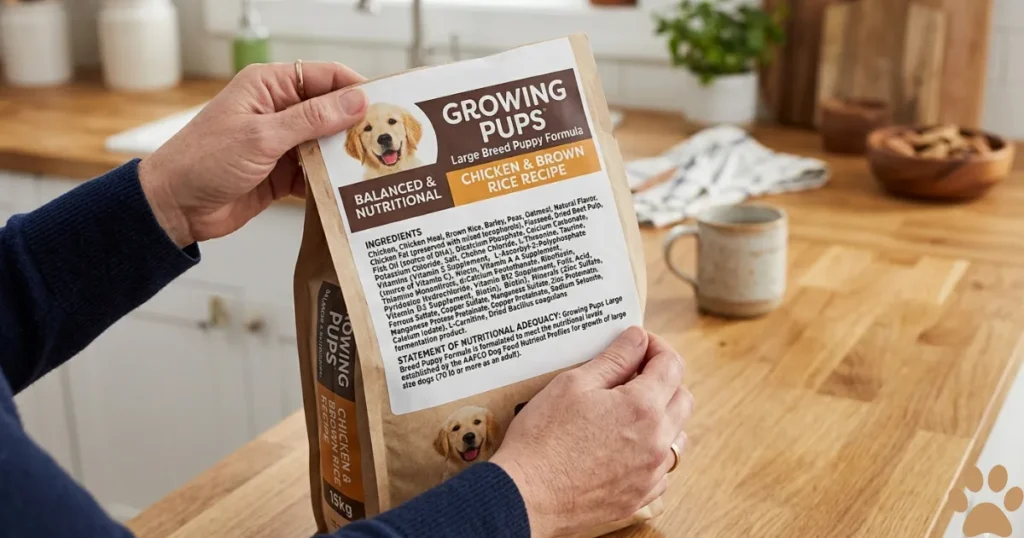
This is the single most important label criterion. Large breed puppy formulas modulate calcium levels (targeting 0.7 – 1.2% on a dry matter basis), limit caloric density, and balance the calcium-to-phosphorus ratio to support controlled bone growth. Standard puppy formulas are too high in calcium for Golden Retrievers.
Named protein source as first ingredient:
Chicken, turkey, salmon, lamb – specific named proteins rather than generic “meat meal” or “poultry by-product.” Golden Retrievers have a documented predisposition to protein-triggered skin sensitivities; knowing the exact protein source matters for tracking reactions.
AAFCO statement for growth:
Look for:
“Formulated to meet the nutritional levels established by AAFCO nutrient profiles for growth and reproduction of large breeds.” This statement confirms that the formula has been developed specifically for the large breed growth phase.
Appropriate caloric density:
For large breed puppy feeding, 340 – 420 kcal/cup is the appropriate range. High-density formulas (450+ kcal/cup) marketed as premium or high-performance are not appropriate for controlled growth in Golden Retriever puppies.
What to Avoid.
| Ingredient / Label Claim | Why to Avoid |
| “All breeds” puppy formula | Calcium levels not modulated for large breeds |
| Adult dog food | Inappropriate Ca:P ratio for growing puppies |
| Grain-free (without vet guidance) | Associated with DCM in some breeds; no proven benefit for Goldens |
| Raw diet without professional oversight | Pathogen risk and nutritional imbalance risk during immune system development |
| Supplements without vet direction | Calcium supplementation on top of complete kibble causes skeletal damage |
Vet’s Tip: Never add calcium supplements to a puppy already eating a complete large breed puppy formula. The formula is calibrated to deliver the correct calcium level for controlled growth. Additional calcium – even from sources like cottage cheese or yogurt given daily – disrupts this balance and directly increases the risk of developmental bone conditions in Golden Retriever puppies.
Puppy Feeding Transitions: When and How to Switch Foods.
Transitioning From the Breeder’s Food.
Most reputable breeders send puppies home with a supply of the food the litter was weaned on. Continue this food for the first 1 – 2 weeks, then transition gradually if you are switching brands.
7-day transition schedule:
| Day | Old Food | New Food |
| 1–2 | 75% | 25% |
| 3–4 | 50% | 50% |
| 5–6 | 25% | 75% |
| 7+ | 0% | 100% |
If loose stools or vomiting occur at any stage, hold the current ratio for 2 additional days before continuing the transition.
Transitioning From Puppy to Adult Food.
The transition from puppy feeding to adult feeding is one of the most commonly mistimed decisions in Golden Retriever ownership.
When to transition to adult food:
- Golden Retrievers are typically ready at 12 – 14 months.
- Transition should not happen before 12 months – the growth phase is not complete.
- Transition should not be pushed past 18 months without a specific reason.
How to transition:
Use the same 7-day ratio schedule. Monitor body condition in the two months following – the adult formula’s different caloric density and nutrient profile often require a cup count adjustment after the transition completes.
8 Golden Retriever Puppy Feeding Mistakes That Affect Long-Term Health.
1. Feeding a standard puppy formula instead of a large breed puppy formula.
Standard formulas contain too much calcium for large breed growth. The skeletal consequences – hip and elbow dysplasia risk – can emerge at 12-18 months and persist for life.
2. Increasing portions every time the puppy acts hungry.
Food-seeking behaviour between meals is normal for Golden Retriever puppies. Assess body condition—not appetite behaviour—to determine whether portions genuinely need adjusting.
3. Supplementing with calcium on top of complete puppy food.
This is one of the highest-risk puppy feeding errors in large breeds. Even “natural” calcium sources like dairy can push total intake to harmful levels.
4. Rushing the transition to two meals before 6 months.
Early elimination of the midday meal creates long gaps, which contribute to bile vomiting and energy instability. Hold at three meals until the puppy consistently tolerates the gaps between them.
5. Switching food brands abruptly.
A sudden change in diet can cause GI upset in most puppies. The 7-day gradual transition is not a suggestion – it is a physiological requirement for microbiome adjustment.
6. Using adult food to “stretch the budget.”
Adult food is not a safe alternative to large breed puppy formula for Golden Retrievers. The calcium-phosphorus imbalance poses a real structural risk at this life stage.
7. Free-feeding to reduce the demands of scheduled meals.
Free-feeding during puppy development disconnects appetite regulation, makes intake impossible to track, and reinforces the persistent food-seeking behaviour that later contributes to obesity in adult Goldens.
8. Ignoring the body condition score during rapid growth phases.
Puppy weight gain is not linear – it surges at certain growth phases. Checking body condition every 3-4 weeks during puppy feeding allows for portion adjustments before weight has shifted significantly in either direction.

The Body Condition Score in Puppy Feeding.
The most reliable tool in Golden Retriever puppy feeding is not a chart or a formula—it is consistent, hands-on body condition assessment.
How to assess puppy body condition:
| What to Check | Ideal Finding | Action if Off |
| Ribcage | Palpable under light pressure, not visible | Too easy → reduce; not palpable → increase |
| Waist (from above) | Slight hourglass shape visible | No waist → reduce portions by 10% |
| Abdominal tuck (from side) | Gentle upward tuck visible | No tuck → reduce; sharp tuck → increase |
| Spine and hip bones | Not prominent, slight coverage | Prominent → increase; buried under fat → reduce |
Assess every 3 – 4 weeks during active puppy feeding. Adjust by 10% increments. Allow 3 weeks between adjustments before reassessing – changes are not visible within days.

Vet Definitive Statement.
In Golden Retriever puppy feeding, large breed puppy formula is not a preference – it is a medical requirement; standard puppy food contains calcium levels that accelerate skeletal growth at rates linked to hip dysplasia and osteochondrosis in this breed.
Golden Retriever puppies should eat four meals daily from 8- 12 weeks, three meals from 3- 6 months, and transition to two meals between 6 and 12 months based on individual GI tolerance- not based on the owner’s scheduling preference.
In large breed canine development, calcium supplementation on top of a complete puppy formula disrupts the precisely calibrated calcium-to-phosphorus ratio that controls bone growth rate – a puppy feeding error with permanent skeletal consequences.
The transition from puppy food to adult food in Golden Retrievers should occur at 12- 14 months; earlier transitions expose the dog to an adult formula’s caloric density and nutrient ratios before skeletal development is complete.
Puppy feeding body condition assessment – performed hands-on every 3- 4 weeks – is more reliable than chart-based feeding guides because it reflects the individual puppy’s actual metabolic response to current portion sizes.
FAQs.
What should I feed my Golden Retriever puppy?
Feed a large breed puppy formula specifically – not a standard all-breeds puppy food or adult food. Large breed formulas modulate calcium levels and caloric density to support controlled skeletal growth during the Golden Retriever’s extended growth phase.
How much should a Golden Retriever puppy eat per day?
At 8 – 12 weeks: 1 – 1.5 cups daily across 4 meals.
At 3 – 6 months: 2 – 3 cups across 3 meals.
At 6 – 12 months: 3 – 4 cups across 2 – 3 meals.
Always verify the caloric content against the label on your specific food.
How often should I feed my Golden Retriever puppy?
Four times daily at 8 – 12 weeks. Three times daily from 3 – 6 months. Gradually transition to twice daily between 6 and 12 months based on the puppy’s tolerance of longer gaps between meals.
When should I switch my Golden Retriever from puppy food to adult food?
At 12- 14 months. Golden Retrievers have an extended growth period; transitioning before 12 months risks incomplete skeletal development on an inappropriate adult nutrient profile. Use a 7-day gradual transition when switching.
Can I free-feed my Golden Retriever puppy?
No. Free-feeding during puppy development makes it impossible to monitor intake, disconnects appetite regulation, and reinforces the persistent food-seeking behaviour this breed is already predisposed to. Structured meals are essential.
How do I know if I’m feeding my puppy too much?
Assess body condition hands-on every 3 – 4 weeks. If you cannot feel the puppy’s ribs with light pressure, or there is no visible waist from above, the puppy is overfed. Reduce portions by 10% and reassess after 3 weeks.
Is grain-free food okay for a Golden Retriever puppy?
Current veterinary guidance does not support grain-free diets as a default choice for Golden Retrievers. Grain-free formulas have been associated with dilated cardiomyopathy (DCM) in some breeds. Consult your vet before choosing a grain-free puppy feeding.
Can I add supplements to my Golden Retriever puppy’s food?
Do not add calcium supplements to a puppy already eating a complete large breed formula. Excess calcium disrupts bone growth regulation in large breed puppies and can cause permanent skeletal damage. Consult a vet before adding any supplement.
What happens if I feed my Golden Retriever puppy adult food?
Adult food has an inappropriate calcium-to-phosphorus ratio for large breed puppies. Sustained feeding of adult food during the growth phase increases the risk of developmental orthopaedic conditions, including hip and elbow dysplasia.
My puppy acts hungry all the time – should I feed more?
Not necessarily. Golden Retriever puppies are food-motivated by temperament. Assess body condition before increasing portions – a puppy with palpable ribs and a visible waist is correctly fed, not underfed, even if they always seem interested in more food.
How do I transition my puppy to a new food without stomach upset?
Over 7 days: 75% old/ 25% new for days 1 – 2; 50/50 for days 3 – 4; 25% old/ 75% new for days 5 – 6; 100% new from day 7. If loose stools appear, hold the current ratio for 2 extra days before continuing.
Should I soak my Golden Retriever puppy’s kibble in water?
Moistening kibble with warm water is appropriate at 8- 10 weeks to ease the transition from the breeder’s diet. By 10- 12 weeks, transition to dry kibble to support dental health and establish the texture expectation for adult feeding.
How do I know what size kibble to choose for my puppy?
Large breed puppy formulas typically come in appropriately sized kibble. Avoid extra-large adult kibble for very young puppies – the piece size should be manageable enough that the puppy chews rather than swallows whole.
How long does the puppy feeding stage last for Golden Retrievers?
Golden Retriever puppy feeding on a large breed puppy formula continues until 12- 14 months. This is longer than for small and medium breeds, which typically transition at 9 – 12 months, due to the Golden’s extended skeletal development window.
What is the best puppy food brand for Golden Retrievers?
Choose any brand that carries an AAFCO statement for growth and reproduction in large breeds, lists a named protein source as the first ingredient, and falls within 340 – 420 kcal/cup. Specific brand loyalty matters less than meeting these three criteria.
Conclusion.
Golden Retriever puppy feeding is one of the most direct influences on that dog’s musculoskeletal health, immune development, and adult body weight. The decisions made in the first 12 months – what to feed, how much, how often, and when to transition – shape outcomes that are still visible at 5 and 10 years of age.
The fundamentals are not complicated. Use a large breed puppy formula. Feed four meals at 8 weeks, three meals at 3 months, and transition toward two meals by 6- 12 months. Assess body condition hands-on every 3 – 4 weeks rather than relying on estimates. Transition to adult food at 12 – 14 months using a 7-day gradual protocol.
Avoid the common errors – calcium supplementation on top of a complete diet, rushed reductions in meal frequency, free-feeding, and adult food at the wrong stage. These are the errors most likely to produce consequences that aren’t visible until the puppy is well into adulthood.
Puppy feeding done right doesn’t require perfection. It requires consistency, regular body condition monitoring, and a willingness to adjust when the dog’s condition – not the dog’s enthusiasm – signals that something needs to change.
What was the hardest part of puppy feeding when you first brought your Golden home?
Whether it was figuring out portions, dealing with a puppy who acted perpetually starving, or navigating a food transition that didn’t go smoothly – your experience matters. Share what worked, what didn’t, and what you wish someone had told you in the comments below. New Golden Retriever owners are reading this right now.