Recognizing deadly foods for dogs means understanding that lethality isn’t binary – it depends on dose, body weight, time to treatment, and individual susceptibility. I’ve watched Golden Retrievers survive massive chocolate ingestions with immediate intervention, while others died from small grape amounts due to delayed care. The critical distinction between “toxic” and “deadly” lies in lethal dose calculations: some foods kill from tiny amounts (xylitol, certain mushrooms), others require substantial quantities (milk chocolate, garlic), and a few cause death through cumulative exposure rather than acute poisoning (onions, fatty foods causing recurrent pancreatitis).
Golden Retrievers face an elevated risk of deadly foods for dogs due to factors that increase both exposure and mortality rates. Their large size means they consume larger absolute amounts when accessing containers – eating an entire bag of chocolate chips versus sampling one piece – pushing doses into lethal range. Their indiscriminate eating habits eliminate the cautious tasting that protects selective eaters, their counter-surfing abilities grant access to foods stored at heights fatal to dogs but unreachable by smaller breeds, and their retriever genetics drive them to pick up and consume anything encountered outdoors, including deadly wild mushrooms and poisoned bait.
This lethality-focused guide identifies deadly foods for dogs organized by how quickly they kill rather than alphabetically, provides specific lethal dose calculations for 60-80 pound Golden Retrievers so owners understand the difference between “toxic” and “potentially fatal” amounts, explains time-to-death windows showing how quickly intervention must occur to prevent mortality, and addresses the dangerous food for dogs that cause death through mechanisms Golden Retriever owners consistently underestimate.
Deadly Foods for Dogs: Immediate Lethality (Death within Hours).
What can dogs eat and not eat? These substances kill quickly – minutes to hours determine survival:
Xylitol – Fastest Killing Food.
Lethal Mechanism:
Triggers massive insulin release, causing hypoglycemia within 15-30 minutes. Higher doses cause acute liver failure 12-24 hours later.
Lethal Dose for 70-lb Golden Retriever:
- Hypoglycemia: 0.1 g/kg = 3.2 grams (2-3 pieces xylitol gum).
- Liver failure: 0.5 g/kg = 16 grams (10-15 pieces gum).
- Death: 1.0 g/kg = 32 grams without treatment.
Time to Death:
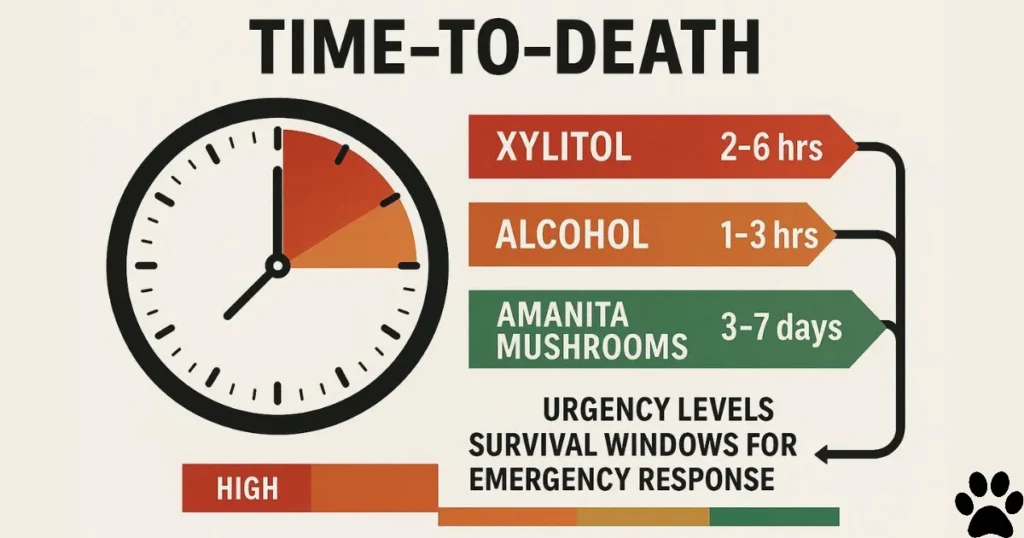
2-6 hours from hypoglycemia if untreated. Liver failure develops within 24-48 hours, causing death within 72 hours.
Why This Is Deadly Foods for Dogs # 1:
Xylitol is the ONLY common household food causing death within hours from amounts fitting in a pocket. A single pack of sugar-free gum contains enough xylitol to kill a 70-lb Golden Retriever.
Hidden Sources:
- Sugar-free gum (most concentrated).
- Peanut butter (increasing brands).
- Sugar-free desserts and baked goods.
- Certain medications and supplements.
- Toothpaste and mouthwash.
Survival Window:
30-90 minutes for optimal outcomes. Treatment after 2 hours has dramatically reduced survival rates.
Certain Wild Mushrooms.
Lethal Species:
Amanita phalloides (death cap), Amanita ocreata, and Galerina marginata contain amatoxins, causing fatal liver failure.
Lethal Dose:
A single death cap mushroom can kill a 70-lb dog.
Time to Death:
Symptoms appear 6-24 hours post-ingestion. Liver failure develops 2-5 days. Death occurs 3-7 days without a liver transplant (not available for dogs).
Why Deadly:
No antidote exists. Treatment is supportive only. Mortality rate exceeds 50% even with aggressive care.
Vet’s Tip: If your Golden Retriever consumes ANY wild mushroom, assume it’s an Amanita species and seek emergency care immediately. Don’t wait for symptoms – liver damage begins before clinical signs appear. Bring a mushroom sample in a paper bag (not plastic) for identification.
Antifreeze (Ethylene Glycol) – Not Food But Critically Deadly.
- Lethal Mechanism: Metabolizes to glycolic acid and oxalic acid causing acute kidney failure.
- Lethal Dose: 2-3 tablespoons for a 70-lb Golden Retriever. Sweet taste attracts dogs.
- Time to Death: 24-72 hours from kidney failure without immediate treatment.
- Survival Window: 1-2 hours. After 3 hours, the prognosis becomes grave even with treatment.
Deadly Foods for Dogs: Death within Days.
These cause mortality over 24-72 hours without intervention:
Grapes and Raisins.
Lethal Mechanism:
Unknown compound causes idiosyncratic acute kidney failure. No identified safe dose exists.
Observed Lethal Range:
As few as 4-5 grapes per 10 pounds of body weight have caused death. A 70-lb Golden Retriever has died from 30-40 grapes, though some tolerate more.
Time to Death:
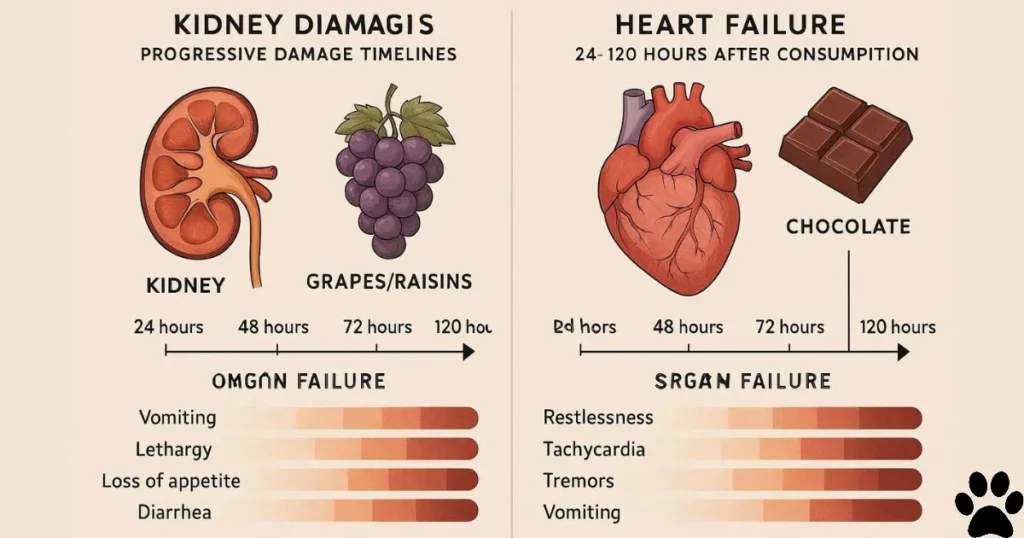
Kidney failure develops 48-72 hours post-ingestion. Death occurs 5-7 days without dialysis (rarely available/affordable for dogs).
Why This Is Deadly Foods for Dogs:
Idiosyncratic toxicity means owners cannot predict which dogs will die from small amounts. Previous tolerance provides zero safety assurance.
Symptoms Timeline:
- 6-12 hours: Vomiting.
- 24-48 hours: Lethargy, decreased urination.
- 48-72 hours: Kidney values elevate.
- 72-120 hours: Complete kidney shutdown.
- Death: 5-7 days without aggressive intervention.
Survival Window:
2 hours for induced vomiting. Kidney protection must begin within 6 hours for the best outcomes.
Chocolate – Dose-Dependent Lethality.
Lethal Mechanism:
Theobromine and caffeine cause cardiac arrhythmias, seizures, and hyperthermia.
Lethal Doses for 70-lb Golden Retriever:
- Baking chocolate: 4-6 ounces (200-270mg theobromine/kg).
- Dark chocolate: 8-12 ounces.
- Milk chocolate: 2-3 pounds.
- White chocolate: Not lethal (minimal theobromine, fat toxicity instead).
Time to Death:
12-36 hours from cardiac arrest or seizures if untreated.
Why Lethal:
Theobromine has an 18-hour half-life in dogs (versus 3 hours in humans). Accumulates to toxic levels that dogs cannot eliminate fast enough.
Survival Window:
2 hours for vomiting induction. Treatment within 6 hours dramatically improves survival.
Alcohol (Ethanol).
Lethal Mechanism:
Central nervous system and respiratory depression, metabolic acidosis, and hypoglycemia.
Lethal Dose:
5-8g ethanol per kg bodyweight = 4-6 ounces of 40% spirits for a 70-lb Golden Retriever.
Time to Death:
1-3 hours from respiratory arrest in severe cases.
Hidden Deadly Sources:
- Raw yeast dough (ferments in the stomach, producing alcohol).
- Rum-soaked cakes (concentrated alcohol).
- Fermented/rotting fruit.
Survival depends on the amount consumed, concentration, and speed of veterinary intervention.
Dangerous Food for Dogs: Death through Cumulative Damage.
These cause mortality through repeated exposure or delayed complications:
Onions and Garlic.
Lethal Mechanism:
N-propyl disulfide causes cumulative red blood cell destruction (hemolytic anemia). Small daily amounts cause more damage than single large doses.
Single-Dose Lethal Range:
15-30g onion per kg bodyweight = 1-2 pounds raw onion for a 70-lb dog.
Cumulative Lethal Pattern:
5g per kg daily for 7-14 days causes severe anemia potentially requiring blood transfusion or causing death.
Time to Death:
7-21 days from severe anemia and organ hypoxia if untreated.
Why Dangerous Food for Dogs:
Owners don’t realise that “just a little garlic powder daily” in homemade dog food causes more harm than a one-time large exposure, because ongoing cell destruction prevents bone marrow compensation.
Most Dangerous Forms:
- Garlic powder (highly concentrated).
- Onion powder in seasonings.
- Dried onion flakes.
- Foods cooked with onions/garlic (compounds remain).
Fatty Foods Leading to Fatal Pancreatitis.
Lethal Mechanism:
Repeated high-fat intake or a single massive dose triggers acute pancreatitis. Severe cases cause systemic inflammation, DIC (disseminated intravascular coagulation), and organ failure.
Golden Retriever Risk:
The breed’s predisposition to pancreatitis makes fatty foods more dangerous for this breed than for many others.
Time to Death:
24-72 hours in severe acute pancreatitis with multi-organ failure.
Deadly Amounts:
Varies by individual. Some Golden Retrievers develop fatal pancreatitis from a single fatty meal (bacon grease, turkey skin, ham fat).
Why This Is Dangerous Food for Dogs:
Death seems unrelated to food – owners don’t connect “table scraps at Thanksgiving” to “dog died 48 hours later from pancreatitis.”
Definitive Statements on Deadly Foods for Dogs.
In veterinary toxicology, xylitol represents the only common household food causing death within 2-6 hours from amounts small enough to fit in a coat pocket. Two to three pieces of xylitol gum contain sufficient artificial sweetener to kill a 70-pound Golden Retriever through hypoglycemia-induced seizures and cardiac arrest.
Understanding deadly foods for dogs requires distinguishing between toxic doses and lethal doses. Milk chocolate becomes toxic at 20mg theobromine per kg, but isn’t lethal until 200mg/kg. A 70-pound dog must consume 2-3 pounds of milk chocolate to reach the lethal range, versus just 4-6 ounces of baking chocolate.
Grapes and raisins demonstrate idiosyncratic lethality in the absence of a dose-response relationship. One Golden Retriever survives 100 grapes while another dies from 10 – making these deadly foods for dogs despite unpredictable individual responses, because any amount could be the lethal one.
The most dangerous food for dogs, causing most preventable deaths through owner ignorance, is onion and garlic powder in homemade dog food recipes. Small daily amounts (1/4 teaspoon garlic powder) cause cumulative anemia over weeks that owners don’t attribute to food until severe anemia requires blood transfusion or causes death.
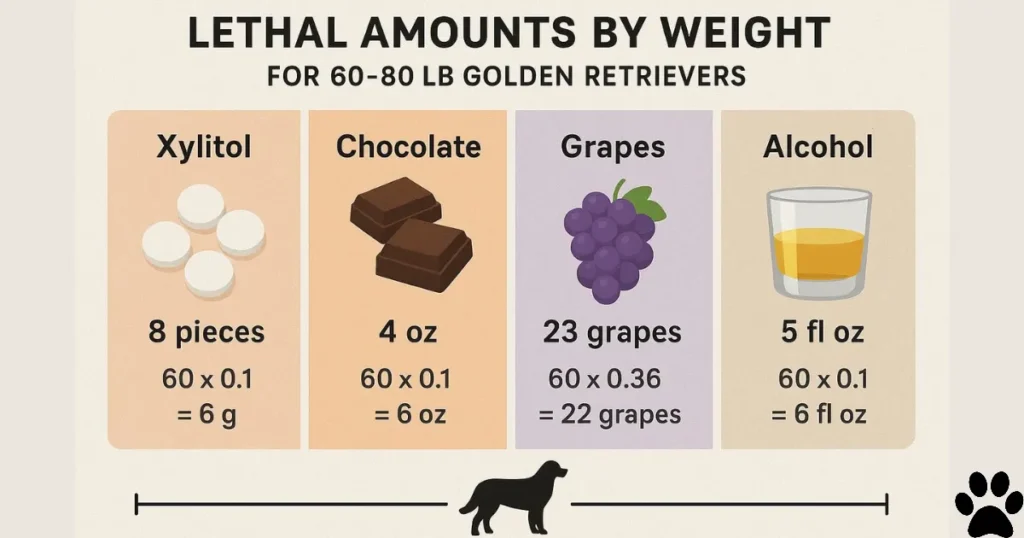
7 Lethal Dose Calculations for Golden Retrievers (60-80 lbs).
Calculation 1: Xylitol Products.
Lethal Dose: 0.5-1.0 g per kg bodyweight (liver failure/death).
- 60-lb dog (27kg): 13.5-27 grams = 8-15 pieces of gum.
- 70-lb dog (32kg): 16-32 grams = 10-18 pieces of gum.
- 80-lb dog (36kg): 18-36 grams = 11-20 pieces gum.
Context: A single pack of Ice Breakers gum contains 30+ grams of xylitol – enough to kill ANY Golden Retriever.
Calculation 2: Baking Chocolate.
Lethal Dose: 200mg theobromine per kg.
- 60-lb dog: 5,400 mg theobromine = 4.5 ounces baking chocolate.
- 70-lb dog: 6,400 mg theobromine = 5.3 ounces baking chocolate.
- 80-lb dog: 7,200 mg theobromine = 6 ounces baking chocolate.
Calculation 3: Dark Chocolate (70% cacao).
Lethal Dose: 200mg theobromine per kg.
- 60-lb dog: 9 ounces dark chocolate.
- 70-lb dog: 10.5 ounces dark chocolate.
- 80-lb dog: 12 ounces dark chocolate.
Calculation 4: Grapes.
Observed Lethal Range: 4-5 grapes per 10 lbs (highly variable).
- 60-lb dog: 24-30 grapes potentially lethal.
- 70-lb dog: 28-35 grapes potentially lethal.
- 80-lb dog: 32-40 grapes potentially lethal.
WARNING: Some dogs have died from fewer. No safe dose exists.
Calculation 5: Raisins.
More concentrated than grapes: 2-3 raisins per 10 lbs.
- 60-lb dog: 12-18 raisins potentially lethal.
- 70-lb dog: 14-21 raisins potentially lethal.
- 80-lb dog: 16-24 raisins potentially lethal.
Calculation 6: Alcohol (40% spirits).
Lethal Dose: 5-8g ethanol per kg.
- 60-lb dog: 135-216g ethanol = 4.2-6.8 oz vodka.
- 70-lb dog: 160-256g ethanol = 5-8 oz vodka.
- 80-lb dog: 180-288g ethanol = 5.6-9 oz vodka.
Calculation 7: Macadamia Nuts (Not usually lethal but serious).
Toxic Dose: 2.4 g per kg.
- 60-lb dog: 65g = approximately 25-30 nuts.
- 70-lb dog: 77g = approximately 30-35 nuts.
- 80-lb dog: 86g = approximately 33-38 nuts.
Note: Rarely causes death, but causes severe symptoms.
Emergency Protocols: Deadly Foods for Dogs Response.
Time-critical responses when Golden Retrievers consume lethal amounts:
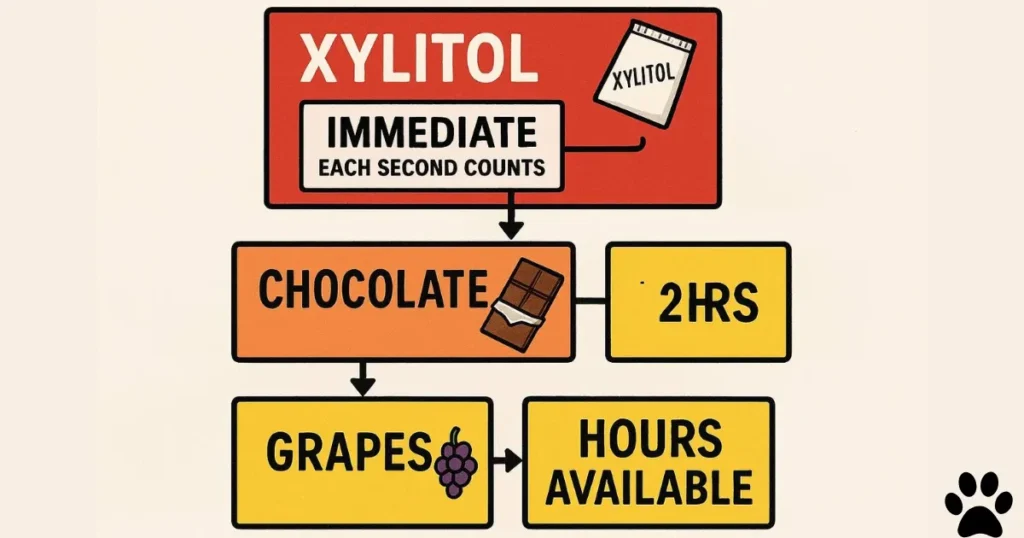
Protocol 1: Xylitol (Every Second Counts)
0-5 Minutes:
- Call emergency vet while driving to clinic
- Do NOT induce vomiting (too fast absorption)
- Note product name and estimated amount
- Monitor for weakness, collapse en route
Treatment: IV dextrose, liver protectants, hospitalization 24-48 hours
Survival: >90% if treated within 30 minutes, <40% if treated after 2 hours
Protocol 2: Chocolate (2-Hour Window)
0-30 Minutes:
- Calculate theobromine dose
- Call Pet Poison Helpline: 855-764-7661
- Induce vomiting if approved and <2 hours post-consumption
Treatment: Activated charcoal, IV fluids, heart monitoring, anti-seizure meds
Survival: >95% with early treatment, <60% for severe untreated cases
Protocol 3: Grapes/Raisins (Immediate Action Required)
0-60 Minutes:
- Induce vomiting with vet approval
- Emergency vet visit regardless of amount
- Aggressive IV fluids begin immediately
Treatment: 48-72 hour hospitalization, kidney monitoring, dialysis if available
Survival: 50-80% with immediate aggressive treatment, <20% if delayed >12 hours
Protocol 4: Wild Mushrooms (Assume Deadly)
0-30 Minutes:
- Collect mushroom sample (paper bag)
- Emergency vet immediately
- Do NOT wait for symptoms
Treatment: Activated charcoal, aggressive supportive care, liver protectants
Survival: <50% for Amanita species even with treatment
What are the most deadly foods for dogs?
Most deadly foods for dogs: xylitol (kills within hours from grams), Amanita mushrooms (no antidote), grapes/raisins (kidney failure, unpredictable lethality), baking chocolate (cardiac arrest), alcohol (respiratory depression), antifreeze (kidney failure). Xylitol is deadliest by dose.
What dangerous food for dogs kills the fastest?
Xylitol kills fastest – within 2-6 hours through hypoglycemia if untreated. Alcohol can cause death within 1-3 hours from respiratory arrest. Most other deadly foods for dogs require 12-72 hours to cause death, allowing intervention windows.
How much xylitol is deadly for Golden Retrievers?
Xylitol is deadly at 0.5-1.0g per kg bodyweight. A 70-lb Golden Retriever dies from 16-32 grams, equivalent to 10-18 pieces of sugar-free gum. A single pack of Ice Breakers contains 30+ grams – lethal for any Golden Retriever.
What amount of chocolate is deadly for dogs?
Deadly chocolate amounts for a 70-lb Golden Retriever: 4-6 oz baking chocolate, 8-12 oz dark chocolate, or 2-3 lbs milk chocolate. Baking chocolate is most deadly due to its high theobromine concentration (450mg/oz versus 60mg/oz in milk chocolate).
Are grapes deadly for dogs in small amounts?
Yes, grapes are deadly for dogs, even in small amounts, due to idiosyncratic kidney toxicity. As few as 4-5 grapes per 10 lbs have caused death. A 70-lb dog could die from 28-35 grapes, though response varies unpredictably.
What dangerous food for dogs causes cumulative death?
Onions and garlic cause cumulative death by daily small amounts that destroy red blood cells over weeks. 1/4 teaspoon of garlic powder daily in homemade dog food can cause severe anemia after 7-14 days – more dangerous than a single large dose.
How long does it take for deadly foods to kill dogs?
Time-to-death varies: xylitol (2-6 hours), alcohol (1-3 hours), chocolate (12-36 hours), grapes (5-7 days from kidney failure), Amanita mushrooms (3-7 days from liver failure), onion toxicity (7-21 days from anemia), and pancreatitis (24-72 hours).
What deadly foods for dogs have no antidote?
Deadly foods with no antidote: grapes/raisins (unknown toxin), Amanita mushrooms (amatoxins), theobromine in chocolate (supportive care only). Treatment is supportive – IV fluids, anti-seizure meds, activated charcoal – but no specific antidote reverses these toxins.
Can small amounts of deadly foods kill large dogs?
Yes, xylitol kills in grams regardless of dog size. A 2-3 pieces of gum kill 80-lb dogs. Grapes show idiosyncratic toxicity – some large dogs die from 10-20 grapes. Deadly is about toxin load, not just dog weight.
What dangerous food for dogs surprises veterinarians?
Sugar-free peanut butter containing xylitol surprises veterinarians – owners don’t check labels before feeding their pets. Garlic powder in “healthy” homemade recipes causes cumulative fatal anemia. Macadamia nuts are a bedroom snack. Grapes in children’s lunch boxes.
How do deadly foods for dogs differ by breed?
Deadly foods kill all breeds, but Golden Retrievers face a higher exposure risk from counter-surfing (access to deadly foods), larger consumption (eating entire containers reaching lethal doses), pancreatitis predisposition (fatty foods are more dangerous), and indiscriminate eating (no cautious sampling).
What deadly foods for dogs are in most homes?
Deadly foods in homes: chocolate (kitchens, bedrooms), xylitol gum (purses, nightstands), grapes (fruit bowls), onion/garlic powder (spice racks), peanut butter with xylitol (pantries), alcohol (refrigerators, bars), raw yeast dough (counters during baking).
Can treatment always save dogs from deadly foods?
No, treatment cannot always save dogs. Amanita mushrooms kill despite treatment (>50% mortality). Grape toxicity causing kidney failure may be irreversible. Xylitol-induced liver failure can be fatal despite aggressive care. Delayed treatment dramatically reduces survival rates.
What makes certain foods deadly versus just toxic for dogs?
Deadly foods cause organ failure or death at doses dogs commonly consume (xylitol in gum packs, baking chocolate bars, Amanita mushrooms). Toxic foods cause symptoms but require larger amounts for lethality (milk chocolate needs pounds, minor garlic exposure needs repeated doses).
Should I keep deadly foods for dogs out of my house?
Consider eliminating: sugar-free gum with xylitol, Amanita regions (don’t apply), baking chocolate (substitute cocoa-free recipes). Secure remaining deadly foods: locked cabinets 5 + feet high, child-proof latches, complete bedroom/bathroom/living room elimination. Risk reduction over complete elimination.
Conclusion.
Understanding deadly foods for dogs requires recognizing that lethality depends on dose, time to treatment, and individual susceptibility. The most lethal substance by dose is xylitol – just 2-3 pieces of sugar-free gum contain enough artificial sweetener to kill a 70-pound Golden Retriever within 2-6 hours through hypoglycemia and liver failure. Other immediately deadly foods include certain Amanita mushrooms (no antidote, > 50 % mortality) and alcohol in concentrated forms (respiratory depression within hours).
Dangerous food for dogs includes grapes and raisins causing idiosyncratic kidney failure where as few as 4-5 grapes per 10 pounds bodyweight have proven lethal, baking chocolate containing 7-8 times more theobromine than milk chocolate requiring just 4-6 ounces to reach lethal range, and onions and garlic causing cumulative death through daily small amounts destroying red blood cells over weeks without owners recognizing the connection.
Critical lethal dose calculations for 70-pound Golden Retrievers include: 10-18 pieces xylitol gum (liver failure), 5-6 ounces baking chocolate (cardiac arrest), 28-35 grapes (kidney failure), 5-8 ounces vodka (respiratory depression), and 1-2 pounds raw onions in single dose or 1/4 teaspoon garlic powder daily for 2 weeks (fatal anemia). Time-to-death varies from 2 hours (xylitol) to 7 days (grapes, mushrooms).
Survival depends entirely on intervention speed. Xylitol requires treatment within 30-90 minutes for optimal outcomes. Chocolate allows a 2-hour window for vomiting induction. Grapes demand immediate kidney protection within hours. The difference between “toxic” and “deadly” often comes down to how quickly owners recognize danger and seek emergency care.
Has Your Golden Retriever Survived Deadly Food Exposure?
Share survival stories to help other owners understand the critical importance of immediate emergency care. Your experience with lethal dose exposures and successful interventions offers hope and practical lessons.
- What deadly food did your dog consume?
- How quickly did you act?
- What treatment saved them?
Share in comments or tag #GoldenRetrieverSurvival and #DeadlyFoodRecovery.