When Golden Retriever owners ask me about simple, reliable homemade meals, the chicken and rice dog food recipe consistently tops my recommendations as the most versatile, digestible, and beneficial foundation for canine nutrition. After years of experience formulating diets and advising families on homemade feeding, I’ve witnessed remarkable health improvements when owners master basic dog food recipes with chicken – from enhanced coat quality and improved digestion to better weight management and overall vitality.
The beauty of chicken and rice lies in its simplicity: easily digestible protein paired with gentle carbohydrates creates a meal suitable for everyday feeding, post-illness recovery, digestive upset management, or serving as a base for more elaborate formulations. Whether you’re seeking a complete daily diet, a temporary bland diet for stomach issues, or want to enhance commercial kibble with fresh ingredients, understanding how to properly prepare chicken and rice dog food recipe variations ensures your Golden Retriever receives maximum nutritional benefit.
This comprehensive veterinary guide covers everything from basic preparation to complete balanced formulations, addressing nutritional requirements, portion guidelines, and customization strategies specifically designed for Golden Retriever health needs.
Why Chicken and Rice Excels for Golden Retrievers
Understanding what makes the chicken and rice dog food recipe so effective helps you appreciate its role in canine nutrition.
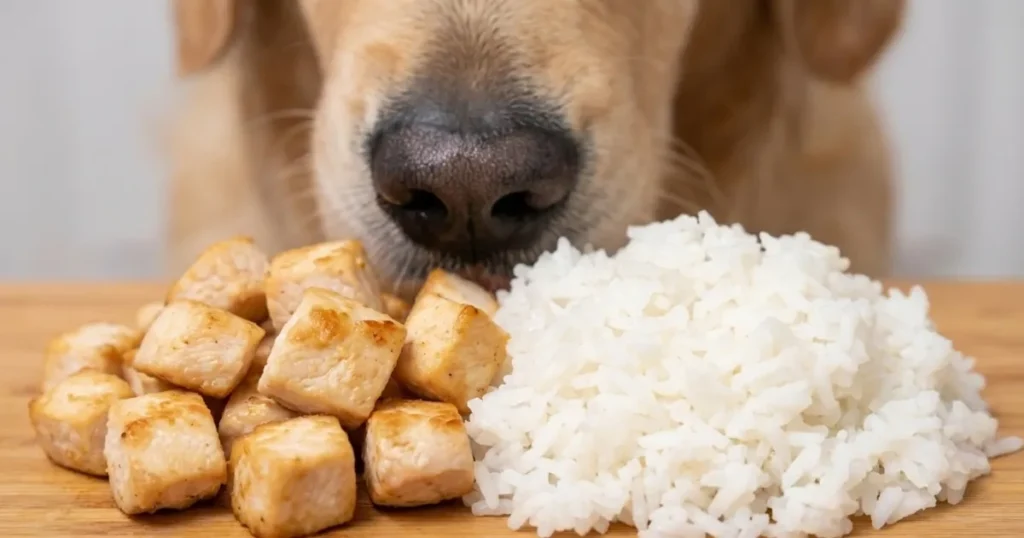
Digestibility and Gentle Nutrition
Chicken benefits:
- High biological value protein: Contains all essential amino acids in optimal ratios
- Lean protein source: Chicken breast provides maximum protein with minimal fat (3-4g fat per 100g).
- Easily digested: Simple protein structure requires less digestive effort.
- Low allergenic potential: While some dogs develop chicken sensitivities, it’s generally well-tolerated initially.
- Highly palatable: Most Golden Retrievers eagerly accept chicken-based meals.
Rice advantages:
- Gentle on the digestive system: White rice is particularly soothing for upset stomachs.
- Quick energy source: Easily digestible carbohydrates provide readily available energy.
- Binding effect: Helps firm loose stools naturally.
- Bland flavor: Doesn’t overwhelm sensitive stomachs.
- Affordable and accessible: Widely available staple ingredient.
In my clinic, I’ve treated many Golden Retrievers recovering from gastrointestinal illness who responded excellently to properly prepared chicken and rice dog food recipe formulations, often showing improvement within 24-48 hours.
Nutritional Foundation.
Protein from chicken:
- 25-30g protein per 100g cooked chicken breast.
- Essential amino acids: lysine, methionine, tryptophan, leucine.
- B-vitamins: niacin (B3), pyridoxine (B6), cobalamin (B12).
- Minerals: phosphorus, selenium, zinc.
- Supports muscle maintenance, immune function, tissue repair.
Carbohydrates from rice:
- Complex carbohydrates provide sustained energy.
- B-vitamins: thiamin (B1), niacin, folate.
- Minerals: manganese, magnesium.
- Minimal fiber (white rice) or moderate fiber (brown rice).
- Gluten-free, making it suitable for grain-sensitive dogs.
Combined benefits:
- Balanced protein-to-carbohydrate ratio.
- Complete amino acid profile.
- Easily adjustable for individual needs.
- Serves as a foundation for vegetable and supplement additions.
Versatility for Multiple Applications.
Dog food recipes with chicken and rice work for:
- Every day feeding: Base for a complete, balanced diet with proper additions.
- Digestive upset recovery: Bland diet settling nausea, vomiting, diarrhea.
- Post-surgical recovery: Gentle nutrition during healing periods.
- Fussy eater encouragement: Highly palatable base for picky Golden Retrievers.
- Weight management: Adjustable portions, lean protein supporting satiety.
- Food transition: Bridge between commercial foods or dietary changes.
Vet’s Tip: When using chicken and rice as a bland diet for digestive upset, use white rice and skinless chicken breast in a 1:2 ratio (one part chicken, two parts rice). Feed small portions every 3-4 hours rather than large meals to ease digestive burden.
Basic Chicken and Rice Dog Food Recipe.
This foundational recipe serves as a starting point for all variations and applications.
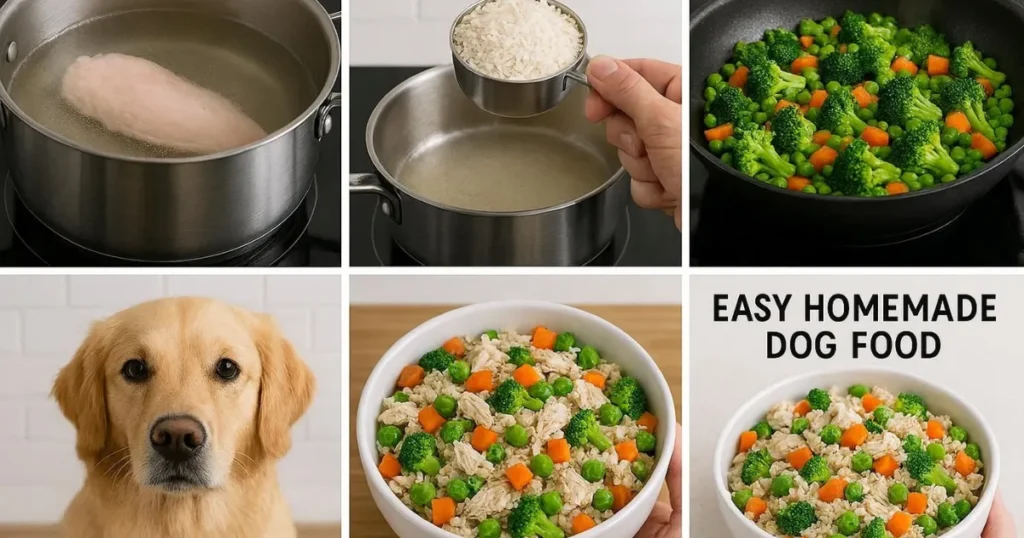
Simple Bland Diet Recipe (Digestive Upset).
Ingredients:
- 1 pound boneless, skinless chicken breast.
- 2 cups uncooked white rice (yields 6 cups cooked).
- 6 cups of water for cooking rice.
Preparation:
- Place the chicken breast in the pot, cover with water.
- Boil for 15-20 minutes until fully cooked (165 °F internal temperature).
- Remove chicken, allow to cool, and shred or dice into small pieces.
- Cook white rice according to package directions (or use 1 part rice to 3 parts water).
- Combine cooked chicken and rice in a 1:2 ratio (1 cup chicken to 2 cups rice).
- Mix thoroughly.
- Cool completely before serving.
- Store in refrigerator up to 3-4 days.
Yield:
- Approximately 7-8 cups.
Serving for 70-pound Golden with digestive upset:
- Feed 1/2 -1 cup every 3-4 hours.
- Gradually increase portions as symptoms improve.
- Transition back to regular food over 3-5 days.
Important notes:
- No seasoning, salt, butter, or oils.
- Use only chicken breast (no skin, bones, or fatty cuts).
- Plain white rice (not flavored or seasoned varieties).
- This bland recipe is NOT nutritionally complete for long-term feeding.
Enhanced Daily Feeding Recipe.
Ingredients:
- 1.5 pounds chicken thighs (slightly higher fat than breast, better for daily feeding).
- 2.5 cups uncooked brown rice (more nutritious than white for long-term use).
- 1 cup carrots, steamed and diced.
- 1 cup green beans, steamed.
- 2 tablespoons fish oil.
- 1 teaspoon calcium carbonate powder (approximately 1,800 mg calcium).
- 1/4 teaspoon iodized salt.
- Veterinary-formulated multivitamin supplement.
Preparation:
- Cook chicken thighs thoroughly (bake at 375 °F for 35-40 minutes or boil 25-30 minutes).
- Remove any bones, dice into bite-sized pieces (can include a small amount of skin for extra fat).
- Cook brown rice according to package directions.
- Steam vegetables until tender.
- Combine all ingredients in a large bowl.
- Add fish oil, calcium powder, salt, and multivitamin.
- Mix thoroughly, ensuring even distribution.
- Cool completely.
- Portion into meal-sized containers.
- Refrigerate up to 4 days or freeze up to 3 months.
Yield:
- Approximately 9-10 cups.
Daily portions for Golden Retrievers:
- 55-65 lbs: 5-6 cups daily (divided into 2 meals).
- 65-75 lbs: 6-7 cups daily.
- 75-85 lbs: 7-8 cups daily.
Nutritional profile (approximate):
- Calories: 280-300 per cup.
- Protein: 22-24%.
- Fat: 12-14%.
- Carbohydrates: 45-48%.
This enhanced chicken and rice dog food recipe provides more complete nutrition suitable for longer-term feeding than the bland diet version.
Complete Balanced Dog Food Recipes With Chicken.
For long-term daily feeding, dog food recipes with chicken require additional components to ensure nutritional completeness.
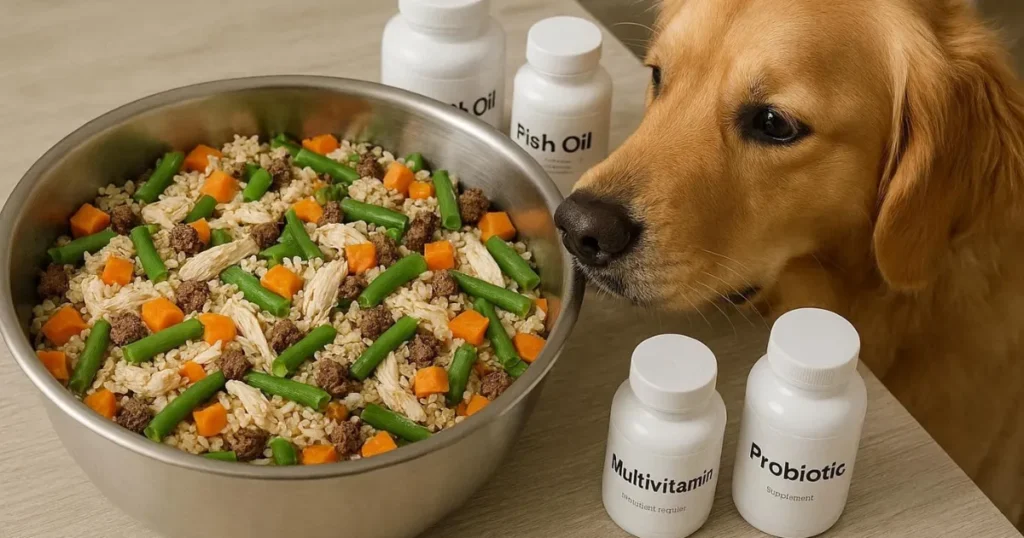
Complete Chicken, Rice, and Vegetable Formula.
Ingredients:
- 2 pounds boneless, skinless chicken thighs (or 1.5 lbs thighs + 0.5 lb chicken breast for leaner option).
- 2.5 cups cooked brown rice.
- 1.5 cups cooked sweet potato, diced.
- 1 cup steamed carrots, diced.
- 1 cup steamed green beans.
- 4 ounces chicken liver (critical for vitamin A, iron, copper).
- 3 tablespoons fish oil.
- 2.5 tablespoons calcium carbonate powder.
- 1/4 teaspoon iodized salt.
- Comprehensive multivitamin (Balance IT or similar).
- 400 IU vitamin E.
Preparation method:
- Cook all chicken thoroughly (thighs and liver).
- Dice chicken into appropriate pieces; finely chop liver.
- Prepare brown rice, sweet potato, and vegetables.
- Combine all ingredients.
- Add supplements and mix thoroughly.
- Portion and store properly.
Yield:
- 10-11 cups.
Why this is complete:
- Adequate protein from chicken (complete amino acids).
- Chicken liver provides vitamin A, B12, iron, copper, and folate.
- Calcium carbonate corrects the meat’s calcium deficiency.
- Fish oil supplies omega-3 fatty acids.
- Multivitamin fills remaining micronutrient gaps.
- Sweet potato adds beta-carotene, fiber, and vitamins.
- Green vegetables provide additional micronutrients.
- Meets AAFCO standards when properly supplemented.
Nutritional analysis:
- Protein: 24-26%.
- Fat: 14-16%.
- Calcium: 1.2-1.5% (appropriate ratio with phosphorus).
- Complete vitamin and mineral profile.
Chicken and White Rice Sensitive Stomach Recipe.
Ingredients:
- 2 pounds boneless, skinless chicken breast (ultra-lean for sensitive systems).
- 3 cups cooked white rice (gentler than brown).
- 1.5 cups cooked pumpkin puree (not pie filling).
- 0.5 cup cooked oatmeal (additional gentle fiber).
- 2 tablespoons fish oil.
- 2 tablespoons calcium carbonate powder.
- 1/4 teaspoon iodized salt.
- Multivitamin supplement.
- 400 IU vitamin E.
Special digestive benefits:
- White rice is easier to digest than brown rice.
- Pumpkin soothes the digestive tract and regulates stool.
- Chicken breast lowest fat option.
- Oatmeal provides soluble fiber supporting gut health.
- Minimal ingredients reduce sensitivity triggers.
Ideal for:
- Golden Retrievers with chronic digestive sensitivity.
- Dogs prone to pancreatitis (ultra-low fat).
- Senior dogs with reduced digestive efficiency.
- Post-illness recovery extending beyond the initial bland diet.
Chicken and Brown Rice Weight Management Recipe.
Ingredients:
- 2 pounds boneless, skinless chicken breast (maximum protein, minimal fat).
- 2 cups cooked brown rice (reduced from standard amount).
- 2 cups steamed green beans (low-calorie bulk).
- 1 cup steamed zucchini (additional low-calorie volume).
- 1 cup steamed carrots.
- 2 tablespoons fish oil.
- 2 tablespoons calcium carbonate.
- 1/4 teaspoon iodized salt.
- Multivitamin.
- 400 IU vitamin E.
Weight loss modifications:
- Increased vegetable proportion (30% vs. standard 15-20%).
- Reduced rice provides fewer calories.
- Ultra-lean chicken breast exclusively.
- Lower overall calorie density (approximately 220-240 calories per cup vs. standard 280-300).
- Higher satiety from increased vegetables and protein.
Feeding for weight loss:
- Calculate current caloric needs.
- Reduce by 20-25% for gradual weight loss.
- Target 1-2% body weight loss per week.
- Monitor weekly, adjusting portions as needed.
Example: 85-pound Golden targeting 70 pounds.
- Maintenance calories: | 2,125.
- Weight loss calories: | 1,600-1,700.
- Feed 7-7.5 cups of weight management recipe daily.
- Expected timeline: 15-20 weeks reaching goal weight.
Advanced Chicken and Rice Variations.
Customizing dog food recipes with chicken addresses specific health needs and prevents monotony.
Chicken, Rice, and Organ Meat Recipe (Maximum Nutrition).
Ingredients:
- 1.75 pounds of chicken thighs.
- 4 ounces chicken liver.
- 2 ounces chicken heart (additional protein, taurine source).
- 2.5 cups cooked brown rice.
- 1 cup cooked sweet potato.
- 1 cup mixed vegetables (carrots, green beans, peas).
- 0.5 cup blueberries (antioxidants).
- 3 tablespoons fish oil.
- 2 tablespoons calcium carbonate.
- 1/4 teaspoon iodized salt.
- Multivitamin.
- 400 IU vitamin E.
Organ meat benefits:
- Liver: Vitamin A, iron, copper, B12, folate (nutritional powerhouse).
- Heart: High-quality protein, taurine, B vitamins, and iron.
- Combined: More complete nutrient profile than muscle meat alone.
- Caution: Limit liver to 5-10% of diet; excessive vitamin A causes toxicity.
Chicken, Rice, and Quinoa Super Food Recipe.
Ingredients:
- 2 pounds chicken thighs.
- 1.5 cups cooked brown rice.
- 1 cup cooked quinoa (complete plant protein).
- 1.5 cups cooked butternut squash.
- 0.75 cup steamed spinach, chopped.
- 0.5 cup blueberries.
- 3 tablespoons fish oil.
- 2 tablespoons calcium carbonate.
- 1/4 teaspoon iodized salt.
- Multivitamin.
- 400 IU vitamin E.
Quinoa advantages:
- Complete protein with all essential amino acids.
- Higher protein than rice.
- Rich in manganese, magnesium, and phosphorus.
- Good fiber source.
- Gluten-free grain alternative.
Combined with chicken: Provides diverse protein sources and amino acid profiles.
Chicken, Rice, and Sweet Potato Anti-Inflammatory Recipe.
Ingredients:
- 2 pounds chicken thighs.
- 2 cups cooked brown rice.
- 2 cups cooked sweet potato.
- 1 cup steamed broccoli (anti-inflammatory compounds).
- 0.5 cup steamed spinach (antioxidants).
- 0.5 cup blueberries (anthocyanins).
- 3 tablespoons fish oil (high omega-3).
- 1 tablespoon ground turmeric (curcumin, anti-inflammatory).
- 2 tablespoons calcium carbonate.
- 1/4 teaspoon iodized salt.
- Multivitamin.
- 400 IU vitamin E (increased for antioxidant support).
Specific for:
- Golden Retrievers with arthritis or joint disease.
- Dogs with chronic inflammation.
- Senior dogs experiencing age-related inflammatory changes.
- Cancer patients (consult oncologist).
Anti-inflammatory components:
- Omega-3 fatty acids reduce inflammatory mediators.
- Turmeric contains curcumin (natural anti-inflammatory).
- Antioxidants from colorful vegetables combat oxidative stress.
- Beta-carotene from sweet potato supports immune function.
Preparation Tips and Techniques.
Proper preparation maximizes nutrition and safety in chicken and rice dog food recipe formulations.
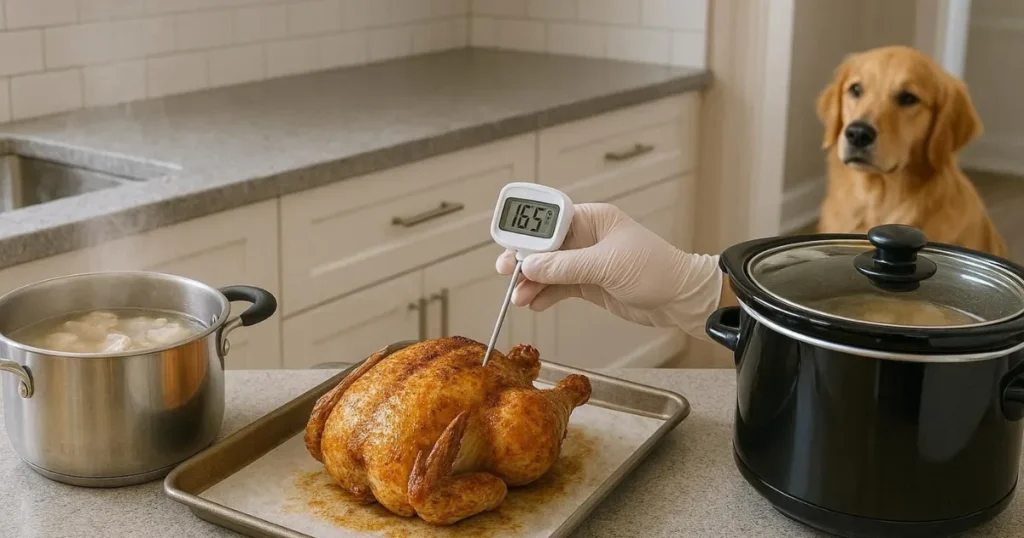
Chicken Cooking Methods.
Boiling:
- Place chicken in pot, cover with water.
- Bring to a boil, reduce to a simmer.
- Cook 15-20 minutes for breast, 25-30 for thighs.
- Ensures thorough cooking, retains moisture.
- Easy to shred after cooking.
Baking:
- Preheat oven to 375°F.
- Place chicken on baking sheet.
- Bake 35-40 minutes for thighs, 25-30 for breasts.
- Verify 165 °F internal temperature.
- Results in firmer texture, easier dicing.
Slow cooking:
- Add chicken and a small amount of water/broth to the slow cooker.
- Cook on low 4-6 hours.
- Extremely tender, easily shredded.
- Batch-friendly method.
Critical safety rules:
- Always cook to 165 °F internal temperature.
- Never use seasoning, marinades, or sauces.
- Remove all bones before feeding.
- Drain excess fat if desired (depends on dog’s needs).
Rice Preparation Guidelines.
White rice:
- Use a 1:2 ratio (1 cup rice to 2 cups water).
- Bring water to a boil, add rice, and reduce the heat.
- Simmer covered 15-18 minutes.
- Let stand 5 minutes before fluffing.
- Results in fluffy, separate grains.
Brown rice:
- Use a 1:2.5 ratio (1 cup rice to 2.5 cups water).
- Longer cooking time: 45-50 minutes.
- More nutritious with additional fiber, vitamins, and minerals.
- Slightly chewier texture.
Instant rice:
- Acceptable for convenience.
- Less nutritious than regular rice.
- Follow package directions (usually 5-10 minutes).
- Best for temporary bland diet use.
Storage and Food Safety.
Refrigeration guidelines:
- Cool chicken and rice completely before storing.
- Use airtight containers.
- Store at 40 °F or below.
- Use within 3-4 days maximum.
- Label containers with preparation date.
Freezing for convenience:
- Portion into meal-sized containers before freezing.
- Use freezer-safe containers or bags.
- Remove excess air, preventing freezer burn.
- Label with contents and date.
- Use within 2-3 months.
- Thaw in refrigerator 24 hours before serving.
Serving temperature:
- Room temperature or slightly warm preferred.
- Can add a small amount of warm water to take the chill off.
- Never serve hot (burns mouth).
- Never serve directly from the refrigerator (too cold, less digestible).
Batch preparation strategy:
- Dedicate 2-3 hours monthly to large batch cooking.
- Prepare chicken, rice, and vegetables simultaneously.
- Portion immediately after cooling.
- Freeze most portions, refrigerate only 3-4 days’ worth.
- Saves time and ensures consistent availability.
Transitioning to Chicken and Rice Dog Food.
Gradual transition prevents digestive upset, whether starting a chicken and rice dog food recipe as a temporary, bland diet or a permanent feeding plan.
Standard Transition Schedule.
For introducing as a regular diet:
- Days 1-2: 75% current food + 25% chicken and rice.
- Days 3-4: 50% current food + 50% chicken and rice.
- Days 5-6: 25% current food + 75% chicken and rice.
- Day 7+: 100% chicken and rice.
Monitoring during transition:
- Stool quality (should remain well-formed).
- Appetite (Golden Retrievers typically love chicken).
- Energy levels (should remain normal).
- Skin and coat (no changes expected immediately).
Transitioning From a Bland Diet to Regular Food.
After digestive upset recovery:
- Days 1-2: 75% bland chicken/rice + 25% regular food.
- Days 3-4: 50% bland + 50% regular.
- Days 5-6: 25% bland + 75% regular.
- Day 7: Return to 100% regular food.
Signs ready to transition:
- Normal formed stools for 24-48 hours.
- Normal appetite returned.
- No vomiting for 48+ hours.
- Energy levels are normal.
- No abdominal discomfort.
If symptoms return: Slow transition, extend bland diet period, or consult a veterinarian.
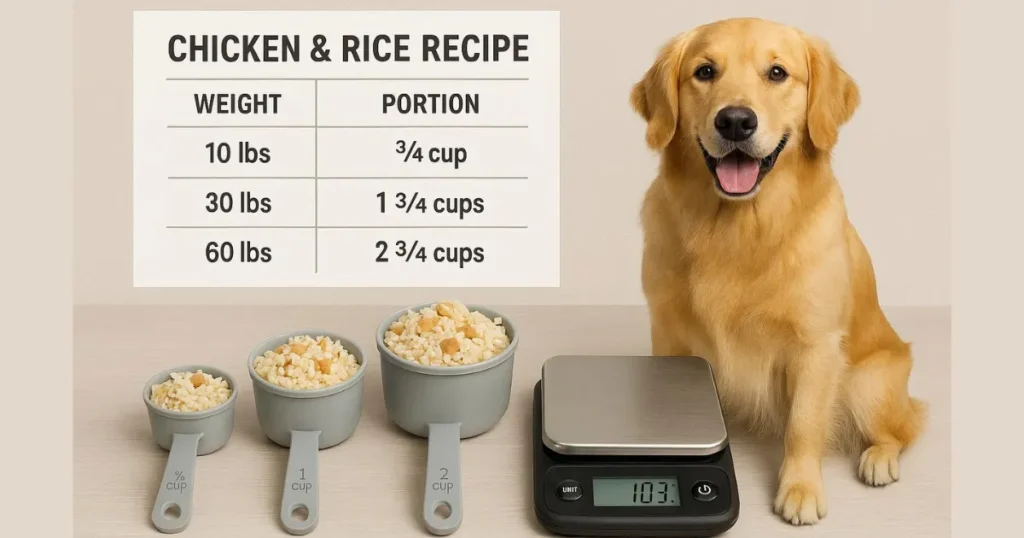
Portion Guidelines and Calorie Calculations.
Appropriate portioning ensures chicken and rice dog food recipe formulations meet but don’t exceed energy needs.
Calculating Daily Portions.
Caloric density of chicken and rice recipes:
- Basic bland diet (chicken breast + white rice): | 220-250 calories per cup.
- Enhanced daily recipe (thighs + brown rice + vegetables): | 280-300 calories per cup.
- Weight loss recipe: | 220-240 calories per cup.
Daily calorie needs for Golden Retrievers:
- Inactive/senior (70 lbs): 1,400-1,600 calories.
- Moderately active (70 lbs): 1,700-1,900 calories.
- Very active (70 lbs): 2,000-2,300 calories.
Feeding Chart.
| Dog Weight | Activity Level | Daily Calories | Cups Enhanced Recipe | Meals Per Day |
| 55-65 lbs | Moderate | 1,400-1,650 | 5-5.5 cups | 2 |
| 65-75 lbs | Moderate | 1,650-1,900 | 5.5-6.5 cups | 2 |
| 75-85 lbs | Moderate | 1,900-2,150 | 6.5-7.5 cups | 2 |
| 55-65 lbs | Active | 1,700-2,000 | 6-7 cups | 2 |
| 65-75 lbs | Active | 2,000-2,300 | 7-8 cups | 2 |
Adjusting portions:
- Monitor body condition score weekly.
- Ideal: ribs easily palpable, visible waist, tucked abdomen.
- If gaining excess weight: reduce portions by 10-15%.
- If losing too much weight: increase portions by 10-15%.
Common Mistakes with Chicken and Rice Recipes.
Avoiding these errors ensures maximum benefit from dog food recipes with chicken.
Critical Mistakes.
Feeding a bland diet long-term:
- Chicken and rice alone lack complete nutrition.
- Missing calcium, essential vitamins, and minerals.
- Causes serious deficiencies within weeks to months.
- Always add supplements for extended feeding.
Using chicken with bones:
- Cooked chicken bones splinter dangerously.
- Risk of intestinal perforation, obstruction.
- Always remove ALL bones before feeding.
Adding harmful seasonings:
- Garlic and onions are toxic to dogs.
- Salt is excessive for canine needs.
- Butter and oils are unnecessary (use fish oil instead).
- Pepper and spices irritate the digestive system.
Incorrect chicken-to-rice ratio:
- Too much rice, insufficient protein.
- Standard ratio: 1:2 for a bland diet, 1:1 or higher protein for daily feeding.
- Balance based on purpose (bland vs. daily nutrition).
Inadequate calcium supplementation:
- Chicken is extremely low in calcium.
- Without supplementation, severe skeletal problems develop.
- Must add 1,000-1,800 mg calcium per pound of prepared food.
Feeding only chicken breast long-term:
- While lean, breast lacks fat-soluble vitamins.
- Benefits from mixing breast and thighs.
- Consider adding small amounts of organ meats.
Life Stage Considerations.
Chicken and rice dog food recipe requirements vary by age and health status.
Puppies (8 weeks to 12 months).
Special requirements:
- Higher protein needs: 22-28%.
- Precise calcium control (large breed puppy formulation).
- More frequent meals (3-4 daily until 6 months).
- Higher calorie density for growth.
- Critical: Consult a veterinary nutritionist for puppy recipe formulation.
Puppy feeding caution:
- Improper calcium: phosphorus ratios cause developmental orthopedic disease.
- Golden Retrievers are particularly susceptible to growth-related skeletal issues.
- Never feed adult chicken and rice recipes to growing puppies without professional modification.
Adult Dogs (1-7 years).
Standard requirements:
- Protein: 18-25%.
- Balanced calcium: phosphorus (1:1 to 2:1).
- Moderate fat: 10-15%.
- Two meals daily.
- All recipes in this guide are designed for healthy adults.
Senior Dogs (7+ years).
Age-related modifications:
- Reduce portions by 10-20% for decreased activity.
- Maintain protein levels, preserving muscle mass.
- Consider softer textures (add warm water).
- Increase joint support supplements.
- More digestible formulations (white rice, lean chicken breast).
Senior-specific chicken and rice recipe:
- Use chicken breast (easier to digest).
- White rice (gentler on the aging digestive system).
- Increased pumpkin for fiber.
- Extra omega-3 for joint support.
- Glucosamine/chondroitin supplementation.
What is the basic chicken and rice dog food recipe for digestive upset?
For digestive upset, use 1 pound boneless, skinless chicken breast boiled and shredded, combined with 6 cups cooked white rice in a 1:2 ratio (1 cup chicken to 2 cups rice). Feed small portions ( 1/2 -1 cup) every 3-4 hours. This bland chicken and rice dog food recipe settles upset stomachs within 24-48 hours but lacks complete nutrition for extended use.
Can I feed dog food recipes with chicken and rice long-term?
Yes, but only when properly supplemented for complete nutrition. Add calcium carbonate (1,000-1,800 mg per pound of food), comprehensive multivitamin, fish oil, and vegetables, ensuring AAFCO compliance. Simple chicken and rice alone cause serious nutritional deficiencies within weeks. Complete formulations provided in this guide support healthy long-term feeding when properly supplemented.
How much chicken and rice should I feed my Golden Retriever daily?
For a 70-pound Golden Retriever eating a complete chicken and rice dog food recipe (approximately 280-300 calories per cup), feed 6-7 cups daily, divided into two meals. Adjust based on activity level: inactive dogs need 5-6 cups, very active dogs need 7-8 cups. Monitor body condition weekly, adjusting portions by 10-15% as needed.
What’s the difference between white rice and brown rice in dog food recipes with chicken?
White rice is gentler on digestive systems, ideal for bland diets recovering from upset. Brown rice provides more nutrition (fiber, vitamins, minerals) for long-term feeding. Use white rice for temporary digestive upset (2-3 days); brown rice for complete daily chicken and rice dog food recipe formulations supporting ongoing health.
Do I need to add supplements to the chicken and rice dog food recipe?
Yes, absolutely essential for extended feeding beyond 2-3 days. Add calcium carbonate (chicken contains virtually no calcium), a comprehensive multivitamin (provides vitamins A, D, E, K, B-complex), fish oil (omega-3 fatty acids), and iodized salt. Without supplements, severe nutritional deficiencies develop, causing skeletal problems, anemia, and other serious health issues.
Can puppies eat chicken and rice dog food recipe formulated for adults?
No, puppies require different formulations. Growing Golden Retrievers need precisely controlled calcium: phosphorus ratios (1:1 to 1.8:1), higher protein (22-28%), and specific nutrient profiles preventing developmental orthopedic disease. Adult chicken and rice recipes don’t meet puppy requirements. Always consult a veterinary nutritionist for puppy-specific recipe formulation to prevent permanent skeletal damage.
How long does homemade chicken and rice dog food stay fresh?
Properly prepared chicken and rice dog food recipe stays fresh 3-4 days refrigerated in airtight containers at 40 °F or below. Freeze individual meal portions for 2-3 months for longer storage. Thaw frozen portions in the refrigerator 24 hours before serving. Never leave at room temperature beyond 30-60 minutes during feeding.
Should I use chicken breast or chicken thighs in dog food recipes with chicken?
Use chicken breast for bland diets (ultra-lean, gentlest on digestion) and weight loss recipes. Use chicken thighs for daily complete feeding (slightly higher fat provides better palatability, fat-soluble vitamin absorption). Combining breast and thighs offers a balanced approach. Both work excellently in chicken and rice dog food recipe formulations when properly supplemented.
Conclusion.
After years of experience formulating diets and guiding Golden Retriever families through homemade feeding, I can confidently affirm that mastering the chicken and rice dog food recipe – from basic, bland diet applications to complete balanced formulations – provides one of the most valuable skills in canine nutrition. Dog food recipes with chicken and rice offer unmatched versatility, serving as gentle recovery meals for digestive upset, complete daily nutrition when properly supplemented, or highly palatable bases for customized formulations addressing individual health needs.
Successfully preparing chicken and rice meals for your Golden Retriever requires understanding the critical distinction between temporary bland diets (simple chicken and white rice without supplements, used 2-3 days maximum) and complete balanced recipes (properly supplemented with calcium, multivitamins, omega-3 fatty acids, and vegetables, suitable for long-term feeding). The simplicity of chicken and rice shouldn’t obscure the importance of nutritional completeness – adding essential supplements transforms basic ingredients into AAFCO-compliant nutrition supporting optimal health.
Whether you’re using chicken and rice dog food recipe formulations as your primary feeding approach, rotating them with other proteins for dietary variety, or keeping ingredients on hand for occasional digestive upset management, the proper preparation techniques, supplement protocols, and portioning guidelines outlined in this comprehensive guide ensure your Golden Retriever receives maximum benefit. Regular monitoring of body condition, coat quality, energy levels, and overall health confirms your chosen approach meets individual nutritional needs effectively.
Your Golden Retriever’s health and vitality depend on receiving complete, balanced nutrition consistently. By mastering these proven chicken and rice formulations, incorporating proper supplementation, and adjusting recipes for life stage and health status, you’re providing nutritious, wholesome meals that support your beloved companion’s wellbeing throughout every stage of life. The commitment you demonstrate through careful preparation and attention to nutritional completeness reflects the depth of care that defines exceptional Golden Retriever ownership.
Share Your Chicken and Rice Dog Food Success! Do you prepare chicken and rice dog food recipe meals for your Golden Retriever? We’d love to hear about your experience! What variations have you tried? Have you used chicken and rice for digestive upset recovery or as a complete daily diet? What improvements have you noticed in your Golden’s health, digestion, coat quality, or energy since incorporating dog food recipes with chicken into their feeding routine?