
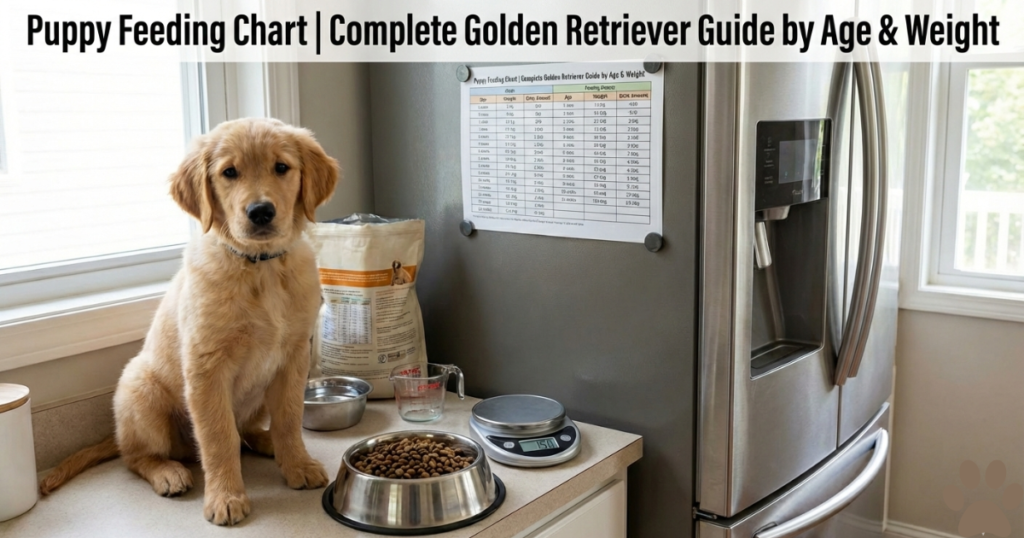
A reliable puppy feeding chart eliminates guesswork and provides the structure Golden Retriever owners need for proper nutrition management during critical growth phases. I’ve worked with countless Golden Retriever owners who struggled with feeding decisions – too much causing rapid growth and joint stress, too little causing developmental delays and poor immunity – because they lacked clear, breed-specific guidance that accounted for their puppy’s individual needs and growth patterns. The right feeding guide transforms nutrition from anxiety-inducing daily decisions into a straightforward, confidence-building routine that supports optimal development.
Golden Retrievers, as large-breed puppies, require specific feeding approaches that differ dramatically from those for small-breed puppies. Their extended growth period lasting 18-24 months to full maturity, genetic predisposition to hip dysplasia that becomes exacerbated by overfeeding during skeletal development, and increased risk of bloat from improper meal timing and rapid eating all demand precise nutritional management based on reliable charts. Standard feeding guidelines often fail to account for large-breed-specific needs, such as controlled calcium ratios and moderate growth targets, leading well-intentioned owners to inadvertently overfeed during the most vulnerable developmental windows when joint formation is occurring.
Understanding chart-based feeding data, applying age-appropriate portions that match developmental stages, timing meals correctly to support digestion and house-training, and adjusting portions as growth progresses, prevents the two most common feeding errors I see in practice: overnutrition, causing orthopedic disease that affects quality of life for years, and undernutrition, causing developmental problems including delayed skeletal maturation and compromised immune function. This guide provides comprehensive charts organized by age, weight-based portion calculators that account for individual variation, daily feeding schedules with optimal timing to prevent bloat, and breed-size-specific adjustments that ensure your Golden Retriever puppy receives precisely the right nutrition throughout the entire development period from weaning through physical maturity.
Contents
- 1 Complete Puppy Feeding Chart by Age
- 2 Dog Feeding Chart: Understanding Caloric Density Differences
- 3 How Much to Feed a Dog Per Day Chart: Meal Timing Guide
- 4 Definitive Statements on Puppy Feeding.
- 5 6 Ways to Adjust Feeding Portions for Your Individual Puppy.
- 6 Common Feeding Mistakes with Charts.
- 6.1 Mistake 1: Using Adult Guidelines for Puppies.
- 6.2 Mistake 2: Following Small-Breed Guidelines.
- 6.3 Mistake 3: Ignoring Food-Specific Directions.
- 6.4 Mistake 4: Never Updating Amounts.
- 6.5 Mistake 5: Free-Feeding Rather Than Measured Meals.
- 6.6 Mistake 6: Not Recalculating When Changing Foods.
- 6.7 What is a puppy feeding chart?
- 6.8 How do I use charts correctly?
- 6.9 Are charts the same for all breeds?
- 6.10 Does feeding timing matter?
- 6.11 How often should I update amounts?
- 6.12 Can I use the same chart for my puppy’s whole life?
- 6.13 What if my puppy doesn’t match the chart weight for age?
- 6.14 Should I adjust for treat calories?
- 6.15 How do I know if portions are right?
- 6.16 Do different foods need different amounts?
- 6.17 When do I switch to the adult chart?
- 6.18 What about working puppies?
- 7 Conclusion.
Complete Puppy Feeding Chart by Age
This comprehensive puppy feeding chart shows daily amounts for Golden Retrievers from 8 weeks through 12 months:
8-16 Weeks: Early Puppy Phase
| Age | Weight Range | Daily Amount | Meals/Day | Per Meal | Feeding Times |
| 8 weeks | 10-15 lbs | 1.5-2 cups | 3 | 0.5-0.7 cups | 7am, 12pm, 5pm |
| 10 weeks | 15-20 lbs | 2-2.5 cups | 3 | 0.7-0.8 cups | 7am, 12pm, 5pm |
| 12 weeks | 20-30 lbs | 2.5-3 cups | 3 | 0.8-1 cup | 7am, 12pm, 5pm |
| 14 weeks | 25-35 lbs | 3-3.5 cups | 3 | 1-1.2 cups | 7am, 12pm, 5pm |
| 16 weeks | 35-45 lbs | 3.5-4 cups | 3 | 1.2-1.3 cups | 7am, 12pm, 5pm |
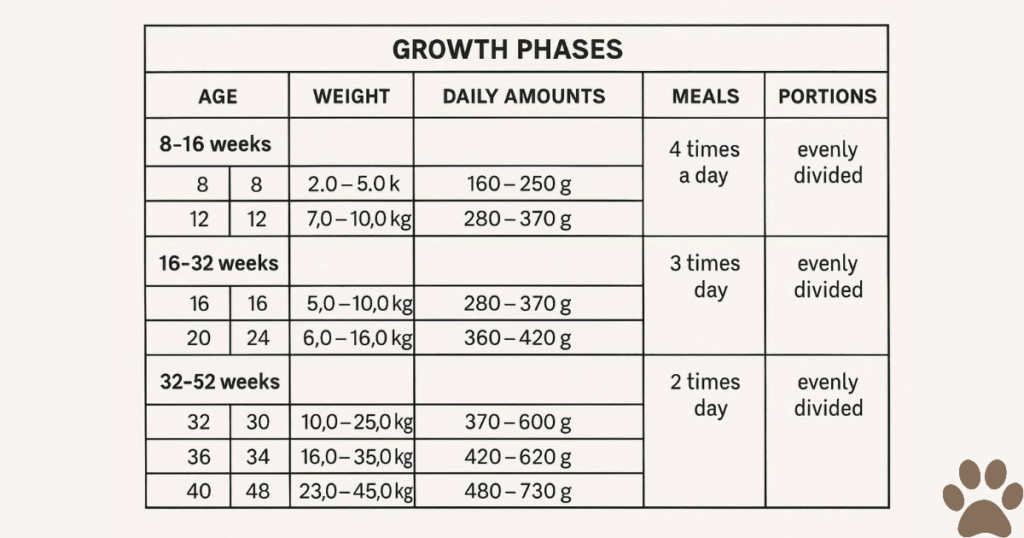
16-32 Weeks: Rapid Growth Phase
| Age | Weight Range | Daily Amount | Meals/Day | Per Meal | Feeding Times |
| 20 weeks | 45-55 lbs | 4-4.5 cups | 3 | 1.3-1.5 cups | 7am, 1pm, 6pm |
| 24 weeks | 50-60 lbs | 4-5 cups | 2-3 | 1.3-2.5 cups | 7am, 5pm or 7am, 12pm, 5pm |
| 28 weeks | 55-65 lbs | 4.5-5 cups | 2 | 2.3-2.5 cups | 7am, 5pm |
| 32 weeks | 55-70 lbs | 4-5 cups | 2 | 2-2.5 cups | 7am, 6pm |
32-52 Weeks: Adolescence to Near-Maturity
| Age | Weight Range | Daily Amount | Meals/Day | Per Meal | Feeding Times |
| 36 weeks | 60-70 lbs | 4-4.5 cups | 2 | 2-2.3 cups | 8am, 6pm |
| 40 weeks | 60-72 lbs | 3.5-4.5 cups | 2 | 1.8-2.3 cups | 8am, 6pm |
| 44 weeks | 65-75 lbs | 3.5-4 cups | 2 | 1.8-2 cups | 8am, 6pm |
| 48-52 weeks | 65-75 lbs | 3-4 cups | 2 | 1.5-2 cups | 8am, 6pm |
Dog Feeding Chart: Understanding Caloric Density Differences
Different foods require different portions to deliver the same amount of nutrition. This dog feeding chart shows how caloric density affects amounts:
| Food Caloric Density | Example Brands | 30-lb Puppy Daily | 60-lb Puppy Daily |
| 300-330 kcal/cup | Some economy brands | 3.5-4 cups | 5-6 cups |
| 350-380 kcal/cup | Most premium brands | 2.5-3 cups | 4-4.5 cups |
| 400-420 kcal/cup | High-energy formulas | 2-2.5 cups | 3.5-4 cups |
| 450-480 kcal/cup | Performance formulas | 1.8-2 cups | 3-3.5 cups |
Critical: Always check your specific food’s kcal/cup (listed on bag) and adjust portions accordingly. Switching foods without recalculating can lead to unintentional overfeeding or underfeeding.
How Much to Feed a Dog Per Day Chart: Meal Timing Guide
Proper timing matters as much as the total amount. This how much to feed a dog per day chart includes optimal schedules:
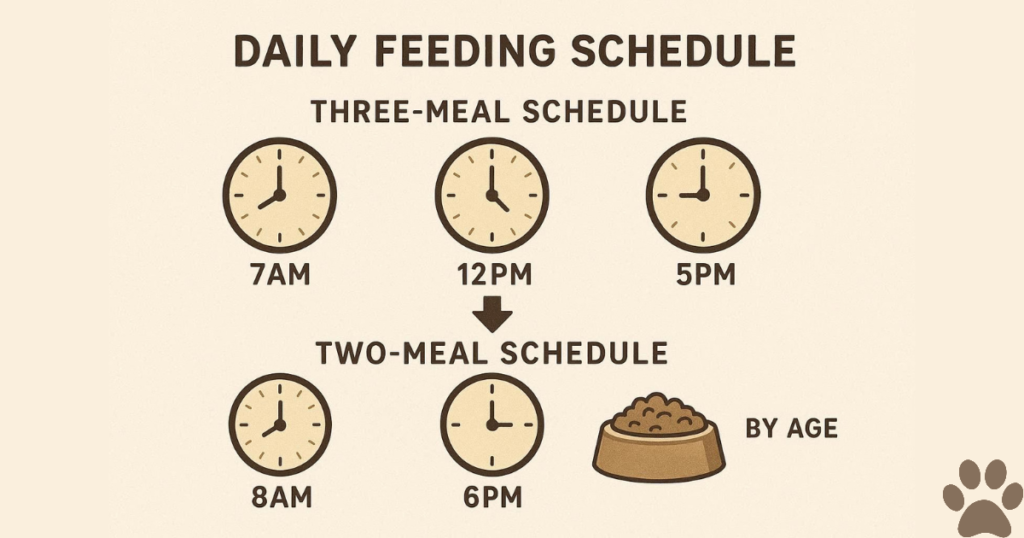
Three Meals Daily (8 Weeks – 6 Months).
Morning (7-8 AM): Largest meal – 40% of daily amount.
- Provides energy for active morning hours.
- Allows digestion before an afternoon nap.
- Example: 30-lb puppy on 3 cups daily = 1.2 cups.
Midday (12-1 PM): Medium meal – 30% of daily amount.
- Maintains energy through the afternoon.
- Supports house-training with predictable elimination.
- Example: 30-lb puppy = 0.9 cups.
Evening (5-6 PM): Smaller meal – 30% of daily amount.
- Early enough for a late-evening bathroom break.
- Prevents overnight hunger.
- Example: 30-lb puppy = 0.9 cups.
Two Meals Daily (6 Months – Adult).
Morning (7-8 AM): 50% of the daily amount.
Evening (5-6 PM): 50% of the daily amount.
Why This Timing:
- 10-12 hours between meals supports digestion.
- Morning meal powers daytime activity.
- Early evening feeding allows pre-bedtime elimination.
- Reduces bloat risk compared to a single large meal.
Definitive Statements on Puppy Feeding.
In veterinary nutrition, a puppy feeding chart must account for individual metabolism variation of 20-30% between puppies. Chart guidelines serve as starting points that require adjustment based on body condition monitoring, rather than rigid rules to follow exactly.
Golden Retrievers should transition from three to two daily meals around 6 months (24 weeks) of age. This timing coincides with a slowing growth rate and an increase in stomach capacity, supporting better digestive efficiency and reducing bloat risk.
The most accurate puppy food chart specifies not just daily amounts but also meal frequency and timing. When meals are fed, timing matters nearly as much as how much – improper timing increases bloat risk in deep-chested breeds like Golden Retrievers.
How much to feed a dog per day: chart amounts must be recalculated whenever switching foods due to variations in caloric density between formulas. A “cup” of one food may contain 30-40% more or fewer calories than another, making direct volume substitution dangerous.
Vet’s Tip: Print your puppy feeding chart and post it where all family members can see it daily. Include the kcal per cup for your specific food and your puppy’s current portions. Update every 3-4 weeks as needs change. This prevents accidental overfeeding from multiple family members feeding “just a little extra.”
6 Ways to Adjust Feeding Portions for Your Individual Puppy.
Charts provide essential baselines, but individual puppies need personalized adjustments based on their unique metabolism, activity levels, and growth patterns:
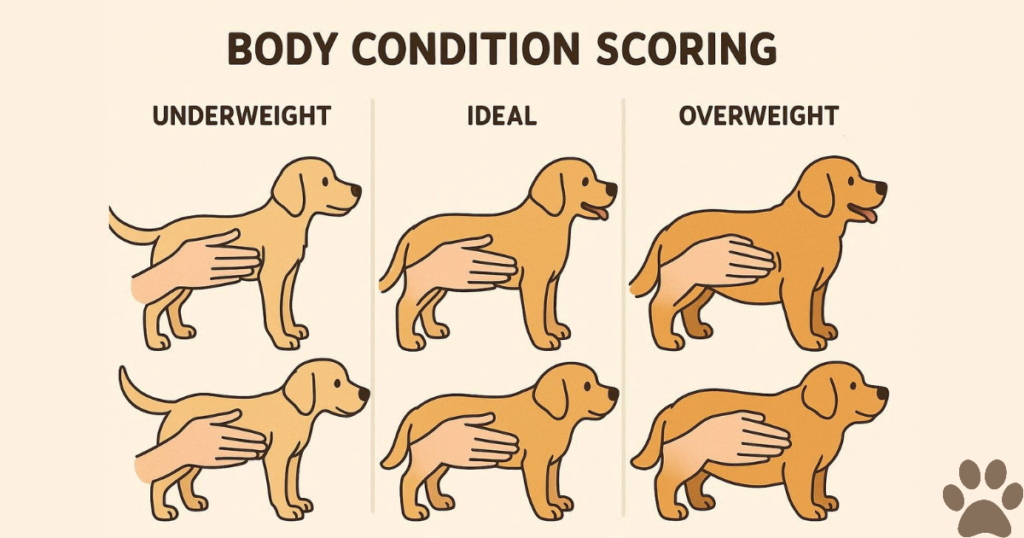
1. Body Condition Scoring Assessment.
Weekly Physical Assessment:
Feel ribs through light finger pressure, check waist definition from above, and observe abdominal tuck from the side.
- Ribs difficult to feel through fat layer: Reduce portions 10-15% immediately.
- Ribs are very prominent and visible: Increase portions 10-15% gradually.
- Ribs easily felt with light pressure, visible waist, slight tuck: Portions perfect – maintain current amounts.
Monitor not just weight but body composition. A puppy can weigh appropriately while carrying too much fat or insufficient muscle, so hands-on assessment matters more than scale numbers alone.
2. Growth Rate Monitoring Protocol.
Biweekly Weighing Sessions:
Plot weight on breed-specific growth curves available from your veterinarian.
- Gaining more than 10 pounds monthly after 4 months: Reduce portions immediately to prevent orthopedic stress.
- Gaining less than 4 pounds monthly during peak growth: Increase portions 10% and reassess in two weeks.
- Steady 5-8 pounds monthly during rapid phase: Maintain current amounts – this represents ideal moderate growth.
Keep detailed records showing date, weight, and portion amounts. Patterns become visible over 4-6 week periods that aren’t apparent week to week.
3. Activity Level Adjustments Based on Lifestyle.
- High Activity Puppies (more than 2 hours daily exercise, training, play): Add 15-20% to baseline chart amounts.
- Normal Activity Levels (typical puppy play, short walks): Follow chart amounts exactly as recommended.
- Low Activity Situations (apartment living, sedentary lifestyle, limited space): Reduce chart amounts by 10-15% to prevent excess weight.
Reevaluate activity levels monthly as puppies’ stamina and exercise tolerance increase with age and conditioning.
4. Treat Compensation Calculations.
Training treat calories must be subtracted from regular meal portions to prevent overfeeding:
- Calculate total treat calories provided daily during training sessions.
- Reduce meal amounts by equivalent caloric value.
- Example: 100 calories from treats = reduce meals by 0.25-0.3 cups depending on the food’s caloric density.
- Use low-calorie training treats (3-5 calories each) rather than biscuits (30-50 calories each).
Many owners don’t realize that extensive training treat usage can add 15-20% to daily caloric intake if not properly accounted for in meal reductions.
5. Post-Spay/Neuter Metabolic Reduction.
Metabolism decreases by 25-30% immediately after sterilization surgery:
- Reduce portions by 20-25% within one week of surgery to prevent rapid weight gain.
- Monitor weight weekly for the first month, then monthly for six months post-surgery.
- Most Golden Retrievers need 15-20% less food lifelong after sterilization compared to intact dogs.
- Weight gain after spay/neuter is preventable through immediate portion adjustment, not inevitable.
6. Seasonal Activity Adjustments.
- Winter Months (decreased activity from weather): Reduce portions 10% if outdoor exercise time significantly decreases.
- Summer Months (increased swimming, hiking, outdoor play): Increase portions by 10-15% if activity level rises substantially with warmer weather.
Track seasonal patterns year to year, as they often repeat predictably in Golden Retrievers who love outdoor activities.
Common Feeding Mistakes with Charts.
Mistake 1: Using Adult Guidelines for Puppies.
Adult maintenance formulas and puppy growth formulas have fundamentally different nutrient profiles, caloric densities, and feeding recommendations. Adult charts dramatically underfeed growing puppies who need 2-3 times the adult caloric density per pound of body weight. The protein, fat, calcium, and phosphorus ratios differ substantially between life stages.
Mistake 2: Following Small-Breed Guidelines.
Small-breed puppies reach full growth by 8-10 months and need more calories per pound than large breeds. Their charts promote dangerously rapid growth in Golden Retrievers, increasing orthopedic disease risk by 40-60% compared to controlled moderate growth rates. Always use large-breed-specific charts.
Mistake 3: Ignoring Food-Specific Directions.
Many owners use generic online charts while completely ignoring their specific food’s feeding guide printed on every bag. Each formula has unique recommendations based on its exact caloric density, nutrient profile, and bioavailability. Generic charts cannot account for these critical differences between brands and formulas.
Mistake 4: Never Updating Amounts.
Puppy nutritional needs change every 2-4 weeks during rapid growth phases as both body size and metabolism shift dramatically. Using identical portions from 3 months through 6 months guarantees either significant overfeeding or severe underfeeding, as caloric requirements per pound change with growth velocity and metabolic efficiency.
Mistake 5: Free-Feeding Rather Than Measured Meals.
Leaving food available all day completely prevents implementing any structured feeding plan. Measured meals at scheduled times enable precise monitoring, adjustment, and the ability to notice appetite changes that may signal health issues. Free-feeding food-motivated Golden Retrievers invariably leads to obesity.
Mistake 6: Not Recalculating When Changing Foods.
Switching from a 350 kcal/cup formula to a 420 kcal/cup formula requires a 20% portion reduction to deliver the same calories. Maintaining identical cup amounts with the new, higher-density food results in a 20% caloric excess, leading to rapid weight gain over just 2-3 weeks. Always recalculate portions based on the new food’s caloric density.
What is a puppy feeding chart?
A puppy feeding chart shows recommended daily food amounts based on age, weight, and growth stage. It includes meal frequency, per-meal portions, and feeding times, ensuring proper nutrition during development without overfeeding or underfeeding.
How do I use charts correctly?
Find your puppy’s age and weight; use the recommended daily amount as a starting point, divide by meals per day for portions, then adjust by 10-15% based on weekly body condition assessments.
Are charts the same for all breeds?
No, charts differ dramatically by breed size. Large-breed puppies need controlled growth with lower calories per pound than small breeds to prevent orthopedic disease. Always use large-breed-specific guidelines.
Does feeding timing matter?
Yes, timing matters significantly. Feed puppies three times daily until 6 months (7am, 12pm, 5pm), then twice daily (8am, 6pm). This supports digestion and house-training and reduces the risk of bloat.
How often should I update amounts?
Update portions every 2-4 weeks during rapid growth (8-24 weeks) based on body condition and weight. After 6 months, reassess monthly. Growth rate changes require immediate adjustment.
Can I use the same chart for my puppy’s whole life?
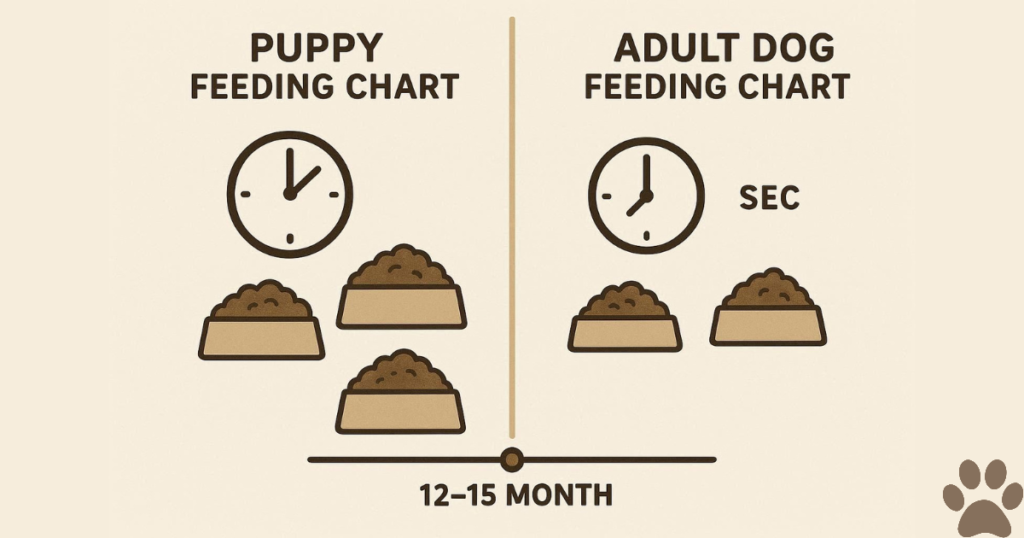
No, puppy charts apply only during growth (8-15 months). Transition to adult amounts around 12-15 months when growth completes and needs shift to maintenance.
What if my puppy doesn’t match the chart weight for age?
Mild variation (± 5 pounds) is normal. Being 10+ pounds off typical ranges may indicate feeding issues or health problems requiring veterinary evaluation.
Should I adjust for treat calories?
Yes, treats should comprise no more than 10% of daily calories. Calculate treat calories and reduce meal portions by an equivalent amount. Training programs often use 100-150 treat calories requiring 0.25-0.4 cup reduction.
How do I know if portions are right?
Monitor weekly: ribs easily palpable but not visible, visible waist from above, slight abdominal tuck from side. Steady monthly gains of 5-8 pounds during peak growth indicate appropriate portions.
Do different foods need different amounts?
Yes, caloric density varies by 30-50% between formulas (300-480 kcal/cup). Always check your food’s kcal/cup and adjust portions accordingly. A cup of different foods delivers vastly different calories.
When do I switch to the adult chart?
Transition around 12-15 months when growth substantially completes. Males still filling out may benefit from puppy amounts through 15 months. Consult your veterinarian for timing.
What about working puppies?
Highly active puppies need 15-30% more than standard amounts. Calculate based on activity: add 15% for moderate work, 20-30% for intense daily training.
Conclusion.
A properly applied puppy feeding chart eliminates feeding anxiety and provides the structure needed for optimal Golden Retriever development. The comprehensive puppy food chart shows that feeding amounts change dramatically from 8 weeks (1.5-2 cups daily) to 12 months (3-4 cups daily), with a critical transition at 24 weeks from three to two daily meals.
Understanding how to use a dog feeding chart correctly requires recognizing that guidelines serve as starting points, not rigid rules. Individual Golden Retriever puppies vary by 20-30% in metabolism and growth rate, demanding weekly body condition assessments and biweekly adjustments. The “how much to feed a dog per day” chart demonstrates that timing matters as much as quantity – proper meal spacing supports digestion, enables house-training, and reduces bloat risk in large-breed puppies.
Most importantly, a puppy feeding chart must be actively used, not just referenced once. Post your chart in a visible location, update portions every 3-4 weeks, recalculate when changing foods due to differences in caloric density, and adjust immediately if body condition drifts from an ideal lean physique. Golden Retriever puppies should maintain easily palpable ribs and visible waist definition throughout growth – never pudgy or underweight.
The investment in precise chart-based feeding pays lifelong dividends. Overfeeding during puppyhood increases hip dysplasia severity and other orthopedic diseases that compromise quality of life and lifespan. Proper nutrition, guided by a reliable puppy feeding chart, supports moderate, steady growth that produces healthier adult Golden Retrievers with reduced orthopaedic disease risk and improved longevity.
What Feeding Chart Schedule Works for Your Golden Retriever?
Real-world feeding experiences help other owners understand how to apply the chart effectively. If you’ve used feeding charts successfully with your Golden Retriever puppy, share your insights.
Tell us about your chart experience:
- Did you follow the chart amounts exactly, or did you need adjustments?
- How often did you update portions as your puppy grew?
- What feeding times worked best for your household schedule?
- Any surprises or lessons learned using a puppy feeding chart?
- Did your puppy match the expected weights for each age?
Share your feeding chart story in the comments or tag us with #GoldenRetrieverInsight and #PuppyFeedingChart. Your practical experience helps other owners confidently implement chart-based feeding and understand that healthy puppies show natural variation within chart ranges.

Dr. Nabeel A.
Hi, I’m Dr. Nabeel Akram – a farm management professional by trade and a passionate Golden Retriever enthusiast at heart. With years of experience in animal science and livestock care, I’ve built a career around understanding animals—how they live, thrive, and bring value to our lives. This blog is a personal project born from that same passion, focusing on one of the most loyal and lovable breeds out there: the Golden Retriever. Whether I’m managing farm operations or sharing insights on canine health, behavior, and care, it all ties back to one core belief—animals deserve thoughtful, informed, and compassionate attention. Welcome to a space where professional expertise meets genuine love for dogs.
Facebook |
Links will be automatically removed from comments.