

One of the most common questions I hear from Golden Retriever owners is deceptively simple: how much should I feed my dog? The answer, as I’ve learned over years of working with this breed, is rarely one-size-fits-all.
I often see dogs that are either significantly underfed – thin along the ribs, low energy – or overfed to the point where joint strain and early-onset health issues become serious concerns. Both are more common than most owners realize.
Golden Retrievers are a breed with a cheerful appetite and an equally cheerful willingness to convince you they are starving, regardless of how much they just ate. Without a structured approach, well-meaning owners frequently overfeed. That mismatch between what your dog wants and what your dog needs is where most feeding problems begin.
In this guide, I’ll walk you through a practical, breed-aware framework for determining how much a dog should eat a day – covering life stage, activity level, food type, and the subtle body signals that matter more than any chart.
Contents
- 1 Why “Follow the Bag” Is Not Enough
- 2 How Much Should a Dog Eat a Day? The Core Formula.
- 3 Golden Retriever Feeding by Life Stage.
- 4 The Body Condition Score: Better Than Any Chart.
- 5 7 Common Feeding Mistakes Golden Retriever Owners Make.
- 5.1 1. Feeding by volume rather than calories.
- 5.2 2. Not accounting for treats.
- 5.3 3. Free-feeding kibble.
- 5.4 4. Skipping the post-spay/neuter recalculation.
- 5.5 5. Ignoring food-switching gradual transitions.
- 5.6 6. Assuming “premium” means calorie-appropriate.
- 5.7 7. Feeding based on the dog’s enthusiasm.
- 6 6 Signs Your Golden Retriever’s Portion Size Needs Adjustment.
- 7 How Meal Frequency Affects Golden Retriever Health.
- 8 5 Food Types and How They Change Daily Amount Calculations.
- 9 Vet Experience.
- 9.1 How much should I feed my dog per day?
- 9.2 How much should a dog eat a day in cups?
- 9.3 Is it okay to feed my dog once a day?
- 9.4 How do I know if I’m feeding my dog too much?
- 9.5 How much should a Golden Retriever puppy eat a day?
- 9.6 Do spayed or neutered dogs need less food?
- 9.7 Can I use the feeding chart on the dog food bag?
- 9.8 How much wet food should I feed my Golden Retriever?
- 9.9 Should I feed my senior Golden Retriever less?
- 9.10 What is a healthy weight for a Golden Retriever?
- 9.11 How many times a day should I feed my dog?
- 9.12 Is free-feeding okay for Golden Retrievers?
- 9.13 Do treats count toward my dog’s daily food intake?
- 9.14 How do I transition my dog to a new food?
- 9.15 My Golden Retriever always acts hungry – is that normal?
- 10 Conclusion.
Why “Follow the Bag” Is Not Enough
Most commercial dog food packaging includes a feeding chart on the back. It’s a starting point – not a prescription.
Those guidelines are calculated for the average sedentary dog at a standard weight. Your Golden Retriever is not average. Breed, metabolism, hormonal status, activity level, age, and even seasonal variation all shift daily caloric needs by as much as 30-50%.
In veterinary practice, the feeding label is where the conversation starts, not where it ends.
What the bag can’t account for:
- Whether your dog is spayed or neutered (which lowers metabolic rate by roughly 20 – 30%).
- Your dog’s individual metabolic rate.
- How active your household actually is.
- Whether your dog is recovering from illness or surgery.
- The caloric density differences between brands.
How Much Should a Dog Eat a Day? The Core Formula.
The foundational calculation in canine nutrition is based on Resting Energy Requirements (RER), adjusted by a life-stage multiplier.
Step 1:
Calculate RER (kcal/day) = 70 × (body weight in kg) ^ 0.75.
Step 2:
Apply a multiplier.
| Dog Profile | Multiplier |
| Intact adult | 1.8 |
| Neutered/spayed adult | 1.6 |
| Inactive/obese prone | 1.2–1.4 |
| Active working dog | 2.0–5.0 |
| Puppy (under 4 months) | 3.0 |
| Puppy (4 months to adult) | 2.0 |
| Senior dog (low activity) | 1.1–1.4 |
| Pregnant/nursing | 2.0–6.0 |
Example for a 30 kg (66 lb) neutered adult Golden Retriever:
- RER = 70 × (30) ^ 0.75 = 70 × 12.8 = 896 kcal/day.
- With multiplier: 896 × 1.6 = 1,434 kcal/day.
Then divide that number by the caloric content per cup listed on your specific food bag to get your daily cup measurement.
Vet’s Tip: Always confirm the kcal/cup for your specific food brand – values vary from 300 to over 500 kcal/cup. Swapping brands without recalculating is one of the most common causes of gradual weight gain in Goldens.
Golden Retriever Feeding by Life Stage.
Puppies (8 Weeks to 12 Months).
Golden Retriever puppies grow fast – and controlled growth matters more in large breeds than most owners realize. Overfeeding a puppy doesn’t just cause obesity; it accelerates skeletal development in ways that increase the risk of hip dysplasia and elbow dysplasia, two conditions Golden Retrievers are already genetically predisposed to.
General puppy feeding targets:
- 8 – 12 weeks: 3 – 4 meals per day.
- 3 – 6 months: 3 meals per day.
- 6 – 12 months: 2 – 3 meals per day.
Approximate daily volumes (dry kibble, large breed puppy formula):
| Age | Approx. Daily Amount |
| 8–12 weeks | 1–1.5 cups/day |
| 3–4 months | 1.5–2.5 cups/day |
| 5–6 months | 2–3 cups/day |
| 7–9 months | 2.5–3.5 cups/day |
| 10–12 months | 3–4 cups/day |
These are starting estimates. Monitor body condition every 2 weeks and adjust by 10% increments.
Based on years of working with Golden Retrievers, I’ve noticed that owners consistently underestimate how rapidly this breed’s appetite outpaces its caloric needs during the 4-7 month growth window. That’s when the risk of overfeeding peaks.

Adult Golden Retrievers (1 – 7 Years).
For most adult Goldens in a moderately active household, daily food intake typically falls between 3 and 4 cups of a quality dry kibble, split into two meals. But again – caloric density matters.
Key variables that shift adult portions:
- Spayed/neutered dogs need roughly 20% fewer calories than intact adults.
- Dogs with access to a yard and daily walks need more than sedentary apartment dogs.
- Working dogs, sport dogs, or those in agility training may need 50 – 100% more than the base estimate.
What 2 meals does better than 1:
- Reduces bloat risk (a serious concern in deep-chested breeds like Goldens).
- Maintains more stable blood glucose.
- Decreases food-guarding and anxiety around feeding.
Senior Golden Retrievers (7+ Years).
Golden Retrievers are considered senior at 7-8 years old. By this point, metabolic rate has typically slowed, muscle mass may have decreased, and joint health is often a factor in activity levels.
Senior Goldens frequently need 10-20% fewer calories than they did at peak adulthood – but they also need higher protein to support muscle maintenance.
What changes in senior feeding?
- Reduce the overall portion if the activity drops significantly.
- Prioritize foods with higher lean protein and lower fat.
- Consider joint-supporting nutrients: EPA/DHA omega-3s, glucosamine, chondroitin.
- Watch for weight loss, which in seniors can signal underlying disease, not just reduced appetite.
The Body Condition Score: Better Than Any Chart.
No feeding chart replaces hands-on body assessment. The Body Condition Score (BCS) is a 9-point scale used in veterinary practice:
- 1 – 3: Underweight (ribs visible, no fat covering, bony prominences).
- 4 – 5: Ideal (ribs palpable with light pressure, waist visible from above, abdominal tuck visible).
- 6 – 7: Overweight (ribs hard to feel, waist barely visible).
- 8 – 9: Obese (ribs not palpable under fat, no waist definition, fat deposits on neck and limbs).
How to assess your Golden at home:
- Run your hands firmly along both sides of the ribcage.
- You should feel your ribs without pressing hard.
- View from above – a slight hourglass shape is correct.
- View from the side – a gentle abdominal tuck should be present.
Adjust food by 10% up or down based on BCS, then reassess after 3 – 4 weeks.

7 Common Feeding Mistakes Golden Retriever Owners Make.
1. Feeding by volume rather than calories.
A cup of one food can contain 300 kcal; a cup of another, 490 kcal. Same volume – completely different outcome.
2. Not accounting for treats.
Treats should contribute no more than 10% of daily calories. For a Golden needing 1,400 kcal/day, that’s only 140 kcal from treats – fewer than many owners realize.
3. Free-feeding kibble.
Leaving food out all day disconnects appetite regulation and makes early weight gain nearly invisible.
4. Skipping the post-spay/neuter recalculation.
Most owners continue pre-surgery portions after the procedure. Hormonal changes significantly reduce metabolic rate – recalculate within 4-6 weeks post-surgery.
5. Ignoring food-switching gradual transitions.
Abrupt food changes cause GI upset in many Goldens. A 7 – 10 day transition (mixing old and new food progressively) prevents most issues.
High-protein, high-fat performance foods fed to low-activity Goldens accelerate weight gain – even when the food quality is excellent.
7. Feeding based on the dog’s enthusiasm.
Golden Retrievers are enthusiastic eaters by temperament. Excitement at mealtime is not hunger – it’s personality.

6 Signs Your Golden Retriever’s Portion Size Needs Adjustment.
- Ribs no longer palpable → reduce by 10%, reassess in 3 weeks.
- Consistent food refusal → check for dental pain, illness, or caloric excess.
- Always hungry 30+ minutes after eating → assess portion against calculated RER.
- Coat quality declining → may signal nutritional gap, not just quantity.
- Energy drop without illness → low caloric intake or inadequate protein.
- Muscle loss over the hindquarters → common in seniors; increase protein, not just calories.
How Meal Frequency Affects Golden Retriever Health.
In canine gastric physiology, meal timing matters – particularly for large and deep-chested breeds. Golden Retrievers are not classified as the highest risk for Gastric Dilatation-Volvulus (GDV/bloat), but their chest depth places them in a moderate-risk category.
Evidence-supported feeding frequency practices:
- Two meals per day is the minimum for adult Goldens.
- Avoid vigorous exercise 1 hour before and 2 hours after meals.
- Raised feeding bowls remain debated in veterinary literature – consult your vet based on your individual dog’s anatomy.
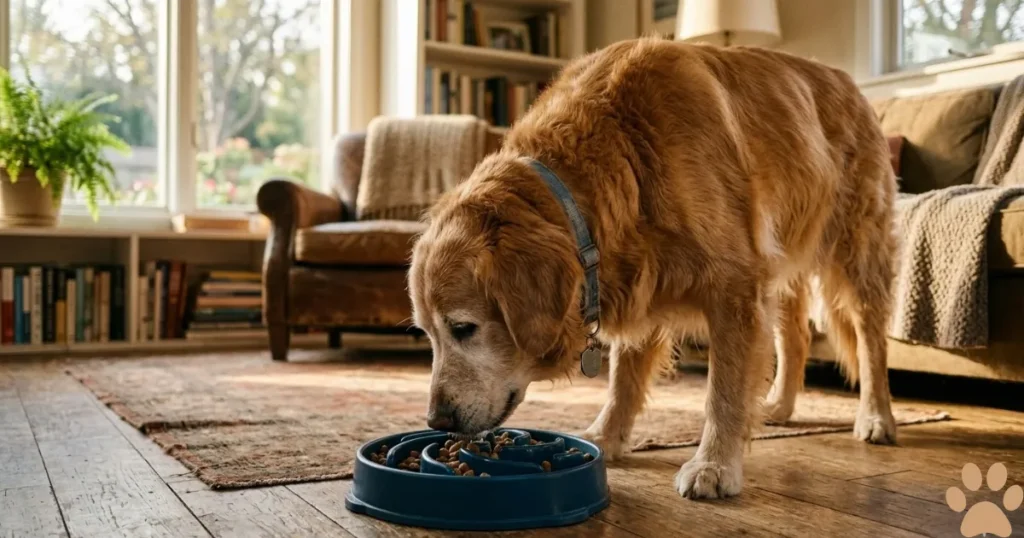
- Slow-feeder bowls reduce ingestion rate and post-meal restlessness in fast eaters.
5 Food Types and How They Change Daily Amount Calculations.
1. Dry kibble:
Most calorie-dense per unit volume. Easier to measure precisely. Typical: 300 – 500 kcal/cup.
2. Wet/canned food:
High moisture content lowers caloric density. A dog eating wet food exclusively may need 3 – 4x the volume of dry to meet caloric needs.
3. Raw/fresh diets:
Caloric content varies widely by recipe. Requires careful tracking. A general starting point: 2 – 3% of ideal body weight per day in raw food.
4. Freeze-dried food:
Dense and calorie-rich. Often used as a topper. Must factor into daily totals.
5. Mixed feeding (kibble + wet or fresh):
Calculate the caloric contribution of each component separately, then combine to hit the daily target.
Vet Experience.
In Golden Retrievers, the correct daily food amount is determined by body weight, life stage, activity level, and caloric density of the specific food – not packaging guidelines alone.
A neutered adult Golden Retriever weighing 30 kg typically requires approximately 1,400 – 1,600 kcal per day, divided into two meals.
Golden Retrievers are predisposed to weight gain after spaying or neutering, requiring a feeding reassessment within 4- 6 weeks of the procedure.
In canine nutrition, the Body Condition Score (BCS) is more diagnostically reliable than weight alone for assessing whether a dog’s daily food intake is appropriate.
Feeding a Golden Retriever puppy in excess of its caloric needs accelerates skeletal growth in ways that increase the risk of developmental orthopedic conditions including hip and elbow dysplasia.
How much should I feed my dog per day?
Daily food intake depends on body weight, age, activity level, and the type of food. A 30 kg adult Golden Retriever typically needs 1,400-1,600 kcal/day, or approximately 3-4 cups of a standard dry kibble, split into two meals.
How much should a dog eat a day in cups?
For most adult Golden Retrievers, 3 – 4 cups of dry kibble daily is a reasonable starting point. Confirm by checking the caloric content (kcal/cup) on your specific food label and calculating against your dog’s daily caloric needs.
Is it okay to feed my dog once a day?
For Golden Retrievers specifically, once-daily feeding increases the risk of bloat and often leads to gulping and digestive upset. Two meals per day are strongly preferred for this breed.
How do I know if I’m feeding my dog too much?
If you cannot feel your dog’s ribs without firm pressure, or there’s no visible waist from above, your dog is likely overfed. Use the Body Condition Score scale to assess and reduce portions by 10%.
How much should a Golden Retriever puppy eat a day?
Golden Retriever puppies need 3 – 4 meals per day until 3 months, then 3 meals until 6 months, then 2 meals. Daily volumes range from 1 cup at 8 weeks to 3.5 cups by 9 months, using large-breed puppy formula.
Do spayed or neutered dogs need less food?
Yes. Spaying or neutering reduces metabolic rate by approximately 20- 30%. Portions should be recalculated within 4- 6 weeks of the procedure to prevent gradual weight gain.
Can I use the feeding chart on the dog food bag?
Use it as a starting point only. Bag guidelines don’t account for spay/neuter status, individual metabolism, or activity level – all of which significantly affect how much your specific dog actually needs.
How much wet food should I feed my Golden Retriever?
Wet food is much lower in calories per volume than dry. A dog needing 1,500 kcal/day may need 3 – 4 standard cans (depending on kcal/can). Always check the caloric content label on your specific product.
Should I feed my senior Golden Retriever less?
Often yes – but it depends. Senior Goldens typically need 10-20% fewer calories but higher lean protein. Portion reduction without consideration of protein quality can accelerate muscle loss.
What is a healthy weight for a Golden Retriever?
Male Goldens typically weigh 29 – 34 kg (65 – 75 lbs); females 25 – 29 kg (55 – 65 lbs). Weight is less meaningful than Body Condition Score – aim for BCS 4 – 5 on a 9-point scale.
How many times a day should I feed my dog?
Adult Golden Retrievers: twice daily. Puppies under 6 months: 3 times daily. Seniors with low appetite: 2 – 3 smaller meals may help with consistency and digestion.
Is free-feeding okay for Golden Retrievers?
Free-feeding (leaving food out all day) is not recommended for Golden Retrievers. This breed is highly food-motivated and prone to overconsumption, making portion control essential.
Do treats count toward my dog’s daily food intake?
Yes. Treats should not exceed 10% of daily caloric intake. For a Golden needing 1,400 kcal/day, that’s about 140 kcal from treats – equivalent to roughly 3-5 standard training treats.
How do I transition my dog to a new food?
Transition over 7 – 10 days. Start with 75% old food/ 25% new, then 50/50, then 25/75, then 100% new. Abrupt changes frequently cause GI upset in Golden Retrievers.
My Golden Retriever always acts hungry – is that normal?
Yes, it is breed-typical behavior. Golden Retrievers are genetically oriented toward food motivation. Persistent food-seeking after a correctly portioned meal is a personality trait, not starvation – provided BCS and energy levels are normal.
Conclusion.
Figuring out how much should I feed my dog isn’t a one-time calculation – it’s an ongoing process that shifts with age, health status, activity, and even the season. For Golden Retrievers especially, where weight-related health consequences compound over time, getting feeding right is one of the most impactful long-term health decisions you can make.
Use the RER formula as a starting framework. Layer in your dog’s life stage, spay/neuter status, and activity level. Then, validate with hands-on Body Condition Score assessments every few weeks. No chart beats consistent, attentive observation.
If your Golden is gaining or losing weight unexpectedly, don’t simply adjust portions blindly – schedule a wellness check. Metabolic changes, thyroid issues, and dental pain can all masquerade as feeding problems.
Getting portions right is not about perfection. It’s about consistent, informed attention. That’s what keeps a Golden Retriever healthy, mobile, and genuinely thriving for years to come.
Have a feeding routine that works for your Golden?
Every dog is different – and Golden Retriever owners often discover smart tricks through trial and error. Share your dog’s daily feeding schedule, favorite slow-feeder bowls, or portion adjustments that made a real difference. Your insight might help another owner get it right.

Dr. Nabeel A.
Hi, I’m Dr. Nabeel Akram – a farm management professional by trade and a passionate Golden Retriever enthusiast at heart. With years of experience in animal science and livestock care, I’ve built a career around understanding animals—how they live, thrive, and bring value to our lives. This blog is a personal project born from that same passion, focusing on one of the most loyal and lovable breeds out there: the Golden Retriever. Whether I’m managing farm operations or sharing insights on canine health, behavior, and care, it all ties back to one core belief—animals deserve thoughtful, informed, and compassionate attention. Welcome to a space where professional expertise meets genuine love for dogs.
Facebook |
Links will be automatically removed from comments.