

I often see Golden Retriever owners get this wrong in both directions – some feed once daily because it feels simpler, others free-feed because their dog always seems hungry. Neither approach serves this breed well, nor do the consequences show up gradually: weight gain, digestive instability, blood sugar fluctuations, and, in worst cases, increased bloat risk.
How many times a day you should feed a dog is not a universal answer. It depends on age, life stage, health status, activity level, and breed-specific physiology. Golden Retrievers have particular feeding considerations that make a thoughtful schedule more important here than with many other breeds. They are enthusiastic, indiscriminate eaters with a documented predisposition to obesity, gastric dilatation-volvulus (GDV), and hypothyroidism – all conditions where feeding frequency and meal timing play a direct role.
What follows is a practical, evidence-grounded guide to dog feeding frequency for Golden Retrievers at every life stage – covering not just how many meals, but why timing and consistency matter as much as the number itself.
Contents
- 1 How Many Times a Day Should You Feed a Dog: The Core Answer.
- 2 Feeding Frequency by Life Stage: Golden Retrievers from Puppy to Senior.
- 3 How Feeding Frequency Affects Golden Retriever Health: 4 Key Connections.
- 4 7 Feeding Frequency Mistakes Golden Retriever Owners Make.
- 4.1 1. Feeding once daily to save time.
- 4.2 2. Free feeding dry kibble.
- 4.3 3. Feeding immediately before or after exercise.
- 4.4 4. Inconsistent meal timing.
- 4.5 5. Using puppy frequency for adult dogs.
- 4.6 6. Dropping to once daily for senior dogs.
- 4.7 7. Not adjusting frequency after spaying or neutering.
- 5 How Many Times a Day Should You Feed a Dog With Specific Health Conditions?
- 6 Feeding Schedule Comparison: What Works for Golden Retrievers.
- 7 9 Vet-Backed Tips for Golden Retriever Feeding Frequency.
- 7.1 How many times a day should you feed a dog?
- 7.2 Is it OK to feed a dog once a day?
- 7.3 How many times a day should you feed a Golden Retriever puppy?
- 7.4 When should I switch my Golden Retriever from three meals to two?
- 7.5 Is free feeding OK for Golden Retrievers?
- 7.6 How far apart should dog meals be?
- 7.7 Should I feed my dog before or after exercise?
- 7.8 How many times a day should you feed a senior Golden Retriever?
- 7.9 Does feeding frequency affect dog weight?
- 7.10 How many times a day should you feed a dog with hypothyroidism?
- 7.11 Should I feed my dog at the same time every day?
- 7.12 How many times a day should a diabetic dog be fed?
- 7.13 Can I feed my dog three times a day as an adult?
- 7.14 How do I know if my dog needs more frequent meals?
- 7.15 Is it bad to feed a dog late at night?
- 8 Conclusion.
How Many Times a Day Should You Feed a Dog: The Core Answer.
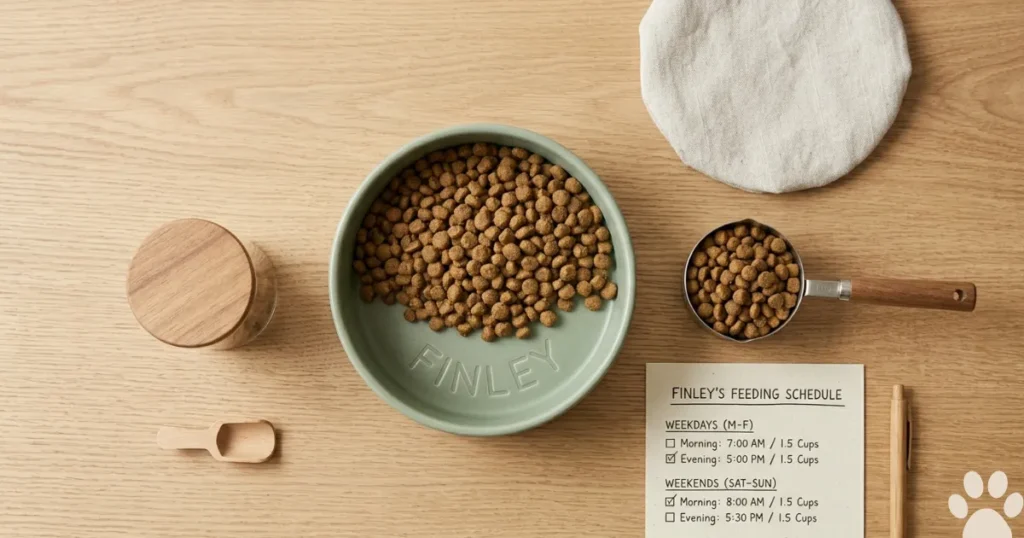
How many times a day should you feed a dog? Most adult dogs, including Golden Retrievers, should be fed twice daily – once in the morning and once in the evening, approximately 8- 12 hours apart. This is the standard recommendation in veterinary medicine for adult dogs over 12 months of age.
Feeding frequency is not arbitrary. It directly affects blood glucose stability, digestive load per meal, gastric distension risk, satiety hormone regulation, and behavioral patterns around food. In Golden Retrievers specifically, these factors are clinically relevant because the breed is predisposed to several conditions that a feeding schedule influences.
In veterinary medicine, twice-daily feeding is the evidence-supported standard for adult dogs because it balances digestive load, blood glucose stability, and gastric distension risk – all of which are particularly relevant for large breeds like Golden Retrievers.
Feeding once daily concentrates the entire day’s caloric and digestive load into a single gastric event. For a large, deep-chested breed like the Golden Retriever, this increases gastric distension – one of the primary risk factors for GDV, a life-threatening condition. Splitting the same daily caloric intake across two meals meaningfully reduces this risk without requiring any change in what the dog eats.
Free feeding – leaving dog food available at all times – removes the body’s natural hunger-satiety cycle, encourages overconsumption in a breed with minimal self-regulation around food, and makes it impossible to monitor appetite changes that serve as early health indicators.
Feeding Frequency by Life Stage: Golden Retrievers from Puppy to Senior.
Feeding frequency requirements change significantly as a Golden Retriever moves through life stages. Using an adult schedule for a puppy or a puppy schedule for a senior dog creates nutritional and metabolic mismatches with real health consequences.

Golden Retriever Puppies (8 Weeks – 6 Months).
Three meals daily.
Puppies have small stomach capacity, high metabolic rates, and rapid growth demands that cannot be met in two meals without creating both digestive overload and energy gaps between feedings.
Feeding three times daily.
Morning, midday, and evening – maintains blood glucose within a stable range critical for neurological development, supports consistent energy for growth, and reduces the risk of hypoglycemia that can affect rapidly growing puppies.
If your Golden Retriever puppy shows shakiness, lethargy, or disorientation between meals, hypoglycemia from infrequent feeding is a possibility – increase feeding frequency before investigating other causes.
Adolescent Golden Retrievers (6 – 12 Months).
Transition to twice daily between 6 and 12 months.
At 6 months, stomach capacity is sufficient to handle two larger meals, and metabolic rate begins normalizing. Drop the midday meal gradually over 1 – 2 weeks rather than abruptly.
Some larger Golden Retriever puppies growing rapidly may benefit from continuing three meals until 9 months. If your dog shows significant hunger or loose stools after dropping to two meals at 6 months, reintroduce the third meal temporarily.
Adult Golden Retrievers (1 – 7 Years).
Twice daily.
8 – 12 hours apart, at consistent times. Morning and evening meals that align with the owner’s routine are the most sustainable and physiologically appropriate schedule for adult Golden Retrievers.
Consistency of timing matters as much as frequency. Dogs regulate cortisol and digestive enzyme secretion partly around feeding schedules. Irregular timing – feeding at 7 am one day and 10 am the next – disrupts these rhythms and can cause digestive instability even when food quality remains constant.
Senior Golden Retrievers (7+ Years).
Maintain twice daily, but adjust portion and composition.
Feeding frequency itself does not need to change in healthy senior dogs, but caloric density should decrease while protein quality increases to support muscle mass preservation.
Some senior Golden Retrievers with gastrointestinal sensitivity benefit from three smaller meals daily to reduce per-meal digestive demand. If your senior dog shows post-meal discomfort, bloating, or appetite irregularity on twice-daily feeding, discuss three-meal scheduling with your veterinarian.
How Feeding Frequency Affects Golden Retriever Health: 4 Key Connections.
1. Bloat and GDV Risk
Gastric dilatation-volvulus is one of the most serious acute conditions in large breeds. Golden Retrievers are among the breeds with documented elevated GDV risk. Feeding one large meal daily creates the gastric distension and post-meal activity patterns most associated with GDV onset. Twice-daily feeding reduces per-meal volume and distension – a clinically meaningful risk reduction.
2. Weight Management
Golden Retrievers are highly food-motivated with limited self-regulation. Two structured daily meals create defined hunger-satiety cycles that support healthy weight maintenance. Free feeding removes this structure entirely, and once-daily feeding drives compensatory overeating behavior in food-motivated breeds.
3. Blood Glucose Stability
Consistent meal timing supports stable blood glucose across the day. This is particularly relevant for Golden Retrievers with hypothyroidism – a breed predisposition – where metabolic regulation is already compromised. Irregular feeding worsens the glucose instability that hypothyroidism creates.
4. Medication Timing
Golden Retrievers on long-term medications – thyroid supplementation, anticonvulsants, and joint support medications – often require consistent food timing relative to dosing for optimal absorption. A structured twice-daily feeding schedule creates the reliable framework that medication management requires.

For Golden Retrievers, twice-daily feeding reduces GDV risk, supports weight management, stabilizes blood glucose, and creates consistent medication timing – making feeding frequency a health management decision, not just a convenience choice.
7 Feeding Frequency Mistakes Golden Retriever Owners Make.
1. Feeding once daily to save time.
One daily meal concentrates gastric load, increases bloat risk, and drives hunger-based anxiety and food guarding behavior in food-motivated breeds. The time saving is minimal; the health cost is not.
2. Free feeding dry kibble.
Leaving kibble available throughout the day removes appetite monitoring as a health indicator, encourages overeating, and makes portion control impossible. Golden Retrievers will consistently overeat when food is continuously available.
3. Feeding immediately before or after exercise.
Feeding within 30 – 60 minutes of vigorous exercise – in either direction – is associated with increased GDV risk in large breeds. A rest period before and after meals is a low-effort, meaningful risk reduction for Golden Retrievers.
4. Inconsistent meal timing.
Varying meal times by more than 1 – 2 hours disrupts digestive enzyme secretion rhythms and cortisol patterns. Dogs experience genuine physiological stress from inconsistent feeding schedules, not just behavioral anticipation.
5. Using puppy frequency for adult dogs.
Continuing three meals past 12 months without a clinical reason often leads to overfeeding because total daily portions are not reduced proportionally when adding an extra meal.
6. Dropping to once daily for senior dogs.
Senior dogs have reduced digestive efficiency and muscle synthesis rates. Once-daily feeding concentrates both digestive and metabolic demands in ways that work against the nutritional goals of aging dog management.

7. Not adjusting frequency after spaying or neutering.
Spaying and neutering reduce metabolic rate by approximately 20- 30%. Feeding frequency itself may stay the same, but total daily portions must be reassessed within 4- 6 weeks of the procedure to prevent the rapid weight gain that commonly follows in Golden Retrievers.
Vet’s Tip: Most feeding guides focus on how many times a day to feed a dog but skip this: the gap between meals matters as much as the number of meals. For adult Golden Retrievers, aim for 10 – 12 hours between evening and morning meals – not 6 – 7 hours. A dog fed at 5pm and again at 6am gets a proper overnight metabolic rest that supports digestion, liver function, and healthy weight maintenance far better than compressed meal timing.
How Many Times a Day Should You Feed a Dog With Specific Health Conditions?
Certain health conditions common in Golden Retrievers alter the standard twice-daily recommendation.
Hypothyroidism:
Consistent twice-daily feeding aligned with levothyroxine dosing is essential. Thyroid medication absorption is affected by food timing – feed at consistent intervals relative to medication administration as directed by your veterinarian.
Diabetes:
Diabetic Golden Retrievers typically require twice-daily feeding timed precisely with insulin injections. Meal size consistency is as important as frequency – the same caloric intake at each meal stabilizes the insulin response.
Inflammatory Bowel Disease (IBD):
Three to four smaller meals daily reduces per-meal digestive load and is often recommended to minimize symptom flares in Golden Retrievers with IBD or chronic digestive sensitivity.
Post-surgical recovery:
Dogs recovering from abdominal or orthopedic surgery often benefit temporarily from three to four small meals daily while appetite is reduced and digestive function is impaired.
Obesity:
Counterintuitively, reducing to once daily is not the solution for overweight Golden Retrievers – it increases hunger-driven food obsession. Twice-daily feeding with strictly controlled portions, measured by weight rather than volume, is the appropriate management approach.
In Golden Retrievers with hypothyroidism, diabetes, or IBD, feeding frequency becomes a clinical management tool – not just a scheduling decision – and should be determined in coordination with veterinary treatment protocols.
Feeding Schedule Comparison: What Works for Golden Retrievers.
| Life Stage | Recommended Frequency | Meal Timing | Key Reason |
| Puppy 8–16 weeks | 3–4 times daily | Every 4–6 hours | Small stomach, hypoglycemia prevention |
| Puppy 4–6 months | 3 times daily | Morning, midday, evening | Growth demand, glucose stability |
| Adolescent 6–12 months | Transition to 2 times | Drop midday gradually | Stomach capacity sufficient |
| Adult 1–7 years | 2 times daily | 10–12 hours apart | GDV risk reduction, satiety cycle |
| Senior 7+ years | 2–3 times daily | Adjusted to GI tolerance | Digestive efficiency decline |
| Hypothyroid adult | 2 times daily | Aligned with medication | Absorption consistency |
| Diabetic adult | 2 times daily | Timed with insulin | Blood glucose management |
| IBD or sensitive GI | 3–4 times daily | Smaller equal portions | Reduced per-meal digestive load |
9 Vet-Backed Tips for Golden Retriever Feeding Frequency.
- Feed adult Golden Retrievers twice daily at the same times every day – consistency of timing supports digestive enzyme secretion and reduces anxiety-based food behavior.
- Always allow 30 – 60 minutes of rest before and after meals to reduce GDV risk – no vigorous exercise, running, or play immediately around meal times.
- Measure food by weight using a kitchen scale, not by cup volume. Kibble density varies significantly between brands and even between bag sizes of the same product.
- Transition puppy feeding frequency gradually – drop from three to two meals over 1 – 2 weeks at 6 months, not abruptly.
- If your Golden Retriever shows post-meal bloating, excessive gas, or restlessness after eating, discuss both feeding frequency and meal size with your veterinarian before assuming it is food-related.
- Reassess total daily portions – not just frequency – within 4 – 6 weeks of spaying, neutering, or starting any long-term medication that affects metabolism.
- Use consistent bowl placement and a calm feeding environment. Golden Retrievers that eat under social stress or competition eat faster, increasing bloat risk regardless of meal frequency.
- Monitor appetite at every meal as an early health indicator. A dog that skips one meal is worth watching; a dog that skips two consecutive meals warrants veterinary contact.
- For senior Golden Retrievers showing reduced appetite on twice-daily feeding, try three smaller meals before investigating food aversion or palatability issues – digestive comfort often improves with smaller, more frequent meals.
Over the years, I’ve noticed that Golden Retrievers on consistent twice-daily feeding schedules – same time, same place, same portions – show markedly more stable body condition scores at annual exams than those on irregular or free-feeding regimens, even when total daily calories are nominally similar.
How many times a day should you feed a dog?
Most adult dogs should be fed twice daily, approximately 10 – 12 hours apart. Puppies need three to four meals daily. Senior dogs generally require twice daily feedings, with some benefiting from three smaller meals.
Is it OK to feed a dog once a day?
Once-daily feeding is not recommended for Golden Retrievers. It increases gastric distension and GDV risk, drives food-obsessive behavior, and creates blood glucose instability across a breed already predisposed to metabolic conditions.
How many times a day should you feed a Golden Retriever puppy?
Golden Retriever puppies need three meals daily from 8 weeks to 6 months, and three to four meals from 8 to 16 weeks. This frequency supports stable blood glucose and meets the high caloric demands of rapid growth.
When should I switch my Golden Retriever from three meals to two?
Transition from three to two meals gradually between 6 and 12 months of age. Drop the midday meal for 1-2 weeks. Some larger or rapidly growing puppies benefit from three meals until they are 9 months old.
Is free feeding OK for Golden Retrievers?
No. Golden Retrievers have minimal self-regulation around food and will overeat when food is continuously available. Free feeding also removes appetite monitoring as an early health indicator. Structured meal feeding is strongly preferred.
How far apart should dog meals be?
For adult Golden Retrievers, 10 – 12 hours between meals is ideal. This provides a proper overnight metabolic rest period and aligns with natural digestive rhythms. Meals compressed to 6- 7 hours apart do not provide the same benefit.
Should I feed my dog before or after exercise?
Neither immediately before nor immediately after. Wait at least 30 – 60 minutes after vigorous exercise before feeding, and avoid vigorous exercise for 30 – 60 minutes after meals. This is a meaningful GDV risk reduction for large breeds.
How many times a day should you feed a senior Golden Retriever?
Maintain twice daily feeding for healthy senior Golden Retrievers. Those with GI sensitivity or reduced digestive efficiency may benefit from three smaller meals. Consult your veterinarian if appetite or digestion changes significantly after age 7.
Does feeding frequency affect dog weight?
Frequency alone does not cause weight gain – total caloric intake does. However, structured twice-daily feeding supports better satiety signaling and portion control than once-daily or free feeding, indirectly supporting healthier weight management.
How many times a day should you feed a dog with hypothyroidism?
Twice daily, timed consistently with levothyroxine administration. Consistent meal timing relative to medication dosing is clinically important for thyroid hormone absorption and stable metabolic management in hypothyroid Golden Retrievers.
Should I feed my dog at the same time every day?
Yes. Consistency of meal timing supports digestive enzyme secretion rhythms and cortisol regulation. Irregular feeding times – varying by more than 1- 2 hours – cause physiological stress and digestive instability even when food quality is unchanged.
How many times a day should a diabetic dog be fed?
Diabetic dogs are typically fed twice daily, timed precisely with insulin injections. Meal size consistency across both meals is critical – caloric variation between meals disrupts insulin response and blood glucose management.
Can I feed my dog three times a day as an adult?
Three meals daily is appropriate for adult dogs with IBD, post-surgical recovery needs, or significant GI sensitivity. For healthy adult Golden Retrievers without these conditions, twice daily is the standard recommendation.
How do I know if my dog needs more frequent meals?
Signs that a dog may benefit from increased feeding frequency include post-meal bloating, excessive hunger between meals, loose stools, hypoglycemic symptoms, or weight loss despite adequate total caloric intake.
Is it bad to feed a dog late at night?
Evening meals are appropriate as part of a twice-daily schedule. Feeding very late – within 1 – 2 hours of bedtime – may reduce overnight digestive rest. An evening meal around 5 – 6pm with a morning meal around 7 – 8am provides an optimal 12 – 14 hour interval.
Conclusion.
How many times a day you should feed a dog comes down to one primary answer for most Golden Retrievers: twice daily, at consistent times, 10 – 12 hours apart. Puppies need three to four meals to support growth and glucose stability. Senior dogs are maintained twice daily, with three smaller meals appropriate for those with digestive sensitivity.
Feeding frequency is not a minor scheduling detail in this breed. For Golden Retrievers – predisposed to obesity, GDV, hypothyroidism, and diabetes – meal timing, portion consistency, and structured feeding schedules are health management decisions with measurable consequences over years of daily repetition.
The owners who get this right are not doing anything complicated. They are feeding at the same time every day, measuring portions, allowing rest around meals, and adjusting frequency as their dog moves through life stages. Those simple, consistent habits produce dogs that maintain a healthy weight, stable digestion, and a lower risk of the conditions this breed faces most commonly.
Reassess feeding frequency at every annual veterinary exam – life stage, medication needs, and health status all evolve in ways that make periodic recalibration worthwhile.
Every Golden Retriever owner lands on a feeding schedule through a mix of advice, trial, and observation – and your experience adds real value here.
- How many times a day do you feed your Golden Retriever, and how did you arrive at that schedule?
- Have you noticed a difference in energy, digestion, or weight between different feeding frequencies?
Share your routine in the comments below.

Dr. Nabeel A.
Hi, I’m Dr. Nabeel Akram – a farm management professional by trade and a passionate Golden Retriever enthusiast at heart. With years of experience in animal science and livestock care, I’ve built a career around understanding animals—how they live, thrive, and bring value to our lives. This blog is a personal project born from that same passion, focusing on one of the most loyal and lovable breeds out there: the Golden Retriever. Whether I’m managing farm operations or sharing insights on canine health, behavior, and care, it all ties back to one core belief—animals deserve thoughtful, informed, and compassionate attention. Welcome to a space where professional expertise meets genuine love for dogs.
Facebook |
Links will be automatically removed from comments.