

How many times a day should a dog eat? It’s one of those questions that sounds simple until you start looking for a concrete answer – and find nothing but vague ranges that don’t account for your dog’s age, weight, or breed.
I often see Golden Retriever owners still using the same feeding frequency they started with when the dog was a puppy. No one told them that the number of daily meals is supposed to change – not just once, but several times throughout a dog’s life. The result is usually a young adult dog still eating three times a day on a puppy plan, or a senior dog pushed to hold out on a twice-daily schedule that stopped working for their digestion two years ago.
How many times a day a dog should eat is directly tied to life stage, body weight, gastric capacity, and metabolic rate. For Golden Retrievers – a breed predisposed to bloat, weight gain, and joint stress – getting meal frequency right is not a minor detail. It shapes digestive health, energy regulation, and long-term body condition from puppyhood through the senior years.
This guide gives you specific, breed-aware meal frequency answers with complete tables, sample meal plans, and weight-based charts – so there is no guesswork left.
Contents
- 1 How Many Times a Day Should a Dog Eat? The Direct Answer by Life Stage
- 2 How Many Times a Day Should a Dog Eat at Each Life Stage?
- 2.1 Stage 1 – Young Puppy: 4 Meals Per Day (8 – 12 Weeks).
- 2.2 Stage 2 – Growing Puppy: 3 Meals Per Day (3 – 6 Months).
- 2.3 Stage 3 – Adolescent: 2 – 3 Meals Per Day (6 – 12 Months).
- 2.4 Stage 4 – Adult Golden Retriever: 2 Meals Per Day (1 – 7 Years).
- 2.5 Stage 5 – Senior Golden Retriever: 2 – 3 Meals Per Day (7+ Years).
- 3 Complete Age-and-Weight Golden Retriever Feeding Reference Chart.
- 4 8 Factors That Change How Many Times a Day a Dog Should Eat.
- 5 How Meal Frequency Interacts With Exercise Timing.
- 6 Vet Statements.
- 6.1 How many times a day should a dog eat?
- 6.2 Is it okay for a dog to eat only once a day?
- 6.3 How many times a day should a puppy eat?
- 6.4 Should I feed my Golden Retriever 2 or 3 times a day?
- 6.5 What is the best time to feed a dog twice a day?
- 6.6 How many times a day should a senior dog eat?
- 6.7 Does how many times a day a dog eats affect bloat risk?
- 6.8 Can I feed my dog at different times each day?
- 6.9 How many times a day should an overweight dog eat?
- 6.10 What happens if I feed my dog too many times a day?
- 6.11 How many times a day should a working or sporting Golden Retriever eat?
- 6.12 Should I feed my dog before or after a walk?
- 6.13 How many times a day should a nursing Golden Retriever eat?
- 6.14 Is free-feeding better than set meal times for dogs?
- 6.15 How do I know if I’m feeding my dog the right number of times per day?
- 7 Conclusion.
How Many Times a Day Should a Dog Eat? The Direct Answer by Life Stage
How many times a day a dog should eat changes at four key transition points across a Golden Retriever’s life. Each shift is driven by physiology – stomach capacity, metabolic rate, and digestive maturity – not convenience.
Master Frequency Chart: How Many Times a Day Should a Dog Eat
| Life Stage | Age Range | Meals Per Day | Reason |
| Young puppy | 8–12 weeks | 4 | Tiny stomach, hypoglycaemia risk |
| Growing puppy | 3–6 months | 3 | GI maturation, larger capacity |
| Adolescent | 6–12 months | 2–3 | Transitioning to adult digestion |
| Adult | 1–7 years | 2 | Optimal gastric rhythm, bloat prevention |
| Senior | 7+ years | 2–3 | Slower motility, appetite variability |
This table is the foundational answer. Every section below explains the physiology, practical timing, and weight-based portion adjustments that make the number work.
How Many Times a Day Should a Dog Eat at Each Life Stage?
Stage 1 – Young Puppy: 4 Meals Per Day (8 – 12 Weeks).
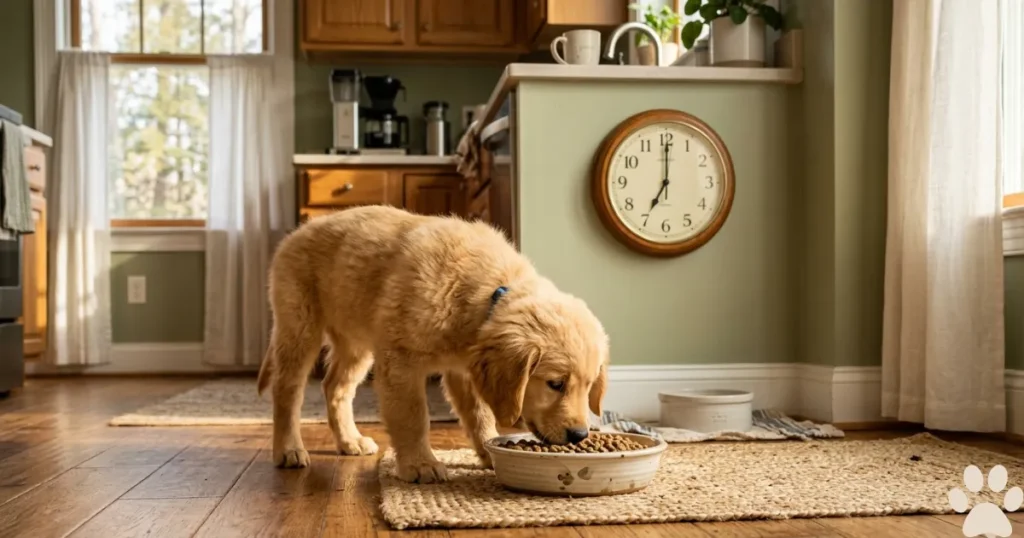
At 8 weeks, a Golden Retriever puppy’s stomach holds approximately 1- 1.5 cups of dog food. Four daily meals spaced 4- 5 hours apart prevent blood glucose crashes between feeds and avoid overloading immature digestion with a single large volume.
Sample 4-Meal Daily Plan – 8 – 12 Week Golden Retriever Puppy.
| Meal | Time | Approximate Portion | Notes |
| Meal 1 | 7:00 AM | ¼–⅓ cup | First meal after morning toilet |
| Meal 2 | 12:00 PM | ¼–⅓ cup | Midday; follow with short rest |
| Meal 3 | 5:00 PM | ¼–⅓ cup | Late afternoon |
| Meal 4 | 9:00 PM | ¼–⅓ cup | Allow 45 min before sleep |
| Daily Total | 1–1.5 cups | Large breed puppy formula |
What NOT to do:
Do not skip the fourth meal to simplify your routine. At this age, the overnight gap from 9:00 PM to 7:00 AM is already at the upper limit of what a young puppy should fast. Removing an earlier meal extends the gap further and increases the risk of hypoglycaemia.
Stage 2 – Growing Puppy: 3 Meals Per Day (3 – 6 Months).
By 3 months, stomach capacity has grown enough to handle a shift from four meals to three. How many times a day a dog should eat at this stage decreases by 1, while the portion size per meal increases to match the puppy’s rapidly growing body weight.
Weight-Based Daily Portion Guide – 3 – 6 Month Golden Retriever Puppy.
| Puppy Weight | Daily Total (approx.) | Per Meal (3 meals) |
| 5–8 kg (11–18 lb) | 1.5–2 cups | ½–⅔ cup |
| 9–13 kg (20–29 lb) | 2–2.5 cups | ⅔–¾ cup |
| 14–18 kg (31–40 lb) | 2.5–3 cups | ¾–1 cup |
Based on a large-breed puppy formula at approximately 370 kcal/cup. Adjust if your food’s caloric density differs.
Sample 3-Meal Daily Plan – 3 – 6 Month Golden Retriever Puppy.
| Meal | Time | Approximate Portion | Notes |
| Meal 1 | 7:00 AM | ¾–1 cup | Morning; follow with toilet break |
| Meal 2 | 1:00 PM | ¾–1 cup | Midday; 30 min rest post-meal |
| Meal 3 | 6:00 PM | ¾–1 cup | Evening; final meal of day |
| Daily Total | 2–3 cups | Adjust every 3–4 weeks by weight |
Over the years, I’ve noticed that Golden Retriever owners at this stage frequently ask how many times a day their dog should eat, when what’s actually happening is a portion problem – the puppy is getting the right number of meals. Still, the per-meal amount hasn’t been increased to match the dog’s current body weight. The result is a correctly-timed but underfed puppy who seems perpetually hungry.
Stage 3 – Adolescent: 2 – 3 Meals Per Day (6 – 12 Months).
The adolescent window is the most variable in terms of how many times a day a dog should eat. Most Golden Retrievers between 6 and 12 months are ready to move toward a twice-daily adult schedule – but the transition should be gradual and individually assessed.
Transition Checklist: Ready to Move from 3 Meals to 2?
| Indicator | Ready for 2 Meals | Hold at 3 Meals |
| Morning bile vomiting | Not present | Present – overnight gap too long |
| Eating pace | Calm, steady | Gulping – too hungry between meals |
| Mid-gap behaviour | Settled | Restless, persistent food-seeking |
| Age | 6+ months | Under 6 months |
| GI tolerance | No upset | Loose stools, nausea signs |
If two or more “hold” indicators apply, maintain three meals and reassess at 9-10 months.
Sample Transitional 2-Meal Plan – 6 – 12 Month Golden Retriever.
| Meal | Time | Approximate Portion | Notes |
| Meal 1 | 7:00 AM | 1.5–2 cups | Increase as puppy grows |
| Meal 2 | 6:00 PM | 1.5–2 cups | 11-hour gap from morning |
| Daily Total | 3–4 cups | Verify against kcal/cup on bag |
Stage 4 – Adult Golden Retriever: 2 Meals Per Day (1 – 7 Years).
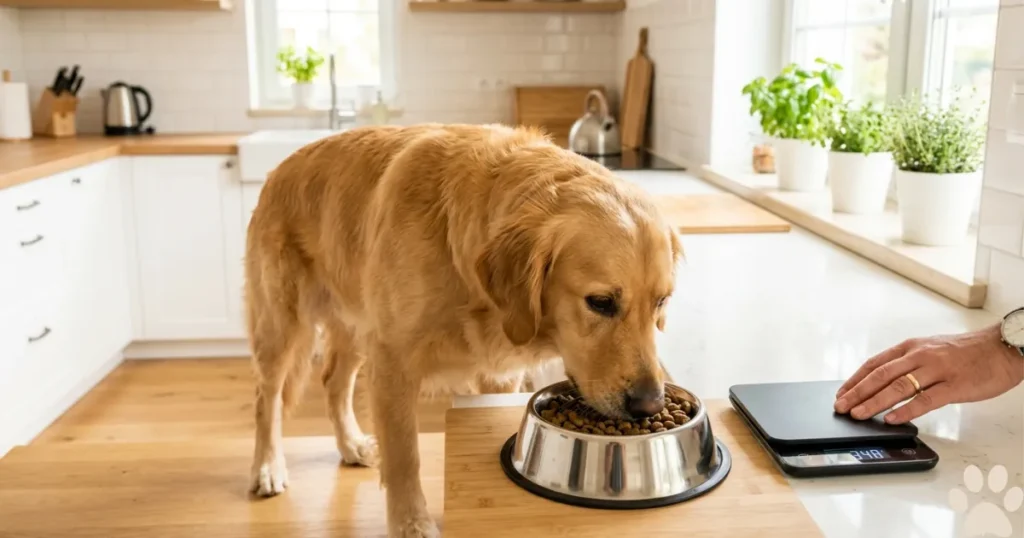
How many times a day an adult dog should eat is the most clearly supported of any life stage question. Twice daily is the standard for healthy adult Golden Retrievers – not once, not three times.
Why twice, not once:
In canine gastric physiology, the stomach empties in approximately 8- 10 hours. A once-daily feeding leaves 14 – 16 hours of gastric acid accumulation with no food buffer – contributing to nausea, bile vomiting, and rapid eating behaviour at the one daily meal. For a deep-chested breed like the Golden Retriever, a single large daily meal also significantly increases the risk of Gastric Dilatation-Volvulus (GDV).
Why twice, not three times:
Three daily meals in a healthy adult Golden Retriever are not harmful. Still, they are unnecessary and tend to increase food-soliciting behaviour throughout the day, adding to mealtime anxiety in a breed already strongly food-motivated.
Adult Golden Retriever Weight-Based Daily Portion Table.
| Dog Weight | Daily Caloric Need (neutered) | Daily Total at 380 kcal/cup | Per Meal (2 meals) |
| 22 kg (48 lb) | ~1,100 kcal | ~2.9 cups | ~1.45 cups |
| 25 kg (55 lb) | ~1,200 kcal | ~3.2 cups | ~1.6 cups |
| 28 kg (62 lb) | ~1,320 kcal | ~3.5 cups | ~1.75 cups |
| 32 kg (70 lb) | ~1,460 kcal | ~3.8 cups | ~1.9 cups |
| 36 kg (79 lb) | ~1,600 kcal | ~4.2 cups | ~2.1 cups |
Figures based on neutered adult multiplier (1.6 × RER). Intact adults require approximately 10 – 15% more. Adjust if the food’s kcal/cup differs from 380.
Sample 2-Meal Daily Plan – Adult Golden Retriever.
| Meal | Time | Approximate Portion | Notes |
| Meal 1 | 7:00 AM | 1.75–2 cups | Before morning walk – feed first, walk 1 hr later |
| Meal 2 | 6:00 PM | 1.75–2 cups | No vigorous exercise within 2 hrs post-meal |
| Daily Total | 3.5–4 cups | Verify kcal/cup with your specific brand |
Vet’s Tip: The 11-hour gap in the plan above is deliberate – not incidental. Meals spaced less than 8 hours apart risk the second meal landing in a stomach that hasn’t fully cleared the first. Keep morning and evening meals consistently spaced regardless of weekend schedule changes. Gap drift is one of the quietest contributors to recurring GI upset I see in otherwise well-managed adult Goldens.
Stage 5 – Senior Golden Retriever: 2 – 3 Meals Per Day (7+ Years).
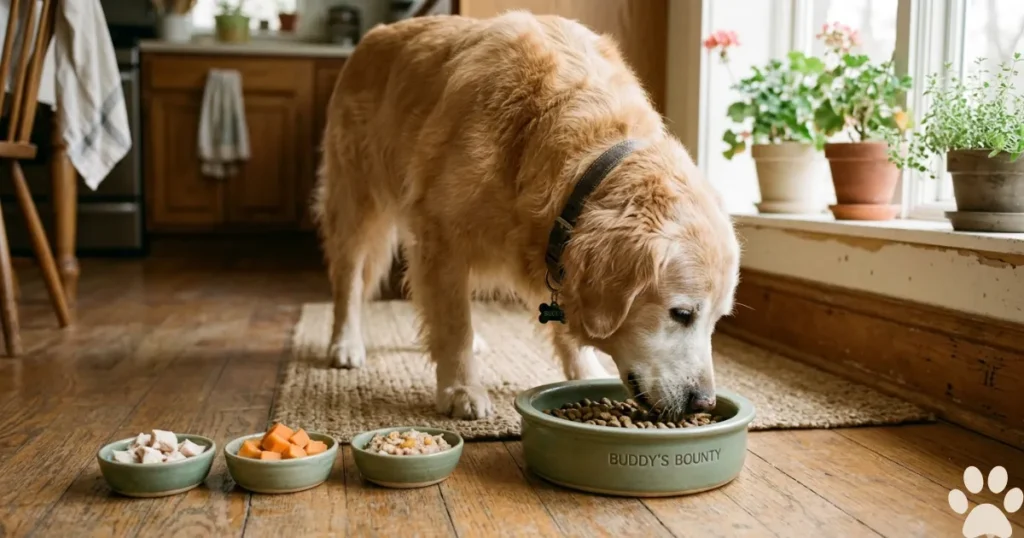
How many times a day a senior dog should eat depends on the individual – but the direction of adjustment, when needed, is always upward: more meals, smaller portions, or the same total daily calories.
Senior Goldens experience reduced GI motility, lower appetite reliability, and often concurrent health conditions that affect digestion. Three smaller meals are easier to absorb, reduce per-meal gastric load, and support medication administration more flexibly.
Senior Golden Retriever: When to Shift from 2 Meals to 3.
| Sign | Action |
| Consistent partial meals | Split daily total into 3 smaller portions |
| Morning bile vomiting returns | Add small evening snack or shift to 3 meals |
| Weight loss without illness | More frequent meals improve intake |
| Medication needs food 3x daily | Align meals with medication schedule |
| Post-meal lethargy or nausea | Smaller portions per sitting |
Sample 3-Meal Daily Plan – Senior Golden Retriever.
| Meal | Time | Approximate Portion | Notes |
| Meal 1 | 7:00 AM | 1–1.25 cups | Warm slightly with water if appetite low |
| Meal 2 | 1:00 PM | 1–1.25 cups | Good window for joint medications |
| Meal 3 | 6:00 PM | 1–1.25 cups | Light activity only after meals |
| Daily Total | 3–3.75 cups | Same total as prior 2-meal plan – redistributed |
Complete Age-and-Weight Golden Retriever Feeding Reference Chart.
| Age | Weight Range | Meals/Day | Approx. Daily Total | Per Meal |
| 8–12 weeks | 3–6 kg | 4 | 1–1.5 cups | ¼–⅓ cup |
| 3–4 months | 7–12 kg | 3 | 1.5–2.5 cups | ½–¾ cup |
| 5–6 months | 13–18 kg | 3 | 2.5–3 cups | ¾–1 cup |
| 7–9 months | 18–25 kg | 2–3 | 3–3.5 cups | 1–1.5 cups |
| 10–12 months | 24–30 kg | 2 | 3–4 cups | 1.5–2 cups |
| Adult 1–3 yrs | 25–34 kg | 2 | 3–4 cups | 1.5–2 cups |
| Adult 4–7 yrs | 25–34 kg | 2 | 3–4 cups | 1.5–2 cups |
| Senior 7–10 yrs | 25–34 kg | 2–3 | 2.5–3.5 cups | 1–1.25 cups |
| Senior 10+ yrs | 22–30 kg | 3 | 2.5–3 cups | ¾–1 cup |
All figures approximate, based on standard large-breed dry kibble at 370 – 390 kcal/cup. Confirm kcal/cup on your specific food label before finalising portions.
8 Factors That Change How Many Times a Day a Dog Should Eat.
How many times a day a dog should eat is not permanently fixed once decided – it needs reassessment when any of the following apply:
1. Spay or neuter surgery.
Metabolic rate drops 20- 30% post-surgery. Meal frequency can remain the same, but per-meal portions must decrease within 4-6 weeks. Failure to adjust leads to gradual weight gain that compounds over months.
2. Food brand change.
Different caloric densities mean different per-meal volumes. Recalculate daily totals before the first meal for a new food – never carry over the same cup count from the old food.
3. Significant weight gain.
Overweight Goldens sometimes benefit from the same daily calories split across three smaller meals rather than two – smaller portions reduce insulin spikes and support slower, more manageable digestion.
4. Recovery from illness or surgery.
Post-operative or post-illness dogs often need 3 – 4 smaller meals daily to maintain intake without overwhelming recovering digestion. Appetite suppression from pain or medication makes frequency more important than portion.
5. Pregnancy and nursing.
A pregnant Golden Retriever in her third trimester needs 3-4 meals daily to meet caloric demands without stomach overcrowding as the uterus displaces gastric space. Nursing mothers may need 4 or more meals to support milk production.
6. Multi-dog household introduction.
Competitive eating – where one dog rushes meals to prevent another from accessing them – is a direct bloat risk. Adding a meal, slowing eating with a puzzle feeder, or separating dogs during meals are all appropriate responses.
7. Seasonal activity change.
A Golden Retriever transitioning from a highly active summer to a low-activity winter may need portion reductions even if meal frequency stays the same. Total daily calories should reflect actual energy expenditure.
8. Dental disease.
Senior Goldens with dental pain often eat more slowly, eat less, or refuse hard kibble. Softening kibble with warm water and shifting to more frequent, smaller meals can maintain intake when chewing is painful.
How Meal Frequency Interacts With Exercise Timing.
Regardless of how many times a day a dog eats, meal-to-exercise spacing is a non-negotiable safety rule for Golden Retrievers.
Exercise and Meal Timing Safety Table.
| Scenario | Safe? | Recommendation |
| Walk within 30 min before meal | Generally safe | Feed after, not before |
| Vigorous exercise 30 min after meal | Not safe | Wait a minimum 2 hours |
| Light walk 1 hour after meal | Safe | Appropriate for daily routine |
| Swimming immediately after meal | Not safe | High bloat risk – wait 2+ hours |
| Training session before meal | Ideal | Pre-meal hunger = strong motivation |
| Off-leash play 90 min after meal | Borderline | Monitor for restlessness or distension |
The safest daily structure for a Golden Retriever is exercise first, meal after, rest period, then normal activity resumes. Build how many times a day your dog eats around this sequence – not the other way around.

Vet Statements.
How many times a day a dog should eat is determined by life stage: four meals at 8 – 12 weeks, three meals at 3 – 6 months, two to three meals between 6 and 12 months, and two meals from adulthood through most of the senior years.
In canine gastric physiology, twice-daily feeding for adult dogs aligns meal timing with the stomach’s 8- 10 hour emptying cycle- preventing the prolonged acid accumulation associated with once-daily feeding.
Golden Retrievers are predisposed to Gastric Dilatation-Volvulus (GDV); how many times a day a dog eats directly influences bloat risk – two measured meals reduce the per-meal gastric load that once-daily large-volume feeding creates.
Senior Golden Retrievers with reduced appetite or slower GI motility benefit from redistribution of their daily caloric intake across three smaller meals rather than two, without increasing total daily calories.
In veterinary practice, meal frequency is the most reliable variable for detecting early appetite changes in dogs – structured twice-daily feeding makes partial or missed meals immediately visible. At the same time, free-feeding or irregular schedules obscure this diagnostic signal entirely.
How many times a day should a dog eat?
Most healthy adult dogs should eat twice daily, spaced 10- 12 hours apart. Puppies need 3 -4 meals daily, depending on age; seniors may need 2 -3 meals based on appetite and digestion. For Golden Retrievers, twice daily is the standard adult answer.
Is it okay for a dog to eat only once a day?
Once-daily feeding is not recommended for Golden Retrievers. It extends gastric acid exposure, encourages fast eating, raises bloat risk, and makes appetite monitoring harder. Twice daily is safer and more appropriate for this breed’s digestive physiology.
How many times a day should a puppy eat?
Golden Retriever puppies should eat four times daily at 8- 12 weeks, three times daily from 3- 6 months, and transition to two or three times daily between 6 and 12 months based on their individual readiness and GI tolerance of longer gaps.
Should I feed my Golden Retriever 2 or 3 times a day?
Twice daily is standard for healthy adults. Three times daily is appropriate for puppies under 6 months, seniors with reduced appetite, and dogs recovering from illness. A healthy adult on two structured meals does not need a third.
What is the best time to feed a dog twice a day?
Morning and evening meals spaced 10-12 hours apart work best – for example, 7:00 AM and 6:00 PM. Consistency within a 30-minute window daily matters more than the specific times chosen.
How many times a day should a senior dog eat?
Senior Golden Retrievers do well on two meals daily until appetite or digestion changes. When partial meals, morning bile vomiting, or weight loss occur, redistributing daily calories across three smaller meals often improves intake without increasing total food intake.
Does how many times a day a dog eats affect bloat risk?
Yes. For Golden Retrievers, twice-daily feeding reduces per-meal stomach volume compared to once-daily feeding. Vigorous exercise within 2 hours of any meal also independently elevates bloat risk; both variables must be managed together.
Can I feed my dog at different times each day?
Inconsistency within 30-minute windows is manageable. Shifts of 2-3 hours disrupt digestive enzyme priming and the gastric acid rhythm. For Golden Retrievers, meal-time consistency directly correlates with digestive comfort and calm mealtime behaviour.
How many times a day should an overweight dog eat?
Portion reduction is more important than frequency change for overweight dogs. However, splitting the same reduced daily calories across three meals rather than two can slow eating pace, reduce post-meal insulin spikes, and help manage hunger between meals.
What happens if I feed my dog too many times a day?
For adult Goldens, more than three structured meals can increase food-anticipation anxiety and food-soliciting behaviour throughout the day. It does not typically harm digestion, but it reinforces a food-focused routine that can be hard to dial back.
How many times a day should a working or sporting Golden Retriever eat?
Active working dogs often need three meals daily to meet elevated caloric demands without overloading the GI system per sitting. All meals should still maintain the 1-hour pre-exercise and 2-hour post-exercise gap.
Should I feed my dog before or after a walk?
After a minimum 2-hour wait following vigorous exercise. Short, gentle walks after meals are generally safe. Vigorous running, swimming, or off-leash play should not occur within two hours of any meal in Golden Retrievers.
How many times a day should a nursing Golden Retriever eat?
Nursing mothers often need four or more meals daily to meet the dramatically elevated caloric demands of milk production. Total daily intake may need to double or more, depending on litter size – consult a vet for a nursing-specific feeding plan.
Is free-feeding better than set meal times for dogs?
No. Free-feeding eliminates portioning, disrupts appetite monitoring, and is associated with higher overweight rates in food-motivated breeds like Golden Retrievers. Structured meals on a fixed frequency are consistently the better approach.
How do I know if I’m feeding my dog the right number of times per day?
If your dog maintains a healthy body condition score (BCS 4 – 5 on a 9-point scale), eats calmly without gulping, shows no bile vomiting between meals, and has stable energy, your current meal frequency is appropriate. If any of those indicators are off, frequency or timing needs reassessment.
Conclusion.
How many times a day a dog should eat is one of those questions that changes with your dog – not just once when you bring a puppy home, but multiple times across an entire lifetime. Puppies need four meals to protect against hypoglycaemia and digestive overload. Adults need two meals to align with gastric physiology and minimise the risk of bloat. Seniors often need a return to more frequent, smaller meals as digestion slows and appetite becomes less reliable.
For Golden Retrievers specifically, meal frequency is not a secondary concern. It directly influences bloat risk, weight management, energy regulation, and how quickly illness manifests through changes in appetite behaviour. Getting the number right – and adjusting it at the right life-stage transitions – is one of the highest-return health decisions an owner makes.
Use the charts and meal plans in this guide as your starting framework. Adjust based on your dog’s actual body condition, not assumptions. And at every major life transition – adolescence, the post-surgery window, the shift to senior status – revisit how many times a day your Golden should eat with fresh eyes. When in doubt, a wellness visit gives you the most accurate, dog-specific answer of all.
How many times a day does your Golden Retriever eat – and has that changed as they’ve aged?
Some owners discover the twice-daily switch too late; others find their senior dogs thrive on three smaller meals in ways they didn’t expect. If a meal frequency change made a real difference for your Golden – in weight, digestion, or behaviour – share it below. Your experience is the kind of detail no chart can fully capture.

Dr. Nabeel A.
Hi, I’m Dr. Nabeel Akram – a farm management professional by trade and a passionate Golden Retriever enthusiast at heart. With years of experience in animal science and livestock care, I’ve built a career around understanding animals—how they live, thrive, and bring value to our lives. This blog is a personal project born from that same passion, focusing on one of the most loyal and lovable breeds out there: the Golden Retriever. Whether I’m managing farm operations or sharing insights on canine health, behavior, and care, it all ties back to one core belief—animals deserve thoughtful, informed, and compassionate attention. Welcome to a space where professional expertise meets genuine love for dogs.
Facebook |
Links will be automatically removed from comments.