

Golden Retriever puppy food is not a category where guesswork serves you well. I often see owners who have made a thoughtful effort – reading reviews, comparing prices, checking ingredients – only to find they’ve been evaluating the wrong things entirely. The criteria that determine whether a puppy food is appropriate for a Golden Retriever are rarely what the marketing emphasises.
Golden Retrievers are a breed with well-documented developmental vulnerabilities. Their joints are susceptible to orthopaedic disease when dietary calcium is not carefully controlled. The taurine-disrupting effects of grain-free, legume-heavy formulas influence their cardiac health. Their skin and coat are directly responsive to omega-3 adequacy. None of these considerations appears on the front of the bag.
Getting golden retriever puppy food right in the first 12 to 15 months matters more than most owners realise – because the skeletal system, heart, and immune function developed during this window are the foundation the dog lives on for the rest of its life. This guide covers which formulas make genuine golden retriever puppy food recommendations worth following, what the labels mean, how to feed correctly at each growth stage, and the pitfalls that are easiest to miss.
Contents
- 1 What Makes Golden Retriever Puppy Food Different From Generic Puppy Formulas
- 2 Top 8 Golden Retriever Puppy Food Recommendations – Vet-Evaluated
- 2.1 1. Royal Canin Golden Retriever Puppy
- 2.2 2. Purina Pro Plan Large Breed Puppy – Chicken & Rice.
- 2.3 3. Hill’s Science Diet Large Breed Puppy
- 2.4 4. Eukanuba Large Breed Puppy
- 2.5 5. Merrick Healthy Grains Large Breed Puppy
- 2.6 6. Diamond Naturals Large Breed Puppy
- 2.7 7. Nutro Natural Choice Large Breed Puppy
- 2.8 8. Purina ONE SmartBlend Large Breed Puppy
- 3 Golden Retriever Puppy Food Recommendations: What Every Label Must Show.
- 4 Golden Retriever Puppy Feeding Schedule: Portions, Frequency, and Timing.
- 5 5 Signs Your Current Golden Retriever Puppy Food Isn’t Working.
- 6 9 Vet-Backed Golden Retriever Puppy Food Tips Most Guides Don’t Cover.
- 6.1 1. Never use a puppy food for more than three weeks from an open bag.
- 6.2 2. Weigh every meal in grams, not cups.
- 6.3 3. Body condition score weekly – not monthly.
- 6.4 4. Never supplement calcium on top of complete puppy food.
- 6.5 5. Treat calories count – always.
- 6.6 6. Do not interpret hunger as underfeeding.
- 6.7 7. Introduce one supplement at a time, two weeks apart.
- 6.8 8. Keep the same formula through the puppy phase unless clinically indicated.
- 6.9 9. Schedule a nutrition review at the 6-month veterinary appointment.
- 6.10 What is the best golden retriever puppy food?
- 6.11 What nutrients should golden retriever puppy food contain?
- 6.12 Is grain-free food okay for golden retriever puppies?
- 6.13 How much golden retriever puppy food should I feed per day?
- 6.14 When should I switch from golden retriever puppy food to adult food?
- 6.15 Can I feed my golden retriever puppy adult dog food?
- 6.16 How many times a day should a golden retriever puppy eat?
- 6.17 Does golden retriever puppy food need DHA?
- 6.18 What calcium level is correct for golden retriever puppy food?
- 6.19 What should I look for in golden retriever puppy food recommendations?
- 6.20 Are there golden retriever puppy food recommendations for sensitive stomachs?
- 6.21 What makes Royal Canin Golden Retriever Puppy different?
- 6.22 Should I add fish oil to my golden retriever puppy’s food?
- 6.23 How do I transition golden retriever puppy food to a new formula?
- 6.24 What are signs golden retriever puppy food isn’t working?
- 7 Conclusion.
What Makes Golden Retriever Puppy Food Different From Generic Puppy Formulas
Golden Retrievers are predisposed to developmental orthopaedic disease, diet-associated dilated cardiomyopathy, and food-triggered atopic dermatitis – making golden retriever puppy food selection a breed-specific decision, not a generic large-breed one.
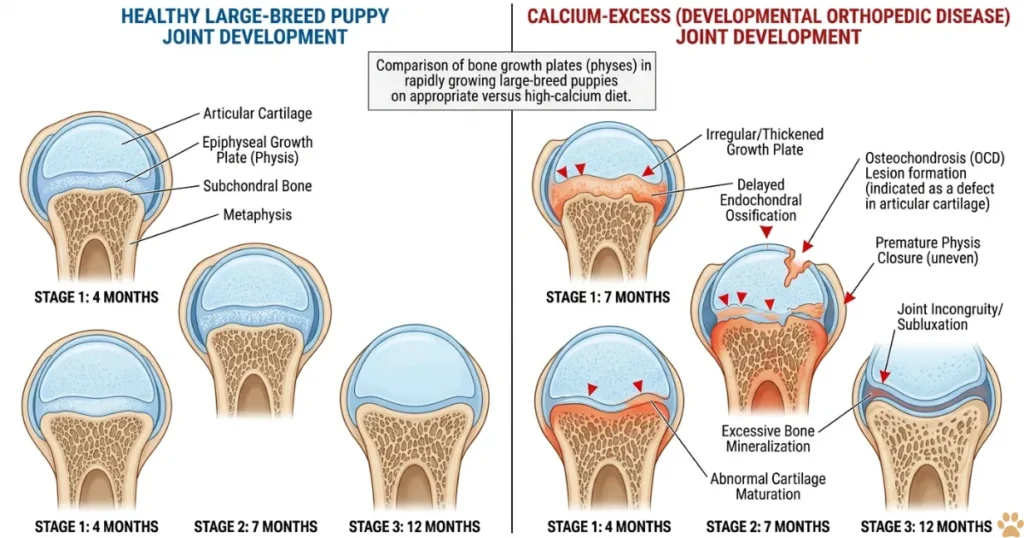
Calcium Calibration Is Non-Negotiable
The most consequential nutritional variable in golden retriever puppy food is calcium concentration. In large-breed puppies, dietary calcium in excess of the growth-appropriate threshold is absorbed – not excreted – and deposited into developing bone at a rate that outpaces cartilage adaptation. The outcome is structural joint defects: hip dysplasia, elbow dysplasia, and osteochondrosis dissecans – all of which are overrepresented in Golden Retrievers compared to the broader dog population.
This risk is not weight-dependent. A Golden Retriever puppy at a perfectly normal weight can develop developmental orthopaedic disease if the formula delivers calcium above the safe threshold.
The correct range: 1.0 – 1.5% calcium as-fed, with a Ca:P ratio of 1.2:1 to 1.4:1. Only formulas explicitly labelled and verified for large-breed puppy growth reliably maintain this.
Grain-Inclusive Is the Breed-Default
In Golden Retrievers, the metabolic pathway responsible for synthesising taurine from dietary methionine and cysteine is impaired by low-animal-protein, high-legume diets – making grain-free puppy food a breed-specific cardiac risk, not simply a nutritional preference.
The FDA has been investigating a link between grain-free, legume-heavy diets and dilated cardiomyopathy (DCM) since 2018, with Golden Retrievers disproportionately represented in reported cases. Grain-inclusive golden retriever puppy food – built on brown rice, oats, or barley as the carbohydrate base – is the clinically supported default unless a veterinarian has confirmed a specific grain sensitivity through a controlled elimination diet.
DHA for Brain and Coat Development
In canine developmental nutrition, DHA is the primary structural fatty acid in the formation of the brain and retina. Golden Retriever puppies have a documented need for marine-sourced DHA – fish oil or salmon oil – that plant-based ALA cannot adequately meet due to inefficient enzymatic conversion in dogs. Golden retriever puppy food recommendations should always include a formula with a named marine omega-3 source.
Top 8 Golden Retriever Puppy Food Recommendations – Vet-Evaluated
Every formula below clears the five criteria that define appropriate golden retriever puppy dog food: explicitly labelled large-breed puppy, AAFCO-verified (feeding trial preferred), named animal protein first, marine-source DHA, and grain-inclusive carbohydrate base.
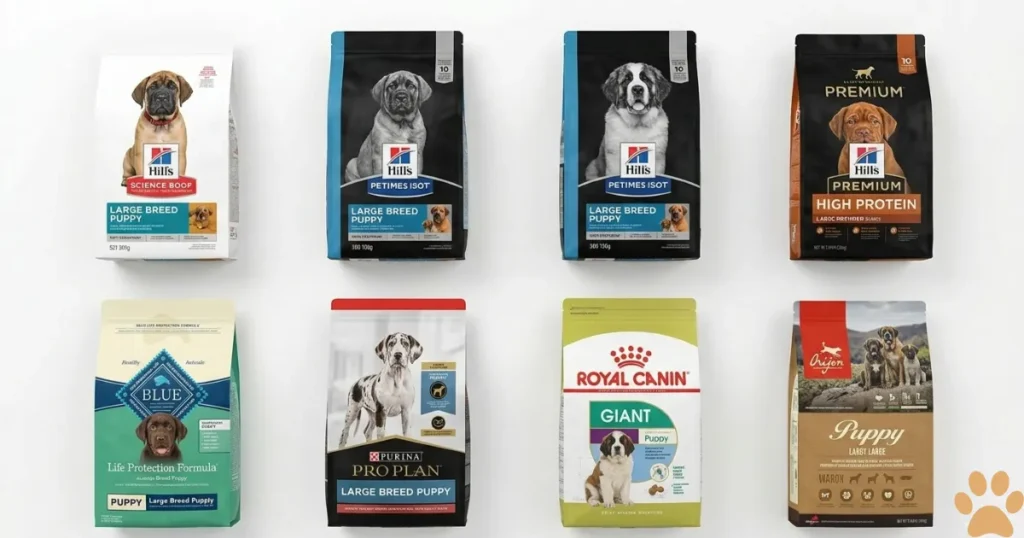
1. Royal Canin Golden Retriever Puppy
The only formula formulated specifically for Golden Retrievers – not large breeds generally. Contains EPA and DHA for brain, coat, and retinal development; a targeted antioxidant blend supporting immune maturation in this breed; and a kibble shape designed for the Golden’s jaw structure. The definitive breed-specific golden retriever puppy food recommendation.
- Protein: 30%
- Fat: 18%
- Calcium: 1.3%.
- First ingredient: Chicken
- AAFCO: Feeding trials verified.
Vet’s Pick: If there is one formula where “breed-specific” reflects genuine formulation differences rather than marketing, this is it.
2. Purina Pro Plan Large Breed Puppy – Chicken & Rice.
The most consistently recommended large-breed puppy formula by veterinary professionals. AAFCO feeding-trial verified, chicken first, DHA from fish oil, calcium controlled at 1.3%. Developed by in-house veterinary nutritionists with research depth that is unusually strong for a commercially available formula.
- Protein: 30%
- Fat: 13%
- Calcium: 1.3%.
- First ingredient: Chicken
- AAFCO: Feeding trials verified.
Owner’s Choice: The combination of research backing, feeding trial verification, and accessibility makes this the most defensible everyday recommendation for most Golden Retriever puppies.
3. Hill’s Science Diet Large Breed Puppy
AAFCO feeding-trial verified with DHA from fish oil, controlled calcium at 1.1%, and a prebiotic fibre blend supporting gut microbiome development. The lower fat content (14.3%) makes this particularly appropriate for Golden Retriever puppies with post-weaning digestive sensitivity.
- Protein: 25.7%
- Fat: 14.3%
- Calcium: 1.1%.
- First ingredient: Chicken meal
- AAFCO: Feeding trials verified.
4. Eukanuba Large Breed Puppy
Chicken first, DHA from fish oil, and a clinically studied calcium concentration calibrated for large-breed skeletal development. One of the longer-established large-breed puppy formulas with a consistent ingredient sourcing track record.
- Protein: 28%
- Fat: 14%
- Calcium: 1.2%.
- First ingredient: Chicken
- AAFCO: Feeding trials verified.
5. Merrick Healthy Grains Large Breed Puppy
Deboned chicken and salmon as the first two protein sources, ancient grains (quinoa, barley) as the carbohydrate base, and DHA from salmon oil. A grain-inclusive whole-food option for owners who want a less-processed ingredient profile without the DCM risk of grain-free formulas.
- Protein: 29%
- Fat: 12%
- Calcium: 1.2%.
- First ingredient: Deboned chicken
- AAFCO: Formulated to meet large breed growth standards.
6. Diamond Naturals Large Breed Puppy
Cage-free chicken first, DHA from salmon oil, added probiotics for digestive support, and a superfoods blend including fruits and vegetables. Grain-inclusive with competitive ingredient quality at an accessible price point. AAFCO feeding-trial verified.
- Protein: 28%
- Fat: 17%
- Calcium: 1.3%.
- First ingredient: Chicken
- AAFCO: Feeding trials verified.
7. Nutro Natural Choice Large Breed Puppy
Real chicken first, non-GMO ingredients, DHA from fish oil, and no artificial colours, flavours, or preservatives. Grain-inclusive with a clean label profile. AAFCO feeding-trial verified for large-breed growth.
- Protein: 27%
- Fat: 13%
- Calcium: 1.2%.
- First ingredient: Chicken
- AAFCO: Feeding trials verified.
8. Purina ONE SmartBlend Large Breed Puppy
Named chicken first, DHA added, grain-inclusive, calcium at 1.2%, and no artificial colours or preservatives. Formulated to meet AAFCO standards – not feeding-trial verified – which is the key trade-off at this price. Meets core safety criteria for golden retriever puppy food at an accessible cost.
- Protein: 30%
- Fat: 13%
- Calcium: 1.2%.
- First ingredient: Chicken
- AAFCO: Formulated to meet large breed growth standards.
Golden Retriever Puppy Food Recommendations: What Every Label Must Show.
Choosing golden retriever puppy food from any brand requires reading past the marketing. These are the label elements that carry genuine diagnostic weight.
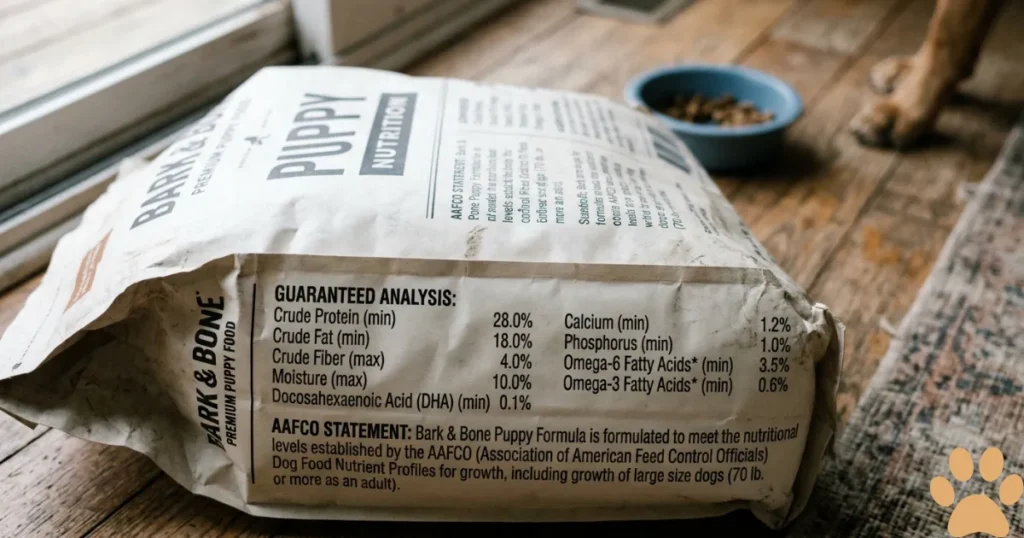
The AAFCO Nutritional Adequacy Statement
It exists in two versions and is not interchangeable between them.
- “Formulated to meet AAFCO standards for large-breed puppy growth” – nutrient calculations meet minimums on paper. No real animals were fed.
- “Animal feeding tests using AAFCO procedures substantiate complete and balanced nutrition for large-breed puppy growth” – real animals were fed under controlled conditions, and health outcomes were measured.
For golden retriever puppy food, the second statement reflects a meaningfully higher evidence standard. Seek it where available.
Guaranteed Analysis: The Numbers That Matter.
| Nutrient | Target Range | Why It Matters for Golden Retrievers |
| Calcium (as-fed) | 1.0–1.5% | Excess causes developmental joint disease |
| Ca:P Ratio | 1.2:1 to 1.4:1 | Imbalance impairs bone mineralisation |
| Protein (dry matter) | 25–30% | Supports taurine synthesis, muscle growth |
| Fat (dry matter) | 12–16% | Moderate density prevents excess growth rate |
| DHA | Listed in analysis | Neural and retinal development |
Ingredient Panel Red Flags.
- Peas, lentils, or chickpeas in the first five ingredients – taurine pathway risk.
- “Poultry,” “meat,” or “animal by-products” without species identification – unverifiable quality.
- BHA, BHT, or Ethoxyquin as preservatives – synthetic additives with safety concerns.
- No named omega-3 source anywhere in the ingredient list.
Decision checkpoint:
If the guaranteed analysis panel shows calcium above 1.6% as-fed and the formula isn’t explicitly labelled large breed puppy, that formula is not appropriate for a Golden Retriever under 15 months – regardless of how the rest of the label reads.
Golden Retriever Puppy Feeding Schedule: Portions, Frequency, and Timing.
Golden retriever puppy food should be served three times daily from 8 to 12 weeks, transitioning to twice daily from 12 weeks onward – with portions calibrated to current body weight and adjusted every two to three weeks during active growth phases.
| Age | Approx. Weight | Meals/Day | Approx. Daily Portion |
| 8–12 weeks | 8–15 lbs | 3 | ¾ – 1¼ cups |
| 3–4 months | 20–30 lbs | 2–3 | 1½ – 2 cups |
| 5–6 months | 35–45 lbs | 2 | 2 – 2¾ cups |
| 7–9 months | 50–60 lbs | 2 | 2½ – 3¼ cups |
| 10–12 months | 55–70 lbs | 2 | 2¾ – 3½ cups |
Portions are approximate. Cross-reference with formula kcal/cup. Weigh daily portions in grams – cup density varies significantly by kibble size.
Transitioning to Adult Food:
Move from golden retriever puppy food to adult formula between 12 and 15 months, when the puppy reaches approximately 90% of expected adult weight.
Transition over 10 – 14 days:
75% puppy/ 25% adult for days 1 – 3, 50/50 for days 4 – 7, 25/75 for days 8 – 11, 100% adult from day 12.
Over the years, I’ve noticed that the body condition score divergence – where a Golden Retriever puppy begins to visibly gain excess fat despite seemingly appropriate portions – most often occurs between months four and six. At this stage, owners are still feeding the same puppy food the dog was on three weeks earlier. Recalibrating every two weeks, not every month, is the practical solution. A visible waist from above and easily palpable ribs are the benchmarks to maintain.
5 Signs Your Current Golden Retriever Puppy Food Isn’t Working.
1. Soft or inconsistent stools persisting beyond two weeks.
A settling period of seven to ten days on new food is normal. Loose stools beyond two weeks – after parasites and environmental adjustment are ruled out – typically indicate the formula’s fat content, fibre profile, or a specific ingredient is not well-tolerated by the puppy’s developing digestive system. Reduce fat percentage before concluding it’s a protein sensitivity.
2. Coat appearing dull, sparse, or rough by 12 – 16 weeks.
A Golden Retriever puppy’s coat at this age should be soft, increasingly dense, and showing natural lustre. Dullness or roughness developing this early almost always reflects omega-3 inadequacy – either a missing marine source or a formula in which omega-3s have degraded due to improper storage. Check the ingredient panel for fish oil or salmon oil, and verify the bag has been stored in a sealed airtight container.
3. Visible hunger after appropriately sized meals.
Persistent foraging behaviour – searching the floor, following you to the kitchen between meals – after a correctly portioned meal can signal the formula’s satiety profile is poor. High-starch, low-fibre formulas digest faster and provide less sustained satiety than formulas with quality prebiotic fibre (beet pulp, chicory root). Consider a formula with higher fibre content rather than simply increasing portion size.
4. Waistline loss with ribs becoming difficult to feel.
This signals unintentional weight gain from caloric excess – the most common outcome of measuring by cup rather than weighing by gram. A formula that delivers 400 kcal/cup, measured by cup, will consistently over-deliver calories if the owner’s cup technique varies. Transition to gram-based weighing immediately and reduce daily intake by 10%.
5. Recurring soft spots or swelling around joints.
Any joint swelling, asymmetrical limb development, or reluctance to bear weight in a puppy under 12 months warrants immediate veterinary assessment – but also a dietary review. Developmental orthopaedic lesions at this age may be associated with calcium levels above the safe threshold for large-breed growth. This is a signal to check the guaranteed analysis of the current formula against the 1.0 – 1.5% as-fed calcium target.

9 Vet-Backed Golden Retriever Puppy Food Tips Most Guides Don’t Cover.
1. Never use a puppy food for more than three weeks from an open bag.
Kibble oxidises once exposed to air, degrading omega-3 fatty acids faster than any other nutrient. DHA – critical for golden retriever puppy brain and cardiac development – is among the first casualties. Buy bag sizes that your puppy finishes within three weeks, and transfer immediately to a sealed, airtight container.
2. Weigh every meal in grams, not cups.
Kibble density variation between formulas is significant enough to create 30 – 40% caloric discrepancies at the same cup volume. A kitchen scale costs very little and eliminates the most common source of inadvertent overfeeding in golden retriever puppies.
3. Body condition score weekly – not monthly.
A Golden Retriever puppy’s growth rate changes fast enough that monthly check-ins miss the window for correction. Weekly BCS assessment – visible waist from above, ribs palpable but not visible – takes 60 seconds and allows timely adjustments before overfeeding compounds.
4. Never supplement calcium on top of complete puppy food.
Large-breed puppy formulas are already calcium-calibrated. Adding dairy, bone broth, or calcium tablets to a complete formula raises the total above the safe threshold and directly increases the risk of developmental orthopaedic disease.
5. Treat calories count – always.
Ten small training treats per day can add 100- 200 calories – up to 15% of a Golden Retriever puppy’s daily budget. Low-calorie training alternatives: small pieces of plain cooked chicken, blueberries, and carrot slices. Include treat calories in the daily total.
6. Do not interpret hunger as underfeeding.
Golden Retriever puppies appear perpetually hungry – this is a breed trait, not a signal that the formula is insufficient. Appetite is not a reliable indicator of feeding. Body condition score is.
7. Introduce one supplement at a time, two weeks apart.
If adding fish oil, a probiotic, or a joint supplement, establish the baseline diet first for two weeks before adding anything. Introducing multiple supplements simultaneously makes it impossible to identify the cause of any digestive response.
8. Keep the same formula through the puppy phase unless clinically indicated.
Digestive stability in the first 15 months supports gut microbiome development. Switching golden retriever puppy food for variety or marketing reasons – without a clinical reason – unnecessarily disrupts this.
9. Schedule a nutrition review at the 6-month veterinary appointment.
By six months, the puppy’s growth trajectory is trackable and dietary responses – coat condition, stool consistency, energy, body weight trend – are established enough to evaluate. A nutrition check at this point allows adjustments before the second half of the growth phase.
Vet’s Tip: The most overlooked difference between golden retriever puppy food recommendations and what owners actually buy is the AAFCO statement. “Formulated to meet” and “feeding trial verified” are not the same – but they look nearly identical on a bag. Before buying any formula, turn it over and find that statement specifically. If it says “formulated to meet,” the food has never been fed to a real animal under controlled conditions. For a breed as developmentally specific as a Golden Retriever, that distinction matters.
What is the best golden retriever puppy food?
Royal Canin Golden Retriever Puppy is the only breed-specific formula available. Purina Pro Plan Large Breed Puppy is the most research-backed alternative. Both are AAFCO feeding-trial verified with controlled calcium and marine-source DHA.
What nutrients should golden retriever puppy food contain?
DHA from marine sources, calcium calibrated between 1.0 – 1.5% as-fed, minimum 25% protein from named animal sources, a Ca:P ratio of 1.2:1 to 1.4:1, and a grain-inclusive carbohydrate base. These address the breed’s documented developmental vulnerabilities directly.
Is grain-free food okay for golden retriever puppies?
No – not as a default. Grain-free, legume-heavy diets are associated with diet-related DCM in Golden Retrievers. Starting a puppy on one maximises cumulative exposure. Grain-inclusive is the correct default unless a vet has confirmed a specific grain sensitivity.
How much golden retriever puppy food should I feed per day?
Portions vary by age and formula caloric density. Use the kcal/cup value to calculate the current body weight in grams, and adjust every 2 to 3 weeks based on body condition score – not appetite or the manufacturer’s feeding chart alone.
When should I switch from golden retriever puppy food to adult food?
Between 12 and 15 months, the puppy reaches approximately 90% of the expected adult weight. Transition over 10 – 14 days using graduated ratios. Switching before 12 months introduces calcium levels not calibrated for the final skeletal growth phase.
Can I feed my golden retriever puppy adult dog food?
No. Adult formulas contain higher calcium levels calibrated for maintenance, not skeletal growth. Feeding adult foods during active bone development increases the risk of developmental orthopaedic disease. Stay on large-breed puppy food until 12 to 15 months.
How many times a day should a golden retriever puppy eat?
Three times daily from 8 to 12 weeks; twice daily from 12 weeks onward. Structured mealtimes – not free access – support accurate intake monitoring and make appetite changes easier to detect early.
Does golden retriever puppy food need DHA?
Yes. DHA is the primary structural fat in the developing brain and retina and must come from a marine source – fish oil or salmon oil. Plant-based ALA converts to DHA at insufficient rates in dogs to meet the developmental requirements of puppyhood.
What calcium level is correct for golden retriever puppy food?
Target 1.0 – 1.5% as-fed, with a Ca:P ratio of 1.2:1 to 1.4:1. Calcium above 1.6% as-fed in a non-calibrated formula accelerates bone mineralisation beyond what cartilage development can safely accommodate in a growing Golden Retriever.
What should I look for in golden retriever puppy food recommendations?
AAFCO feeding trial verification, “large breed puppy” designation, named animal protein first, marine-source DHA, calcium within 1.0 – 1.5% as-fed, grain-inclusive carbohydrates, and no peas or lentils in the first five ingredients.
Are there golden retriever puppy food recommendations for sensitive stomachs?
Yes. Hill’s Science Diet Large Breed Puppy and Purina Pro Plan Sensitive Skin & Stomach Large Breed Puppy are both AAFCO-verified, lower in fat, and include prebiotic fibre supporting gut microbiome development during the post-weaning transition period.
What makes Royal Canin Golden Retriever Puppy different?
It is the only puppy formula formulated specifically for Golden Retrievers – not large breeds in general. Nutrient ratios, antioxidant complex, and kibble shape are all calibrated to Golden Retriever developmental biology. AAFCO feeding trial verified.
Should I add fish oil to my golden retriever puppy’s food?
Only if the current formula does not already contain a named marine omega-3 source. Adding fish oil to a formula already containing salmon oil risks exceeding the appropriate fat intake for the puppy’s age. Verify the baseline formula first, then supplement if genuinely deficient.
How do I transition golden retriever puppy food to a new formula?
Over 10 – 14 days: 75% old/ 25% new for days 1 – 3, 50/50 for days 4 – 7, 25% old/ 75% new for days 8 – 11, 100% new from day 12. Extend each phase by two to three days if digestive upset occurs before proceeding.
What are signs golden retriever puppy food isn’t working?
Persistent loose stools beyond two weeks, dull or rough coat developing by 12 – 16 weeks, visible weight gain with ribs becoming hard to feel, persistent hunger after correct portions, or any joint swelling or irregular limb development.
Conclusion.
Golden retriever puppy food is not a category where any large-breed formula will do. The breed’s documented predispositions – orthopaedic disease, cardiac vulnerability, and skin sensitivity – make this a decision that requires breed-specific criteria, not just general puppy nutrition principles.
Follow credible golden retriever puppy food recommendations grounded in those criteria: large-breed calibrated calcium, AAFCO feeding trial verification, named animal protein first, marine-source DHA, and grain-inclusive formulation. Feed structured meals, weigh portions in grams, and track body condition score every two weeks through active growth.
The first 12 to 15 months of a Golden Retriever’s life are the most nutritionally consequential. The decisions made in that window – what goes in the bowl, how much, and how consistently – shape the joints, heart, and immune system the dog will rely on for the next decade. There is no better time to get the fundamentals right.
What Golden Retriever Puppy Food Are You Using?
Choosing the right formula for a Golden Retriever puppy is one of the first challenges new owners face – and real experience from other Golden families is genuinely valuable.
- What formula worked for your puppy?
- Did you navigate a digestive issue, a picky eater, or a transition that took longer than expected?
Share your experience below and help other Golden Retriever owners make a better-informed choice from the start.

Dr. Nabeel A.
Hi, I’m Dr. Nabeel Akram – a farm management professional by trade and a passionate Golden Retriever enthusiast at heart. With years of experience in animal science and livestock care, I’ve built a career around understanding animals—how they live, thrive, and bring value to our lives. This blog is a personal project born from that same passion, focusing on one of the most loyal and lovable breeds out there: the Golden Retriever. Whether I’m managing farm operations or sharing insights on canine health, behavior, and care, it all ties back to one core belief—animals deserve thoughtful, informed, and compassionate attention. Welcome to a space where professional expertise meets genuine love for dogs.
Facebook |
Links will be automatically removed from comments.