
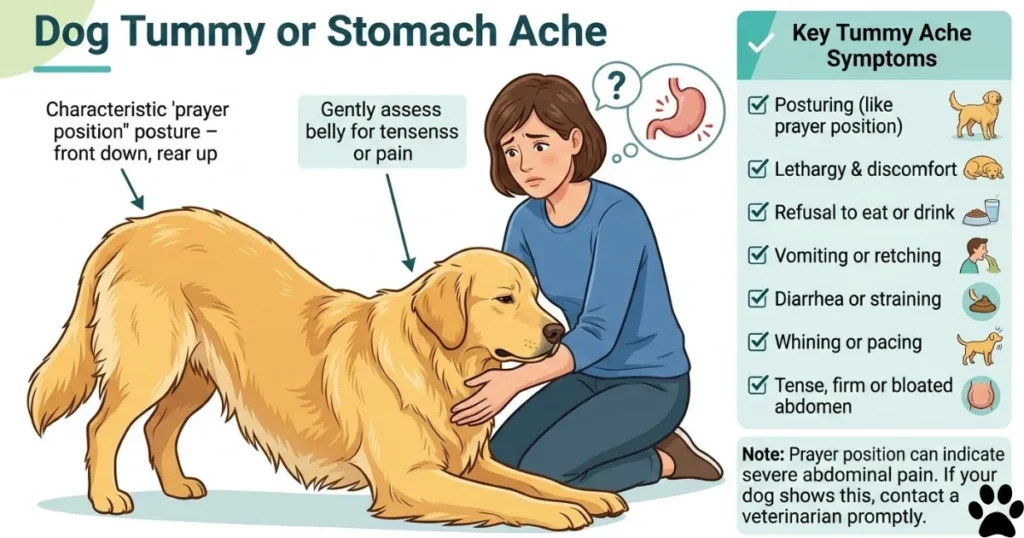
Recognizing when your dog has tummy ache transforms vague worry into decisive action that could save your Golden Retriever’s life. I’ve consulted with dozens of owners who sensed “something wrong” with their dog’s belly – subtle behavior changes, mild restlessness, decreased appetite – but waited hours or days before seeking help, only to discover gastric torsion, intestinal obstruction, or severe pancreatitis requiring emergency surgery. The critical skill isn’t just identifying that your dog has stomach ache, but rather determining within minutes whether the situation demands immediate veterinary intervention versus appropriate home monitoring, understanding which specific behaviors indicate pain versus simple discomfort, and knowing the Golden Retriever-specific tummy ache patterns that signal breed-related emergencies like bloat.
Golden Retrievers demonstrate tummy ache differently than many breeds due to their high pain tolerance masking symptoms until severe, their enthusiastic personality making behavior changes harder to detect against a normally happy demeanor, their deep chest anatomy creating a unique bloat presentation requiring specific recognition, and their tendency toward stress-induced abdominal pain from separation anxiety or routine changes. Additionally, Golden Retrievers’ indiscriminate eating habits mean that when this breed has tummy ache, foreign object ingestion, or dietary indiscretion, these must always be considered as primary causes requiring different management than simple gastritis.
This owner-focused guide provides immediate action protocols when your dog has tummy ache organized by what you observe at home, explains how to assess dog stomach ache severity through simple tests you can perform before deciding on veterinary care, details the specific comfort measures and treatments appropriate for home management versus those requiring professional intervention, and addresses the emergencies where Golden Retriever tummy ache progresses from manageable discomfort to life-threatening crisis within hours.
Contents
- 1 When Your Dog Has Tummy Ache: Immediate Recognition Protocol
- 2 Dog Stomach Ache: Home Treatment for Mild Cases.
- 3 Definitive Statements on Dog Tummy Ache.
- 4 6 Critical Decision Points: Home Care vs. Veterinary Emergency.
- 5 7 Mistakes Owners Make When Dog Has Tummy Ache.
- 5.1 Mistake 1: Waiting Too Long to Seek Care.
- 5.2 Mistake 2: Giving Human Medications.
- 5.3 Mistake 3: Forcing Food.
- 5.4 Mistake 4: Ignoring Prayer Position.
- 5.5 Mistake 5: Overlooking Breed-Specific Risks.
- 5.6 Mistake 6: Continuing Normal Activity.
- 5.7 Mistake 7: Inconsistent Monitoring.
- 5.8 How do I know if my dog has tummy ache?
- 5.9 What should I do immediately when my dog has stomach ache?
- 5.10 How long does dog tummy ache last?
- 5.11 Can I give my dog anything for stomach ache at home?
- 5.12 When is dog stomach ache an emergency?
- 5.13 Why does my Golden Retriever get tummy aches?
- 5.14 What is the prayer position in dogs with tummy ache?
- 5.15 How can I tell if my dog has bloat?
- 5.16 Should I let my dog eat grass when he has tummy ache?
- 5.17 Can stress cause dog stomach ache?
- 5.18 What bland diet should I feed my dog with a tummy ache?
- 5.19 How do I check my dog’s belly for a tummy ache?
- 5.20 Why do Golden Retrievers hide their tummy ache pain?
- 5.21 When should I call the vet about my dog tummy ache?
- 5.22 What foods cause tummy ache in dogs?
- 6 Conclusion.
When Your Dog Has Tummy Ache: Immediate Recognition Protocol
First-response assessment determines your next actions:
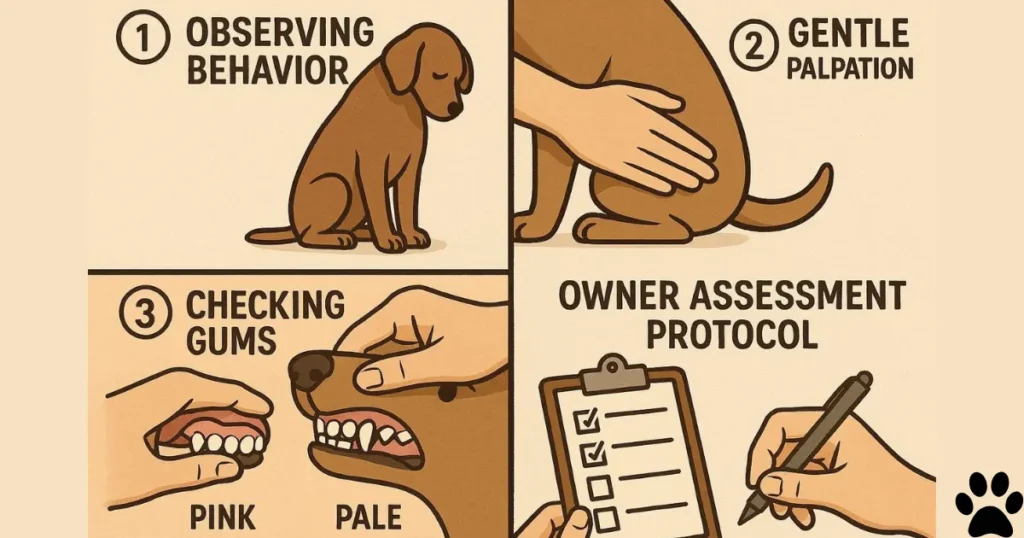
Step 1: Observe Behavior (First 5 Minutes).
What to Look For:
Body Position Indicators:
- Prayer position: Front legs stretched forward, chest down, rear elevated (indicates abdominal pain).
- Hunched posture: Back arched, belly tucked, tense stance.
- Reluctance to lie down: Stands or sits but won’t lie comfortably.
- Frequent position changes: Can’t get comfortable, keeps moving.
- Restlessness and pacing: Walks the room repeatedly, doesn’t settle.
Behavioral Signs:
- Decreased activity: Unusually quiet, withdrawn.
- Seeking isolation: Hides in closets, under furniture.
- Attention-seeking: Repeatedly approaches the owner, whines.
- Anxious expression: Worried facial expression, ears back.
- Looking at belly: Turns head toward abdomen repeatedly.
Vocalization:
- Whining or whimpering: Especially when moving.
- Groaning when lying down.
- Yelping if the belly is touched.
- Unusual silence: Normally, a vocal dog becomes quiet.
Step 2: Gentle Physical Assessment.
Safe Examination Protocol:
Abdominal Palpation (Only if Dog Tolerates):
- Approach calmly – speak soothingly
- Place flat hand on belly – very gentle pressure
- Note reactions:
- Flinching or pulling away (pain)
- Tense, hard abdomen (serious concern)
- Soft, pliable belly (less concerning)
- Distended, tight abdomen (EMERGENCY)
- STOP immediately if dog shows pain
Visual Inspection:
- Abdominal distension: Belly appears bloated, larger than normal.
- Visible bloating: Sides of the abdomen stick out abnormally.
- Asymmetry: One side is larger than the other.
Gum Check:
- Normal: Pink, moist, quick color return when pressed.
- Concerning: Pale, white, gray, or bright red.
- Capillary refill: Press the gum, release, and the color should return in 1-2 seconds.
Vet’s Tip: When checking if your dog has tummy ache through gentle belly palpation, compare both sides of the abdomen. Bloat often creates unilateral distension – one side dramatically larger. If you feel firm distension on either side with any GDV symptoms (unproductive vomiting, restlessness), this is an IMMEDIATE emergency. Don’t wait even 30 minutes.
Step 3: Check for Immediate Emergency Signs.
CALL VET IMMEDIATELY if ANY Present:
- Distended, drum-tight abdomen.
- Repeated unsuccessful vomiting attempts (dry heaving).
- Extreme lethargy or collapse.
- Pale or white gums.
- Bloody vomit or diarrhea.
- Severe pain response to gentle touch.
- Difficulty breathing.
- Known toxin ingestion.
Step 4: Document Symptoms.
For Veterinary Consultation:
- When did symptoms start?
- What specific behaviors were observed?
- Any vomiting or diarrhea? (How many times?).
- Last normal meal? What was eaten?
- Any access to garbage, toxins, foreign objects?
- Previous episodes?
- Current medications?
Dog Stomach Ache: Home Treatment for Mild Cases.
When severity assessment indicates mild discomfort without emergency signs:

Withhold Food (But Not Water).
Protocol:
- Remove food immediately for 12-24 hours.
- Provide unlimited fresh water – critical to prevent dehydration.
- Small, frequent water amounts if the dog gulps excessively (prevents vomiting).
- Monitor closely for worsening symptoms.
Duration:
- Adult dogs: 12-24 hours safe.
- Puppies under 6 months: Maximum 12 hours (hypoglycemia risk).
- Senior dogs: 12-18 hours, monitor closely.
- Diabetic dogs: Consult a vet before fasting.
When NOT to Withhold Food:
- If already weak or lethargic.
- If diabetic without vet guidance.
- If symptoms worsen during fasting.
- Young puppies (toy breeds especially).
Create a Comfortable Rest Environment.
Optimize Recovery Space:
Quiet Location:
- Away from household traffic.
- Low lighting.
- Minimal noise.
- Temperature is comfortable (not too warm/cold).
Soft Bedding:
- Thick, comfortable bed.
- Easy access (low height).
- Washable materials (accidents possible).
Easy Water Access:
- Fresh water within reach.
- Multiple water stations.
- Clean bowl frequently.
Minimize Stress:
- Limit visitors, loud noises.
- Maintain a calm household.
- Gentle interaction only.
- No forced activity.
Monitor Key Indicators.
Check Every 2-3 Hours:
Appetite:
- Shows interest in high-value treats?
- Drinks water willingly?
- Any improvement after 6-8 hours?
Activity Level:
- Resting comfortably?
- Responding to interaction?
- Moving normally when awake?
Elimination:
- Normal urination frequency?
- Any bowel movements? (Consistency, color, blood?).
- Straining or difficulty?
Pain Behaviors:
- Prayer position continuing?
- Abdominal tension decreasing?
- Able to rest without restlessness?
Reintroduce Food Gradually.
After 12-24 Hour Fast (If Improving):
Small Bland Meals:
- Boiled boneless skinless chicken.
- Plain white rice.
- Ratio: 1 part chicken to 2 parts rice.
- First meal: 1/4 to 1/2 cup for 70-lb dog.
- Feed every 3-4 hours.
- Very small portions.
Progression:
- Day 1 post-fast: Tiny, frequent meals.
- Day 2-3: Increase portion size slightly.
- Day 4-7: Gradually transition back to regular dog food.
- Mix ratios: 75% bland/25% regular → 50/50 → 25/75 → 100% regular.
If Vomiting Returns:
- Stop food immediately.
- Offer water only.
- Call the veterinarian.
Natural Remedies for a Dog Tummy Ache.
Evidence-Based Supplements:
Plain Pumpkin:
- Soothes GI tract irritation.
- Provides soluble fiber.
- Dosage: 2-4 tablespoons for a 60-80 lb dog.
- Mix with a small amount of bland food.
- Critical: Plain canned only, NOT pie filling.
Probiotics:
- Restores beneficial gut bacteria.
- Reduces harmful bacteria overgrowth.
- Types: Veterinary formulas best (Proviable, FortiFlora).
- Dosage: Follow product instructions.
- Give separately from meals for best absorption.
Bone Broth (Plain, Homemade):
- Gentle on the stomach.
- Provides hydration and nutrients.
- Soothing warmth.
- Make: Simmer bones 12-24 hours, strain, remove fat layer.
- Critical: NO onions, garlic, seasonings.
- Offer cooled to room temperature.
Slippery Elm Bark:
- Creates protective mucilage coating.
- Reduces inflammation.
- Dosage: 1/4 tsp powder per 10 lbs body weight.
- Mix with water to form a paste.
- Give 30 minutes before meals.
- 2-3 times daily for 3-5 days.
Definitive Statements on Dog Tummy Ache.
In veterinary emergency medicine, the time between “my dog has tummy ache” and life-threatening bloat requiring surgery can be as short as 1-2 hours in Golden Retrievers. The deep chest anatomy creating GDV risk means any dog stomach ache involving abdominal distension and unproductive vomiting demands immediate evaluation – not 4-hour observation to “see if it gets better.”
Golden Retrievers’ high pain tolerance means that when this breed visibly demonstrates a tummy ache through a prayer position, reluctance to move, or vocalization, the actual pain level is likely severe. Unlike breeds that vocalize dramatically with minor discomfort, Golden Retrievers typically minimize pain responses, making their obvious discomfort indicators more clinically significant.
Understanding when your dog has stomach ache versus experiencing normal post-meal gas or temporary hunger discomfort requires pattern recognition rather than single observations. One-time mild belly rumbling after eating differs categorically from sustained prayer position, repeated position changes, and persistent restlessness over 2-4 hours – the latter pattern demands veterinary assessment regardless of appetite maintenance.
The most dangerous assumption when your dog has tummy ache is that waiting overnight to “see if it gets better” remains safe. Foreign object obstructions, gastric torsion, severe pancreatitis, and intestinal intussusception all progress rapidly – conditions survivable with 2-hour intervention have 50%+ mortality if delayed 12-24 hours.
Home treatment for dog stomach ache, including fasting, a bland diet, and comfort measures, appropriately manages simple dietary indiscretion but delays appropriate care for serious conditions when owners miss emergency indicators. The critical decision point is recognizing when symptoms exceed home management capability within the first 1-2 hours of onset.
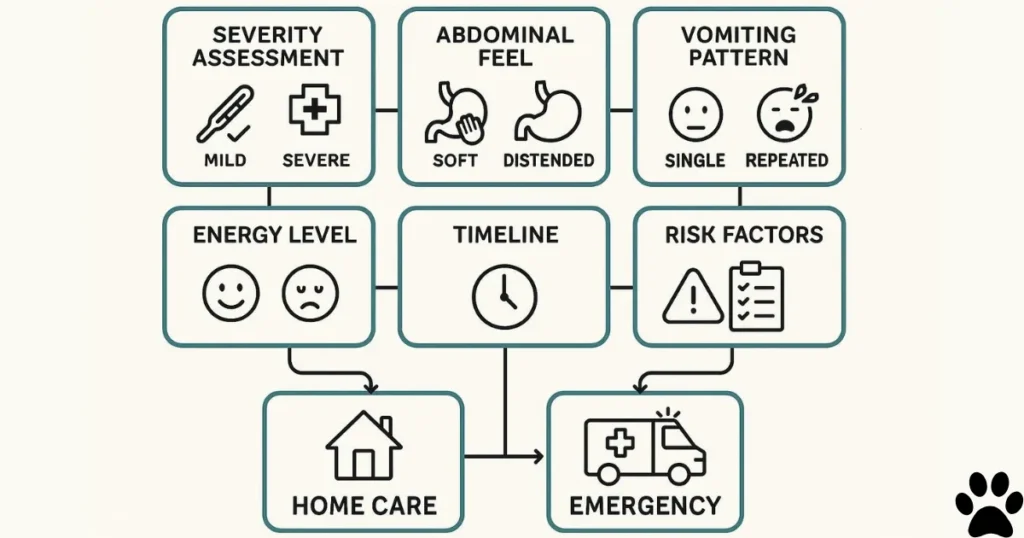
6 Critical Decision Points: Home Care vs. Veterinary Emergency.
Decision Point 1: Severity of Visible Distress.
Home Care Appropriate:
- Mild discomfort, still interactive.
- Occasional prayer position, but also rests normally.
- Responds positively to gentle touch.
- Maintains interest in surroundings.
Veterinary Care Required:
- Obvious severe pain (crying, unable to rest).
- Continuous prayer position held 30+ minutes.
- Withdraws aggressively from gentle touch.
- Unresponsive to comfort attempts.
Decision Point 2: Abdominal Appearance and Feel.
Home Care Appropriate:
- Soft, pliable abdomen.
- No visible distension.
- Tolerates gentle palpation.
- Symmetrical appearance.
Veterinary Emergency:
- Distended, bloated appearance.
- Hard, tense, board-like feel.
- Painful response to the lightest touch.
- Visible unilateral (one-sided) swelling.
- Drum-tight abdomen.
Decision Point 3: Vomiting Pattern.
Home Care Appropriate:
- Single vomiting episode.
- Able to keep water down.
- No repeated attempts 4+ hours.
- Vomit contains food only.
Veterinary Care Required:
- Repeated vomiting (3+ times in 4 hours).
- Unproductive vomiting (tries but nothing comes up).
- Bloody vomit (red blood or coffee-ground appearance).
- Cannot keep water down.
- Projectile vomiting.
Decision Point 4: Energy Level and Responsiveness.
Home Care Appropriate:
- Decreased energy but still responsive.
- Recognizes family members.
- Interested in high-value treats even if they refuse.
- Able to stand and walk normally.
Veterinary Emergency:
- Extreme lethargy, won’t stand.
- Glassy-eyed, vacant stare.
- Doesn’t respond to name or favorites.
- Collapse or inability to walk.
- Progressive weakness.
Decision Point 5: Timeline and Progression.
Home Care Appropriate:
- Symptoms stable over 2-4 hours.
- Gradual improvement is visible.
- Good moments between discomforts.
- Symptoms less than 12 hours with an improvement trend.
Veterinary Care Required:
- Rapidly worsening symptoms (worse every hour).
- No improvement after 12 hours.
- New severe symptoms are appearing.
- Symptoms 24+ hours without improvement.
Decision Point 6: Known Risk Factors.
Home Care Appropriate:
- Simple dietary indiscretion (ate something unusual).
- No access to toxins or foreign objects.
- Previous similar episodes resolved at home.
- Young healthy adult dog.
Veterinary Emergency:
- Known toxin ingestion (chocolate, xylitol, etc).
- Possible foreign object consumption.
- Breed at high bloat risk (Golden Retriever).
- Senior dog or chronic disease present.
- First tummy ache episode in a previously healthy dog.
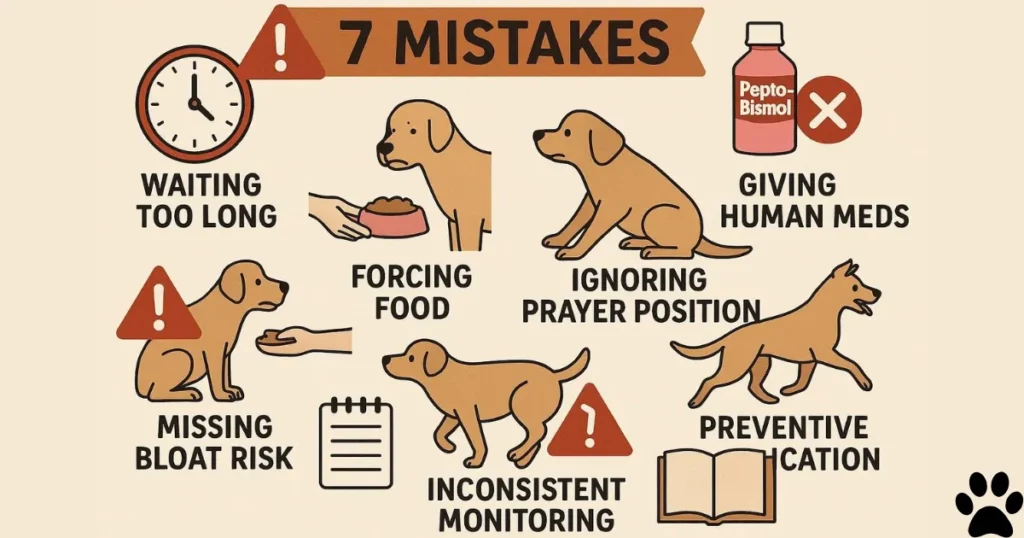
7 Mistakes Owners Make When Dog Has Tummy Ache.
Mistake 1: Waiting Too Long to Seek Care.
The Error: “Let’s see if he’s better in the morning”.
Why Dangerous: Bloat, obstructions, and pancreatitis progress rapidly. 12-hour delays turn survivable conditions into fatal ones.
Correct Approach: If symptoms worsen over 2-4 hours or fail to improve after 6-8 hours, seek evaluation. Emergency symptoms require immediate care, regardless of the time of day.
Mistake 2: Giving Human Medications.
The Error: Administering Pepto-Bismol, Imodium, and Tums without veterinary guidance.
Why Dangerous:
- Some safe for humans are toxic to dogs.
- May mask serious symptoms.
- Delay appropriate diagnosis.
- Interact with the dog’s medications.
Correct Approach: NEVER give human medications without explicit veterinary approval for that specific situation.
Mistake 3: Forcing Food.
The Error: “He needs to eat something” when the dog refuses.
Why Dangerous: Nauseous dogs vomit food immediately. Forces dogs to expend energy eating when they need rest. May worsen symptoms.
Correct Approach: Respect appetite loss. Withhold food for 12-24 hours, focus on hydration. Reintroduce gradually, only when improved, with a bland diet.
Mistake 4: Ignoring Prayer Position.
The Error: “He’s just stretching” when the dog holds a position repeatedly.
Why Dangerous: Prayer position held continuously indicates significant abdominal pain. Not normal stretching. Requires veterinary assessment.
Correct Approach: If the prayer position is held for 10+ minutes or repeated multiple times over 1-2 hours without playful context, consider a veterinary evaluation.
Mistake 5: Overlooking Breed-Specific Risks.
The Error: Not considering bloat risk in a deep-chested Golden Retriever.
Why Dangerous: Bloat requires surgery within hours. Golden Retrievers’ anatomy creates an elevated risk. Delay is fatal.
Correct Approach: Any abdominal distension + unproductive vomiting in a Golden Retriever = immediate emergency regardless of other factors.
Mistake 6: Continuing Normal Activity.
The Error: Taking the dog for a walk or play to “work it out”.
Why Dangerous? Exercise worsens many causes of tummy aches. Bloat risk increases. A foreign object may shift dangerously.
Correct Approach: Complete rest. No exercise until symptoms fully resolved 24+ hours. Gentle short potty breaks only.
Mistake 7: Inconsistent Monitoring.
The Error: Checking once, assuming stable.
Why Dangerous: Conditions deteriorate rapidly. What’s mild at 10 AM becomes an emergency by 2 PM.
Correct Approach: Check every 2-3 hours minimum. Document changes. Reassess severity frequently.
How do I know if my dog has tummy ache?
Signs your dog has tummy ache: prayer position (front legs stretched, rear legs elevated), hunched posture, decreased appetite, restlessness, seeking isolation, looking at the belly repeatedly, reluctance to lie down, whining, belly rumbling, and gentle touch causes flinching.
What should I do immediately when my dog has stomach ache?
Immediate actions: assess severity (check for emergency signs), withhold food for 12-24 hours, provide unlimited water, create a quiet, restful space, monitor every 2-3 hours, document symptoms, call the vet if symptoms worsen, seek emergency care for bloat/severe pain.
How long does dog tummy ache last?
Mild dietary indiscretion: 24-48 hours with home care. Moderate gastritis: 3-5 days. Serious conditions require veterinary treatment. If symptoms persist for more than 24 hours without improvement or worsen within 4-6 hours, veterinary evaluation is needed.
Can I give my dog anything for stomach ache at home?
Safe home remedies: withhold food 12-24 hours, provide water, plain pumpkin (2-4 tbsp), probiotics, and a bland diet after fasting, and slippery elm bark. Do NOT give human medications without veterinary approval. Never give Pepto-Bismol, Imodium, or Tums without vet guidance.
When is dog stomach ache an emergency?
Emergency signs: distended, tight abdomen, repeated unproductive vomiting (dry heaving), bloody vomit/diarrhea, extreme lethargy/collapse, pale gums, severe pain response, difficulty breathing, known toxin ingestion, symptoms 24+ hours without improvement, Golden Retriever bloat risk.
Why does my Golden Retriever get tummy aches?
Golden Retriever causes: dietary indiscretion (eating inappropriate items), stress-induced gastritis (separation anxiety, changes), pancreatitis (breed predisposition), bloat (deep chest anatomy), food sensitivities, parasites, foreign object ingestion, and exercise after meals.
What is the prayer position in dogs with tummy ache?
Prayer position: front legs stretched forward, chest down on the ground, rear end elevated. Looks like play bow but held continuously without playful context. Indicates significant abdominal pain. If held 10+ minutes or repeated frequently, it requires veterinary evaluation.
How can I tell if my dog has bloat?
Bloat symptoms: distended drum-tight abdomen, repeated unsuccessful vomiting attempts (trying but nothing comes up), excessive drooling, rapid shallow breathing, pale gums, extreme restlessness/pacing, weakness/collapse. THIS IS LIFE-THREATENING. Emergency surgery is required immediately.
Should I let my dog eat grass when he has tummy ache?
Small amounts of grass eating are normal self-soothing. However, frantic compulsive grass consumption indicates significant nausea. If grass eating is accompanied by vomiting, pain behaviors, or continued symptoms, veterinary evaluation is needed.
Can stress cause dog stomach ache?
Yes, stress causes gastritis in Golden Retrievers frequently due to emotional sensitivity. Triggers: boarding, vet visits, household changes, separation anxiety, storms, travel. Stress increases stomach acid and delays gastric emptying, causing tummy ache symptoms.
What bland diet should I feed my dog with a tummy ache?
Bland diet: boiled boneless skinless chicken or lean turkey mixed with plain white rice (1:2 ratio). Feed small amounts every 3-4 hours after a 12-24 hour fast. Gradually increase portions over 2-3 days, then transition back to regular food slowly.
How do I check my dog’s belly for a tummy ache?
Gentle palpation: approach calmly, place a flat hand on the belly with very gentle pressure, note if the dog flinches/pulls away (pain), check if the abdomen feels soft/pliable (less concerning) or hard/tense (serious), look for visible distension, STOP if the dog shows pain.
Why do Golden Retrievers hide their tummy ache pain?
Golden Retrievers have high pain tolerance and a people-pleasing nature, making them minimize pain responses to avoid disappointing owners. When this breed shows obvious pain (prayer position, vocalization), actual discomfort is likely severe – making their pain signals more clinically significant.
When should I call the vet about my dog tummy ache?
Call vet: symptoms worsening over 2-4 hours, no improvement after 12 hours, repeated vomiting, bloody vomit/stool, severe pain, abdominal distension, extreme lethargy, can’t keep water down, known toxin access, any uncertainty about severity, Golden Retriever showing bloat symptoms.
What foods cause tummy ache in dogs?
Common causes: fatty foods (bacon, fried items trigger pancreatitis), spoiled food, garbage, sudden diet changes, dairy products, human food with garlic/onions, excessive treats, new foods introduced too quickly, food sensitivities (beef, chicken, wheat).
Conclusion.
When your dog has tummy ache, immediate recognition and an appropriate response determine the outcome. Mild dog stomach ache from dietary indiscretion presents with decreased appetite, occasional prayer position, mild restlessness, and belly rumbling – manageable with 12-24 hours of fasting, a bland diet, plain pumpkin, probiotics, and a quiet rest environment. These cases typically resolve within 24-48 hours with home care and close monitoring every 2-3 hours.
Emergencies requiring immediate veterinary intervention include a distended, tight abdomen (bloat risk), repeated unsuccessful vomiting attempts, bloody vomit or diarrhea, extreme lethargy or collapse, severe pain responses, and any symptoms in Golden Retrievers suggesting gastric torsion. The breed’s deep chest anatomy creates elevated bloat risk, where 1-2 hour delays between symptom onset and emergency surgery dramatically reduce survival rates.
Critical decision points distinguishing home care from veterinary emergency include severity of visible distress (mild discomfort versus obvious severe pain), abdominal appearance (soft pliable versus distended tight), vomiting pattern (single episode versus repeated or unproductive), energy level (decreased but responsive versus extreme lethargy), and symptom progression (stable or improving versus rapidly worsening). When any indicator suggests a serious condition, immediate evaluation prevents progression from manageable to fatal.
The most dangerous mistakes include waiting overnight to “see if better,” giving human medications without veterinary approval, forcing food when the dog refuses, ignoring the prayer position as “just stretching,” overlooking the Golden Retriever bloat risk, continuing normal activity, and inconsistent monitoring. Understanding that tummy ache can progress from mild to life-threatening within hours – especially in Golden Retrievers with GDV risk – makes aggressive early intervention the safest approach when any doubt exists about severity.
Has Your Golden Retriever Had a Tummy Ache Scare?
Share your experience with recognizing and responding to stomach pain.
- What symptoms did you notice?
- How did you decide between home care and a vet visit?
- What treatment helped?
Your stories help other owners make critical decisions quickly. Tell us your tummy ache story in the comments or tag #GoldenRetrieverHealth and #DogTummyAche.

Dr. Nabeel A.
Hi, I’m Dr. Nabeel Akram – a farm management professional by trade and a passionate Golden Retriever enthusiast at heart. With years of experience in animal science and livestock care, I’ve built a career around understanding animals—how they live, thrive, and bring value to our lives. This blog is a personal project born from that same passion, focusing on one of the most loyal and lovable breeds out there: the Golden Retriever. Whether I’m managing farm operations or sharing insights on canine health, behavior, and care, it all ties back to one core belief—animals deserve thoughtful, informed, and compassionate attention. Welcome to a space where professional expertise meets genuine love for dogs.
Facebook |
Links will be automatically removed from comments.