

I often see Golden Retriever owners arrive with a bag of food chosen because it sounded premium or was recommended at a feed store without much nutritional context. Black Gold is one of those brands that circulates in certain owner communities – particularly among those with working dogs or high-activity breeds – but rarely gets a genuinely thorough evaluation against what Golden Retrievers actually need.
Black Gold is a performance and working dog food brand. That positioning matters because a food designed for high-activity sporting dogs is not automatically appropriate for every Golden Retriever. Some are field dogs covering miles daily. Many more are companion dogs with moderate activity levels living in family homes. Feeding a high-protein, high-fat performance formula to a sedentary Golden is a direct path to weight gain, digestive stress, and the joint problems this breed is already predisposed to.
What I want to give you here is an honest, ingredient-level assessment of black gold dog food – what it contains, where it performs well, where it falls short for this breed, and which Golden Retrievers it is and isn’t appropriate for. No filler, no brand loyalty.
Contents
- 1 What Is Black Gold Dog Food?
- 2 Black Gold Dog Food Ingredients: What’s Actually in the Bag
- 3 How Black Gold Dog Food Compares to Golden Retriever Nutritional Requirements.
- 4 5 Types of Golden Retrievers Black Gold May Be Appropriate For.
- 5 6 Limitations of Black Gold Dog Food for Golden Retrievers.
- 6 7 Signs Black Gold Dog Food Is or Isn’t Working for Your Golden Retriever.
- 6.1 Signs it is working:
- 6.2 1. Firm, consistent stools
- 6.3 2. Maintained energy without restlessness
- 6.4 3. Stable body weight at an appropriate body condition score
- 6.5 4. Coat maintaining baseline condition
- 6.6 Signs it is not working:
- 6.7 5. Progressive weight gain despite package portions
- 6.8 6. Recurring soft stools beyond the transition period
- 6.9 7. Dull or brittle coat developing over 2 – 3 months
- 7 Black Gold Dog Food vs Alternatives for Golden Retrievers.
- 8 8 Vet-Backed Tips if you’re Feeding Black Gold to a Golden Retriever.
- 8.1 Is Black Gold dog food good for Golden Retrievers?
- 8.2 Who manufactures Black Gold dog food?
- 8.3 What are the main ingredients in Black Gold dog food?
- 8.4 Does Black Gold dog food contain corn?
- 8.5 Is Black Gold Sport dog food appropriate for Golden Retrievers?
- 8.6 Does Black Gold dog food contain omega-3 fatty acids?
- 8.7 Can Golden Retriever puppies eat Black Gold dog food?
- 8.8 How does Black Gold dog food compare to Purina Pro Plan for Golden Retrievers?
- 8.9 Is Black Gold dog food AAFCO certified?
- 8.10 Does Black Gold dog food help with Golden Retriever coat health?
- 8.11 Is Black Gold dog food appropriate for senior Golden Retrievers?
- 8.12 Does Black Gold dog food cause digestive problems in Golden Retrievers?
- 8.13 Where is Black Gold dog food available?
- 8.14 Is Black Gold dog food grain-free?
- 8.15 What supplements does a Golden Retriever need if fed Black Gold dog food?
- 9 Conclusion.
What Is Black Gold Dog Food?
Black Gold is a brand produced by Sunshine Mills, one of the largest private-label and store-brand pet food manufacturers in the United States. That manufacturer detail is one the brand does not lead with, and it’s worth knowing.
Black Gold dog food is manufactured by Sunshine Mills, a private-label producer responsible for dozens of store-brand and budget-to-mid-tier pet food products – a manufacturing context that directly informs expectations about ingredient sourcing and quality control compared to single-source premium brands.
Sunshine Mills produces food for a wide range of price points and brands simultaneously. This is not inherently disqualifying – many legitimate pet food brands use contract manufacturing – but it is a meaningful contrast to single-facility manufacturers like Fromm, and it affects how consistently ingredient quality can be controlled across production runs.

Black Gold markets itself around three core product lines:
Black Gold Explorer
The flagship formula, designed as an all-life-stages or adult maintenance food
Black Gold Sport
Higher protein and fat; explicitly positioned for active and working dogs
Black Gold Select
A mid-tier option with different protein profiles
For Golden Retriever owners, the Explorer and Sport formulas are the most commonly encountered. Understanding which formula is being evaluated matters because their nutritional profiles differ significantly.
Black Gold Dog Food Ingredients: What’s Actually in the Bag
The ingredient panel is where an honest black gold dog food assessment has to begin. Most reviews of this brand stay at the level of “it has protein” – here is what the ingredients actually mean for a Golden Retriever.
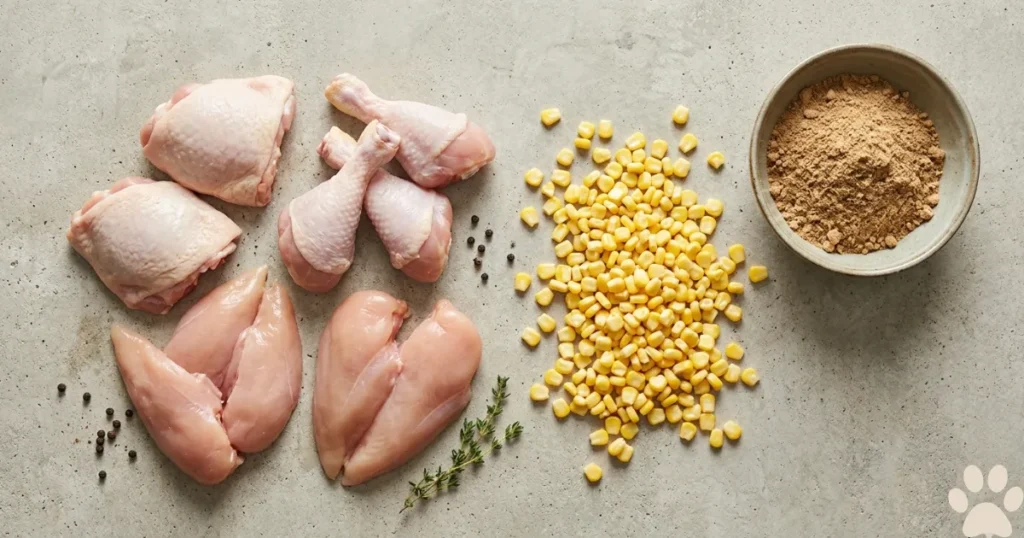
Black Gold Explorer Adult (representative formula):
First five ingredients:
- Chicken
- Chicken Meal
- Corn
- Corn Gluten Meal
- Animal Fat (preserved with Mixed Tocopherols)
What this tells you:
Chicken as the first ingredient is positive – it’s a named, specific animal protein. Chicken meal, as the second ingredient, is also nutritionally sound; concentrated protein with more dry-matter protein than whole chicken by weight.
The third and fourth ingredients are where this formula diverges from premium-tier options. Corn and corn gluten meal are the primary carbohydrate sources. Corn is not inherently harmful – it is a digestible energy source – but corn gluten meal is a plant-derived protein concentrate that inflates the total protein percentage without delivering the same amino acid profile as animal protein. For a breed like the Golden Retriever that needs genuinely bioavailable protein for muscle maintenance and coat health, this distinction matters.
Animal fat as the fifth ingredient is vague. Named fat sources – chicken fat, salmon oil, beef tallow – indicate known origin and consistent composition. “Animal fat” can come from varying sources across production runs, which affects both the omega-6 to omega-3 ratio and palatability consistency.
Black Gold Sport Adult (representative formula):
First five ingredients:
- Chicken
- Chicken Meal
- Corn
- Corn Gluten Meal
- Chicken Fat
The Sport formula delivers higher protein (approximately 30%) and higher fat (approximately 20%) than the Explorer. Chicken fat is a named source – an improvement over generic animal fat – and the elevated protein and fat ratios support high-output working dogs. For field Golden Retrievers with genuine high daily activity, this profile is appropriate. For companion Golden Retrievers, it is calorie-dense beyond what daily maintenance requires.
What’s missing across both formulas?
- No named omega-3 source (fish oil, salmon oil, menhaden) in the primary ingredient list.
- No prebiotics or probiotics listed.
- No joint-supportive compounds (glucosamine, chondroitin) declared.
- No antioxidant-rich whole food ingredients (blueberries, spinach, sweet potato).
For a breed with documented predispositions to joint disease, skin inflammation, and cancer, these absences represent genuine nutritional gaps compared to purpose-formulated premium alternatives.
Vet’s Tip: When evaluating any working-dog food brand like Black Gold for a Golden Retriever, check the fat percentage before the protein percentage. A food with 20% fat fed at the package’s recommended portion to a 65-lb companion Golden will typically deliver 15 – 20% more daily calories than that dog needs – the weight gain appears gradually. It is almost always attributed to the dog’s age or activity level rather than the food’s caloric density.
How Black Gold Dog Food Compares to Golden Retriever Nutritional Requirements.
Over the years, I’ve noticed that Golden Retrievers fed on working-dog or high-performance formulas without appropriate portion calibration tend to present with weight creep by age 3- 4 that owners consistently underestimate. By the time it becomes visible as a body condition issue, the joint stress has already been accumulating for months.
Black Gold dog food formulas are nutritionally designed for high-activity working dogs – a profile that matches active field Golden Retrievers but is misaligned with the energy and joint requirements of the average companion Golden Retriever in a family home setting.
Here is how Black Gold maps against this breed’s core nutritional demands:
| Nutritional Need | Golden Retriever Requirement | Black Gold Performance |
| Quality animal protein | Named animal protein, high bioavailability | Met — chicken and chicken meal in first two positions |
| Omega-3 fatty acids (EPA/DHA) | High — coat, skin, joint, inflammatory support | Not met — no named fish oil or omega-3 source declared |
| Joint support (glucosamine/chondroitin) | Important from adulthood onward | Not declared |
| Controlled caloric density | Important for weight management in companions | Sport formula is high-calorie; requires careful portioning |
| Antioxidant support | Relevant given breed’s cancer predisposition | Limited — no whole food antioxidants listed |
| Digestive support (prebiotics/probiotics) | Beneficial for breed’s tendency toward loose stools | Not included |
| Artificial preservative-free | Preferred | Mixed tocopherols used — acceptable |
| AAFCO compliance | Required | Met — formulation method |
The picture that emerges is a food that covers protein and energy requirements adequately but leaves meaningful gaps in the areas where Golden Retrievers are most nutritionally vulnerable.
5 Types of Golden Retrievers Black Gold May Be Appropriate For.
Black Gold is not universally wrong for this breed. There are specific ownership contexts where it represents a reasonable choice.
1. Active Field and Hunting Golden Retrievers.
Dogs covering 3-5+ hours of physical work daily have genuine high-protein, high-fat requirements. The Black Gold Sport formula’s caloric density is appropriate for this activity profile, and the protein-to-fat ratio supports muscle recovery and sustained energy output.
2. Underweight Golden Retrievers Needing Caloric Rehabilitation.
Under veterinary supervision, the higher caloric density of Black Gold Sport can help underweight adult Goldens regain body condition more efficiently than standard maintenance foods.
3. Budget-Constrained Owners Seeking Better Than Entry-Level.
Black Gold sits at a lower price point than premium brands. For owners who cannot sustain the cost of Fromm, Orijen, or Royal Canin, Black Gold Explorer is a meaningful step above store-brand generic foods, with named animal proteins in the first two positions.
4. Multi-Dog Households with Mixed Breeds.
Households feeding multiple dogs of different breeds, where a single food is impractical, sometimes use Black Gold as a baseline, supplementing individually for higher-need dogs like Golden Retrievers.
5. Short-Term Use during Transitions or Shortages.
As a temporary food during supply issues with a primary formula, Black Gold Explorer is a functional bridge option for adult Golden Retrievers without health complications.
6 Limitations of Black Gold Dog Food for Golden Retrievers.
1. Corn gluten meal inflates protein percentages misleadingly.
The declared protein percentage includes plant-derived protein from corn gluten meal. For Golden Retrievers, the bioavailable animal protein content is lower than the label’s overall protein figure suggests – relevant for muscle maintenance and amino acid completeness.
2. No omega-3 source declared.
Golden Retrievers have among the highest omega-3 requirements of any companion breed due to their skin, coat, and inflammatory predispositions. A food with no named EPA/DHA source requires omega-3 supplementation as a non-negotiable addition – not an optional upgrade.
3. Vague fat source in the Explorer formula.
“Animal fat” without species identification introduces variability in fatty acid composition across production batches. For a breed sensitive to dietary fat composition, named fat sources are preferable.
4. No joint support compounds.
Neither glucosamine nor chondroitin appears in the declared nutrient panel. For Golden Retrievers – a breed where orthopedic issues are a leading cause of reduced quality of life from middle age onward – this represents a missed opportunity that must be addressed through supplementation.
5. Manufactured by a private-label contract producer.
Sunshine Mills produces food for many brands simultaneously. Ingredient sourcing and quality consistency are harder to verify compared to brands with dedicated single-facility manufacturing. This doesn’t make the food unsafe, but it raises the bar on how closely owners should monitor stool quality and coat condition as proxies for batch-to-batch consistency.
6. Not formulated for large-breed-specific needs.
Black Gold does not offer a large-breed-specific formula with controlled calcium and phosphorus ratios. For Golden Retriever puppies especially, this absence makes Black Gold inappropriate as a puppy food – a large-breed-specific formula is clinically necessary during the growth phase.

7 Signs Black Gold Dog Food Is or Isn’t Working for Your Golden Retriever.
Decision checkpoints owners should monitor within the first 8 weeks:
Signs it is working:
1. Firm, consistent stools
Indicates the protein and fiber balance is appropriate for your dog’s digestive system. The corn-based carbohydrate profile delivers adequate fiber for most adult Goldens.
2. Maintained energy without restlessness
Appropriate caloric delivery for your dog’s activity level; no excess energy or post-meal lethargy.
3. Stable body weight at an appropriate body condition score
Particularly on the Explorer formula, weight stability indicates that portioning is calibrated correctly.
4. Coat maintaining baseline condition
Note: coat improvement above baseline is unlikely without omega-3 supplementation alongside this food.
Signs it is not working:
5. Progressive weight gain despite package portions
The Sport formula is calorie-dense; reduce portions by 10- 15% and reassess over 4 weeks before attributing weight gain to other causes.
6. Recurring soft stools beyond the transition period
May indicate sensitivity to corn gluten meal or the animal fat source; consider a food with identified fat sources and no corn gluten meal.
7. Dull or brittle coat developing over 2 – 3 months
Almost certainly indicates omega-3 deficiency; add fish oil immediately and reassess after 6 weeks. If the coat does not respond, the food itself may need to be replaced.
Black Gold Dog Food vs Alternatives for Golden Retrievers.
| Food | Primary Protein | Omega-3 Source | Joint Support | Best For | Price |
| Black Gold Explorer | Chicken + Chicken Meal | None declared | None declared | Budget-conscious adult owners | $ |
| Black Gold Sport | Chicken + Chicken Meal | None declared | None declared | High-activity field Goldens | $ |
| Purina Pro Plan Adult Large Breed | Chicken | Fish oil | Glucosamine declared | Most adult Golden Retrievers | $$ |
| Royal Canin Golden Retriever Adult | Chicken Meal | Fish oil | Declared | Breed-specific management | $$$ |
| Fromm Gold Large Breed Adult | Duck + Chicken + Salmon | Salmon oil + flaxseed | Naturally occurring | Ingredient-conscious owners | $$$ |
| Hill’s Science Diet Large Breed | Chicken Meal | Omega-6 + Vitamin E | Declared | Weight management focus | $$ |
Owner’s Choice note: For the vast majority of Golden Retriever owners seeking a single food that covers this breed’s nutritional priorities without requiring supplementation, Black Gold does not outperform Purina Pro Plan Large Breed at a comparable or lower price point. Pro Plan delivers fish oil, declared glucosamine, and feeding-trial AAFCO certification for roughly the same cost or less, depending on the retailer.

Black Gold’s price advantage only holds if the cost of required supplementation (fish oil, joint support) is not factored in. When it is, the effective cost difference narrows significantly.
8 Vet-Backed Tips if you’re Feeding Black Gold to a Golden Retriever.
- Add a quality fish oil supplement daily – EPA and DHA are not negotiable for this breed. A 1,000 – 2,000 mg fish oil softgel per day is appropriate for most adult Golden Retrievers.
- Choose the Explorer formula over Sport unless your Golden Retriever is genuinely working or exercising for 2+ hours daily. The caloric density difference is meaningful over months.
- Weigh your dog monthly and adjust portions based on body condition score, not package guidelines alone. Package guidelines are built around average activity levels that many companion Goldens do not meet.
- Add a glucosamine and chondroitin supplement starting at age 2- 3 years. Black Gold does not deliver joint support compounds – supplementation is the only way to address this gap.
- Monitor stool quality weekly for the first 60 days. Loose stools persisting beyond the transition period warrant a food change, not just a probiotic addition.
- If your Golden Retriever has any history of skin irritation, ear infections, or food sensitivity, Black Gold is not a first-choice food. The vague fat source and corn gluten meal protein increase the likelihood of dietary triggers.
- Do not feed Black Gold Sport to Golden Retriever puppies under any circumstances. It has no large-breed puppy formulation, and its protein and fat levels are mismatched for controlled skeletal development.
- Reassess the food choice at each annual veterinary exam. If coat quality is declining, weight is trending upward, or joint symptoms are appearing, the food should be among the first variables reconsidered.
Black Gold dog food covers baseline protein and energy requirements for adult Golden Retrievers, but requires omega-3 and joint support supplementation to address the breed’s most critical nutritional vulnerabilities – making it a functional but incomplete choice compared to purpose-formulated large-breed alternatives at comparable cost.
Is Black Gold dog food good for Golden Retrievers?
It depends on the individual dog. Black Gold covers baseline protein needs but lacks declared omega-3 sources and joint support – both critical for this breed. It requires supplementation to close these gaps and is most appropriate for active adult Goldens.
Who manufactures Black Gold dog food?
Black Gold is manufactured by Sunshine Mills, one of the largest private-label pet food producers in the United States. Sunshine Mills also produces many store-brand and budget pet food products under contract.
What are the main ingredients in Black Gold dog food?
The Explorer and Sport formulas lead with chicken and chicken meal as primary protein sources, followed by corn and corn gluten meal as carbohydrate and supplemental protein sources, and animal fat or chicken fat as the primary fat source.
Does Black Gold dog food contain corn?
Yes. Corn and corn gluten meal are primary ingredients in most Black Gold formulas. Corn gluten meal specifically inflates total protein percentages without delivering equivalent bioavailability to animal protein sources.
Is Black Gold Sport dog food appropriate for Golden Retrievers?
Only for genuinely high-activity fields or working Golden Retrievers exercising 2+ hours daily. For companion Goldens, the caloric density of the Sport formula is too high, contributing to weight gain and joint stress.
Does Black Gold dog food contain omega-3 fatty acids?
No named omega-3 source (fish oil, salmon oil, menhaden) appears in the declared ingredients. Golden Retriever owners feeding Black Gold should supplement with fish oil daily to meet the breed’s EPA and DHA requirements.
Can Golden Retriever puppies eat Black Gold dog food?
No. Black Gold does not offer a large-breed puppy formula with the controlled calcium and phosphorus ratios required for safe skeletal development in Golden Retrievers. A large-breed-specific puppy food is necessary.
How does Black Gold dog food compare to Purina Pro Plan for Golden Retrievers?
Purina Pro Plan Large Breed Adult delivers fish oil, declared glucosamine, and feeding-trial AAFCO certification at a comparable or lower price point. For most Golden Retriever owners, Pro Plan is the stronger nutritional choice without requiring supplementation.
Is Black Gold dog food AAFCO certified?
Yes, by the formulation method. It meets AAFCO minimum nutritional standards but has not undergone the feeding trial process used by brands like Purina Pro Plan and Royal Canin.
Does Black Gold dog food help with Golden Retriever coat health?
Not meaningfully on its own. Without a declared omega-3 source, Black Gold cannot support the coat health demands of this breed. Fish oil supplementation alongside the food is necessary for coat outcomes.
Is Black Gold dog food appropriate for senior Golden Retrievers?
With reservations. The Explorer formula is calorie-appropriate if portioned carefully. Still, the lack of joint support compounds and omega-3s makes it nutritionally incomplete for senior Goldens, who need both in higher amounts than younger adults.
Does Black Gold dog food cause digestive problems in Golden Retrievers?
Not typically during a properly managed transition. Corn gluten meal may be a sensitivity trigger for some dogs. Persistent loose stools beyond 2 weeks post-transition warrant investigating a food change.
Where is Black Gold dog food available?
Black Gold is primarily available through rural supply stores, feed stores, and online retailers. It is less commonly stocked in urban specialty pet retailers than premium brands.
Is Black Gold dog food grain-free?
No. Standard Black Gold formulas are grain-inclusive, using corn as the primary carbohydrate source. This is not a disadvantage for most Golden Retrievers, for whom grain-free diets carry an unresolved FDA advisory concern.
What supplements does a Golden Retriever need if fed Black Gold dog food?
At minimum: a daily fish oil supplement for EPA and DHA, and a glucosamine/chondroitin supplement from age 2 – 3 onward. These are not optional additions – they address gaps the food does not cover for this breed’s health requirements.
Conclusion.
Black Gold dog food is an honest, budget-accessible option for working and high-activity dogs. For Golden Retrievers specifically, it is a functional but incomplete choice. It meets protein and energy baselines with named animal proteins in the first two positions, and no artificial preservatives – and that foundation is worth acknowledging.
Where it falls short for this breed is equally clear: no declared omega-3 source, no joint support compounds, no antioxidant-rich whole food ingredients, and a manufacturing context that limits quality control transparency. These gaps are not theoretical – they map directly onto the health vulnerabilities Golden Retrievers are most commonly affected by in practice.
Based on years of working with this breed, my honest assessment is that Black Gold works best as a budget-accessible option for genuinely active Goldens when supplemented correctly, and as a temporary bridge during food transitions. For the average companion Golden Retriever, the investment in a purpose-formulated large-breed food that covers omega-3s, joint support, and antioxidant nutrition without requiring additional supplementation delivers better long-term value – and better long-term health.
Have you fed Black Gold dog food to your Golden Retriever?
Your real-world experience – whether the coat responded well, digestion stayed consistent, or you noticed issues over time – is genuinely useful to other owners making the same decision. Share what you observed in the comments, including how long you fed it and whether you supplemented alongside it.

Dr. Nabeel A.
Hi, I’m Dr. Nabeel Akram – a farm management professional by trade and a passionate Golden Retriever enthusiast at heart. With years of experience in animal science and livestock care, I’ve built a career around understanding animals—how they live, thrive, and bring value to our lives. This blog is a personal project born from that same passion, focusing on one of the most loyal and lovable breeds out there: the Golden Retriever. Whether I’m managing farm operations or sharing insights on canine health, behavior, and care, it all ties back to one core belief—animals deserve thoughtful, informed, and compassionate attention. Welcome to a space where professional expertise meets genuine love for dogs.
Facebook |
Links will be automatically removed from comments.