

Choosing the best food for Golden Retriever is harder than it looks – not because good options don’t exist, but because most owners are evaluating the wrong criteria. I often see dogs arrive with chronic ear infections, dull coats, or early joint stiffness, all traced directly to a diet that looked reasonable on paper but didn’t account for what this breed specifically needs.
Golden Retrievers are not a nutritional average. They carry a well-documented predisposition to joint disease, dilated cardiomyopathy, hypothyroidism, and food-triggered skin conditions – each of which has a measurable dietary component. A formula that works for a Labrador or a Border Collie may actively underserve a Golden in ways that don’t become visible for months or years.
This guide covers what the best food for Golden Retriever must deliver and why, which formulas genuinely meet that standard, the ingredients that help versus harm, how needs shift by life stage, and the warning signs that tell you your current formula isn’t doing the job. Every section is built to be useful, whether you’re starting from scratch or reassessing a diet that isn’t working.
Contents
- 1 Why the Best Food for Golden Retriever Is a Breed-Specific Decision
- 2 Top 6 Best Foods for Golden Retrievers – Vet-Evaluated
- 3 Ingredients to Look For – and Avoid – in the Best Food for Golden Retriever
- 4 Best Food for Golden Retriever by Life Stage
- 5 5 Signs the Current Food Is Not the Best Food for Your Golden Retriever.
- 5.1 1. Recurring ear infections without a diagnosed environmental cause.
- 5.2 2. Chronic coat dullness or excessive shedding beyond seasonal norms.
- 5.3 3. Persistent soft stools or frequent flatulence.
- 5.4 4. Unexplained weight gain despite appropriate portions.
- 5.5 5. Joint stiffness appearing before age five.
- 5.6 What is the best food for Golden Retriever?
- 5.7 Should Golden Retrievers eat grain-free food?
- 5.8 What protein is best for Golden Retrievers?
- 5.9 Do Golden Retrievers need omega-3 supplements?
- 5.10 What ingredients should Golden Retrievers avoid?
- 5.11 How much should I feed my Golden Retriever per day?
- 5.12 Is wet food or dry food better for Golden Retrievers?
- 5.13 What causes Golden Retrievers to itch after eating?
- 5.14 Do Golden Retrievers need glucosamine in their food?
- 5.15 Is senior dog food necessary for Golden Retrievers over 7?
- 5.16 How do I know if my Golden Retriever’s food is AAFCO-compliant?
- 5.17 Can Golden Retrievers eat raw food?
- 5.18 What is the best food for Golden Retriever with skin allergies?
- 5.19 How often should I feed my adult Golden Retriever?
- 5.20 When should I reassess my Golden Retriever’s diet?
- 6 Conclusion.
Why the Best Food for Golden Retriever Is a Breed-Specific Decision
Golden Retrievers are predisposed to dilated cardiomyopathy, hip and elbow dysplasia, food-triggered atopic dermatitis, and hypothyroidism – all of which are directly influenced by diet composition, ingredient quality, and feeding consistency.

Cardiac Risk and Grain-Free Diets
Since 2018, the FDA has investigated a link between grain-free, legume-heavy diets and DCM in dogs, with Golden Retrievers disproportionately represented. The mechanism centres on impaired taurine synthesis when diets are low in animal protein and high in peas, lentils, or chickpeas. Grain-inclusive formulas with named animal protein are the clinically supported default for this breed.
In Golden Retrievers, grain-free diets high in legumes are associated with a higher incidence of diet-related dilated cardiomyopathy than grain-inclusive formulas – making grain-inclusive the correct starting position for this breed.
Joint Health
Hip and elbow dysplasia affect a significant percentage of Golden Retrievers. Dietary omega-3s (EPA and DHA) reduce joint inflammation, while glucosamine and chondroitin – naturally occurring in cartilage-rich protein sources – support synovial joint health. The best food for Golden Retriever addresses joint health proactively, not reactively.
Skin and Coat
In canine dermatology, Golden Retrievers are among the most commonly affected breeds for food-triggered allergic skin disease. Beef, chicken, dairy, and wheat are the most frequently implicated proteins. Marine omega-3s directly support skin barrier function – a formula without a named fish oil source misses the most responsive nutritional lever for this breed’s skin health.
Top 6 Best Foods for Golden Retrievers – Vet-Evaluated
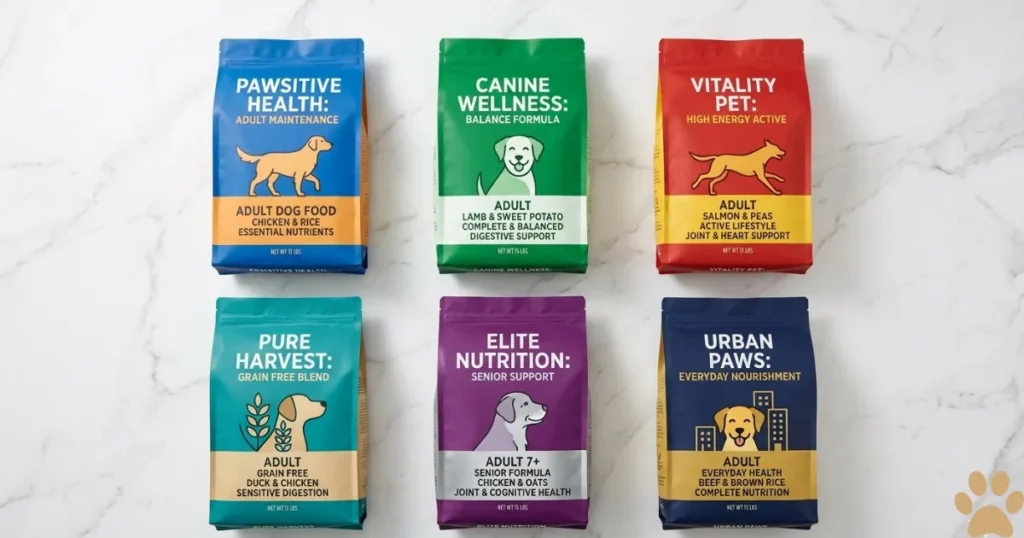
Every formula below is grain-inclusive, AAFCO-verified, built on named animal protein, and contains a marine omega-3 source – the four criteria that define appropriate food for a Golden Retriever.
1. Royal Canin Golden Retriever Adult:
The only formula specifically formulated for Golden Retrievers. Contains EPA and DHA from fish oil, glucosamine and chondroitin for joints, and an antioxidant blend supporting immune health. Kibble shape designed for the breed’s jaw. AAFCO feeding-trial verified.
- Protein: 25%
- Fat: 14%
- First ingredient: Chicken
Vet’s Pick:
Breed-specific formulation reflects genuine nutritional differences – not marketing.
2. Purina Pro Plan Adult Large Breed (Chicken & Rice)
AAFCO feeding-trial verified with real chicken first, EPA and DHA from fish oil, and natural glucosamine from protein sources. Backed by in-house veterinary nutritionists with strong research depth.
- Protein: 26%
- Fat: 12%
- First ingredient: Chicken
Owner’s Choice:
Most consistently recommended by veterinary professionals for large-breed adults.
3. Hill’s Science Diet Adult Large Breed
Salmon as the primary protein, naturally occurring omega-3s, and a clinically studied antioxidant blend. Particularly well-suited to Golden Retrievers with skin sensitivity or recurring coat issues. AAFCO feeding-trial verified.
- Protein: 20%
- Fat: 12%
- First ingredient: Chicken meal, whole grain wheat
Best for:
Goldens with mild skin or coat concerns.
4. Merrick Grain-Inclusive Large Breed Adult
Deboned beef and lamb as primary proteins, ancient grains (barley, quinoa), and salmon oil for omega-3s. Whole-food ingredient profile for owners who want less-processed sourcing without grain-free risk.
- Protein: 27%
- Fat: 12%
- First ingredient: Deboned beef
Best for:
Owners prioritising minimally processed ingredients.
5. Eukanuba Adult Large Breed
Chicken as the first ingredient, DHA from fish oil, and a fibre system supporting digestive health. Long-established formula with consistent ingredient sourcing and AAFCO feeding trial verification.
- Protein: 23%
- Fat: 12%
- First ingredient: Chicken
Best for:
Goldens with no specific sensitivities needing a reliable everyday formula.
6. Purina ONE SmartBlend Large Breed Adult
Named chicken first, natural glucosamine sources, grain-inclusive, no artificial colours or preservatives. Formulated to meet AAFCO standards – not feeding-trial verified – which is the key trade-off at this price.
- Protein: 26%
- Fat: 13%
- First ingredient: Chicken
Best for:
Budget-conscious owners who don’t want to compromise on ingredient fundamentals.
Ingredients to Look For – and Avoid – in the Best Food for Golden Retriever
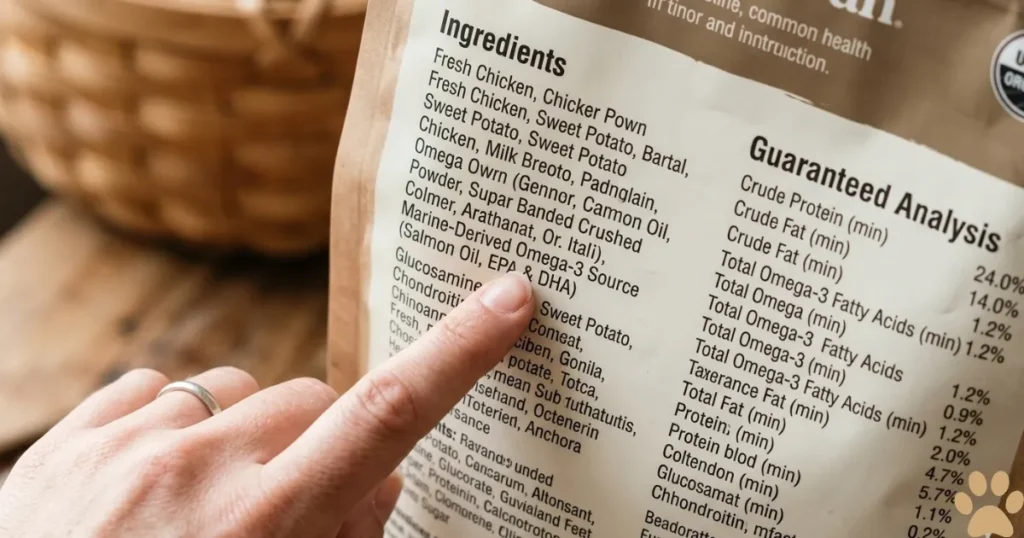
The best food for Golden Retriever is identifiable by five ingredient-level markers: named species protein first, marine omega-3 source, grain-inclusive carbohydrate base, joint-support compounds, and natural preservation.
Look For
Named whole meat first:
Chicken, turkey, salmon, or lamb – by species. Traceable, consistent, and verifiable batch to batch.
Fish oil or salmon oil:
Marine-source EPA and DHA – not flaxseed alone. Dogs convert plant-based ALA to EPA/DHA at low efficiency. Non-negotiable for this breed’s skin and joint needs.
Brown rice, oats, or barley:
Grain-inclusive carbohydrates with no DCM association and a long safety record in canine nutrition.
Glucosamine and chondroitin:
Naturally present in cartilage-rich protein meals or added directly. Look for at least 400mg/kg glucosamine in adult formulas.
Mixed tocopherols (Vitamin E):
The correct natural preservation method. Signals a manufacturer prioritising long-term quality over shelf-life economics.
Avoid
Peas, lentils, or chickpeas in the top five ingredients:
Associated with impaired taurine synthesis and DCM risk in Golden Retrievers specifically.
Unnamed protein sources:
“Meat,” “poultry,” or “animal by-products” without species identification cannot be verified for consistency.
BHA, BHT, or Ethoxyquin:
Synthetic preservatives with no nutritional benefit.
No omega-3 source listed:
A formula without fish oil or salmon oil is nutritionally incomplete for this breed.
| Look For | Avoid |
| Named species protein (first) | “Meat,” “poultry” unnamed |
| Fish oil or salmon oil | Flaxseed as sole omega-3 source |
| Brown rice, oats, barley | Peas/lentils in top 5 ingredients |
| Glucosamine + chondroitin | No joint support in adult formula |
| Mixed tocopherols | BHA, BHT, Ethoxyquin |
Best Food for Golden Retriever by Life Stage
Here is the best dog food for a Golden Retriever by life stage.
Adult Golden Retrievers (1 – 7 Years).
The adult phase is where dietary consistency pays compounding dividends. Target 22 – 26% protein, 12 – 16% fat, and a named marine omega-3 source. Glucosamine is a priority from year one – Golden Retrievers begin accumulating joint stress before clinical symptoms appear.
Caloric need varies significantly by activity and neuter status. A sedentary neutered Golden may need 20 – 30% fewer calories than an active intact dog of the same weight. Body condition score – not appetite – is the calibration tool.
Over the years, I’ve noticed that the earliest dietary problems in Golden Retrievers – coat dullness, recurring ear infections, mild joint stiffness – are almost always present by age two or three, well before owners connect them to diet. The best food for Golden Retriever is one that pre-empts these conditions, not one chosen after they appear.
Senior Golden Retrievers (7+ Years).
Senior Goldens need elevated protein to counter age-related muscle wasting (sarcopenia), reduced phosphorus to support kidney function, and increased omega-3 and joint support. The outdated guidance to reduce protein intake in senior dogs to “protect kidneys” applies only to dogs with diagnosed renal disease – for healthy seniors, reduced protein intake accelerates muscle loss.
Decision checkpoint:
If your senior Golden is losing visible muscle mass on a low-protein senior formula, the food is the most likely cause. A formula with 25%+ protein dry matter from named animal sources is appropriate for a healthy senior Golden with normal bloodwork.
Switching Between Life Stages.
Transition any formula change over 10 – 14 days: 75% old/ 25% new for days 1 – 3, 50/50 for days 4 – 7, 25/75 for days 8 – 11, 100% new from day 12. Abrupt dietary changes disrupt the gut microbiome and can trigger GI symptoms that are easily misread as food sensitivity.

5 Signs the Current Food Is Not the Best Food for Your Golden Retriever.
Here are the 5 Signs the Current Food Is Not the Best Food for Your Golden Retriever:
1. Recurring ear infections without a diagnosed environmental cause.
In Golden Retrievers, recurrent yeast or bacterial ear infections are frequently connected to food-triggered immune responses. The ear canal becomes a secondary target of inflammation. Dietary changes often significantly reduce infection frequency – something that gets missed when antibiotics keep resolving the acute episode.
2. Chronic coat dullness or excessive shedding beyond seasonal norms.
A Golden Retriever’s coat is a direct reflection of omega-3 adequacy. Brittle shafts, reduced density, or persistent dullness between grooming sessions almost always indicate marine omega-3 deficiency. Changes are typically visible within six to eight weeks of correcting the source.
3. Persistent soft stools or frequent flatulence.
Poor ingredient digestibility or an imbalanced fibre profile. High-starch fillers and low-quality fibre sources are the most common dietary causes. Reducing fat percentage is the first-line dietary adjustment before suspecting a specific protein sensitivity.
4. Unexplained weight gain despite appropriate portions.
If a Golden is gaining weight on correct portions, the formula’s caloric density likely exceeds expectations. Many premium formulas deliver 400+ kcal/cup – dense enough that small measuring inconsistencies add up meaningfully over weeks. Switch to gram-based weighing and verify the kcal/cup figure before reducing food.
5. Joint stiffness appearing before age five.
Early-onset stiffness in a Golden Retriever under five warrants both a veterinary orthopaedic assessment and a dietary review. A formula chronically low in omega-3s, glucosamine, and antioxidants may be accelerating inflammatory joint changes that better nutrition could slow.
Vet’s Tip: One thing most golden retriever food guides miss – if you store kibble in the original bag after opening, the omega-3s begin degrading immediately. Transfer to a sealed airtight container on day one. A formula with excellent fish oil content on paper can deliver near-zero functional omega-3s by week four of an open bag stored poorly.
What is the best food for Golden Retriever?
Royal Canin Golden Retriever Adult is the only breed-specific formula available. Purina Pro Plan Large Breed Adult is the most research-backed alternative. Both are grain-inclusive, AAFCO feeding-trial verified, with named protein first and marine-source omega-3s.
Should Golden Retrievers eat grain-free food?
No – not as a default. Grain-free, legume-heavy diets are associated with diet-related DCM in Golden Retrievers. Grain-inclusive formulas are the clinically supported default unless a vet has confirmed a specific grain sensitivity through an elimination diet.
What protein is best for Golden Retrievers?
Salmon, turkey, and lamb are well-tolerated and less frequently implicated in food sensitivities. Chicken works for most Goldens, but it is the most common food allergen in this breed. For recurring skin issues, a novel protein elimination trial is the diagnostic standard.
Do Golden Retrievers need omega-3 supplements?
If the current formula contains salmon oil or fish oil as a named ingredient, supplementation may be unnecessary. If no marine omega-3 source is listed, adding fish oil – at a veterinarian-recommended dosage – is warranted for this breed’s skin and joint health.
What ingredients should Golden Retrievers avoid?
Peas, lentils, or chickpeas as primary carbohydrates; BHA, BHT, or Ethoxyquin as preservatives; unnamed protein sources; and any formula without a marine omega-3 source. These represent the four most consequential ingredient-level red flags for this breed.
How much should I feed my Golden Retriever per day?
Most adults need 1,400-1,800 kcal daily, depending on weight, activity, and neuter status. Use the formula’s kcal/cup to calculate portions, weigh in grams, and calibrate against body condition score – not just manufacturer feeding charts alone.
Is wet food or dry food better for Golden Retrievers?
Dry kibble is more practical for accurate portioning and provides mild dental abrasion. Wet food supports hydration – useful for seniors or dogs with low water intake. Combining both is common and effective; account for both in the daily caloric total.
What causes Golden Retrievers to itch after eating?
Post-meal itching is typically food-triggered atopic dermatitis linked to protein hypersensitivity. Beef, chicken, and dairy are the most common triggers. Diagnosis requires an 8-12 week elimination diet on a single novel protein – not a blood allergy test, which has poor accuracy for food sensitivities in dogs.
Do Golden Retrievers need glucosamine in their food?
Yes – from adulthood onward. Given the breed’s orthopaedic risk, formulas providing at least 400mg/kg glucosamine are preferable. If the formula doesn’t deliver therapeutic levels, a separate joint supplement covering glucosamine, chondroitin, and omega-3s is warranted.
Is senior dog food necessary for Golden Retrievers over 7?
Yes, with caveats. Senior formulas should maintain elevated protein (25%+ dry matter for healthy seniors), reduce phosphorus to support kidney health, and increase joint support. Avoid formulas that significantly reduce protein intake – in healthy seniors, this accelerates muscle wasting, not kidney protection.
How do I know if my Golden Retriever’s food is AAFCO-compliant?
Look for: “animal feeding tests using AAFCO procedures substantiate that it provides complete and balanced nutrition.” This feeding trial statement reflects real-world validation. “Formulated to meet AAFCO standards” is a lower bar – just nutrient calculations on paper.
Can Golden Retrievers eat raw food?
Raw diets carry real pathogen risks – Salmonella, E. coli, and Listeria. Commercial frozen-raw formulas tested for pathogens are substantially safer than home-prepared raw. The AVMA advises caution, particularly in households with children or immunocompromised individuals.
What is the best food for Golden Retriever with skin allergies?
A salmon-based or novel protein formula with no unnamed by-products, no artificial additives, and a confirmed marine omega-3 source. An 8- to 12-week elimination diet with a single novel protein (venison, duck, hydrolyzed chicken) is the diagnostic standard before any formula is selected as allergy-appropriate.
How often should I feed my adult Golden Retriever?
Twice daily – morning and evening. Two structured meals reduce per-meal gastric volume, support stable energy levels, and enable accurate appetite monitoring. Free-feeding is not appropriate for a food-motivated breed like the Golden Retriever.
When should I reassess my Golden Retriever’s diet?
Every 6- 12 months, or immediately when any of the five warning signs appear: recurring ear infections, coat deterioration, persistent digestive irregularity, unexplained weight gain, or early joint stiffness. Dietary needs also shift meaningfully at neutering and at the senior transition around age seven.
Conclusion.
The best food for Golden Retriever is not defined by brand recognition or price – it is defined by how well it addresses the breed’s specific vulnerabilities. Grain-inclusive. Named animal protein first. Marine-source omega-3s. Glucosamine and chondroitin. AAFCO feeding trial verified.
Those five criteria reliably filter the field. From there, the decision comes down to life stage, individual tolerance, and whether the formula is being stored, portioned, and fed correctly. A great formula fed inconsistently or stored poorly will underperform a mid-tier formula used with discipline.
Reassess every six to twelve months. The best food for Golden Retriever at age two is not necessarily the best food at age seven. Nutritional needs shift, and staying ahead of those shifts is among the most valuable things a consistent owner can do.
What Are You Feeding Your Golden Retriever?
Every Golden has a different history – different sensitivities, different responses, different formulas that finally clicked.
- What food has worked best for your dog? H
- ave you navigated a skin issue, a weight callenge, or a life stage transition worth sharing?
Leave a comment below. Your experience is genuinely useful to other Golden Retriever owners making the same decisions.

Dr. Nabeel A.
Hi, I’m Dr. Nabeel Akram – a farm management professional by trade and a passionate Golden Retriever enthusiast at heart. With years of experience in animal science and livestock care, I’ve built a career around understanding animals—how they live, thrive, and bring value to our lives. This blog is a personal project born from that same passion, focusing on one of the most loyal and lovable breeds out there: the Golden Retriever. Whether I’m managing farm operations or sharing insights on canine health, behavior, and care, it all ties back to one core belief—animals deserve thoughtful, informed, and compassionate attention. Welcome to a space where professional expertise meets genuine love for dogs.
Facebook |
Links will be automatically removed from comments.