

People say golden retrievers are “the worst” as a joke, because their so-called flaws are really charms. The real downsides are true, though. Goldens shed heavily all year, need lots of exercise and company, go through a mouthy puppy stage, and face a higher cancer risk. They make poor guard dogs because they are too friendly. For an active, at-home family, they are a wonderful fit.
Search “why golden retrievers are the worst” and you will find lists calling them “too loving” and “too loyal.” That is the joke. Owners say golden retrievers are the worst, the way you might tease a best friend. The phrase is affection in disguise.
But there is a real question hiding underneath. Every breed has true downsides, and a Golden is a big commitment. So this guide gives you the honest version, no jokes and no sales pitch, so you can decide if this breed fits your life. Goldens are a long commitment too, often living 10 to 12 years, and you can read the full picture in our golden retriever lifespan guide.
Contents
- 1 Are Golden Retrievers Really the Worst? The Honest Answer
- 2 The Real Golden Retriever Downsides and How to Manage Them
- 3 Are Golden Retrievers Destructive? The Puppy Stage Nobody Warns You About
- 4 Golden Retrievers Make Terrible Guard Dogs
- 5 The Time and Money Reality of Owning a Golden
- 6 The Golden Fit Check: Should You Get One?
- 7 Expert Insight
- 7.1 BREED FIT PANEL
- 7.2 Why do people say golden retrievers are the worst?
- 7.3 What are the biggest downsides of a golden retriever?
- 7.4 Are golden retrievers destructive?
- 7.5 Do golden retrievers shed a lot?
- 7.6 Are golden retrievers good guard dogs?
- 7.7 How much exercise does a golden retriever need?
- 7.8 At what age do golden retrievers calm down?
- 7.9 Can golden retrievers be left alone all day?
- 7.10 Are golden retrievers high maintenance?
- 7.11 Do golden retrievers have a lot of health problems?
- 7.12 Is a golden retriever a good first dog?
- 7.13 Why is my golden retriever puppy so mouthy?
- 7.14 Are golden retrievers good with children?
- 7.15 Do golden retrievers bark a lot?
- 7.16 Should I still get a golden retriever after reading the downsides?
- 7.17 When should I worry that my golden’s behavior is a real problem?
- 8 The Bottom Line on Why Golden Retrievers Are “the Worst”
Are Golden Retrievers Really the Worst? The Honest Answer
No. By almost every measure, Golden Retrievers are one of the friendliest and most trainable breeds in the world. That is exactly why the joke exists.
The “worst” lists are really a backhanded compliment. They poke fun at traits that are actually wonderful:
- They are “annoyingly” happy every single morning.
- They “force” you to go outside and play.
- They “insist” on greeting every person and dog they meet.
- They “make” you laugh when you are trying to be serious.
Here is the honest part, though. The joke hides a few real downsides that catch new owners off guard. None of them make the Golden a bad dog. But some of them can make a Golden the wrong dog for a particular home. The rest of this guide walks through those real golden retriever cons, one by one, and shows you how to manage each.
The Real Golden Retriever Downsides and How to Manage Them
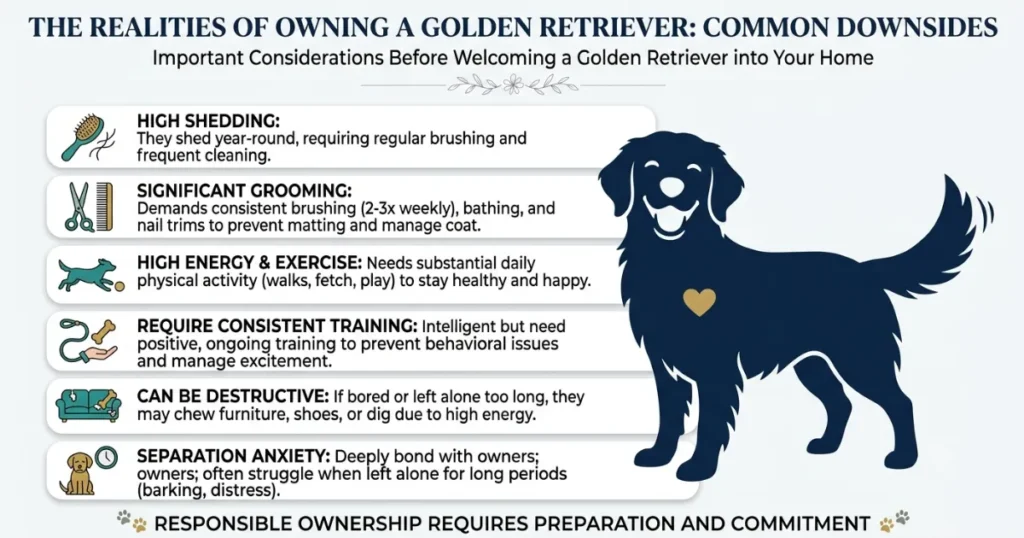
Every honest owner will admit these. The good news is that each downside has a fix. Here is the full picture in one place.
| Real downside | Why it happens | How to manage it |
| Heavy shedding all year | A thick double coat, made for retrieving in cold water | Brush 3 to 4 times a week, vacuum often, keep lint rollers everywhere |
| High exercise needs | Bred to work in the field all day | Give 1 to 2 hours of activity daily, including walks, fetch, or swimming |
| Mouthy puppy stage | A strong instinct to carry things in the mouth | Redirect to toys, train “drop it” early, expect it to pass with age |
| Needs lots of company | Bred to work closely with people | Avoid leaving them alone all day, use puzzle toys and dog walkers |
| Higher cancer and joint risk | A small founding gene pool concentrated some disease risk | Buy from health-tested parents, keep the dog lean, screen early |
| Slow to mature | Goldens stay puppy-like well past their first birthday | Be patient, keep training steady, expect calm around age 3 |
The single most common complaint is the shedding. A Golden’s coat is built for cold water, so it sheds a bit all year and heavily twice a year, in spring and fall. Those two heavy periods are called “blowing coat,” and during them you will find fur on your clothes, your couch, your car, and sometimes your dinner. If you dream of a spotless home, this is the honest deal-breaker to think hard about. Regular brushing helps a lot, but the hair never fully stops.
The second most common surprise is how much company a Golden needs. This is a breed built to work side by side with people all day. Left alone for long hours, a Golden can grow bored, anxious, and destructive. That does not mean you can never leave the house. It does mean a Golden is a poor match for a home where everyone is gone from morning to night with no plan for the dog.
The health risks are real too, but they are also manageable with the right breeder and good care. We keep the full, detailed breakdown of every condition in our golden retriever health issues guide, so this page stays focused on breed fit.
Are Golden Retrievers Destructive? The Puppy Stage Nobody Warns You About
Yes, they can be, but almost always for one simple reason. A bored or under-exercised Golden puppy will chew, dig, and shred to burn off energy. This is the number one reason young Goldens end up in shelters. Owners call it the “landshark” stage.
What the tough puppy months look like
- Constant chewing, on toys, shoes, furniture, and hands
- Nipping and mouthing during play
- Zoomies and wild bursts of energy
- Testing limits well into the teenage months
This phase is normal, and it passes. A Golden is a puppy in body and mind until about 18 months, which surprises many first-time owners. You can see exactly when each stage arrives in our golden retriever age chart.
How to get through it
- Give plenty of daily exercise, since a tired puppy is a calm puppy.
- Provide safe chew toys and rotate them to keep things interesting.
- Start training early and keep it short, fun, and consistent.
- Never leave a bored puppy alone with free run of the house.
The destruction is not a character flaw. It is unspent energy with nowhere to go. Meet the energy needs, and the “destructive” Golden usually disappears.

Golden Retrievers Make Terrible Guard Dogs
This one is true, and it is worth knowing before you buy. If you want a dog to protect your home, a Golden is one of the worst choices you can make.
Why? They love people too much. A Golden is far more likely to greet a stranger with a wagging tail and a stolen shoe than to scare anyone off. They may bark when someone arrives, but the bark is usually an invitation, not a warning.
For most families, this is a feature, not a flaw. A gentle, friendly dog that is safe around children and guests is exactly what they want. But if home protection is your goal, this breed will let you down every time. Be honest with yourself about what you actually need.
What Goldens do instead of guarding
A golden’s instinct is to make friends, not to defend territory. In practice, that means:
- They greet visitors, delivery drivers, and strangers with the same warmth.
- They may bark once or twice, then wag and look for a toy to share.
- They rarely show the territorial or protective drive seen in guarding breeds.
If you want an alert dog that warns you of visitors, a Golden might bark at the doorbell. If you want a dog that will actually deter an intruder, this is the wrong breed, full stop. The same friendliness that makes a Golden a poor guard makes it a wonderful family companion, so this “downside” is really just the flip side of the trait most owners love most.

The Time and Money Reality of Owning a Golden
Goldens are not a low-effort breed, and pretending otherwise sets owners up to fail. Here is the honest commitment.
Time.
A golden needs daily exercise, regular training, frequent brushing, and lots of company. This is a dog that wants to be part of the family, not left in a yard. Plan for it every day, not just when it is convenient.
Money.
Beyond food and routine care, this breed’s higher risk of conditions like hip dysplasia and certain cancers can mean real vet bills. Many owners find that pet insurance, started while the dog is young and healthy, brings peace of mind. Keeping your golden lean and screening early also lowers long-term costs, a theme we cover across our golden retriever health hub.
None of this is meant to scare you off. It is meant to make sure that the wagging tail you bring home stays a joy and does not become a burden you were not ready for.
The Golden Fit Check: Should You Get One?
Here is a simple, honest self-check before you decide. Read each statement and count how many are true for you.
- I can give a dog 1 to 2 hours of activity every day.
- Someone is home for much of the day, or I can arrange company for the dog.
- I am okay with dog hair on my clothes, floors, and furniture.
- I have the patience for a mouthy, playful puppy stage that lasts past a year.
- I can budget for good food, regular vet care, and possible health costs.
- I want a friendly family dog, not a guard dog.
How to read your score:
- 5 to 6 true: A Golden is likely a wonderful match for your life.
- 3 to 4 true: Think carefully. A Golden could work with some changes to your routine.
- 0 to 2 true: This is probably the wrong breed for you right now, and that is okay.
The goal is not to talk you out of a golden. It is to make sure the dog lands in a home that fits, because a Golden in the right home is one of the great joys of dog ownership. If your dog is already older, our guide to caring for an old golden retriever covers the senior years with the same honesty.

Expert Insight
In my practice, I rarely meet a “bad” Golden. What I meet are mismatches: a high-energy dog in a home with no time for it or a heavy shedder in a spotless house. The breed is not the problem. The fit is good. Choose honestly, and you will rarely regret a Golden.
BREED FIT PANEL
| Is a Golden Retriever right for you? | |
| Biggest real downside | Heavy, year-round shedding |
| Hardest life stage | Puppy and teenage “landshark” months |
| Worst fit for | People who are away all day |
| Good guard dog? | No. They tend to greet burglars |
| The honest verdict | Wonderful breed, wrong for some homes |

Why do people say golden retrievers are the worst?
It is a loving joke. Owners tease the breed for being “too” friendly, happy, and loyal. The real downsides, like shedding and energy, are true but manageable.
What are the biggest downsides of a golden retriever?
Heavy shedding, high exercise needs, a mouthy puppy stage, a strong need for company, and higher cancer and joint risk. Each one can be managed with good care.
Are golden retrievers destructive?
They can be, mostly when bored or under-exercised as puppies. Plenty of daily activity, chew toys, and early training usually stop destructive behavior before it starts.
Do golden retrievers shed a lot?
Yes, a lot. Their thick double coat sheds year-round and heavily twice a year. Brushing several times a week helps, but the hair never fully stops.
Are golden retrievers good guard dogs?
No. Goldens are far too friendly to guard a home. They are more likely to greet a stranger warmly than to scare anyone away, which suits most families well.
How much exercise does a golden retriever need?
About 1 to 2 hours a day. Walking, fetching, and swimming all work. Without enough activity, Goldens can become bored, restless, and destructive.
At what age do golden retrievers calm down?
Most settle around age 3. Goldens stay puppy-like well past their first birthday, so patience and steady training help you through the long teenage stage.
Can golden retrievers be left alone all day?
Not really. Goldens are bred to work with people and can grow anxious or destructive when left alone too long. Dog walkers, daycare, or puzzle toys help.
Are golden retrievers high maintenance?
In some ways, yes. They need regular grooming, daily exercise, training, and company. They are not high maintenance in temperament, since they are gentle and eager to please.
Do golden retrievers have a lot of health problems?
The breed has a higher risk of certain cancers and joint issues. Buying from health-tested parents and keeping the dog lean lowers the risk considerably.
Is a golden retriever a good first dog?
Often yes, for an active household. They are gentle and trainable. First-time owners should be ready for the shedding, the exercise needs, and the long puppy stage.
Why is my golden retriever puppy so mouthy?
Goldens are born to carry things in their mouths. Mouthing is normal puppy behavior. Redirect to toys and teach “drop it,” and it fades as the dog matures.
Are golden retrievers good with children?
Yes, they are one of the best breeds with kids. They are patient and gentle, though their size and energy mean young children should always be supervised.
Do golden retrievers bark a lot?
Not usually. Goldens are moderate barkers. When they do bark at the door, it is often a friendly greeting rather than a real warning to intruders.
Should I still get a golden retriever after reading the downsides?
If you have time, space, and patience for an active, shedding, people-loving dog, then yes. If you are away all day or want a low-effort pet, consider another breed.
When should I worry that my golden’s behavior is a real problem?
Sudden aggression, extreme fear, or a sharp change in behavior is not typical for the breed. Call your vet, since it can signal pain, illness, or a fixable training gap.
The Bottom Line on Why Golden Retrievers Are “the Worst”
So, why golden retrievers are the worst? Because they shed on everything, wake up too happy, and would rather hug a burglar than chase one. In other words, they are not the worst at all. That phrase is a joke owners tell because they adore the breed.
The honest downsides are real, though. Heavy shedding, big exercise needs, a long mouthy puppy stage, a need for company, and higher health risks. Take those seriously before you commit.
Run the Golden Fit Check. If your life has room for an active, hairy, endlessly loving dog, a Golden will likely be one of the best decisions you ever make. If it does not, choosing a different breed is the kind and honest thing to do. What is the one “worst” thing about your Golden that you would never actually trade away? And if you are still deciding, tell us which downside worries you most. Your honest take helps the next person choose the right dog for their home.

Dr. Nabeel A.
Dr. Nabeel Akram is a Doctor of Veterinary Medicine with more than five years of hands-on experience in animal health, canine nutrition, and preventive care. He is a registered veterinarian with the Pakistan Veterinary Medical Council (PVMC), the statutory body regulating veterinary practice in Pakistan. As the founder of Golden Retriever Insight, Dr. Akram writes and medically reviews every health, nutrition, and grooming guide published on the site. His clinical interests include canine oncology, epilepsy management, and breed-specific nutrition for large breeds — the core topics this site covers. Every article is checked against current veterinary literature and sources such as the Merck Veterinary Manual, AVMA guidance, and peer-reviewed research.
Links will be automatically removed from comments.