
Golden Retriever cancer symptoms most often include a new lump or swelling, unexplained weight loss, lethargy, reduced appetite, a limp that does not resolve, and unusual bleeding or bruising. Because roughly 60 percent of Goldens die of cancer, any persistent or growing change in a Golden deserves a veterinary exam rather than a wait and see approach.
Golden Retriever cancer symptoms usually start small. A lump you almost missed during a belly rub. A little less interest in dinner. A back leg that seems stiff after a nap. These signs read as ordinary, which is exactly why so many get filed under “getting older.”
In my practice, the Golden owners who catch cancer early are the ones who track changes rather than single moments. One soft lump is rarely an emergency. That same lump doubled in three weeks. Goldens also carry an unusually heavy cancer burden for their size.
The Golden Retriever Club of America estimates that about 60 percent of Golden Retrievers die of cancer, well above most breeds. That number is not meant to scare you. It is the reason a Golden earns closer watching than the average dog and why recognizing these symptoms genuinely changes what your options look like later.
Why Golden Retrievers Face a Higher Cancer Risk Than Most Breeds
Goldens sit near the top of the canine cancer risk curve, and the data backs that up rather than just breeder folklore. A necropsy study of 652 Golden Retrievers at a veterinary academic center found that 65 percent of the dogs had died of cancer, with hemangiosarcoma the single most common diagnosis. That is why the Morris Animal Foundation built its Golden Retriever Lifetime Study around this breed, following more than 3,000 Goldens to hunt for the genetic and environmental factors behind that risk.
Here’s the part most owners never hear. The risk is not spread evenly across dozens of cancers. The AKC reports that 54 percent of the breed’s deaths come from just four cancers: lymphoma, high grade mast cell tumor, hemangiosarcoma, and osteosarcoma. Knowing those four by sight gives you a real edge, because each one announces itself differently.
I’ll be honest about what this does and does not mean. It does not mean your Golden will get cancer. Plenty live long lives and die of something else entirely. It means the base rate is high enough that a “let’s keep an eye on it” lump in a golden deserves a faster trip to the clinic than the same lump on a low risk breed.
Interestingly, the risk is not fixed worldwide. Studies of Goldens in the UK and Scandinavia have reported notably lower cancer rates, in the range of 20 to 39 percent, which tells researchers that environment and breeding lines shape the odds alongside genetics. You can read more across our Golden Retriever health library.
The Cancer Symptoms Golden Retriever Owners Notice First
Most Golden cancers reveal themselves through a handful of changes. Any one of these on its own can be harmless. Two or more together, or one that keeps progressing, is your cue to book an exam.
Lumps, bumps, and swelling
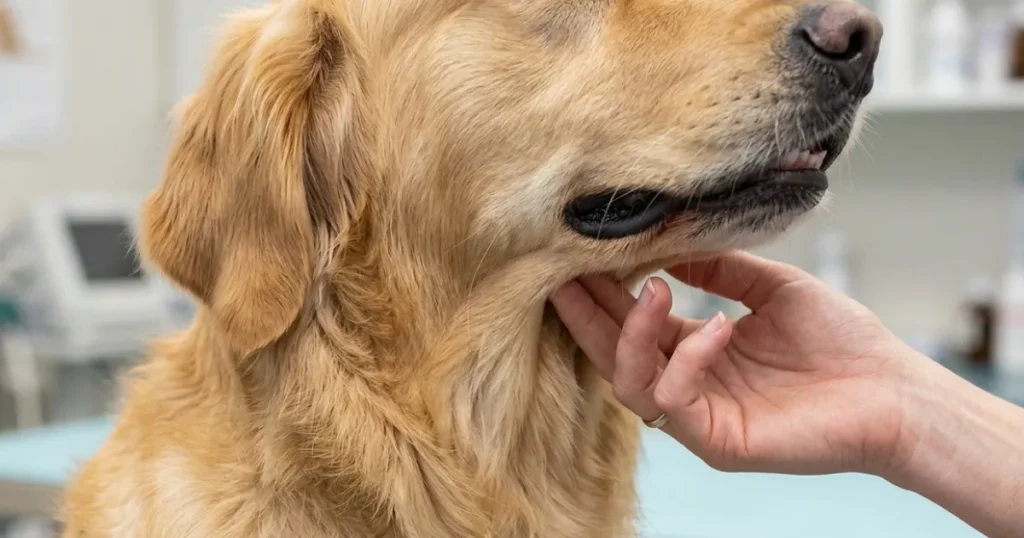
New growth is the symptom owners spot most. The reassuring part is that up to 80 percent of skin lumps in pets are not cancerous. The catch is that you cannot tell which 20 percent is dangerous by feel alone. Firm, swollen lymph nodes under the jaw, in front of the shoulders, or behind the knees are a different concern, since swollen lymph nodes can point to lymphoma.
Weight loss and appetite shifts
Weight that drops without a diet change is a classic warning, because tumors burn energy and can disrupt how the body uses nutrients. Pair that with a golden picking at food they used to inhale, and it earns a workup.
Energy, breathing, and lameness
Lethargy that lingers, a cough that will not clear, labored breathing, or a limp that does not improve with rest all belong on the list. In Goldens, a persistent limp in a middle aged or senior dog is worth taking seriously, since osteosarcoma targets the limbs.
Sores, odors, and bathroom changes
A handful of quieter signs round out the list. A sore that will not heal, a new foul odor from the mouth or rear, an abnormal discharge, or a clear change in how your Golden urinates or passes stool all warrant a look. These can flag oral, nasal, bladder, or gastrointestinal tumors that produce no obvious lump at all.

The Four Cancers Behind Most Golden Retriever Cancer Symptoms
Because four cancers drive most Golden deaths, their symptoms are the ones worth memorizing. Hemangiosarcoma is the one I most want owners to respect. It grows silently in the spleen, heart, or liver, and the first sign is often a sudden internal bleed and collapse rather than a slow decline. If you understand why a Golden can crash with no warning, read our guide on why a dog can bleed internally before dying.
Lymphoma usually shows as those firm, painless lymph nodes and often responds well to protocols built around prednisone and doxorubicin. Osteosarcoma shows as bone pain and limping. Mast cell tumors show as skin lumps that change size, redden, or flare. Bladder tumors are less common but real, and they tend to cause straining and blood in the urine, which we cover in the final stages of bladder cancer in dogs.
Each of these four behaves very differently under treatment, which is why a precise diagnosis beats a guess every time. Lymphoma is often the most responsive to chemotherapy. Osteosarcoma usually centers on pain control and a decision about amputation. Mast cell tumors are graded, because a low grade tumor and a high grade one carry very different outlooks even when they look identical on the surface.
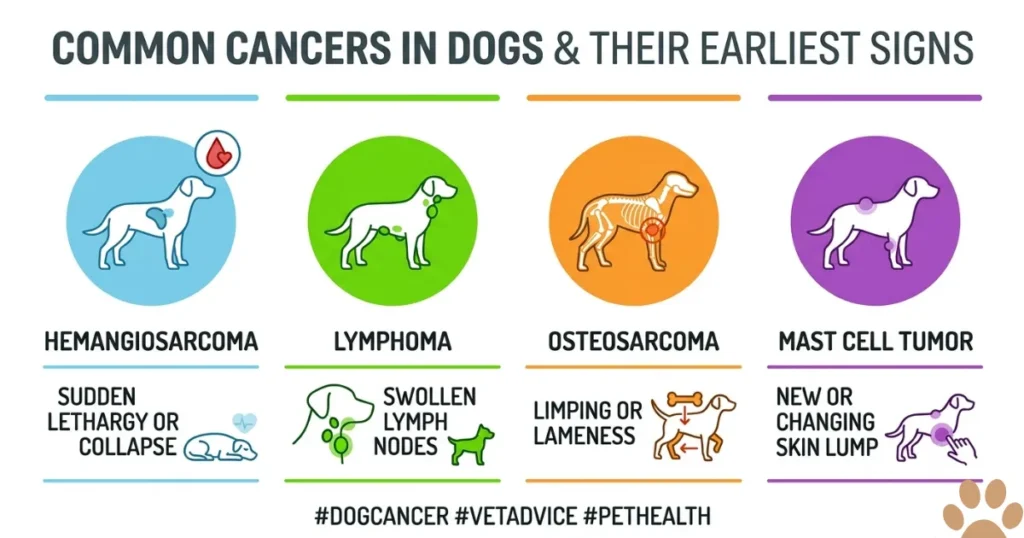
Golden Retriever Cancer Symptom Map (quick reference)
| Cancer (Merck term) | Earliest sign owners notice | Body system | Typical age in Goldens | Urgency |
| Hemangiosarcoma | Sudden weakness, pale gums, collapse | Spleen, heart, blood vessels | Senior (8+) | Emergency |
| Lymphoma | Firm swollen nodes under jaw or behind knees | Lymphatic / immune | Middle age to senior | Prompt |
| Osteosarcoma | Persistent limp, leg swelling, bone pain | Bone (limbs) | Middle age to senior | Prompt |
| Mast cell tumor | A skin lump that changes size or reddens | Skin and sometimes organs | Adult to senior | Prompt |
For what these diagnoses mean for time and treatment, see how long a dog can live with cancer.
How Cancer Symptoms Change by Life Stage in Golden Retrievers
Age reshapes what a symptom is likely to mean. The same limp tells a different story at one year than at ten.
In puppies and young Goldens, from roughly 8 weeks to 18 months, true cancer is uncommon. Most lumps are benign things like histiocytomas or reactive lymph nodes from a vaccine or infection. A growth here still deserves a look, but the odds favor something minor.
In adults, from about 2 to 7 years, cancer becomes a genuine consideration. Lymphoma and mast cell tumors can appear in this window, so a node that stays swollen or a skin lump that changes is not something to sit on.
In seniors, 8 years and up, the risk climbs sharply. The necropsy data found Goldens dying of cancer at a median age near 10 years. This is the stage where I want owners running monthly hands-on checks and treating any new lump, limp, or energy drop as worth a visit.
Many of the Goldens in the Golden Retriever Lifetime Study are now in this senior window, which is exactly when the cohort’s cancer diagnoses have climbed. For a senior Golden, I would rather examine five harmless lumps than miss the one that mattered. If your senior is already facing a diagnosis, our walkthrough of the stages of cancer as it progresses toward death maps what to expect.

What Most Owners Get Wrong About Golden Retriever Cancer Symptoms
The most common mistake I see is treating “no lump” as “no cancer.” Understandable, because lumps are the symptom everyone is told to watch for. But in Goldens, the deadliest common cancer often produces no external lump at all. Hemangiosarcoma can grow to a dangerous size inside the spleen while the skin stays perfectly smooth, and the first thing an owner notices is a dog who suddenly cannot stand.
The second mistake is assuming a benign-feeling lump confirms it is safe. Texture is a terrible diagnostic tool. Soft and movable can still be a mast cell tumor. The only way to know is a fine needle aspirate, a quick in-clinic sample your vet reads under a microscope.
A third mistake is reading behavior changes as mood. A Golden who suddenly sleeps more, pulls back from the family, or loses interest in a favorite walk may be telling you something physical rather than emotional. Cancer drains energy as tumors consume it, so a quiet, withdrawn dog is sometimes the earliest clue of all, well before any lump appears.
Here’s what I tell Golden owners. Don’t wait for symptoms to stack up before acting. With this breed, a single persistent change is enough reason to book. Early aspiration of a lump costs little and occasionally catches something that a few weeks of waiting would have let spread.
When to Call the Vet and When to Monitor: The 2-Week Change Rule
You don’t need to rush to the emergency room for every bump. You do need a clear rule so nothing slips. I give owners what I call the 2-Week Change Rule.
If a lump is new but small, soft, and unchanged, then mark the date and measure it. Recheck in two weeks. If it has grown, hardened, ulcerated, or multiplied, book an exam that week. A growth that persists beyond a few weeks always warrants evaluation.
If your Golden shows a mild appetite dip or slow weight loss, then track meals and weight for several days and book a non-emergency visit if it continues.
Call your vet immediately, without waiting, if you see pale gums, collapse, labored breathing, a hard, distended belly, a seizure, or bleeding that will not stop. Those can signal an internal bleed or an advanced tumor, and minutes matter. When a diagnosis turns toward end of life decisions, our guidance on knowing when to consider euthanasia can help you think it through, with companion pieces on the timing for a dog with a brain tumor, making the call with lung cancer, and the same decision with liver cancer.

Expert Insight
The Goldens I lose too early are almost never the ones with an obvious tumor. They are the ones whose owners waited a month on a vague symptom because the dog “seemed fine.” With this breed, fine can change in an afternoon. A quick aspirate or a belly ultrasound buys certainty for the price of a worry.
URGENT vs MONITOR
| Call your vet immediately | Book a non-emergency exam within days |
| Pale or white gums with sudden weakness or collapse | A new lump that is small, soft, and not changing |
| Labored breathing, or a hard, swollen belly | A mild appetite dip lasting more than a few days |
| Bleeding that will not stop, or blood in urine or stool | Slow weight loss with no diet change |
| A seizure, or sudden inability to stand | An on and off mild limp |
| A lump that is hot, ulcerated, or growing fast | A slight rise in thirst or urination |
What are the symptoms of cancer in Golden Retrievers?
Golden Retriever cancer symptoms include new lumps, swollen lymph nodes, weight loss, lethargy, a persistent limp, trouble breathing, and unusual bleeding. Any change that grows or lingers beyond two weeks deserves a veterinary exam.
What is usually the first sign of cancer in a Golden Retriever?
The first sign is often a new lump or a swollen lymph node you feel during petting. With hemangiosarcoma, though, the first sign can be sudden collapse from internal bleeding, with no lump at all.
Why do Golden Retrievers get so much cancer?
Golden Retrievers carry inherited genetic risk that researchers are still mapping through the Golden Retriever Lifetime Study. About 60 percent die of cancer, per GRCA estimates, far above most breeds, likely from a mix of genes and environment.
How do you check a Golden Retriever for hemangiosarcoma?
Hemangiosarcoma hides internally, so a vet uses abdominal ultrasound, chest imaging, and bloodwork rather than a skin exam. Sudden weakness or pale gums in a senior Golden warrants emergency evaluation.
Are swollen lymph nodes in a Golden Retriever always lymphoma?
No, swollen lymph nodes are not always lymphoma. Infection and inflammation also enlarge nodes. A fine needle aspirate quickly distinguishes lymphoma from a reactive node, so book an exam if the swelling lasts more than a few days.
How long can a Golden Retriever live with cancer?
Survival depends entirely on the cancer type and stage. Some lymphomas respond to chemotherapy for over a year, while untreated hemangiosarcoma may give weeks. A vet can estimate the prognosis once the specific cancer is identified.
Are lumps on a dog always cancer?
No, most lumps are not cancer. Up to 80 percent of skin lumps in pets are benign. Texture cannot confirm safety, so any new, growing, or changing lump should be aspirated by your veterinarian to be sure.
Can dogs survive cancer?
Yes, many dogs survive or live well with cancer. Outcomes hinge on the type, the stage at diagnosis, and treatment. Early detection widens the options, which is why catching symptoms quickly matters so much.
What tests diagnose cancer in dogs?
Veterinarians diagnose cancer using fine needle aspirates, biopsies, bloodwork, X-rays, and ultrasound. The first step for a lump is usually an aspirate, a fast sample examined under the microscope to tell benign from malignant.
Is cancer painful for dogs?
Some cancers cause pain and others do not, especially early on. Bone cancer like osteosarcoma is notably painful, while a small skin tumor may not. Pain control is part of any cancer plan.
At what age do Golden Retrievers get cancer?
Golden Retrievers are diagnosed most often from middle age onward, with risk climbing sharply after 8 years. Necropsy data showed Goldens dying of cancer at a median age near 10, so seniors warrant the closest monitoring.
Do Golden Retrievers need extra cancer screening?
Yes, given their high breed risk, senior Golden Retrievers benefit from monthly at-home lump checks and routine vet exams. Some owners add periodic bloodwork or ultrasound, which can catch hidden tumors like hemangiosarcoma earlier.
Can Golden Retrievers get mast cell tumors?
Yes, mast cell tumors are among the four cancers responsible for most Golden Retriever deaths. They appear as skin lumps that may change size or redden. Any such lump should be aspirated, since appearance alone cannot grade them.
Why do Golden Retrievers limp with bone cancer?
Golden Retrievers limp with osteosarcoma because the tumor weakens and inflames the bone, usually in a leg. A persistent limp or leg swelling in an adult or senior Golden that does not improve with rest needs prompt imaging.
When should I rush my Golden Retriever to the vet?
Go immediately if your Golden has pale gums, sudden collapse, labored breathing, a hard swollen belly, a seizure, or bleeding that will not stop. These can signal an internal bleed or advanced cancer, and fast care saves lives.
Conclusion
Golden Retriever cancer symptoms are easy to dismiss because they look like ordinary aging, yet this breed’s high cancer rate means a persistent change is worth acting on early. Watch for new lumps, weight loss, lethargy, lameness, breathing trouble, and any unexplained bleeding.
The single most useful habit is a monthly hands-on check, paired with the 2-Week Change Rule for anything new. When something grows, lingers, or comes on suddenly, your vet, not the internet, is the next step. Caught early, far more Goldens get a real shot at a good time on the other side of a diagnosis.
What was the first symptom that made you take your Golden to the vet, and how long did you wait before going? Share your story below. It might be the nudge another worried owner needs.