Seizures in dogs are sudden, uncontrolled bursts of electrical activity in the brain that cause temporary loss of body control, ranging from full convulsions to subtle facial twitching. In Golden Retrievers, they’re more common than most owners realize.
In my practice, Goldens develop idiopathic epilepsy at a higher rate than most retriever breeds. The first seizure typically presents between 1 and 3 years, younger than owners expect and younger than most general guides acknowledge.
According to the Morris Animal Foundation’s Golden Retriever Lifetime Study, neurological disorders are among the most actively tracked health outcomes in the breed, reflecting documented vulnerability compared to mixed-breed populations. Understanding their causes, how to identify them by severity, and what treatment looks like gives you a real plan when seconds count.
What Causes Seizures in Dogs and Why Golden Retrievers Are More Vulnerable
Seizures in dogs fall into three structural categories. Intracranial causes originate inside the brain: idiopathic epilepsy, brain tumors, encephalitis, or trauma. Extracranial causes originate outside: liver disease, hypoglycemia, or electrolyte imbalances. Reactive seizures occur when a healthy brain responds to a metabolic insult, xylitol ingestion, organophosphate pesticide exposure, or certain mushrooms.
What Most Seizure Guides Get Wrong About Golden Retrievers
Most guides say idiopathic epilepsy is a diagnosis of exclusion; rule everything else out, and what remains is epilepsy. That’s accurate. But what they don’t say: in Goldens under 3 years presenting with a first generalized seizure and no toxic exposure history, idiopathic epilepsy is the working diagnosis before bloodwork returns.
The breed-specific reason is familial transmission. Golden Retrievers carry a genetic predisposition to idiopathic epilepsy that tracks through bloodlines at a higher rate than Labrador Retrievers at equivalent ages. When a 2 years old golden owner calls me describing a 90-second tonic-clonic episode with clean recovery, the first question I ask isn’t “What did he eat?” It’s “any littermates affected?” The answer tells me whether I’m looking at inherited epilepsy or a first toxic exposure.
Senior Goldens shift the calculus entirely. The Morris Animal Foundation GRLS documents elevated intracranial neoplasia rates in the breed, meaning a 7 years old Golden with a first seizure gets imaging sooner than a 7 years old Lab in the same presentation.
In June 2023, a 7 years old intact female golden presented with two cluster seizures within 12 hours. The owner attributed the first episode to heat stress. MRI confirmed a right temporal meningioma. She recovered with surgical intervention and is currently managed on levetiracetam. The owner’s 18-hour delay between episodes was the narrowest acceptable window.
Dog Seizure Symptoms by Severity: What to Watch in Your Golden
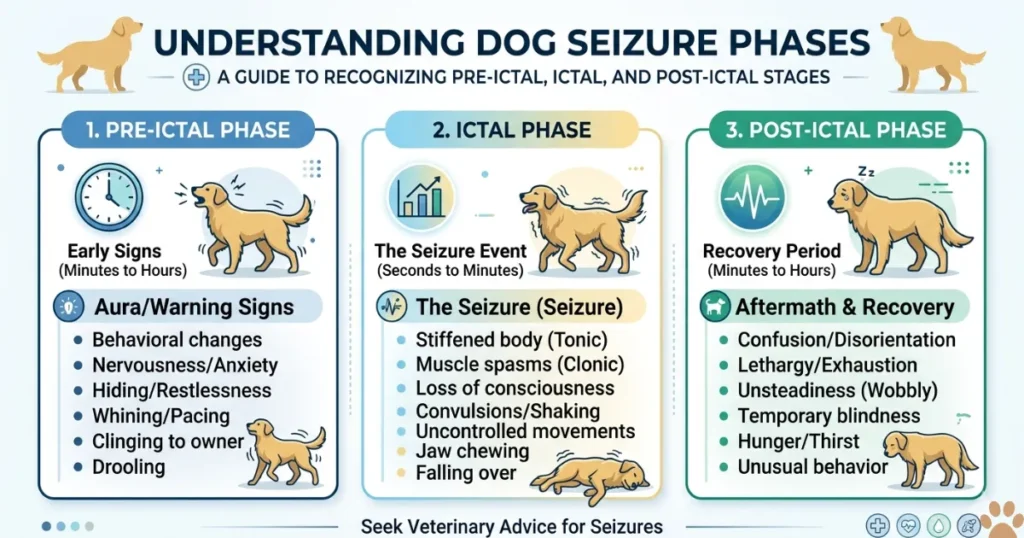
Dog seizure symptoms move through three phases, and missing the first phase means you can’t clock duration accurately. Duration is the most clinically important variable I ask about.
Three Phases Every Owner Should Know
The pre-ictal phase arrives before the seizure itself. Your Golden may pace, whine, or appear glassy-eyed. Many owners miss this, which means they start timing late. The ictal phase is the seizure: falling, loss of consciousness, paddling legs, jaw chomping, heavy salivation, and possible urination. Focal seizures look different, with one twitching limb or facial contractions while the dog stays conscious. In Goldens, focal seizures often precede generalized events by weeks. The post-ictal phase brings confusion, temporary blindness, wall-bumping, or ravenous hunger. This isn’t a second seizure. Don’t leave your Golden unsupervised near stairs or water during this window.
How Golden Retriever Seizure Signs Differ by Age
Puppies (8 weeks to 18 months):
Seizures in dogs this young demand toxin investigation before epilepsy is considered. A 12 weeks old Golden at 12 lbs reaches toxic thresholds at a fraction of the dose that affects an adult. Call immediately.
Adults (2-7 years):
The idiopathic epilepsy window. A first isolated seizure under 3 minutes with clean recovery is a same-day vet call, not an emergency. Two seizures within 24 hours changes that.
Seniors (8 years and older):
First-onset seizures need imaging. The GRLS confirms elevated brain tumor rates in Goldens over 8. I treat a first-time senior seizure as structural until proven otherwise.
| Symptom | URGENT—Call Vet Now | MONITOR at Home |
| Seizure duration | Over 5 minutes | Under 3 minutes |
| Frequency | 2+ within 24 hours | Single isolated episode |
| Post-ictal recovery | Not recovering after 30 min | Normal within 20 min |
| Senior dog (8+), first episode | Always call | N/A |
| Temperature post-seizure | Above 104°F / 40°C | Normal within 10 min |
Dog Seizure Medication: What Gets Prescribed and When
The most common mistake I see is owners requesting dog seizure tablets after one episode. It’s understandable; the event is terrifying. But in Goldens specifically, medicating after a single isolated seizure creates long-term liver stress without measurable seizure reduction. My threshold: two or more seizures in 6 months, any cluster episode, or post-ictal recovery lasting over an hour.
The Three Primary Options
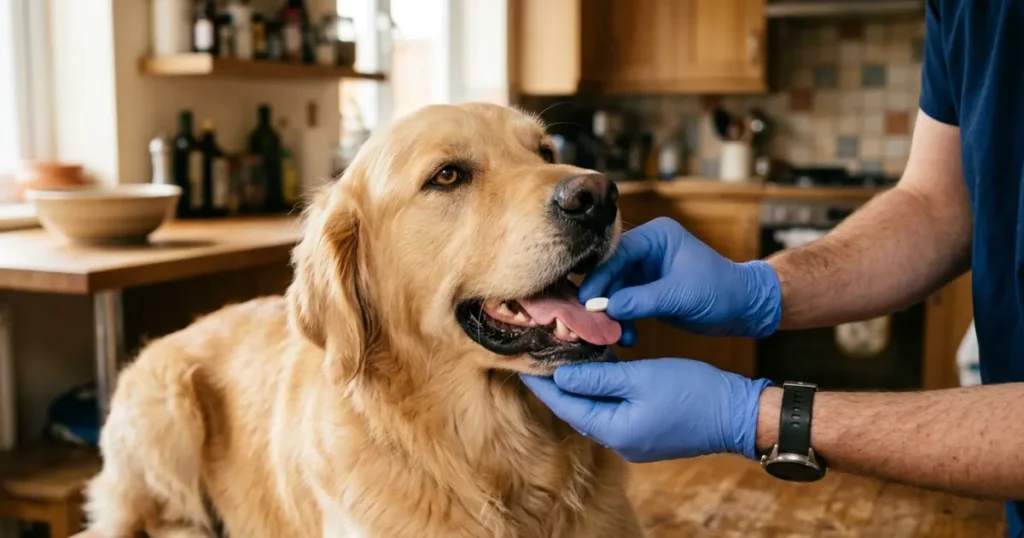
Phenobarbital is the first-line anti-seizure medication for dogs in most cases. It enhances GABA inhibition to reduce neuronal excitability. For a 65-lb Golden, the starting dose typically sits at 2.5 mg/kg twice daily, with titration over 2-4 weeks based on serum levels. Phenobarbital requires 6-monthly liver enzyme panels; elevated ALT is the primary marker I watch in Goldens, who carry moderate hepatic sensitivity.
Levetiracetam (Keppra) is my preferred add-on when phenobarbital alone gives incomplete control and increasingly a first-line option when early liver enzyme changes appear. Here’s what owners must understand: Keppra IR (immediate release) requires three times daily dosing, while Keppra ER (extended release) covers twice daily. Missing this distinction leads to underdosing and breakthrough seizures. I’ve seen it happen.
Potassium bromide is a second-line add-on, slow to reach therapeutic levels (3-4 months), and carries higher bromide-induced pancreatitis risk in retrievers on long-term therapy, a breed-specific risk generic medication guides don’t mention.
Diazepam (rectal or intranasal) is the emergency intervention, not a daily medication. I prescribe it to every epileptic Golden’s owner for cluster seizure interruption at home. A 65-lb Golden receives 5-10 mg rectally to break an active cluster before transport to an emergency clinic.
What I tell owners: the goal isn’t zero seizures; it’s a 50% reduction in frequency. Full control isn’t always achievable, and that’s not treatment failure. Here is the best dog food for seizures list.
The GRI Seizure Response Protocol: When to Act, When to Watch
The most common failure isn’t missing a seizure; it’s freezing during one or making the wrong call in the 30 minutes after. This is the framework I give every Golden Retriever owner with a confirmed seizure disorder.

Three Steps, No Guesswork
Step 1: Protect, Don’t Restrain.
Move your Golden away from stairs, furniture edges, and water. Don’t put your hand near their mouth; jaw clamping during a tonic-clonic seizure fractures fingers. Place a folded towel under their head. Time the seizure from the first muscle contraction. Your job is witness, not intervention.
Step 2: Clock It and Classify It.
Under 3 minutes, single episode, and recovery starting within 5 minutes: monitor the situation. Over 5 minutes, or a second episode within 24 hours: emergency. Status epilepticus, continuous seizure over 30 minutes, is immediately life-threatening and requires an emergency clinic regardless of time.
Step 3: The Binary Decision Rule.
| IF you observe | THEN | ESCALATE if |
| Single seizure, under 3 min, recovery in 20 min | Same-day vet call, monitor at home | Second seizure within 24 hrs |
| Seizure lasting 3–5 minutes | Call vet immediately and prepare transport | Doesn’t resolve by the 5 minutes mark |
| Seizure over 5 minutes | Emergency clinic now | Non-negotiable |
| Two seizures within 24 hours | Emergency clinic: give rectal diazepam if prescribed | N/A |
| First seizure in a senior Golden (8+) | Same-day emergency, flag age at triage | Any post-ictal neuro signs |
| Known epileptic, single brief episode | Monitor 24 hrs, log duration + time | Second episode or recovery >30 min |
How Many Seizures Can a Dog Have Before It Dies?
There’s no safe count. Seizures in dogs that last over 30 minutes, status epilepticus, can cause permanent brain damage or death through hyperthermia and neuronal death. The question “how many seizures before it’s too many” doesn’t have a number-based answer. Duration and frequency are the variables that matter, which is why the GRI Protocol focuses exclusively on those.
Expert Insight
“The Goldens that fare worst aren’t those with the most frequent episodes. They’re the ones whose owners delayed assessment because the first episode was brief. A 90-second seizure that resolves cleanly is still a diagnostic event; bloodwork, a neurological exam, and a medication conversation should follow within 48 hours. In Goldens, that window matters because the breed’s elevated intracranial tumor rate means early imaging can change the trajectory entirely.”
What are seizures in dogs?
Seizures in dogs are sudden, uncontrolled electrical discharges in the brain causing temporary loss of muscle control or consciousness. They’re a symptom, not a diagnosis; the underlying cause determines treatment.
Can a dog’s seizure disorder be treated long-term?
Some causes, such as toxin exposure or hypoglycemia, resolve when the trigger is treated. Idiopathic epilepsy isn’t cured but is managed with medication. Many dogs live full lives with controlled seizure disorders.
What are the visible signs of a dog having a seizure?
The most common dog seizure symptoms are muscle rigidity, paddling limbs, jaw chomping, heavy salivation, and loss of consciousness. Post-seizure confusion and temporary blindness are equally diagnostic but frequently missed.
Can dog seizure symptoms look like sleep twitching?
Yes. Focal seizures can mimic normal sleep movement. The key difference: sleep twitching stops when you touch or call the dog. Seizure activity during sleep doesn’t respond to stimulation and continues regardless of contact.
What causes seizures in dogs most often?
Idiopathic epilepsy is the most common cause of seizures in dogs. In Goldens under 5, genetic epilepsy accounts for most presentations. In seniors, intracranial tumors become the primary differential to investigate first.
What are the most life-threatening causes a vet looks for first?
Status epilepticus, intracranial brain tumors, and xylitol ingestion are among the most dangerous causes. All three can progress to permanent brain damage or death within hours without emergency intervention.
What is the standard dog seizure medication vets prescribe?
Phenobarbital is the first-line dog seizure medication. Levetiracetam (Keppra) is the most common add-on or alternative. Both require regular blood monitoring, phenobarbital for liver enzymes, and Keppra for renal function.
How long does a dog need to stay on seizure medication?
Most dogs with idiopathic epilepsy stay on medication for life. Stopping abruptly risks rebound seizures more severe than the originals. Any taper requires veterinary supervision; never adjust dosing independently.
Why do dogs have seizures out of nowhere?
Most “out of nowhere” seizures reflect undetected idiopathic epilepsy, not a sudden new event. The first visible episode is rarely the first neurological event; subclinical episodes often precede it without obvious outward signs.
Why do dogs have seizures more often at night?
The shift between wakefulness and sleep can trigger breakthrough electrical activity. This pattern is particularly noted in Golden Retrievers with idiopathic epilepsy on incomplete medication control.
Do Golden Retrievers have a higher risk of epilepsy than other breeds?
Yes. Golden Retrievers carry a documented genetic predisposition to idiopathic epilepsy, recognized by the AKC and tracked in the Morris Animal Foundation Golden Retriever Lifetime Study, placing them above Labradors and most mixed breeds in incidence.
What does the Golden Retriever Lifetime Study say about neurological conditions?
The Morris Animal Foundation GRLS actively tracks neurological disorders as a primary health outcome, confirming elevated rates of both idiopathic epilepsy and intracranial neoplasia in Golden Retrievers versus general canine populations.
How does idiopathic epilepsy affect Golden Retrievers differently than Labradors?
Idiopathic epilepsy in Golden Retrievers shows earlier average onset, typically 1 to 3 years, and a stronger familial transmission pattern than in Labradors. Goldens are also more likely to present with cluster seizures on first assessment.
At what age do Golden Retrievers typically have their first seizure?
Goldens with idiopathic epilepsy most commonly seize first between 1 and 3 years. First-onset seizures after age 6 raise suspicion for structural causes, brain tumors, or inflammatory disease, rather than idiopathic epilepsy.
My dog just had a seizure. Should I call the vet immediately or wait?
Call immediately if the seizure lasted over 3 minutes, a second follows within 24 hours, or recovery takes more than 30 minutes. A single brief episode with clean recovery is a same-day call, not an emergency visit.
Conclusion | What You Now Know and What to Do Next
Seizures in dogs are manageable. Duration and frequency matter more than episode count. A single brief seizure with clean recovery is a same-day vet call. Two episodes in 24 hours or anything over 5 minutes is an emergency now.
For Golden Retrievers, early onset between ages 1 and 3 points toward idiopathic epilepsy with well-established treatment options. Senior Goldens need imaging sooner than other breeds. The GRI Seizure Response Protocol removes the guesswork: know the duration, know the action.
The types of seizures in dogs guide covers focal, cluster, and generalized presentations in detail. For medication specifics, it covers Keppra IR vs. ER and phenobarbital monitoring for Goldens.
Has your Golden Retriever had a seizure? Share their age at first episode, how long it lasted, and what your vet found. Real accounts help other Golden families recognize what they’re seeing before a diagnosis is confirmed.