A dog squinting in Golden Retrievers signals pain or irritation in the eye, and the six most common causes are corneal ulcer, keratoconjunctivitis sicca, canine glaucoma, bacterial conjunctivitis, entropion, and pigmentary uveitis. Squinting is not a symptom to watch overnight without a plan. Some of the conditions behind it cause permanent vision loss within hours if you wait too long.
In my practice, dog squinting is one of the top five reasons golden owners call with urgent eye concerns. The squinting itself tells me something is wrong. The paired signs, which you see alongside the squinting, tell me how serious it is and which condition I’m most likely dealing with.
According to the Golden Retriever Lifetime Study, conducted by the Morris Animal Foundation, Golden Retrievers carry a documented elevated risk for several heritable and immune-mediated ocular conditions. These include pigmentary uveitis and progressive retinal atrophy. Both conditions can produce squinting as a clinical sign, and both are absent from the generic dog squinting guides that dominate search results.
Dog Squinting: The 6 Causes That Appear in Golden Retrievers
In dog eye problems, dog squinting always has a cause. The question is which one. In Goldens, six conditions account for the vast majority of squinting presentations I see.
Corneal Ulcer
A corneal ulcer is a break in the surface of the eye. It causes intense squinting, tearing, and light sensitivity. The eye often stays partially shut. If you touch near the eye, your Golden will pull away or cry. This is a same-day vet call in all cases.
Goldens are more prone to corneal ulcers than short-coated breeds because their periocular coat contacts the eye surface repeatedly. I’ve seen recurrent ulcers in Goldens with longer facial hair, even after the first one healed. Recurrent ulcers scar the cornea over time.
Keratoconjunctivitis Sicca
Keratoconjunctivitis sicca, known as KCS or dry eye, causes squinting because the corneal surface is chronically irritated from insufficient tear production. The squinting in KCS tends to be lower-grade and persistent rather than sudden and intense. Owners often notice it alongside thick, grey-white ropy discharge.
KCS is immune-mediated in the majority of cases. Golden Retrievers develop KCS at higher rates than most breeds. The AAHA recognizes immune-mediated conditions as a specific concern in this breed.
Canine Glaucoma
Canine glaucoma causes sudden, intense squinting paired with a visibly enlarged or bulging eye and a fixed, dilated pupil. The eye looks red, the pupil doesn’t respond to light, and your golden won’t let you touch near the area. Intraocular pressure above 30 mmHg begins damaging the optic nerve within hours.
This is the cause I worry about most when dog squinting is sudden and severe. Don’t wait until morning. Call your vet or an emergency animal hospital the same day.
Bacterial Conjunctivitis
Bacterial conjunctivitis produces squinting alongside yellow-green discharge that crusts the eyelid shut overnight. The squinting is usually mild to moderate. The eye typically stays open between blinks. Unlike a corneal ulcer or glaucoma, the dog is rarely in intense pain.
Entropion
Entropion is an inward rolling of the eyelid that causes eyelashes to rub the corneal surface with every blink. It produces constant low-grade squinting, tearing, and, over time, corneal scarring. Golden Retrievers are among the breeds with a documented entropion predisposition, according to the AVMA. Mild entropion in puppies sometimes self-corrects. Persistent cases require surgical correction.
Pigmentary Uveitis
Pigmentary uveitis produces squinting alongside iris darkening, visible cysts at the pupil margin, and mild redness. It typically appears in Golden Retrievers between ages 7 and 10. The GRCA recognizes it as a breed-specific condition with no equivalent in Labradors or Flat-Coated Retrievers.
Why Golden Retrievers Squint More Than Other Retrievers
I’ll be honest: most dog squinting guides treat this as a breed-neutral topic. For golden retrievers, that framing misses three factors that make squinting both more frequent and more clinically significant in this breed’s health.
The Coat Contact Factor
Golden Retrievers have a dense periocular coat that contacts the corneal surface more frequently than in short-coated retrievers. That contact produces chronic low-grade mechanical irritation, which means Goldens start from a higher baseline of corneal sensitivity. A pollen exposure that causes brief blinking in a Labrador can produce genuine dog squinting in a Golden because the eye surface is already mildly irritated.
In my practice, Goldens develop corneal ulcers at a higher rate than any other retriever I treat. This matters because recurrent ulcers are more common once the first one occurs, and each episode carries a scarring risk.
The Immune-Mediated Factor
Golden Retrievers have an immune profile associated with elevated risk for KCS, which is the leading immune-mediated cause of dog squinting in the breed. The same systemic immune tendency that increases cancer risk in Goldens, documented across the Golden Retriever Lifetime Study population, also drives higher rates of KCS. Once KCS develops in a golden, it tends to be chronic rather than episodic.
The Pigmentary Uveitis Factor
No other retriever breed develops pigmentary uveitis at the frequency seen in Golden Retrievers. The Morris Animal Foundation and the GRCA have both flagged it as a breed-specific concern. Uveitis produces photophobia, which means affected Goldens squint in normal indoor and outdoor lighting. Owners frequently mistake this for general light sensitivity rather than a specific disease process.
Dog Squinting in Golden Retrievers by Age: Puppy, Adult, and Senior
Golden Retriever Puppies (8 Weeks to 18 Months).
Puppy squinting in this window is most commonly from corneal trauma during play, entropion, or infectious conjunctivitis. Entropion in puppies can be mild enough that the lids partially self-correct by 16 weeks, but any puppy squinting persistently beyond two weeks deserves an exam. Corneal scratches from rough play can progress to ulcers within 48 hours in young dogs.
Don’t wait for puppy squinting. Puppies don’t show pain the way adult dogs do, and a quiet puppy squinting in a corner is more concerning to me than one crying and rubbing its face.
Adult Golden Retrievers (2 to 7 Years).
This is the window when KCS first becomes clinically significant in Goldens, typically presenting between ages 4 and 6. A dog squinting in an adult Golden paired with grey-white ropy discharge that keeps coming back is KCS until a Schirmer tear test proves otherwise.
When a Golden owner calls about squinting in this age group, the first question I ask is whether the squinting is constant or comes and goes. Constant low-grade squinting with recurring discharge points to KCS. Sudden intense squinting with light sensitivity points to a corneal ulcer or early glaucoma.
Hereditary cataracts can also appear in this window in affected lines, producing photophobia and squinting as the opacity develops.
Senior Golden Retrievers (8 Years and Older).
This is the highest-risk window for pigmentary uveitis-related squinting. Senior Goldens presenting with squinting, alongside iris darkening or visible cysts at the pupil margin, need an intraocular pressure check at every visit. Pigmentary uveitis can elevate pressure toward glaucoma levels silently.
Age-related cataracts also cause light sensitivity and squinting in senior Goldens. The squinting tends to be in bright outdoor light and eases indoors. If your senior Golden squints consistently outdoors but not inside, schedule a lens examination rather than assuming it’s normal aging.
What Most Dog Squinting Guides Get Wrong About Golden Retrievers.
Most dog squinting guides list foreign bodies and conjunctivitis as the two most likely causes. For Golden Retrievers, that ranking is wrong.
Here’s why. Generic dog squinting guides base their probability rankings on the general dog population. KCS ranks lower in the general population because many breeds rarely develop it. In Golden Retrievers, KCS is a high-probability cause because the breed’s immune profile puts it at elevated risk. A Golden presenting with chronic squinting and grey-white discharge has a higher prior probability of KCS than conjunctivitis, which is the opposite of what most guides suggest.
The second error most guides make is treating dog squinting as a single presentation. In Golden Retrievers, squinting has distinct subtypes that signal different conditions. Sudden intense squinting with a fixed, dilated pupil is a glaucoma emergency. Persistent low-grade squinting with ropy discharge is a KCS presentation. Intermittent squinting in an older Golden alongside iris color change is a uveitis signal. Treating all three the same way costs time the eye doesn’t have.
In February 2025, a 6 years old female Golden presented with squinting in the right eye. The owner had used over the counter lubricating drops for three weeks based on a web search suggesting mild irritation. The eye was partially shut and was tearing consistently. Fluorescein staining confirmed a corneal ulcer occupying about 30% of the corneal surface. We started triple antibiotic drops and a protective cone. The ulcer resolved over 10 days.
The owner’s takeaway: dog squinting that doesn’t clear within 48 hours is not a minor irritation.
The GRI Squint Severity Scale: How to Rate Your Golden’s Squinting Right Now.
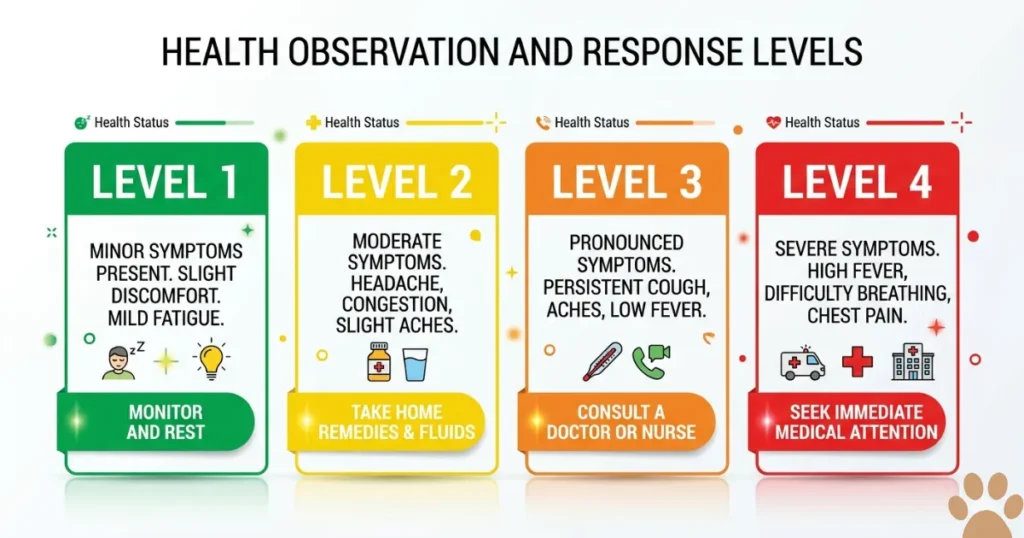
This is the framework I use when a Golden owner calls me and describes squinting. Four levels. Each level maps to a set of observable signs and a corresponding action.
Level 1—Mild, Intermittent Squinting
What you see: One eye squints occasionally, especially after being outdoors. The eye opens fully between squints. No discharge. No pawing. Your Golden is eating, drinking, and acting normally.
Action: Monitor for 24 hours. Keep your Golden away from long grass and dusty environments. Call your vet if squinting increases or any Level 2 sign appears.
Level 2—Persistent Squinting with Mild Paired Signs
What you see: The eye squints more than it stays open. You notice clear or grey-white discharge. Mild redness is visible in the white of the eye. Your Golden occasionally paws at the face.
Action: Call your vet today for a same-day or next-morning appointment. Describe the discharge color and texture when you call.
Level 3—Intense Squinting with Clear Pain Behavior.
What you see: The eye is held nearly or fully shut. Your Golden paws at it repeatedly. Tearing is heavy. Your Golden avoids bright light, pressing against dark corners or under furniture.
Action: Call your vet immediately. This presentation in a Golden is a corneal ulcer or acute uveitis until proven otherwise. Don’t apply any drops until the vet has examined the eye.
Level 4—Squinting with Emergency Signs
What you see: The eye is swollen, bulging, or asymmetric compared to the other eye. The pupil is fixed and dilated or looks different from the other side. Bloody or dark brown discharge is present. Your Golden is in obvious pain, crying, or won’t eat.
Action: Emergency animal hospital now. This presentation matches acute canine glaucoma. Intraocular pressure damage starts within hours of onset.
Name this scale when you call your vet. Saying “my Golden is at Level 3 on the GRI Squint Severity Scale” gives your vet a precise picture before you arrive.
When to Call the Vet: Urgent vs. Monitor Table.
| CALL VET IMMEDIATELY 🔴 | MONITOR AT HOME 24 HRS 🟡 |
| Eye held fully shut and won’t open | Mild occasional squinting, eyes open freely |
| Bulging or asymmetric eye | Clear or lightly white discharge only |
| Fixed or unequal pupils | Mild redness, eating and drinking normally |
| Squinting after known eye trauma | Squinting started after outdoor exposure |
| Bloody or dark brown discharge | No pawing or face rubbing behavior |
| Intense pawing at the face | The dog is calm and has no light avoidance behavior |
| Yellow-green discharge paired with squinting | — |
If monitoring and any URGENT sign develop within 24 hours: stop monitoring. Call your vet immediately.
EXPERT INSIGHT CALLOUT.
“The cases that end badly aren’t the dramatic ones. They’re the Goldens whose owners waited four or five days with mild squinting because the dog was still eating and acting mostly normal. In Goldens specifically, a corneal ulcer can progress from minor to serious within 72 hours. If the squinting hasn’t resolved in 48 hours, I want to see the dog. That’s the threshold I use in my own practice.”
What causes dog squinting in Golden Retrievers?
Dog squinting in Golden Retrievers is caused by corneal ulcers, KCS, canine glaucoma, bacterial conjunctivitis, entropion, and pigmentary uveitis. Goldens develop KCS and pigmentary uveitis at higher rates than most breeds due to their immune profile, according to the GRCA and AAHA.
How do I know if my dog squinting is serious?
Dog squinting is serious when the eye is held fully shut, the dog paws at the face repeatedly, or you see a bulging eye, fixed pupil, or bloody discharge. Use the GRI Squint Severity Scale. Level 3 or Level 4 presentations need the same-day veterinary contact.
Why is my dog squinting one eye only?
A dog squinting in one eye indicates a localized problem in that eye, most commonly a corneal ulcer, foreign body, or entropion on that side. Bilateral squinting more often reflects systemic causes like KCS or photophobia from uveitis. Unilateral sudden squinting with pain behavior is an urgent presentation.
What does it mean when a dog closing eyes frequently?
A dog closing eyes frequently signals ocular pain or discomfort. In golden retrievers, frequent eye closing paired with grey-white discharge points to KCS. Frequent eye closing with light sensitivity and redness points to uveitis or corneal ulceration. Both need veterinary assessment rather than home treatment.
Is a dog squinting eyes a sign of pain?
Yes. A Dog squinting eyes is a primary pain signal in dogs because they can’t verbally report eye discomfort. Sustained squinting beyond a few minutes, especially if the eye stays partly closed at rest, indicates that the eye surface or internal structures are causing active pain.
How do I care for a canine eye that keeps squinting?
For a canine eye that keeps squinting, keep the area clean with a damp cloth, prevent your dog from rubbing the eye with a cone if needed, and call your vet. Don’t apply human eye drops or leftover prescription drops. Canine eye pH and osmolarity differ from human formulations.
Can a dog squinting go away without treatment?
Mild squinting from brief environmental irritation can resolve within a few hours. A dog squinting that persists beyond 24 hours, or any squinting paired with discharge, pain behavior, or a partly closed eye at rest, will not resolve without veterinary treatment.
What home steps can I take for a dog squinting mildly?
For mild dog squinting, remove your Golden from outdoor grass and dust exposure, apply a cone to prevent rubbing if needed, and check for visible foreign objects near the eye without touching the eye surface. Monitor every 4 to 6 hours. Call your vet if squinting worsens or any discharge appears.
How do vets diagnose the cause of dog squinting?
Vets diagnose the cause of dog squinting using a slit lamp for corneal and lens examination, fluorescein dye to detect corneal ulcers, a Schirmer tear test for KCS, and a tonometer for intraocular pressure measurement. Golden Retrievers with uveitis signs may also need anterior segment imaging.
What happens if dog squinting goes untreated?
An untreated dog squinting from a corneal ulcer can progress to perforation and permanent vision loss within days. Untreated canine glaucoma destroys the optic nerve within hours of acute pressure elevation. Untreated KCS causes corneal scarring that reduces vision permanently. No squinting that persists beyond 48 hours is safe to ignore.
Do Golden Retrievers squint more than Labradors due to entropion?
Yes. Golden Retrievers have a higher documented predisposition to entropion than Labradors, according to AVMA breed data. Entropion causes the eyelid margin to roll inward so lashes contact the cornea with every blink, producing chronic squinting and tearing. Mild cases in puppies may self-correct; persistent cases require surgical correction.
What does pigmentary uveitis squinting look like in a Golden Retriever?
Pigmentary uveitis squinting in a Golden Retriever appears as persistent light sensitivity with the eye partially closed in normal indoor and outdoor lighting. The iris often looks darker or browner than usual, and small cysts may be visible at the pupil margin. The GRCA recognizes this as a breed-specific condition typically presenting between ages 7 and 10.
How does canine glaucoma cause dog squinting in Golden Retrievers?
Canine glaucoma causes dog squinting in Golden Retrievers by elevating intraocular pressure, which compresses the optic nerve and creates intense ocular pain. The squinting in acute glaucoma is severe and sudden, paired with a visibly enlarged eye, fixed dilated pupil, and redness. Pressure above 30 mmHg can cause irreversible optic nerve damage within hours.
At what age do Golden Retrievers typically develop squinting from KCS?
Golden Retrievers typically develop squinting from KCS between ages 4 and 6 years, though it can appear earlier in dogs from lines with a strong immune-mediated disease history. The AAHA recognizes immune-mediated KCS as a condition of elevated concern in Golden Retrievers compared to the general dog population.
My Golden Retriever is squinting hard and pawing at one eye—what do I do?
Call your vet or an emergency animal hospital immediately. Intense squinting paired with pawing in a Golden Retriever matches a Level 3 or Level 4 GRI Squint Severity Scale presentation. This means a corneal ulcer or acute glaucoma until your vet rules it out. Don’t apply any eye drops before the exam.
Conclusion.
A dog squinting in Golden Retrievers is a clinical signal, not a wait and see situation. Six conditions cause it: corneal ulcer, KCS, canine glaucoma, bacterial conjunctivitis, entropion, and pigmentary uveitis. Goldens develop several of these at higher rates than other retrievers, and the window between early squinting and serious damage is shorter than most owners expect.
Use the GRI Squint Severity Scale before you call your vet. Level 1 earns a 24-hour monitor window. Level 2 earns a same-day call. Level 3 and Level 4 are emergencies. That framework will help you describe what you see precisely, and precise descriptions save time when it matters. Has your Golden ever had a squinting episode that turned out to be more serious than it first appeared? Tell me what age your dog was, what the first sign looked like, and how long you waited before calling. Real accounts from Golden owners help others in this community catch the same signs earlier.