
Golden Retrievers develop specific eye conditions, including pigmentary uveitis and progressive retinal atrophy, at rates higher than most other retriever breeds, and several of these conditions cause permanent vision loss if caught late. Seven eye problems account for the vast majority of cases I see in Goldens: conjunctivitis, corneal ulcers, cataracts, glaucoma, pigmentary uveitis, keratoconjunctivitis sicca (KCS), and progressive retinal atrophy (PRA).
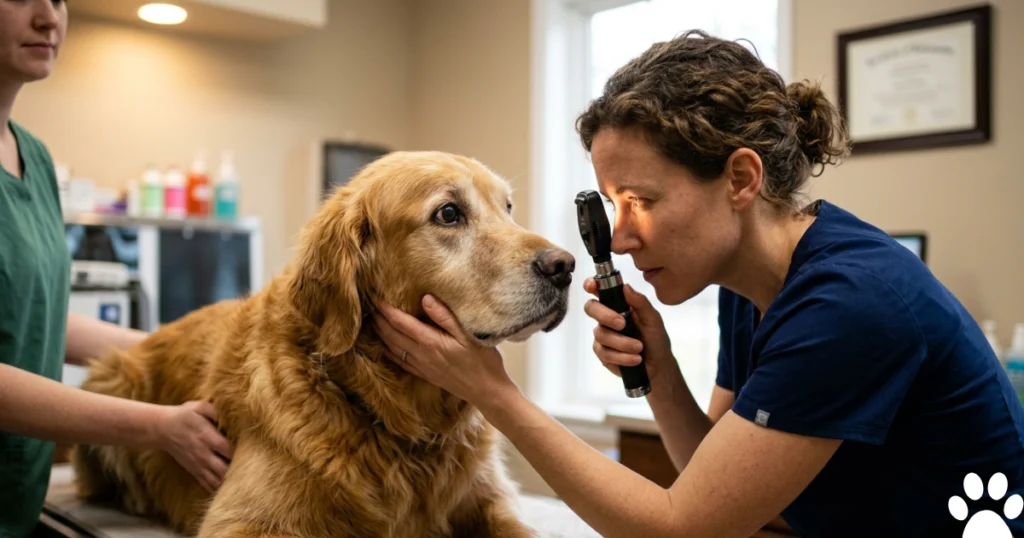
In my practice, the Goldens that come in at the right time are rarely the ones with the most dramatic symptoms. They’re the ones whose owners knew which signals mattered. Discharge color, pain behavior, and one simple vision check at home; those three observations tell me more in the first 60 seconds than most owners realize.
According to the Golden Retriever Lifetime Study, conducted by the Morris Animal Foundation, Golden Retrievers carry a statistically elevated lifetime risk for several heritable ocular conditions, with pigmentary uveitis documented as a breed-specific concern not reflected in general canine ophthalmology data.
Dog Eye Problems in Golden Retrievers: What the 7 Most Common Conditions Actually Look Like
Most dog eye problem guides give you a list. This section gives you what each condition looks like, specifically in a golden, because presentation matters for triage.
1. Conjunctivitis
Red, irritated conjunctiva with discharge ranging from clear and watery to thick and yellow-green. In Goldens, I see this most often after outdoor exposure; pollen, grass seeds, and dust lodge easily, given the breed’s eye anatomy and forward-facing skull structure. Viral conjunctivitis produces watery, bilateral discharge. Bacterial conjunctivitis produces mucopurulent (yellow-green, sticky) discharge, usually unilaterally at first.
Don’t confuse this with a corneal ulcer. Both cause redness. The difference: a Golden with a corneal ulcer squints hard and holds the eye partially shut. A Golden with conjunctivitis typically keeps the eye open.
2. Corneal Ulcers
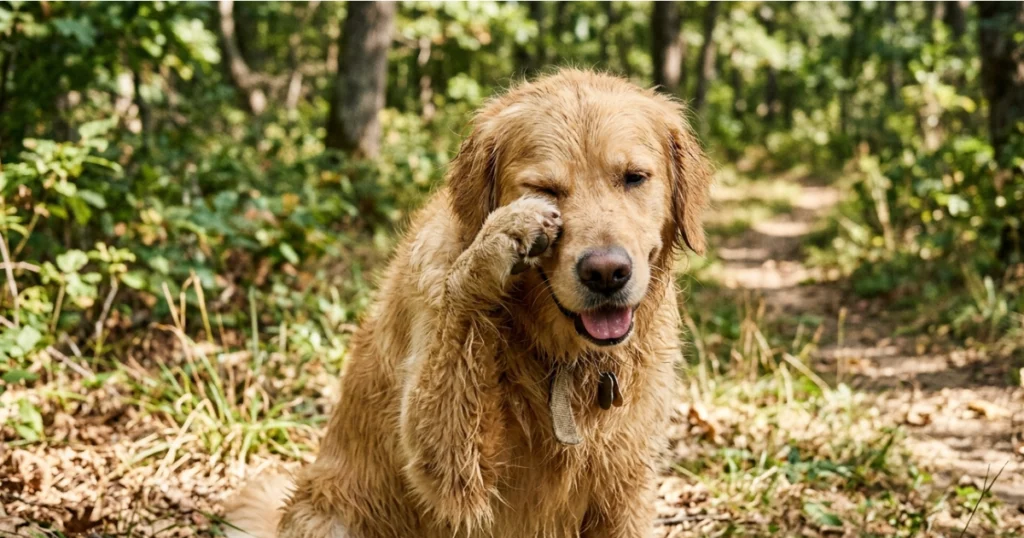
A break in the surface of the cornea. Goldens with longer facial hair are at elevated risk because their facial hair repeatedly contacts the corneal surface. Signs include intense squinting, pawing at the eye, tearing, and sensitivity to light. The eye may look hazy at the ulcer site. This is always a same-day vet call; untreated ulcers perforate.
3. Cataracts
Opacity of the lens. In Goldens, cataracts appear most often in two windows: hereditary cataracts surfacing between 1 and 5 years and age-related cataracts presenting after 8. The pupil appears white, grey, or bluish. Vision impairment varies by opacity percentage. Partial cataracts often go unnoticed by owners until signs of hesitation on stairs or nighttime disorientation appear.
4. Canine Glaucoma
Elevated intraocular pressure can damage the optic nerve. This is the condition I’m most worried about missing in Goldens. Acute glaucoma presents with sudden redness, a fixed dilated pupil, a visibly enlarged or bulging eye, and intense pain. Your Golden won’t let you touch the area. Chronic glaucoma is more insidious: gradual enlargement of the eyeball, subtle vision decline, and no obvious pain. Both require urgent care. Pressure above 30 mmHg causes irreversible nerve damage within hours.
5. Pigmentary Uveitis
This is the condition most general dog guides don’t mention. Pigmentary uveitis is a golden retriever-specific inflammatory condition of the uveal tract (iris, ciliary body, and choroid). The GRCA and Morris Animal Foundation have flagged it as disproportionately prevalent in the breed. It presents as a darkening or browning of the iris, cysts visible at the pupil margin, mild redness, and eventually, cataract formation in chronic cases. Age of onset is typically 7 to 10 years. Owners often miss it entirely until secondary cataracts appear.
6. Keratoconjunctivitis Sicca (Dry Eye).
KCS occurs when the tear film is insufficient to protect the cornea. In Goldens, I see this most in dogs over 6 who’ve had repeated conjunctivitis or prior infections. Signs include thick, ropy mucoid discharge (not watery; this is the distinguishing sign), a dull corneal surface, and chronic squinting. Left untreated, the cornea ulcerates and scars. Cyclosporine eye drops, prescribed by your vet, address the immune-mediated component that causes most KCS cases.
7. Progressive Retinal Atrophy (PRA).
PRA is a hereditary degeneration of the retinal photoreceptors. The AVMA recognizes Golden Retrievers as a breed with a documented PRA predisposition. It causes progressive vision loss, first at night (nyctalopia) and then in full light. There’s no pain. No redness. No discharge. The first sign most owners catch is their golden bumping into furniture after dark or becoming hesitant on stairs. This is why night behavior observations matter; they’re frequently the earliest clinical signal.
Why Golden Retrievers Develop Eye Problems at Higher Rates Than Other Breeds.
The answer isn’t one factor. It’s three, and they interact with each other.
The Genetic Load Goldens Carry.
Golden Retrievers carry heritable mutations affecting ocular health at rates above the general dog population. OFA eye certification data shows that Goldens account for a disproportionate share of PRA-affected dogs in the retrieval group. The gene responsible for one form of Golden Retriever PRA, a mutation in the SLC4A3 gene, was identified through the Golden Retriever Lifetime Study population.
Pigmentary uveitis adds a second layer. The GRCA officially recognizes it as a breed-specific condition with no equivalent prevalence in Labradors, Flat-Coated Retrievers, or Chesapeake Bay Retrievers. The mechanism isn’t fully understood, but uveal cyst formation and accumulation of fluid-filled structures at the ciliary body appear central to the inflammatory cascade.
Facial Anatomy and Coat Structure.
Goldens have a moderate brow, forward-facing eyes, and a dense facial coat. That combination means periocular hair contacts the corneal surface more often than in short-coated breeds. Repeated mechanical irritation elevates corneal ulcer risk and creates a low-grade inflammatory environment that predisposes the conjunctiva to secondary infection.
In my practice, Goldens present with corneal ulcers more than any other retriever. This matters because it means a first ulcer in a dog carries a higher recurrence probability, and recurrent ulcers scar.
The Immune Profile.
Golden Retrievers have a well-documented tendency toward immune-mediated conditions, which is part of why they’re overrepresented in cancer statistics in the GRLS data. KCS, the most common cause of dry eye in dogs, is immune-mediated in the majority of cases. Goldens’ immune profile means that once KCS appears, it tends to be chronic and progressive rather than episodic.
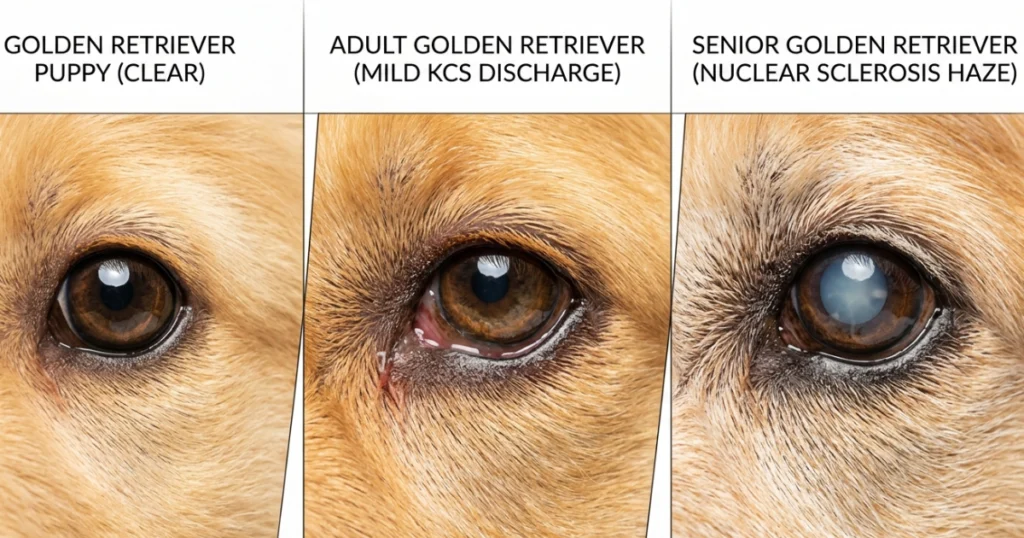
Golden Retriever Eye Conditions by Age: Puppy, Adult, and Senior.
Golden Retriever Puppies (8 Weeks to 18 Months).
Puppies in this window are primarily at risk for infectious conjunctivitis and corneal trauma. Hereditary cataracts can appear as early as 12 months in affected lines, though many owners miss the early opacity. If you notice your puppy squinting in bright light or showing asymmetric pupil response, don’t wait. I recommend an OFA eye exam by a board-certified veterinary ophthalmologist at 12 months for any Golden from lines without documented eye clearances.
Neonatal conjunctivitis (ophthalmia neonatorum) can occur before the eyes fully open, the eyelids swell, and discharge accumulates beneath them. This requires immediate veterinary intervention; delay risks corneal perforation.
Adult Golden Retrievers (2-7 Years).
This is the window when KCS and hereditary cataracts typically present clinically. In my practice, the 4- 6 year age range is when I most frequently diagnose KCS in female Goldens, consistent with the breed’s immune-mediated predisposition.
Glaucoma can present in this window too, particularly in dogs with a prior uveitis history. Any Golden in this age range with a prior uveitis diagnosis needs annual intraocular pressure checks, not just a visual exam.
Senior Golden Retrievers (8 Years and Older).
This is the highest-risk window. Pigmentary uveitis most commonly presents clinically in dogs 7-10 years old. Age-related nuclear sclerosis is a normal lens change that produces a bluish haze, which appears in most Goldens over 8 and is frequently mistaken for cataracts by owners. Nuclear sclerosis doesn’t impair vision meaningfully. Cataracts do.
The distinction: Nuclear sclerosis produces a diffuse blue-grey haze that still allows the tapetal reflection (the “glow” in photos) to show through. A cataract produces a dense white opacity that blocks the reflection entirely. If you’re unsure which you’re looking at, that uncertainty alone is reason to have it examined.
PRA typically reaches clinical significance (noticeable vision loss) in Goldens between 8 and 12 years. By the time owners notice it, retinal degeneration has usually been progressing for 1-2 years.
What Most Dog Eye Problem Guides Get Wrong About Golden Retrievers.
Most guides treat uveitis as a general inflammatory condition equivalent across breeds. For Goldens, that framing misses the clinical picture entirely.
General guides say uveitis is secondary to infection, trauma, or a systemic disease. Treat the cause, treat the inflammation, and monitor the eye. That’s accurate for most breeds.
For Golden Retrievers specifically, pigmentary uveitis is a primary, breed-specific condition and not secondary to another cause. The inflammation originates in the uveal tract itself, likely driven by cyst formation, and the treatment protocol differs. Standard anti-inflammatory topical therapy without addressing the cyst burden is insufficient. This distinction means a Golden presenting with uveitis needs a specialist workup, not just a course of prednisolone drops.
I’ve seen three cases in the past two years where a Golden was treated for “generic uveitis” elsewhere, responded partially, relapsed, and arrived at my clinic with secondary cataract formation that was already irreversible. In each case, an earlier breed-specific diagnosis would have changed the outcome.
In March 2024, a 9 years old male Golden presented with bilateral iris darkening and small cysts visible at both pupil margins. The owner had noticed “his eyes looking different” for about four months but assumed it was age-related. Intraocular pressure was 28 mmHg OD and 26 mmHg OS, within the normal range but elevated for a baseline check. We confirmed pigmentary uveitis with anterior segment imaging. We started topical dorzolamide and referred to a veterinary ophthalmologist.
Outcome: Pressure stabilized, and cyst progression halted at the 6-month follow-up.
The owner’s takeaway: Iris color change in a senior Golden is not cosmetic. It’s a clinical signal.
The GRI Eye Triage Protocol: How to Decide If Your Golden’s Eye Needs a Vet Today.
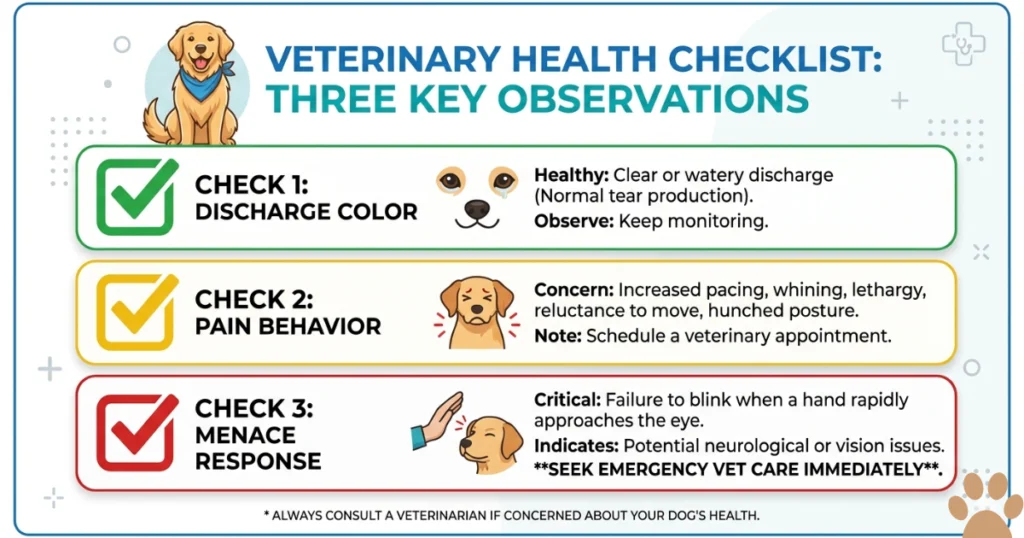
This is the framework I walk owners through on the phone. Three checks, in order. Don’t skip ahead.
CHECK 1—Discharge Color.
- Clear or slightly white: monitor 24 hours.
- Yellow or green: call your vet today (same-day appointment, not emergency unless paired with pain).
- Bloody or brown with pain: emergency; call now.
CHECK 2—Pain Behavior
Signs of ocular pain in Goldens: sustained squinting, pawing at the eye, rubbing the face on the ground, reluctance to open the eye in light, and crying when the eye area is touched.
- No pain behavior: proceed to Check 3.
- Any pain behavior present: call your vet today and describe the pain signs specifically.
CHECK 3—Vision Test
In a well-lit room, cover your Golden’s unaffected eye with your hand. Move your other hand slowly toward the open eye from the side (menace response test). A dog with functional vision will blink or pull back. No response indicates reduced vision in that eye.
- Normal menace response: monitor, recheck in 24 hours.
- Absent or reduced menace response: call your vet today; this is not a wait-and-see finding.
If your Golden fails, Check 2 OR Check 3
Same-day vet contact is the correct action. Not tomorrow. Today.
Name this framework when you call: “I ran the GRI Eye Triage Protocol. He failed Check 2; he’s squinting and pawing. It helps your vet triage your call accurately.
When to Call the Vet: Urgent vs. Monitor.
| CALL VET IMMEDIATELY 🔴 | MONITOR AT HOME 24 HRS 🟡 |
| Eye bulging or visibly enlarged | Clear, watery discharge, both eyes open |
| Fixed, dilated pupil not responding to light | Mild redness with no squinting |
| Sudden vision loss (failed menace response) | Single episode of eye rubbing, no recurrence |
| Bloody or brown discharge | White or grey haze over lens (possible nuclear sclerosis) |
| Sustained squinting or pawing at eye | Slightly increased tearing after outdoor exposure |
| Eyelid turned inward (entropion), causing rubbing | Mild conjunctival redness, eating and drinking normally |
| Yellow or green discharge with swelling | — |
| Any eye injury (foreign body, scratch, trauma) | — |
If monitoring and any URGENT symptom develop within the 24-hour window, stop monitoring. Call immediately.
EXPERT INSIGHT CALLOUT.
“The cases that concern me most aren’t the ones with dramatic red eyes. They’re the quiet ones, a 9 years old Golden whose owner says, ‘his eyes look darker than they used to.’ In my experience, iris darkening in a senior golden is pigmentary uveitis until proven otherwise. I check intraocular pressure on every one of those dogs, regardless of whether they’re squinting. Two-thirds of the time, pressure is elevated, and the owner has no idea anything is wrong.”
What are the most common dog eye problems?
The most common dog eye problems are conjunctivitis, corneal ulcers, cataracts, glaucoma, dry eye (KCS), and progressive retinal atrophy. In golden retrievers specifically, pigmentary uveitis is also a well-documented breed-specific condition requiring early detection.
How do I know if my dog has eye problems?
Watch for squinting, discharge, redness, cloudiness, pawing at the eye, or changed iris color. Use the GRI Eye Triage Protocol: assess discharge color, pain behavior, and menace response. Any failed check warrants a same-day vet call.
What are common eye issues in dogs?
Common dog eye issues include bacterial or viral conjunctivitis, corneal abrasions, cataracts, and KCS. In Golden Retrievers, hereditary conditions like PRA and pigmentary uveitis are breed-specific concerns not commonly seen at this frequency in other retrievers.
What are the signs of eye conditions in dogs?
Signs of eye conditions in dogs include unusual discharge (watery, mucoid, or purulent); redness; squinting; visible opacity on the lens; iris discoloration; enlarged eye; and reluctance to open the eye in bright light. An absent menace response indicates vision loss.
What eye disorders in dogs need immediate veterinary care?
Eye disorders in dogs requiring immediate care include acute glaucoma (bulging, painful eye with fixed pupil), corneal perforation, sudden vision loss, hyphema (blood in the eye), and severe chemical or mechanical eye injury. These are emergency presentations.
How do canine eye problems differ from human eye problems?
Canine eye problems often progress faster than equivalent human conditions because dogs can’t report early symptoms like blurred vision or light sensitivity. Conditions like glaucoma can cause irreversible optic nerve damage in dogs within hours of acute pressure elevation, faster than the typical human timeline.
Can dogs go blind from untreated eye infections?
Yes. Untreated bacterial conjunctivitis can progress to corneal ulceration; severe ulcers can perforate, leading to permanent vision loss. Untreated KCS scars the cornea. Untreated glaucoma destroys the optic nerve. Early treatment prevents the majority of blindness cases seen in clinical practice.
What does a cloudy eye in a dog mean?
A cloudy eye in a dog indicates one of three things: nuclear sclerosis (normal aging, doesn’t impair vision significantly), cataracts (lens opacity that does impair vision), or corneal edema from injury or glaucoma. A vet exam with a slit lamp distinguishes them definitively.
How do you treat dry eye in dogs?
Dry eye (KCS) in dogs is treated with cyclosporine or tacrolimus ophthalmic drops to address the immune-mediated component, paired with artificial tear supplementation. In Golden Retrievers, treatment is typically lifelong. Most dogs respond within 4-6 weeks if treatment starts before corneal scarring develops.
Is eye discharge in dogs normal?
Small amounts of clear discharge at the inner corner of the eye are normal. Thick, ropy, or colored (yellow, green, brown) discharge is not normal and warrants evaluation. In Golden Retrievers, ropy mucoid discharge specifically suggests KCS rather than infectious conjunctivitis.
Are Golden Retrievers more prone to eye problems than other breeds?
Yes. Golden Retrievers have a documented predisposition to pigmentary uveitis, progressive retinal atrophy, and hereditary cataracts, conditions either absent or far less prevalent in Labradors and other retrievers. The Morris Animal Foundation’s Golden Retriever Lifetime Study has contributed significantly to identifying these breed-specific risks.
What is pigmentary uveitis in Golden Retrievers?
Pigmentary uveitis is a Golden Retriever-specific inflammatory condition of the uveal tract, the iris, the ciliary body, and the choroid. It’s characterized by iris darkening, uveal cysts at the pupil margin, and risk of secondary glaucoma and cataracts. The GRCA recognizes it as a breed-specific concern with onset typically between 7 and 10 years.
At what age do Golden Retrievers typically develop cataracts?
Golden Retrievers develop hereditary cataracts between 1 and 5 years of age in affected lines. Age-related cataracts typically appear after age 8. Any lens opacity in a golden under 6 should be evaluated by a veterinary ophthalmologist to distinguish hereditary from acquired causes and assess progression risk.
Do Golden Retrievers have a higher risk of progressive retinal atrophy?
Yes. The AVMA and OFA both recognize Golden Retrievers as a breed with a documented PRA predisposition. The condition causes progressive retinal degeneration beginning with night blindness, advancing to full vision loss. DNA testing identifies carriers before breeding, which is why OFA eye certification matters for Golden Retriever breeders.
My Golden Retriever’s eye is bulging and red. What should I do right now?
Call your veterinarian or an emergency animal hospital immediately. A bulging, red eye in a dog is the classic presentation of acute glaucoma, where intraocular pressure can cause permanent optic nerve damage within hours. Don’t wait until morning. This is a same day emergency.

Conclusion.
Dog eye problems in Golden Retrievers are manageable when caught early and mismanaged when dismissed as minor. Seven conditions, conjunctivitis, corneal ulcers, cataracts, glaucoma, pigmentary uveitis, KCS, and PRA, account for the vast majority of what I treat. Of these, pigmentary uveitis is the one most owners and even some clinicians miss, because the early signs (iris darkening, subtle cysts) don’t look like a classic eye emergency.
Use the GRI Eye Triage Protocol when you’re unsure: check discharge color, pain behavior, and menace response. Any failed check is a same-day vet call.
Have you noticed any eye changes in your golden iris color shifts, nighttime hesitation, or discharge that keeps coming back? Tell me your dog’s age and what you’ve observed. Breed-specific details help other Golden owners in this community recognize patterns they might be missing.