
I often see small dog owners arrive with the same mistaken assumption: that dog food is dog food, and size is just a matter of portion. In practice, small breed nutrition is a fundamentally different discipline from large breed feeding, and the consequences of getting it wrong accumulate quietly over the years before becoming obvious.
Small breeds have metabolic rates two to three times higher than large breeds relative to body weight. Their energy demands per kilogram are significantly greater, their blood sugar regulation is more fragile, their dental anatomy creates unique food-texture requirements, and their gastrointestinal tracts are shorter – affecting how quickly they process and absorb nutrients.
The best small breed dog food accounts for all of these biological realities, not just particle size. A food that is technically complete and balanced for a large dog may leave a small dog hypoglycemic between meals, under-nourished in caloric density, or accumulating dental disease from kibble that doesn’t generate adequate mechanical cleaning action on smaller teeth.
This guide covers what small breed nutrition actually requires, how to evaluate small dog feeding requirements accurately, what ingredients and formulations genuinely matter, and which well-documented commercial options deliver consistent results.
Why Small Breed Nutrition Is Biologically Distinct
Small breed dogs require more calories per kilogram of body weight than large breeds, smaller and denser kibble for dental and jaw health, and more frequent meals to prevent hypoglycemia – particularly in puppies and toy breeds.
The core difference lies in the metabolic surface area principle. Smaller bodies have a higher surface area relative to their mass, which means they lose heat faster and must generate more energy per unit of body weight to maintain core temperature. This drives a caloric demand that standard dog food formulas – designed around average metabolic needs – often fail to meet at practical portion sizes.
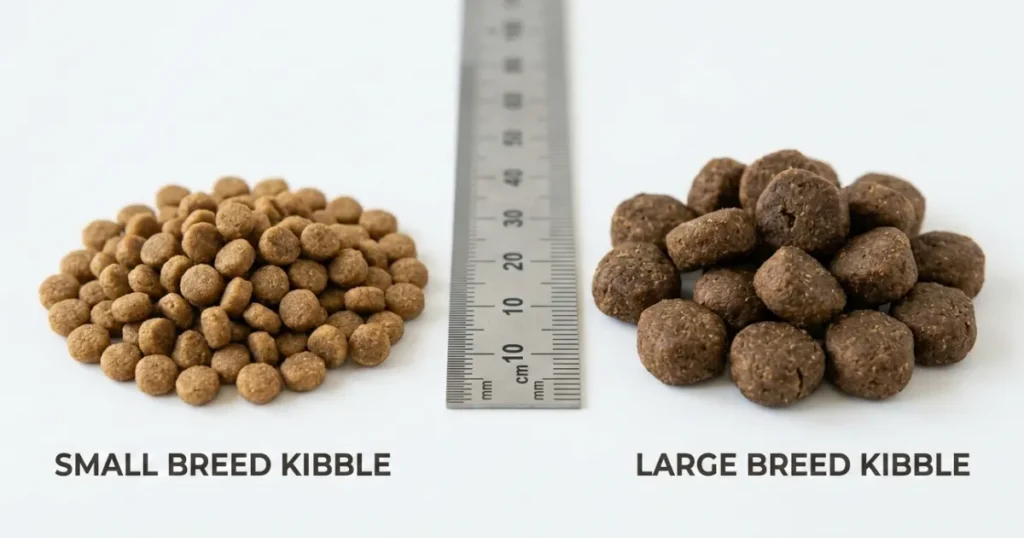
Three biological realities drive small breed nutrition requirements:
1. Caloric density requirements.
A 5kg Chihuahua may need 400 – 500 calories daily. Feeding a standard-calorie food at a size-appropriate portion often delivers 250 – 300 calories – a consistent deficit that produces low energy, poor coat condition, and weight loss over months. The best small breed dog food is calorie-dense enough to meet full daily requirements in portions the dog will actually consume.
2. Kibble size and dental health.
Small breeds are disproportionately affected by periodontal disease. Genetics, jaw crowding, and the angle of tooth eruption all contribute. Kibble designed for small breeds is formulated to a size and hardness that generates mechanical abrasion on small teeth – standard-sized kibble is either too large to chew properly or swallowed whole, eliminating any dental benefit.
3. Blood sugar stability.
Toy breeds and small breeds – particularly puppies – are prone to hypoglycemia because their liver glycogen stores are proportionally smaller and deplete faster between meals. Small breed nutrition must account for this through calorie-dense food, appropriate meal frequency, and avoidance of high-glycemic carbohydrate fillers that cause blood sugar spikes followed by rapid drops.
In veterinary medicine, small breed hypoglycemia in puppies is almost always a feeding management problem – insufficient caloric density, incorrect meal frequency, or both – rather than a primary metabolic disorder.
How to Read a Small Breed Dog Food Label Correctly
Most small breed dog food labels are optimized for marketing, not transparency. Understanding what to look for changes every purchase decision.
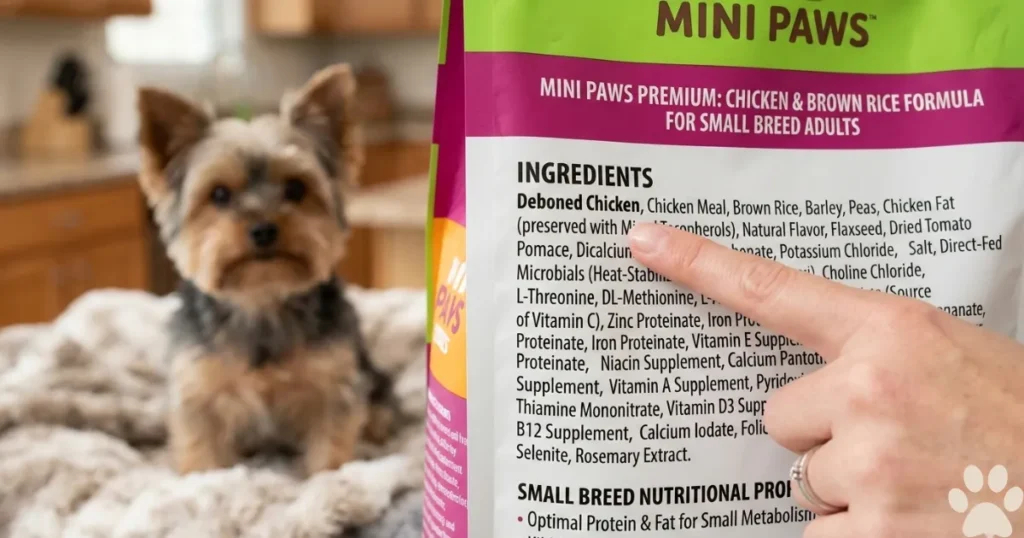
Caloric content (kcal/cup or kcal/kg):
This is the single most important number for small breed nutrition. Two foods can have identical protein percentages but dramatically different caloric densities. A food at 350 kcal/cup is 40% more calorie-dense than a food at 250 kcal/cup – critical when your dog’s total daily portion is half a cup.
First five ingredients:
Animal protein should dominate. Named sources – deboned chicken, turkey meal, salmon – indicate quality. Unnamed by-products, multiple grain forms, or plant proteins in the first five ingredients indicate a food that prioritizes cost over nutritional value.
Fat content for small breeds:
Fat is the most calorie-dense macronutrient at 9 kcal/gram. Quality fat sources – chicken fat, salmon oil, flaxseed – support caloric density while delivering omega-3 and omega-6 fatty acids essential for coat, skin, and inflammatory regulation in small breeds. Look for named fat sources, not generic “animal fat.”
Moisture and dry matter basis:
When comparing wet and dry foods, always convert to a dry matter basis. A wet food showing 9% protein on the label delivers approximately 40- 45% protein on a dry matter basis – comparable to premium kibble. Use dry matter protein to compare across food types accurately.
AAFCO statement:
The best small breed dog food carries an AAFCO statement confirming the food is “complete and balanced” based on feeding trials – not just “formulated to meet” standards. Feeding trial certification indicates the food was tested on live animals and confirmed to deliver claimed nutritional outcomes.
10 Best Small Breed Dog Foods: Vet-Reviewed Comparison Table
These options are evaluated based on caloric density, protein quality, small-breed-specific formulation, and documented performance across small dog life stages.
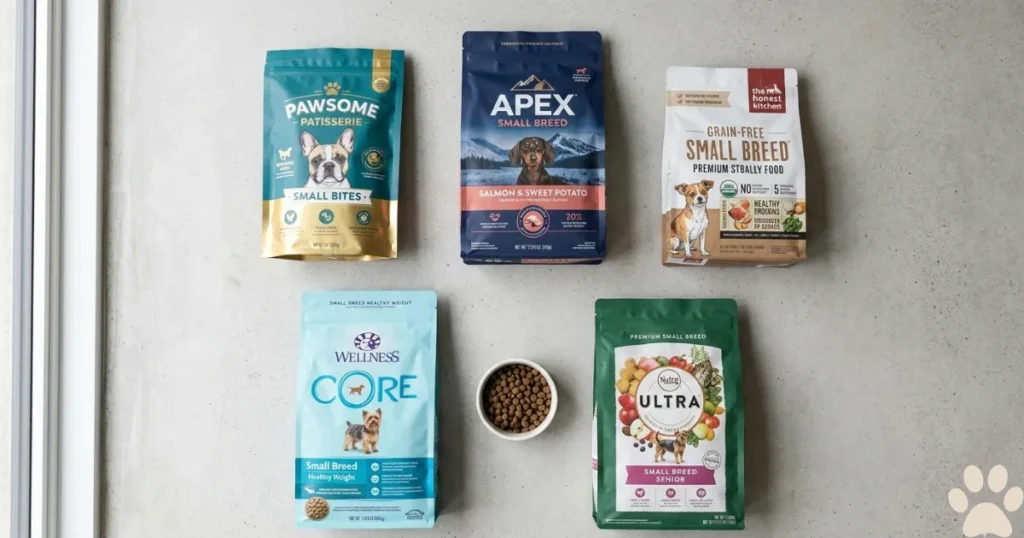
| Food Name | Primary Protein | Life Stage | Kcal/Cup (approx.) | Key Benefit for Small Breeds |
| Royal Canin Small Adult | Chicken by-product meal | Adult | ~363 | Breed-size specific kibble shape; highly digestible; dental texture optimized |
| Hill’s Science Diet Small & Toy Breeds | Chicken meal | Adult | ~354 | AAFCO feeding trial certified; antioxidant blend; precise mineral balance |
| Purina Pro Plan Small & Toy Breed | Chicken | Adult | ~394 | High caloric density; live probiotics; strong coat and digestive outcomes |
| Orijen Small Breed | Chicken, turkey, fish | Adult | ~449 | Whole-prey protein sourcing; highest caloric density; ideal for active small dogs |
| Royal Canin Small Puppy | Chicken by-product meal | Puppy (up to 10 months) | ~358 | Controlled DHA; supports immune development; small kibble for milk teeth |
| Hill’s Science Diet Small Paws Puppy | Chicken meal | Puppy | ~394 | DHA from fish oil for brain development; calcium-phosphorus balanced |
| Purina Pro Plan Small & Toy Senior 11+ | Chicken | Senior | ~364 | Elevated protein for muscle retention; EPA/DHA for joint health; bright mind formula |
| Merrick Lil’ Plates Grain-Free Chicken | Deboned chicken | Adult | ~370 | High meat content; no legume concerns documented; real whole food ingredients |
| Wellness CORE Small Breed | Turkey, chicken | Adult | ~421 | Grain-free with whole protein; glucosamine added; strong coat performance |
| Acana Small Breed Recipe | Chicken, turkey, fish | Adult | ~393 | Biologically appropriate ratios; novel protein rotation friendly; low glycemic |
Vet’s Tip: When transitioning a small breed dog to a new food, reduce the transition window to 5- 7 days rather than the standard 10. Small dogs have shorter GI tracts and adapt faster. Still, their smaller stomach volume means even moderate digestive stress causes visible symptoms quickly. Monitor stool consistency from day two onward and slow down if stool softens.
6 Small Breed Nutrition Requirements That Standard Dog Food Misses
These are the specific nutritional gaps where generic Golden Retriever food – not formulated for small breeds – consistently falls short.
1. Higher caloric density per gram.
Small dogs cannot physically consume the volume needed to meet caloric requirements from low-density food. Small breed nutrition requires food delivering at least 340 – 450 kcal per cup to support full daily energy needs in practical portions.
2. Elevated fat-to-carbohydrate ratio.
High-glycemic carbohydrates cause blood sugar volatility in small breeds. Quality fat as the primary energy source delivers more stable, sustained energy between meals – critical for preventing the energy crashes that manifest as shivering, lethargy, or irritability in toy breeds mid-afternoon.
3. Smaller kibble particle size.
Kibble designed for large dogs measures 12- 18mm across. Small breed dogs have jaw openings of 20 – 30mm. Standard kibble can be physically difficult to chew and generates no dental benefit. Small breed-specific kibble typically measures 5 – 8mm, sized to require multiple chewing motions per piece.
4. Omega-3 fatty acids for skin and coat.
Small breeds are disproportionately affected by skin conditions, seasonal allergies, and coat thinning. EPA and DHA from fish oil or whole fish ingredients reduce systemic inflammatory response and support coat density. Small dog feeding requirements should include at least 0.3% DHA on a dry matter basis.
5. Dental support ingredients.
Beyond kibble texture, the best small breed dog food includes ingredients that reduce plaque and tartar formation: sodium hexametaphosphate (SHMP), natural chelating compounds, or specific enzyme systems. Periodontal disease affects over 80% of dogs by age three. In small breeds, it presents earlier and progresses faster due to tooth crowding.
6. Adequate phosphorus and calcium for bone density.
Small breed bones are proportionally dense but smaller in cross-section. Calcium and phosphorus requirements per kilogram of body weight are higher than in large breeds, particularly during puppyhood and senior years when bone remodeling is active. Small breed-specific formulas calibrate these minerals appropriately; generic adult formulas often do not.
Over the years, I’ve noticed that small breed dogs presented with recurring digestive issues – intermittent soft stools, vomiting after meals, food refusal – are most commonly on food formulated for medium or large breeds. When owners switch to a genuine small breed nutrition formula with appropriate caloric density and smaller kibble, these symptoms resolve within two to three weeks in the majority of cases without any other intervention.
7 Common Small Dog Feeding Mistakes That Affect Long-Term Health
1. Feeding adult food to small breed puppies.
Small breed puppies have the highest caloric demand of any dog life stage relative to body weight. Adult formulas – even small breed adult formulas – do not deliver sufficient DHA, caloric density, or developmental nutrient ratios for puppies under 10 months.
2. Free-feeding to prevent hypoglycemia.
Leaving food available all day sounds like a solution to blood sugar instability, but it creates irregular eating patterns and overconsumption. Structured meals three times daily for puppies and twice daily for adults provide better blood sugar regulation than free-feeding.
3. Measuring by volume instead of weight.
Cup measurements vary by 20 – 30% depending on how kibble settles. For small dogs where the entire daily ration may be half a cup, a 20% measurement error represents a significant caloric miscalculation. Use a kitchen scale for portion accuracy.
4. Choosing food based on price per bag rather than price per serving.
A calorie-dense small breed formula at a higher bag price often delivers more servings than a cheaper food, because smaller portions meet caloric requirements. Calculate cost per daily serving, not cost per kilogram of food.
5. Ignoring dental food texture.
Many owners prioritize ingredient quality without considering kibble texture and size. In small breeds, where dental disease is the most prevalent health condition seen before age five, dental texture is a health variable – not an aesthetic one.
6. Treating small dogs like large dogs on reduced portions.
Small dog feeding requirements aren’t just large breed requirements scaled down. Meal frequency, caloric density, fat ratios, and kibble design are all different. Feeding a large-breed formula at a proportionally smaller volume consistently under-delivers on small breed nutritional needs.
7. Not adjusting food at the transition to the senior life stage.
Small breeds are considered senior at 10- 12 years, later than large breeds. Many owners transition to senior food too early, reducing caloric density and protein at a point when the dog still has normal metabolic needs. Confirm life-stage transition with a veterinary assessment rather than defaulting to age alone.

5 Small Breed Puppy Foods That Support Healthy Development
Small breed puppies have the most demanding small breed nutrition requirements of any life stage. These formulas are specifically evaluated for developmental nutritional completeness.
1. Royal Canin Small Puppy
Designed for small breeds under 10kg from weaning to 10 months. Delivers highly digestible proteins, controlled DHA from fish oil, and immune-supportive antioxidants. Kibble sized for milk teeth and transitional dentition.
2. Hill’s Science Diet Small Paws Puppy
AAFCO feeding trial certified for puppies. DHA from fish oil supports neurological development. A precise calcium-phosphorus ratio prevents skeletal issues during the rapid growth phase.
3. Purina Pro Plan Small & Toy Breed Puppy
Live probiotic (Bacillus coagulans) supports digestive microbiome stability – important for small breeds prone to GI sensitivity. High caloric density supports the energy demands of small breed puppy metabolism.
4. Merrick Lil’ Plates Puppy Recipe
High whole-meat protein content. Grain-free without a heavy legume base. Suitable for puppies whose owners prefer whole-food-sourced ingredients at an appropriate small breed caloric density.
5. Acana Small Breed Puppy Formula.
Biologically appropriate protein ratios from named animal sources. Omega-3 from whole fish supports coat development from an early age. Lower glycemic index than grain-heavy puppy formulas.
8 Early Warning Signs Your Small Dog’s Food Isn’t Meeting Their Needs
- Persistent shivering or trembling between meals – in toy breeds, this is a hypoglycemia signal before overt symptoms develop. Evaluate meal frequency and caloric density immediately.
- Dull, thinning, or brittle coat – omega-3 deficiency or inadequate protein quality. Add fish oil and evaluate the protein source bioavailability in the current food.
- Consistent soft stools without infection or parasites – often a digestibility issue. The current food’s protein or fat source may not match the dog’s digestive capacity.
- Reluctance to eat kibble after the first few days – frequently indicates the kibble size is too large or too hard for the dog’s jaw structure. Assess kibble dimensions relative to the dog’s bite.
- Visible weight loss despite normal portions – caloric density may be insufficient for the dog’s metabolic demand. Recalculate daily caloric need based on body weight and activity.
- Excessive flatulence or borborygmi – a common sign of fermentable carbohydrate excess or poor protein digestibility. Evaluate the ingredient list for high-starch fillers.
- Recurring bad breath or visible tartar before age four – diet is contributing to dental disease. Switch to a food with a specific dental texture or a VOHC-approved dental benefit.
- Low energy or lethargy mid-afternoon – blood sugar drop from high-glycemic food or insufficient meal frequency. Add a midday meal or switch to a more calorically stable formula.
9 Vet-Backed Tips for Small Breed Feeding Long-Term
- Feed small breeds at least twice daily as adults – once daily increases fasting time and blood sugar variability beyond what small body glycogen stores can buffer reliably.
- Calculate daily caloric needs using the formula: RER = 70 × (body weight in kg) ^ 0.75, then multiply by a life stage factor (1.6 for active adults, 1.4 for sedentary adults, 3.0 for puppies).
- Choose foods with VOHC (Veterinary Oral Health Council) approval or specific dental texture claims for small breeds – periodontal disease prevention is more cost-effective than treatment.
- Supplement with fish oil even if the food contains omega-3s – most commercial small breed formulas don’t deliver therapeutic EPA/DHA levels at practical portion sizes.
- Reassess food choice at every annual exam – a small breed’s nutritional needs at age 2, 7, and 12 are meaningfully different and warrant active dietary management.
- Rotate protein sources every 3 – 6 months to reduce sensitization risk. Small breeds on single-protein diets for years develop reactions to that protein more frequently than dogs fed varied sources.
- Avoid human food supplementation beyond occasional plain cooked protein – small dogs have proportionally lower caloric budgets, meaning even small table scraps represent a meaningful percentage of their daily intake and displace balanced nutrition.
- Use puzzle feeders or slow-feed bowls for fast-eating small breeds – rapid consumption leads to aerophagia (air swallowing), which drives the bloating and discomfort common in small dogs despite their size.
- For small breeds over 10 years, run a full blood panel annually before adjusting food – kidney values, thyroid function, and liver enzymes all influence appropriate dietary protein and caloric targets in aging small dogs.
The best small breed dog food is not a large-breed formula served in smaller portions – it is a distinct nutritional formulation accounting for higher metabolic rate, smaller jaw anatomy, blood sugar stability, and the specific disease predispositions of small dog physiology.
Small breed dental disease is significantly influenced by kibble size and texture – dogs fed appropriately sized small breed kibble show measurably lower plaque accumulation than those fed standard kibble at the same ingredient quality.
In small breed nutrition, caloric density per cup is more clinically relevant than protein percentage alone – a food that cannot meet daily energy needs at a practical portion size fails the dog regardless of its macronutrient ratios.
What makes small breed dog food different from regular dog food?
Small breed food is calorie-denser, has smaller kibble sized for small jaws, delivers higher energy per portion, and is formulated for faster metabolisms. Regular dog food served in small portions consistently under-delivers on small breed nutrition requirements.
How many times a day should I feed a small breed dog?
Adults: twice daily minimum. Puppies under 6 months: three times daily. Toy breeds prone to hypoglycemia may benefit from three small meals daily into adulthood to maintain blood sugar stability.
What is the best protein source in small breed dog food?
Named animal proteins – deboned chicken, turkey meal, salmon – rank highest for digestibility and biological value. These deliver complete amino acid profiles efficiently, which matters especially in small dogs with limited stomach volume.
Can small breed dogs eat large breed dog food?
Technically, yes, but not optimally. Large breed formulas are lower in caloric density and not sized for small breed jaws. Persistent feeding of large breed food to small dogs commonly results in insufficient caloric intake and no dental benefit from kibble.
What is the right calorie intake for a small breed dog?
Use RER = 70 × (kg) ^ 0.75 as a baseline. A 4kg adult small breed dog typically needs 280 – 350 kcal daily, depending on activity. Confirm with your vet and adjust based on body condition score.
Is grain-free food better for small breed dogs?
Not inherently. Small breeds don’t require grain-free diets unless a specific grain sensitivity is confirmed. Grain-free formulas with heavy legume bases have been under FDA investigation for a potential link to cardiac disease. Quality whole grains are appropriate for most small dogs.
How do I prevent hypoglycemia in small breed puppies?
Feed calorie-dense small breed puppy food three times daily on a fixed schedule. Never skip meals. Keep a small amount of honey or corn syrup accessible for emergency low blood sugar events while consulting your vet.
What should I look for on a small breed dog food label?
Named animal protein in the first ingredient, caloric density of 340+ kcal/cup, AAFCO feeding trial certification, and specific small breed formulation. Avoid foods with unnamed by-products, corn syrup, or artificial preservatives.
Do small breed dogs need more protein than large dogs?
Per kilogram of body weight, yes. Small breed nutrition requires higher protein density relative to body mass to support faster metabolism, muscle maintenance, and immune function. Look for foods delivering 25 – 30% crude protein on a dry matter basis.
Is wet food good for small breed dogs?
Yes, particularly for dogs with dental sensitivity, difficulty chewing, or low appetite. Wet food delivers higher moisture intake and palatability. It does not replace dental care – combine with dental chews or regular tooth brushing.
How do I know if my small dog’s food is causing digestive problems?
Soft stools for more than three days, frequent vomiting, visible bloating, or food refusal after initial acceptance are the primary indicators. These typically resolve within 2 – 3 weeks of switching to an appropriately formulated small breed diet.
What is the best small breed senior dog food?
Purina Pro Plan Small & Toy Senior 11+ and Royal Canin Small Aging 12+ are the most evidence-backed options. Both maintain elevated protein for muscle preservation while managing caloric density for the reduced activity levels common in senior small dogs.
Should small breed puppies eat puppy food or adult food?
Puppy food exclusively until 10- 12 months. Small breed puppies have developmental nutritional needs – DHA for brain development, controlled calcium for skeletal growth, and higher caloric density – that adult formulas do not meet.
How much food should I feed my small breed dog per day?
Start with the manufacturer’s guideline, then adjust based on body condition score. If you can feel but not see the ribs with light pressure, the dog is at a healthy weight. Scale portions up or down accordingly and reassess every 4 – 6 weeks.
Can I mix wet and dry small breed dog food?
Yes. Mixing improves palatability, increases daily moisture intake, and allows caloric fine-tuning. Ensure the combined caloric total stays within the dog’s daily requirement. Both foods should be AAFCO-certified small breed formulas.
Conclusion
Small breed nutrition is precise work. The best small breed dog food isn’t determined by the most prominent marketing claim or the highest protein percentage – it’s determined by caloric density, protein bioavailability, kibble design, meal frequency, and how well the formula addresses the genuine physiological realities of small dog metabolism.
Small dog feeding requirements differ from large breed requirements in ways that matter clinically: faster metabolism, greater blood sugar vulnerability, dental anatomy, and proportionally higher caloric demand per kilogram. Choosing food that accounts for all of these variables – rather than just scaling down a generic formula – produces visible differences in energy, coat quality, dental health, and long-term weight stability.
Evaluate food based on what your specific dog needs at their current life stage. Reassess annually. Run bloodwork in dogs over eight years before making dietary changes. The investment in genuinely appropriate small breed nutrition returns measurably better health outcomes over a lifetime.
Small breed dogs are as individual as their owners – what works brilliantly for one Chihuahua may not suit a Dachshund or a Maltese.
- Have you found a small breed dog food that genuinely transformed your dog’s energy, coat, or digestion?
- Or struggled to find something your small dog will actually eat consistently?
Share your experience in the comments – real owner feedback helps this community make smarter feeding decisions.