

A consistent dog feeding schedule is one of the most overlooked tools in canine health management. I often see Golden Retriever owners focused entirely on what they feed – the brand, the protein content, and the ingredient list – while treating when and how often as an afterthought. Timing matters more than most people realize.
In Golden Retrievers specifically, feeding schedule decisions carry consequences that go beyond hunger management. Meal frequency influences digestive health, bloat risk, blood glucose stability, and behaviour around food. A poorly timed dog feeding schedule can quietly undermine even the best diet.
What I’ve found, working closely with this breed across every life stage, is that a structured dog feeding schedule by age makes the single biggest difference in maintaining a healthy weight, predictable digestion, and a calm relationship with mealtimes.
This guide gives you a complete, breed-aware dog feeding schedule for every stage of a Golden Retriever’s life – from the first weeks after bringing a puppy home through to the senior years. Every recommendation here is grounded in how this breed specifically processes food, not a generic guide for all dogs.
Why a Dog Feeding Schedule Matters More Than Most Owners Realize
A structured dog feeding schedule does more than keep your Golden from pestering you at irregular hours. It creates physiological and behavioural predictability that supports long-term health.
What a consistent dog feeding schedule regulates:
Digestive enzyme timing
The digestive system primes itself around anticipated meal times; irregular feeding disrupts this rhythm
Blood glucose stability
Especially relevant for active and growing Goldens; consistent meal timing prevents energy spikes and crashes
Gastric acid balance
Irregular feeding allows acid to pool without food to buffer it, contributing to nausea and grass-eating behaviour
Appetite regulation
A dog on a reliable dog feeding schedule learns when food is coming and is less likely to overeat when it arrives
Behaviour management
Food-motivated breeds like Golden Retrievers can develop anxiety and food-guarding when meals are unpredictable
In veterinary medicine, meal-fed dogs (vs. free-fed dogs) are consistently easier to monitor for appetite changes – one of the earliest and most reliable indicators of illness.
Dog Feeding Schedule by Age: The Complete Golden Retriever Breakdown
8 Weeks to 3 Months: 4 Meals per Day
A Golden Retriever puppy at 8 weeks has a small stomach, high energy demand, and an immature metabolic system. The dog feeding schedule at this stage prioritises frequency over volume – four small meals spread evenly across the day support steady growth without overloading the GI tract.
Recommended daily dog feeding schedule (8 – 12 weeks):
| Meal | Suggested Time |
| Meal 1 | 7:00 AM |
| Meal 2 | 12:00 PM |
| Meal 3 | 5:00 PM |
| Meal 4 | 9:00 PM |
Why four meals at this stage:
- Prevents hypoglycaemia between feeds in rapidly growing puppies.
- Reduces digestive overload from large single portions.
- Establishes early positive associations with a structured dog feeding schedule.
What NOT to do:
Do not feed the last meal immediately before bed – allow at least 30-45 minutes for a bathroom break. This supports housetraining alongside the feeding routine.
3 to 6 Months: 3 Meals per Day.
By 3 months, a Golden Retriever puppy’s stomach capacity has grown enough to handle a shift to three meals per day. This adjustment in the dog feeding schedule by age also aligns more realistically with most owners’ daily routines.
Recommended daily dog feeding schedule (3 – 6 months):
| Meal | Suggested Time |
| Meal 1 | 7:00 AM |
| Meal 2 | 1:00 PM |
| Meal 3 | 6:00 PM |
Daily dog food quantity should increase during this window as the puppy’s weight grows – typically reassessed every 3-4 weeks using a body condition check and weight measurement.
Over the years, I’ve noticed that Golden Retriever puppies in the 4- to 6-month window tend to go through an appetite surge that owners frequently misread as a need to add a fourth meal back in. In most cases, it’s increased energy demand during a rapid growth phase – the three-meal dog feeding schedule remains appropriate, but portion sizes within each meal need to increase.

6 to 12 Months: Transitioning to 2 – 3 Meals per Day.
Between 6 and 12 months, Golden Retrievers transition toward the adult dog feeding schedule. Most dogs in this window do well on two structured meals per day, though some owners maintain three meals until 10 – 12 months, particularly for more active puppies.
Recommended daily dog feeding schedule (6 – 12 months):
| Meal | Suggested Time |
| Meal 1 | 7:00 AM |
| Meal 2 | 6:00 PM |
Optional third meal (if maintaining three):
Add a midday meal around 1:00 PM, reducing morning and evening portions proportionally.
The transition from three to two meals should be gradual – not a sudden drop. Reduce the middle meal over 1 – 2 weeks by progressively redistributing those calories to the morning and evening meals.
If your 6-month puppy shows signs of excessive hunger or GI upset at two meals, maintain three meals and reassess at 9 months. Not all puppies are ready for the adult dog feeding schedule at the same point.
Adult Golden Retrievers (1 – 7 Years): 2 Meals per Day.
Two meals per day is the standard and strongly preferred dog feeding schedule for healthy adult Golden Retrievers. This is not merely a convenience – it carries specific health implications for this breed.
Why twice-daily is the right dog feeding schedule for adult Goldens:
- Golden Retrievers have a deep chest cavity that places them in a moderate-risk category for Gastric Dilatation-Volvulus (GDV/bloat). Once-daily feeding with large single portions increases the risk of bloat compared to two smaller meals.
- Two meals maintain more stable energy across the day – important for an active, people-oriented breed.
- Meal-skipping behaviour (which can occur with once-daily feeding if the dog isn’t hungry at mealtime) is easier to detect on a two-meal schedule.
Recommended adult dog feeding schedule:
| Meal | Suggested Time |
| Morning meal | 7:00 AM |
| Evening meal | 6:00 PM |
Key timing rule:
Do not feed within 1 hour before or 2 hours after vigorous exercise. In Golden Retrievers, exercising on a full stomach increases the risk of bloat. Build the dog feeding schedule around exercise timing, not the other way around.
What NOT to do:
Do not free-feed adult Golden Retrievers. Leaving food available all day disconnects appetite regulation, makes early-illness detection nearly impossible, and is directly associated with higher rates of overweight in food-motivated breeds.
Vet’s Tip: The 12-hour gap between meals on a twice-daily dog feeding schedule is intentional – it allows full gastric emptying between feeds. Meals spaced less than 8 hours apart can mean the evening meal lands on a stomach that hasn’t fully cleared the morning meal. Keep the gap consistent.
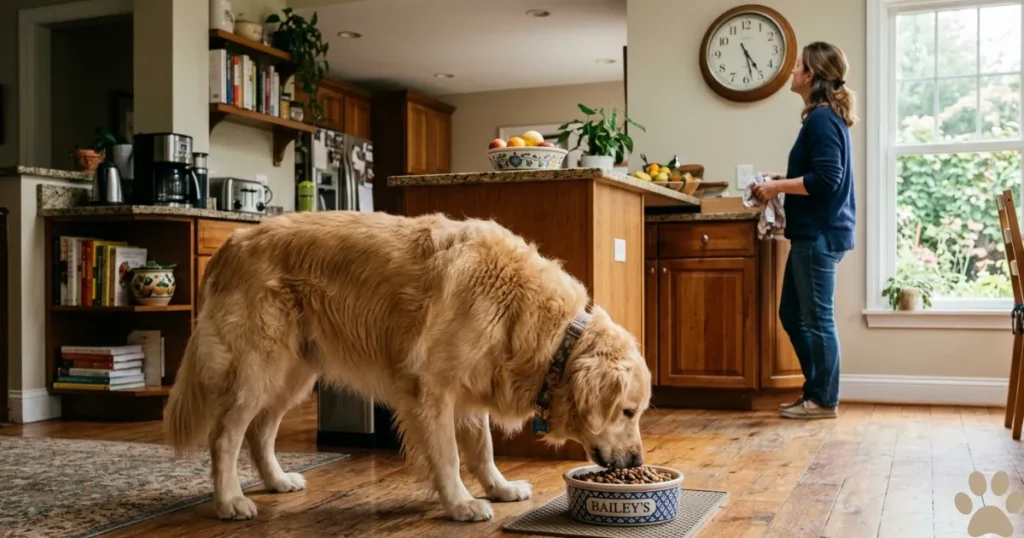
Senior Golden Retrievers (7+ Years): 2 – 3 Smaller Meals per Day.
The recommended dog feeding schedule by age for senior Goldens shifts slightly from the adult standard. While twice daily remains appropriate for many seniors, dogs showing reduced appetite, slower digestion, or weight loss may benefit from three smaller meals.
Adjustments to the dog feeding schedule in senior Goldens:
- Slower GI motility in senior dogs means large meals are digested less efficiently – smaller portions spread across more meals often improve nutrient absorption.
- Reduced appetite is common in seniors; splitting the same daily caloric amount into three meals often improves total intake.
- Medication timing – many senior Goldens are on joint or cardiac medications that need to be given with food; three meals create more administration flexibility.
- Hydration support – adding a small amount of warm water to kibble at each meal increases total daily fluid intake, supporting kidney function.
Recommended senior dog feeding schedule (if shifting to 3 meals):
| Meal | Suggested Time |
| Meal 1 | 7:00 AM |
| Meal 2 | 1:00 PM |
| Meal 3 | 6:00 PM |
If a senior Golden Retriever misses two or more consecutive meals, this is not a normal part of a senior dog feeding schedule – it warrants a veterinary check, not a schedule adjustment.

Building Your Golden Retriever’s Dog Feeding Schedule around Daily Life.
A dog feeding schedule only works if it’s sustainable for the household. The most precisely timed schedule, in theory, becomes useless if it can’t be maintained consistently.
Practical framework for structuring a dog feeding schedule:
1. Anchor meals to fixed daily events
Morning meal aligned with your wake time; evening meal aligned with dinner or end of workday.
2. Build in the exercise buffer
Map out walk and play times first, then set meal times at least 1 hour before or 2 hours after.
3. Assign feeding responsibility explicitly
In multi-person households, designate who feeds each meal to prevent double-feeding.
4. Use consistent locations
Feeding Golden Retrievers in the same spot each time reduces mealtime anxiety and food-guarding behaviour.
5. Time meals before bathroom opportunities
Particularly useful for puppies; helps associate the post-meal window with elimination rather than play.
9 Dog Feeding Schedule Mistakes Golden Retriever Owners Make.
1. Feeding immediately before exercise.
Vigorous activity within an hour of a full meal increases the risk of bloat in deep-chested breeds. Always allow adequate post-meal rest before walks or play sessions.
2. Inconsistent meal times day to day.
A dog feeding schedule that shifts by 2 – 3 hours daily disrupts digestive enzyme priming and can cause acid-related nausea. Consistency within 30-minute windows is the target.
3. Switching from 3 meals to 1 overnight.
Reducing meal frequency should be gradual – a direct jump from three meals to one is harsh on the GI system and often causes digestive upset.
4. Feeding late-night meals right before bed.
The last meal of the day should be given 2-3 hours before the household settles for the night, to allow for a final bathroom outing and initial digestion.
5. Not adjusting the schedule after spaying or neutering.
Hormonal changes post-surgery reduce metabolic rate. The schedule itself may stay the same, but portion sizes within each meal must be recalculated within 4 – 6 weeks.
6. Allowing the schedule to drift on weekends.
Weekend lie-ins that delay morning meals by 2 – 3 hours create a pattern break that can cause gastric discomfort, especially in dogs accustomed to early feeds.
7. Confusing food-seeking behaviour with genuine hunger.
Golden Retrievers will solicit food outside their dog feeding schedule by default – this is breed temperament, not a sign that the schedule needs changing.
8. Skipping the midday meal too early in puppyhood.
Moving a puppy from 4 meals to 2 before 5-6 months leaves long gaps that can cause hypoglycaemia-like energy crashes, particularly in very active puppies.
9. No structured schedule for multiple dogs.
In multi-dog households, each dog should be fed separately on the same schedule. Competitive eating – where one dog rushes to prevent another from accessing food – can lead to overeating, gulping, and potential bloat.
How the Dog Feeding Schedule Interacts With Training.
A well-timed dog feeding schedule gives Golden Retriever owners a powerful training tool that many underuse.
Golden Retrievers are highly food-motivated. Feeding at structured times means the pre-meal window – when hunger is genuine – becomes the ideal moment for short training sessions. A 5-minute recall or sit-stay session immediately before placing the food bowl reinforces calm behaviour and productively redirects mealtime excitement.
Applying this to the dog feeding schedule by age:
- Puppies: short 1 – 2 minute sessions before each of the 3 – 4 daily meals.
- Adults: 5 – 7 minutes of obedience or enrichment work before both meals.
- Seniors: light, low-impact mental stimulation (puzzle feeders, scent work) before meals to maintain cognitive engagement.
This approach works precisely because it leverages the natural appetite cycle built into the dog feeding schedule – hunger is a motivator, not something to be bypassed.

Vet Definitive Statements.
A consistent dog feeding schedule is one of the most effective tools for preventing bloat in Golden Retrievers – two meals per day, spaced 10 – 12 hours apart, reduces single-meal stomach load and associated GDV risk compared to once-daily feeding.
The correct dog feeding schedule by age for Golden Retrievers moves from four meals daily at 8 weeks, to three meals at 3 months, to two meals at approximately 6- 12 months, with transition timing based on the individual dog’s growth and GI tolerance.
In veterinary medicine, a structured dog feeding schedule enables earlier detection of appetite changes – one of the most diagnostically reliable early indicators of illness in dogs.
Senior Golden Retrievers with reduced appetite or slower digestion often benefit from shifting their dog feeding schedule from two meals to three smaller meals daily, even if total caloric intake remains unchanged.
Golden Retrievers should not be exercised within one hour before or two hours after meals; structuring the daily dog feeding schedule around exercise timing, rather than the reverse, is the safest practice for this breed.
What is the best dog feeding schedule for a Golden Retriever?
Two meals per day – morning and evening, spaced 10- 12 hours apart – is the standard dog feeding schedule for healthy adult Golden Retrievers. Puppies need 3 – 4 meals daily; seniors may benefit from 3 smaller meals.
What is the right dog feeding schedule by age?
8 – 12 weeks: 4 meals/day. 3 – 6 months: 3 meals/day. 6 – 12 months: 2 – 3 meals/day. Adults (1 – 7 years): 2 meals/day. Seniors (7+): 2 – 3 meals/day depending on appetite and digestion.
How many times a day should I feed my Golden Retriever?
Twice daily for adults. The once-daily feeding some owners practise is not recommended for Golden Retrievers – it increases bloat risk and creates long fasting periods that disrupt digestive rhythm.
What time should I feed my dog each day?
Morning and evening meals 10 – 12 hours apart work best. Example: 7:00 AM and 6:00 PM. Consistency within a 30-minute window daily is more important than the specific clock time chosen.
Should I stick to the same feeding times every day?
Yes. Consistent meal times prime digestive enzymes, regulate blood glucose, and reduce food-anxiety behaviour in Golden Retrievers. Irregular schedules – even by a few hours – can cause GI discomfort.
Is free-feeding okay for Golden Retrievers?
No. Free-feeding is not recommended for this breed. Golden Retrievers are highly food-motivated and prone to overconsumption when food is continuously available. A structured dog feeding schedule is essential for portion control.
How do I transition my puppy from 3 meals to 2 meals a day?
Gradually, over 1- 2 weeks. Begin by making the middle meal progressively smaller while redistributing those calories to morning and evening meals. A sudden drop to two meals can cause GI upset.
Can I feed my Golden Retriever right before a walk?
No. Feed at least 1 hour before or 2 hours after vigorous exercise. In deep-chested breeds like Golden Retrievers, exercising on a full stomach elevates the risk of bloat (GDV).
What should I do if my dog misses a meal?
Missing one meal occasionally is not concerning. If a Golden Retriever misses two or more consecutive meals without explanation, schedule a vet check – appetite loss is one of the earliest signs of underlying health issues.
How does the dog feeding schedule change for a senior Golden Retriever?
Seniors may shift from two meals to three smaller meals if appetite decreases or digestion slows. Total daily calories often stay the same or decrease slightly, but spreading them across more meals supports better nutrient absorption.
Should I feed my dog before or after exercise?
Always after, with a minimum 2-hour gap post-exercise. Build your dog feeding schedule around exercise timing – plan walks first, then set meal times around them.
How long should I wait between meals for my dog?
12 hours between meals is ideal for adult Goldens. This gap allows full gastric emptying before the next meal and supports a consistent digestive rhythm on a twice-daily dog feeding schedule.
Why does my Golden Retriever act hungry between meals?
Food-seeking between meals is typical for this breed – it is temperament-driven, not necessarily a sign of genuine hunger. If body condition score and weight are normal, the dog feeding schedule does not need adjustment.
Can I adjust my dog’s feeding schedule if my routine changes?
Yes, but do so gradually – shift meal times by 15-30 minutes per day over a week rather than changing abruptly. Sudden large time shifts disrupt the digestive rhythm established by the previous schedule.
At what age should a Golden Retriever switch to adult feeding frequency?
Most Golden Retrievers are ready to move to a twice-daily adult dog feeding schedule between 6 and 12 months, depending on size, activity level, and how well the individual dog handles longer gaps between meals.
Conclusion.
A well-designed dog feeding schedule is not a minor convenience – it is a direct investment in your Golden Retriever’s digestive health, weight management, and long-term wellbeing. Following the right dog feeding schedule by age ensures that meals match your dog’s actual physiological needs at each stage of life, rather than defaulting to habits that made sense at one age but no longer serve the dog.
Start with the right frequency for your Golden’s current life stage. Build meal times around exercise, not the other way around. Maintain consistency within a 30-minute window daily. And revisit the schedule at each major transition – puppy to adolescent, adolescent to adult, and adult to senior.
The dogs I’ve seen thrive over the longest periods are rarely the ones fed the most expensive food. They’re the ones whose owners committed to a reliable, age-appropriate dog feeding schedule and stuck to it – making thoughtful adjustments as the dog changed, not when the routine got inconvenient.
If you’re unsure whether your current dog feeding schedule by age is still appropriate, your next routine wellness visit is the right moment to reassess.
What does your Golden Retriever’s daily feeding schedule actually look like?
Every household is different – morning routines, work schedules, and your dog’s own quirks all shape when and how you feed. If you’ve found a feeding routine that works well for your Golden across puppyhood or into the senior years, share it below. Your real-world experience is exactly what other owners need to read.

Dr. Nabeel A.
Dr. Nabeel Akram is a Doctor of Veterinary Medicine with more than five years of hands-on experience in animal health, canine nutrition, and preventive care. He is a registered veterinarian with the Pakistan Veterinary Medical Council (PVMC), the statutory body regulating veterinary practice in Pakistan. As the founder of Golden Retriever Insight, Dr. Akram writes and medically reviews every health, nutrition, and grooming guide published on the site. His clinical interests include canine oncology, epilepsy management, and breed-specific nutrition for large breeds — the core topics this site covers. Every article is checked against current veterinary literature and sources such as the Merck Veterinary Manual, AVMA guidance, and peer-reviewed research.