I get this question almost every week: how many cups of food should I feed my dog? And the honest answer – one that took me years of working with Golden Retrievers to fully appreciate – is that the cup is a unit of volume, not of nutrition. Two bags sitting side by side on a shelf can look nearly identical and yet deliver wildly different amounts of energy per cup. That gap is where most owner feeding errors begin.
I often see Golden Retrievers brought in for weight-related concerns – joint stiffness, laboured movement, or unexplained thinning – and the culprit is almost always a mismatch between how much the owner is scooping and how many calories that scoop actually contains.
This guide will give you a practical, repeatable method for determining how many cups your specific Golden Retriever needs each day. It also covers something most feeding guides skip entirely: how many cups of dog food in a pound, so you can plan, manage food costs, and avoid running short between bag purchases.
If your goal is a healthy, well-portioned Golden Retriever, this is where that starts.
Why the Cup Measurement Is More Complicated Than It Looks
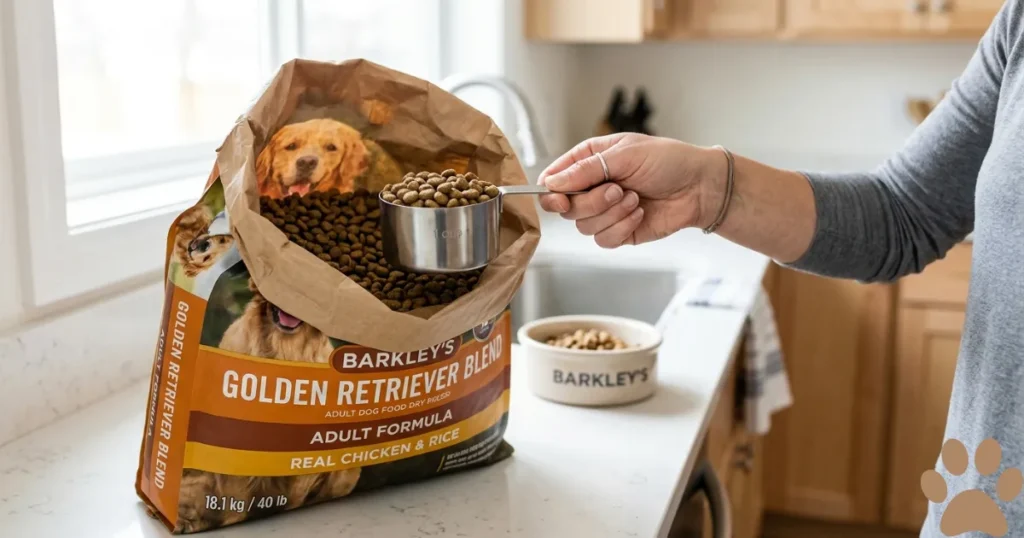
A standard measuring cup holds 8 fluid ounces of liquid. In dry dog food terms, one level cup typically holds between 3.5 and 4.5 ounces by weight – depending on the kibble’s size, shape, and density.
More importantly, the caloric content of one cup varies dramatically:
| Food Type | Typical kcal per Cup |
| Economy/value kibble | 270–320 kcal |
| Mid-range dry kibble | 330–390 kcal |
| Premium/high-protein dry | 390–480 kcal |
| Grain-free dense kibble | 420–520 kcal |
| Raw dehydrated (reconstituted) | 150–250 kcal |
This means a Golden Retriever owner switching from a 330 kcal/cup food to a 480 kcal/cup food – while keeping the same cup count – is feeding their dog roughly 45% more energy per day without realizing it.
The fix: Always locate the kcal/cup figure on your food’s packaging or brand website before calculating portions. This single number determines everything.
How Many Cups of Dog Food in a Pound? The Essential Conversion
Understanding how many cups of dog food are in a pound allows owners to track how long a bag will last, budget accurately, and spot when portion sizes are drifting.
The general conversion: 1 pound of dry dog food ≈ 3 to 4 cups
The range exists because kibble density varies. Smaller, denser pieces pack more tightly; larger, airier shapes leave more space per cup.
Practical estimates by kibble type:
| Kibble Size/Style | Approximate Cups per Pound |
| Small kibble (dense) | ~4 cups per pound |
| Standard medium kibble | ~3.5 cups per pound |
| Large breed kibble | ~3 cups per pound |
| Grain-free (light/puffed) | ~4–4.5 cups per pound |
Example bag math: A 30 lb bag of standard medium kibble → approximately 105 cups total A Golden Retriever eating 3.5 cups per day → bag lasts roughly 30 days
This calculation helps owners recognize immediately if a bag is disappearing faster than expected – often the first sign that cup measurements have been drifting upward over time.
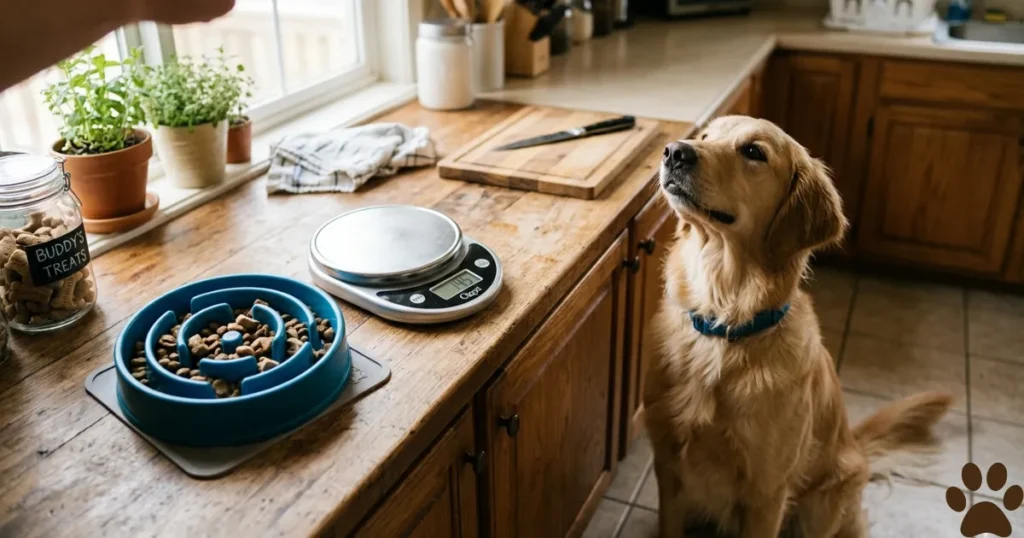
Vet’s Tip: Weigh your dog’s food with a kitchen scale at least once per month. Scoop volume “creep” – where the daily amount gradually increases without intent – is one of the quietest contributors to Golden Retriever weight gain I’ve seen over the years.
How Many Cups of Food Should I Feed My Dog? The Calculation Framework
To determine the right daily cup count of food to feed your dog, you need three inputs:
- Your dog’s daily caloric requirement (kcal/day).
- The caloric density of your food (kcal/cup).
- Your dog’s life stage and health status.
Step 1: Estimate Daily Caloric Needs.
Use the Resting Energy Requirement (RER) as a baseline:
RER = 70 × (body weight in kg) ^ 0.75.
Then apply a life-stage multiplier:
| Dog Profile | Multiplier |
| Intact adult | 1.8 |
| Spayed/neutered adult | 1.6 |
| Weight loss protocol | 1.0 |
| Senior, low activity | 1.2–1.4 |
| Puppy under 4 months | 3.0 |
| Puppy 4–12 months | 2.0 |
| Active/working adult | 2.0–3.0 |
Step 2: Divide by kcal/cup.
Daily cups = Daily caloric need ÷ kcal/cup of your food.
Worked example – 30 kg neutered adult Golden Retriever:
- RER = 70 × (30) ^ 0.75 = 70 × 12.8 = | 896 kcal.
- With multiplier: 896 × 1.6 = | 1,434 kcal/day.
- Food at 380 kcal/cup → 1,434 ÷ 380 = | 3.8 cups/day.
- Split across two meals: | 1.9 cups per meal.
Run this calculation every time you change food brands. The cup count you used on one food rarely transfers accurately to another.
Golden Retriever Daily Cup Guide by Life Stage.
Puppies (8 Weeks to 12 Months).
Golden Retriever puppies require more calories per kilogram of body weight than adults – but controlled growth matters. Overfeeding a large-breed puppy accelerates skeletal development and raises the risk of hip and elbow dysplasia, conditions Golden Retrievers are already genetically predisposed to.
Approximate daily cup targets (large breed puppy formula, | 370 kcal/cup):
| Age | Daily Amount | Meal Frequency |
| 8–12 weeks | 1–1.5 cups | 4 meals/day |
| 3–4 months | 1.5–2.5 cups | 3 meals/day |
| 5–6 months | 2–3 cups | 3 meals/day |
| 7–9 months | 2.5–3.5 cups | 2–3 meals/day |
| 10–12 months | 3–4 cups | 2 meals/day |
These figures apply to a standard large-breed puppy kibble. If your food runs higher in caloric density, reduce cup count accordingly.
Adult Golden Retrievers (1 – 7 Years).
Most adult Goldens at a healthy weight and moderate activity level need 3 to 4 cups of quality dry kibble per day, split into two meals.
Variables that shift cup count:
- Neutered/spayed dogs typically need 15 – 20% fewer cups than intact adults.
- Dogs with consistent outdoor activity and daily structured walks trend toward the higher end.
- Dogs in apartments or low-exercise environments sit at the lower end or below.
Over the years, I’ve noticed that owners of Golden Retrievers consistently start with an accurate cup count and then – slowly and without noticing – add just a little more each month. By year two, a dog that started at 3.5 cups/day is often eating 4.5 or more. The scale never lies, but the scoop often does.
Senior Golden Retrievers (7+ Years).
Senior Goldens typically need 10 – 20% fewer calories than peak adults, but protein quality becomes more important, not less. Reducing cups without maintaining protein can accelerate muscle loss in older dogs.
Senior feeding adjustments:
- Reduce total cup count if activity has significantly dropped.
- If possible, switch to a senior formula with higher protein per kcal.
- Monitor for unexpected weight loss – in seniors, this often signals a health issue, not just reduced appetite.
- Consider splitting into 3 smaller meals if digestion is slower or appetite is inconsistent.
The Pound-to-Cup Calculation in Practice: Planning Your Bag Size.
Knowing how many cups of dog food are in a pound turns bag shopping from guesswork into a system.
Planning formula:
(Cups per day) × 30 = Monthly cup consumption. Monthly cup consumption ÷ cups per pound = Pounds needed per month.
Example:
A Golden Retriever eating 3.5 cups/day of a standard kibble (3.5 cups/lb):
- Monthly consumption: 3.5 × 30 = 105 cups.
- Pounds needed: 105 ÷ 3.5 = 30 lb bag per month.
This calculation also tells you immediately if something is off. If a 30 lb bag is gone in three weeks instead of four, you’re feeding roughly 4.7 cups/day – not the 3.5 you intended. That’s roughly 450 extra calories per day, or over 13,000 excess calories per month.
8 Reasons Your Cup Count May Be Wrong Right Now.
1. Your scoop isn’t a measuring cup.
Many pet food bags include a plastic scoop – but those scoops are not standardized. Measure yours against an actual kitchen cup measure.
2. You’re filling to the brim.
A level cup and a heaped cup differ by 15 – 25% in volume. Always measure the level.
3. You changed food brands without recalculating.
Caloric density differences between brands are significant. A new food requires a new calculation, not the same cup count.
4. You’re not counting toppers, wet food additions, or mix-ins.
Every addition to the bowl contributes calories. These must be subtracted from the kibble portion to keep the total daily intake accurate.
5. You’re using bag guidelines as a final answer.
Feeding charts on packaging are averages calibrated for intact, moderately active dogs. They do not account for spay/neuter status, individual metabolism, or your household’s actual activity level.
6. Your dog has changed weight, but your cup count hasn’t.
RER is calculated on current body weight. As your dog gains or loses weight, the target cup count changes too.
7. Multiple people are feeding without communicating.
In multi-person households, double-feeding is extremely common – someone feeds before work, and another feeds again without knowing.
8. Treat calories aren’t being tracked.
For a Golden needing 1,400 kcal/day, even 5-6 standard treats add 150-200 kcal, equivalent to almost half a cup of kibble. That cup must be removed from the daily total.
How Cup Count Interacts With Food Quality.
Higher-quality dog food is not automatically higher in calories – but it often is, because premium formulas are typically more calorie-dense by design.
What this means practically:
- Upgrading to a premium food at the same cup count often means overfeeding by 15 – 30%.
- Downgrading to a less calorie-dense food at the same cup count can create mild underfeeding.
- Neither problem is severe in the short term, but both compound over weeks and months.
The solution is always the same:
Find the kcal/cup, calculate the daily target, and set the new cup count before the first meal on the new food.
If you cannot find the kcal/cup figure on the packaging, contact the manufacturer directly or check their website. Any reputable brand will have this figure available.
5 Tools That Make Cup Measurement More Accurate.
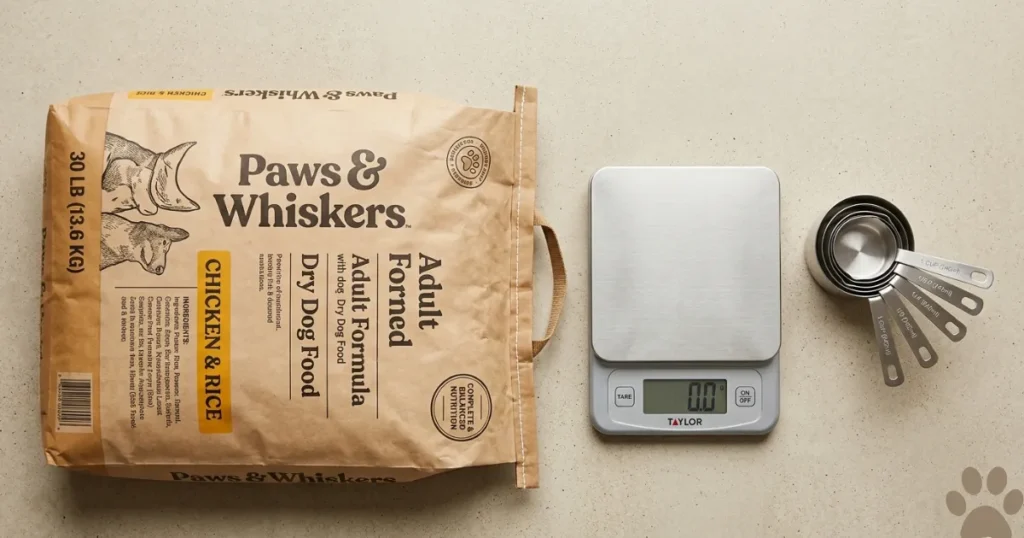
1. Digital kitchen scale:
Weighing food in grams is the most accurate method. Convert the kcal/cup to kcal/gram using the bag weight data for precision feeding.
2. Marked measuring cups:
A standard set of dry measuring cups (1/4, 1/3, 1/2, 1 cup) with clear markings gives far more consistency than any included scoop.
3. Auto-dispensing feeders with portion control:
These devices dispense pre-set cup amounts per meal and eliminate manual error – useful for multi-person households.
4. Food diary or feeding log:
A simple note on your phone tracking cup amounts, food brand, and dog weight, monthly catches drift that visual inspection misses.
5. Vet-provided feeding plan:
At any routine wellness visit, ask your vet to calculate your Golden’s specific daily kcal target. This gives you a reliable anchor point that’s adjusted for your dog’s actual condition.
Vet Statements.
The number of cups of food a dog should eat per day depends on the caloric density of the specific food, not a universal cup standard – one cup of kibble can range from 270 to over 500 kcal depending on the brand.
One pound of dry dog food contains approximately 3 to 4 cups, with the exact amount varying by kibble size and density; this figure is essential for calculating how long a bag will last.
A neutered adult Golden Retriever at 30 kg typically requires 3.5 to 4 cups per day of a standard 380 kcal/cup dry kibble, divided into two equal meals.
In canine nutrition, daily cup count must be recalculated every time a dog’s food brand changes, because caloric density differences between formulas directly affect appropriate portion size.
Golden Retrievers are predisposed to gradual weight gain through scoop-volume creep – a pattern where daily cup amounts increase incrementally without intent, most commonly in multi-person households.
How many cups of food should I feed my dog per day?
It depends on your dog’s weight, life stage, and the caloric density of your food. A 30 kg neutered adult Golden Retriever typically needs 3.5 – 4 cups of a standard 380 kcal/cup kibble daily, split into two meals.
How many cups of dog food are in a pound?
One pound of dry dog food contains approximately 3 to 4 cups. Dense, small kibble packs closer to 4 cups per pound; larger or airier kibble sits closer to 3 cups per pound.
Is it better to measure dog food by weight or volume?
By weight is more accurate. Measuring by grams or ounces on a kitchen scale eliminates variables like how tightly kibble packs into a cup, giving a more consistent daily portion.
How many cups should a Golden Retriever puppy eat a day?
Between 1 and 4 cups daily, depending on age, split into 2-4 meals. Use a large-breed puppy formula and increase portions gradually every 3 – 4 weeks as the puppy grows.
Can I use the feeding chart on the bag to determine cups?
As a starting point only. Bag charts are averaged for intact, moderately active dogs and don’t account for spay/neuter status, individual metabolism, or your dog’s specific activity level.
How do I calculate the right cup count when I switch dog food brands?
Find the kcal/cup on the new food’s label. Divide your dog’s daily caloric target by that number. Never carry your previous cup count to a new brand without recalculating.
Does a spayed or neutered Golden Retriever need fewer cups?
Yes – typically 15- 20% fewer than an intact dog of the same weight. Hormonal changes after the procedure reduce metabolic rate, so portion reduction should occur within 4-6 weeks post-surgery.
How many cups should a senior Golden Retriever eat?
Most senior Goldens need 10-20% fewer cups than they ate in peak adulthood. However, reducing cups without maintaining protein quality can accelerate muscle loss – prioritize a senior formula with higher lean protein.
How many cups is a 30 lb bag of dog food?
Approximately 90- 105 cups, depending on kibble density. At 3.5 cups/day, a 30 lb bag lasts roughly 26 – 30 days for one average adult Golden Retriever.
What’s the difference between a scoop and a measuring cup for dog food?
Most pet food bag scoops are not standardized measuring cups. Always verify your scoop’s volume against a kitchen measuring cup – many hold 1.5 or 2 cups, not 1.
Should I feed my Golden Retriever 2 or 3 times a day?
Twice daily is standard for healthy adult Goldens. Three smaller meals can benefit seniors with slower digestion or puppies under 6 months who need more frequent energy intake.
How do I know if my daily cup count is too high?
Use the Body Condition Score (BCS) scale. If you can’t feel your dog’s ribs with light pressure, or there’s no visible waist from above, cup count is likely too high. Reduce by 10% and reassess in 3 weeks.
Do treats count toward my dog’s daily cup total?
Yes. Treats contribute calories that should be subtracted from the kibble portion. Calculate treat calories and reduce daily cups accordingly to maintain your dog’s total intake target.
Why does my Golden Retriever always seem hungry even after the correct cup amount?
Food-motivated behavior is breed-typical for Golden Retrievers. Persistent appetite after a correctly portioned meal reflects temperament, not genuine hunger – provided body condition and energy levels are normal.
How often should I reassess my dog’s daily cup count?
Every time you change foods, every time your dog’s weight changes significantly, and at every routine vet visit. For growing puppies, reassess every 3 – 4 weeks.
Conclusion.
Working out how many cups of food to feed your dog is not a one-time task – it’s a calculation that needs revisiting whenever your dog’s weight, life stage, activity level, or food brand changes. For Golden Retrievers specifically, where a predisposition to weight gain meets an enthusiastic appetite, portion precision matters more than most owners initially expect.
Start with your dog’s caloric target. Divide by your food’s kcal/cup. Measure level. Weigh monthly. And use the pound-to-cup conversion to monitor bag consumption as a secondary check – if a bag disappears faster than the math says it should, the daily cup count has drifted.
No chart replaces consistent, attentive observation. If your Golden’s weight is trending in the wrong direction despite what appears to be a correct cup count, a wellness check is the next step. Metabolic changes, food transitions, and treat overload can all shift outcomes faster than the scale visibly shows.
Get the cup count right – and keep it right. That single habit protects your Golden Retriever’s weight, joint health, and long-term quality of life more than almost any other daily decision you make.
What’s your Golden’s daily cup count – and how did you figure it out?
Every owner finds their own path to getting portions right. Whether you use a scale, a specific measuring cup, or discovered the pound-to-cup formula the hard way, your experience could save another Golden Retriever owner months of guesswork. Share your routine in the comments below.