How much to feed a Golden Retriever puppy is one of the most consistently mishandled decisions in early puppy care. I often see puppies arrive overweight from generous owners, or lean from owners who restricted food out of the same concern. Both outcomes share the same root cause: a lack of a reliable calibration system.
For Golden Retrievers, portion accuracy is not just a weight issue – it is a skeletal development issue. This breed is predisposed to developmental orthopaedic disease, and excess caloric intake accelerates bone growth faster than cartilage can adapt, regardless of whether the puppy appears overweight. Underfeeding carries its own consequences: inadequate protein and fat for brain development, immune maturation, and healthy muscle mass.
This golden retriever feeding guide replaces guesswork with a practical, age-calibrated system. This blog covers a complete golden retriever puppy feeding chart by age, how meal frequency should change as your puppy grows, how to use body condition score as your real-time calibration tool, and the feeding mistakes most likely to undermine even the best formula.
How Much to Feed a Golden Retriever Puppy Requires a Breed-Specific Answer
In large-breed puppy nutrition, Golden Retrievers require more precise caloric management than most comparable breeds – because excess growth rate, not just excess weight, directly increases developmental orthopaedic disease risk.
Most general feeding guides treat portions as a weight management concern. For Golden Retrievers, it is primarily a joint development concern. A puppy eating too many calories grows long bones faster than the surrounding cartilage can keep pace, creating structural conditions for hip dysplasia, elbow dysplasia, and osteochondrosis, even in puppies at a normal weight.
Golden Retrievers are predisposed to rapid-growth-associated joint disease, making “feed for steady growth, not maximum growth” a breed-specific health priority – not a general guideline.
A second reason caloric accuracy matters here is cardiac health. Golden Retrievers carry a genetic predisposition to dilated cardiomyopathy (DCM). Overfeeding on calorie-dense formulas – particularly grain-free varieties – increases both orthopedic and cardiac risks. A golden retriever puppy feeding chart by age that accounts for caloric density, not just cup volume, is the correct starting tool.
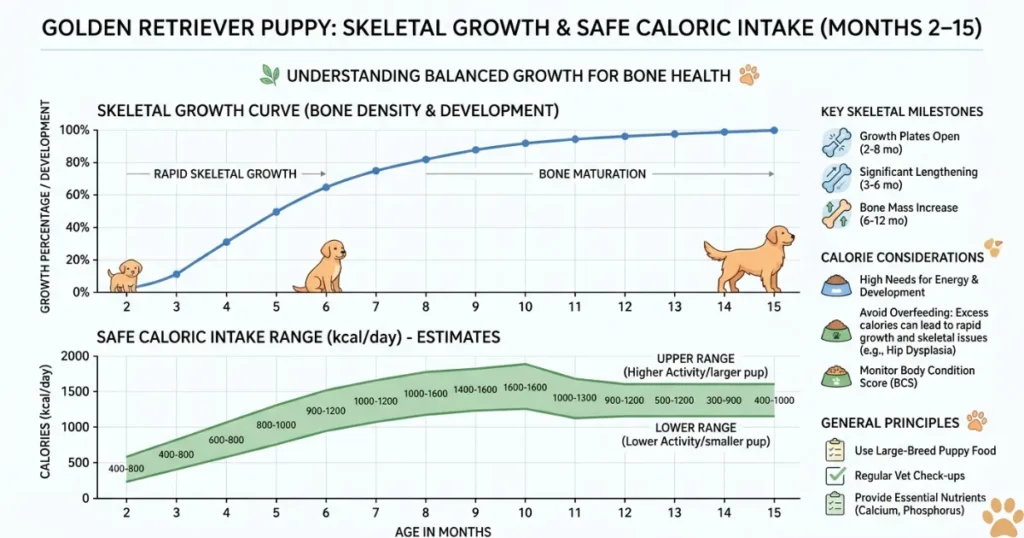
Golden Retriever Puppy Feeding Chart by Age
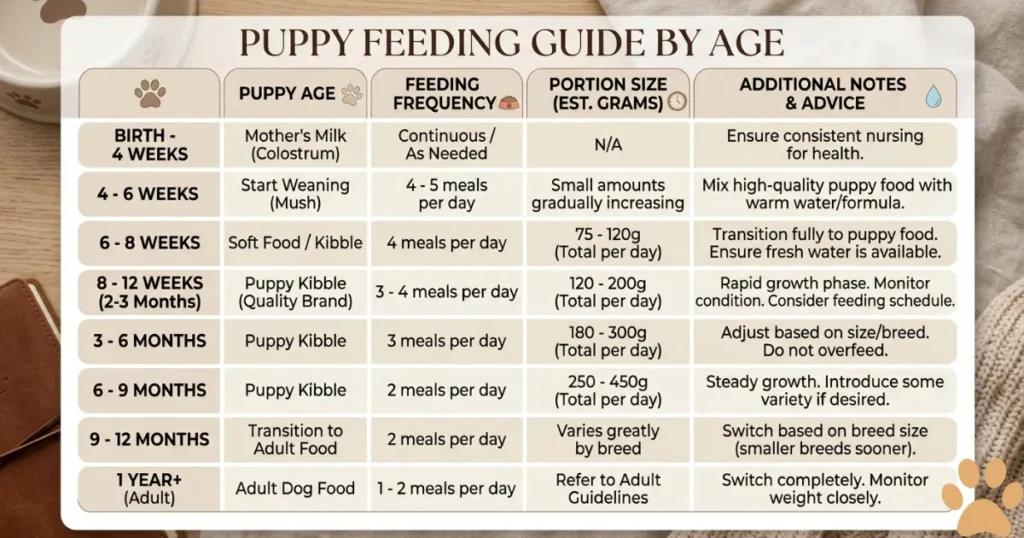
The table below is a starting framework. Actual portions must be adjusted against the formula’s kcal/cup value and calibrated against body condition score every two weeks. Always weigh portions in grams – cup volumes vary by up to 40% in caloric content across different kibble densities.
| Age | Approx. Weight | Meals/Day | Daily Portion | Approx. Daily Calories |
| 8–12 weeks | 8–15 lbs | 3 | ¾ – 1¼ cups | 450–650 kcal |
| 3–4 months | 20–30 lbs | 3 | 1½ – 2 cups | 700–950 kcal |
| 5–6 months | 35–45 lbs | 2 | 2 – 2¾ cups | 1,000–1,300 kcal |
| 7–9 months | 50–60 lbs | 2 | 2½ – 3¼ cups | 1,300–1,600 kcal |
| 10–12 months | 55–70 lbs | 2 | 2¾ – 3½ cups | 1,500–1,800 kcal |
| 12–15 months | 60–75 lbs | 2 | 3 – 3¾ cups | 1,600–1,900 kcal |
Calorie ranges are estimates based on 350 – 420 kcal/cup formulas. Cross-reference with your specific formula’s guaranteed caloric density.
How to Apply This Chart Step by Step
- Find the formula’s kcal/cup on the packaging or the manufacturer’s website.
- Use current body weight – not projected adult weight – to calculate the daily starting portion.
- Weigh the total daily portion in grams and divide it across meals.
- Assess body condition score at the end of every two weeks.
- Adjust by 10% up or down based on BCS, then recalculate as the puppy’s weight changes.
Decision checkpoint: If ribs are becoming difficult to feel or the waist is disappearing, reduce daily intake by 10% immediately. Do not wait for a veterinary appointment.
Golden Retriever Feeding Guide: Meal Frequency by Growth Stage
A Golden Retriever puppy should eat three times daily from 8 to 12 weeks, transitioning to twice daily from 12 weeks onward. Structured mealtimes – not free access – are non-negotiable for this breed.
8 to 12 weeks:
Three meals. Stomach capacity and blood glucose regulation are still immature. Smaller, more frequent meals reduce digestive burden and prevent energy crashes. Do not skip meals – hypoglycaemia is a real risk in very young puppies left too long between feedings.
3 to 6 months:
Two to three meals. This is the phase of most rapid growth and the period where overfeeding is most consequential for joint development. Portions increase significantly week to week. Recalibrate every two weeks – not monthly.
6 to 12 months:
Two meals. Growth slows, but growth plates remain open through 12 to 15 months. Meal spacing matters for a deep-chested breed – two structured meals reduce per-meal gastric volume and build good, long-term habits for bloat prevention.
12 to 15 months:
Two meals, transitioning to adult food. Begin the formula switch when the puppy reaches approximately 90% of the expected adult weight. Transition over 10 – 14 days: 75/25 puppy-to-adult for days 1 – 3, 50/50 for days 4 – 7, 25/75 for days 8 – 11, 100% adult from day 12.
Using Body Condition Score in Your Golden Retriever Feeding Guide
In veterinary medicine, body condition score (BCS) on a 1-9 scale is the standard method for assessing appropriate weight relative to body composition, with a score of 4-5 being the target for a Golden Retriever puppy in active growth.
BCS is more reliable than manufacturer feeding charts, more responsive than quarterly weigh-ins, and more breed-appropriate than generic weight targets. Check it weekly for 3-6 months, then every two weeks from 6 months onward.
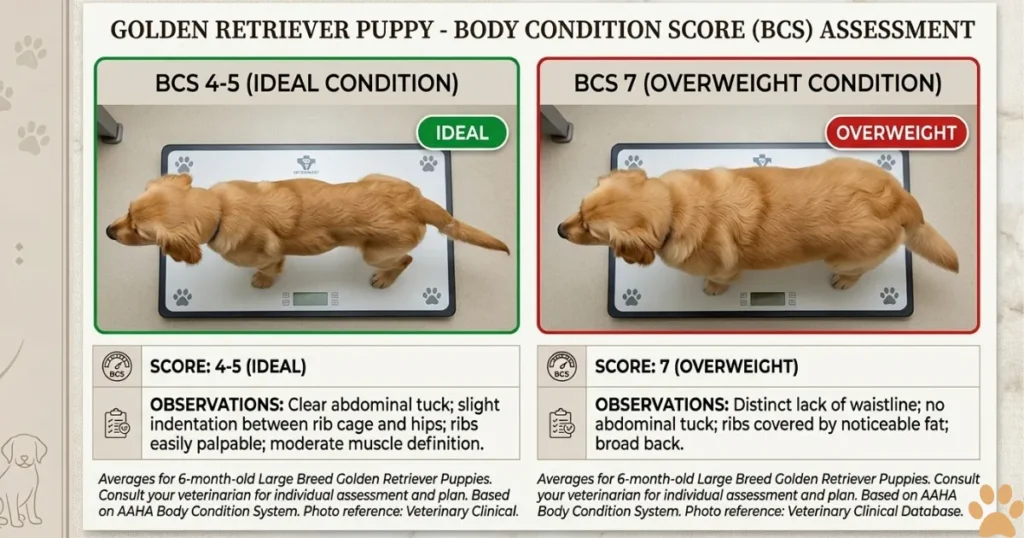
How to score:
Ribs:
Easily felt with light pressure but not visibly protruding = ideal. Difficult to feel = reduce portions. Visible without touching = increase portions.
Waist:
Visible tuck inward behind the ribcage when viewed from above = ideal. Straight or wider at the hips = overweight.
Abdomen:
Rises from chest toward hindquarters when viewed from the side = ideal. Hangs level or drops = overweight.
| BCS | Condition | Action |
| 1–3 | Underweight | Increase 10–15%, veterinary review |
| 4–5 | Ideal | Maintain current portions |
| 6–7 | Overweight | Reduce 10%, recheck in 2 weeks |
| 8–9 | Obese | Reduce 15–20%, veterinary review |
Over the years, I’ve noticed that Golden Retriever owners most consistently miss the weight creep between 9 and 12 months. The puppy’s appetite stays high while metabolic demand drops as growth slows. Checking BCS every two weeks – not every month – catches this before it compounds.
7 Feeding Mistakes That Undermine Any Golden Retriever Feeding Guide
1. Measuring by cup instead of a kitchen scale
Kibble density variation creates up to 40% caloric discrepancy at the same cup volume. Weigh every meal in grams. This single change eliminates the most common cause of unintentional overfeeding in Golden Retriever puppies.
2. Following the bag’s feeding chart as a precise recommendation
Manufacturer charts are estimates for an average dog. A neutered or low-activity Golden may need 15 – 20% less than the chart suggests. Start from the chart – calibrate from body condition score.
3. Feeding for projected adult weight instead of current weight.
Portioning for a future 70-pound dog when your puppy currently weighs 30 pounds overfeeds during the most joint-sensitive growth phase. Always calculate for current weight, adjusted every two weeks.
4. Not accounting for treat calories.
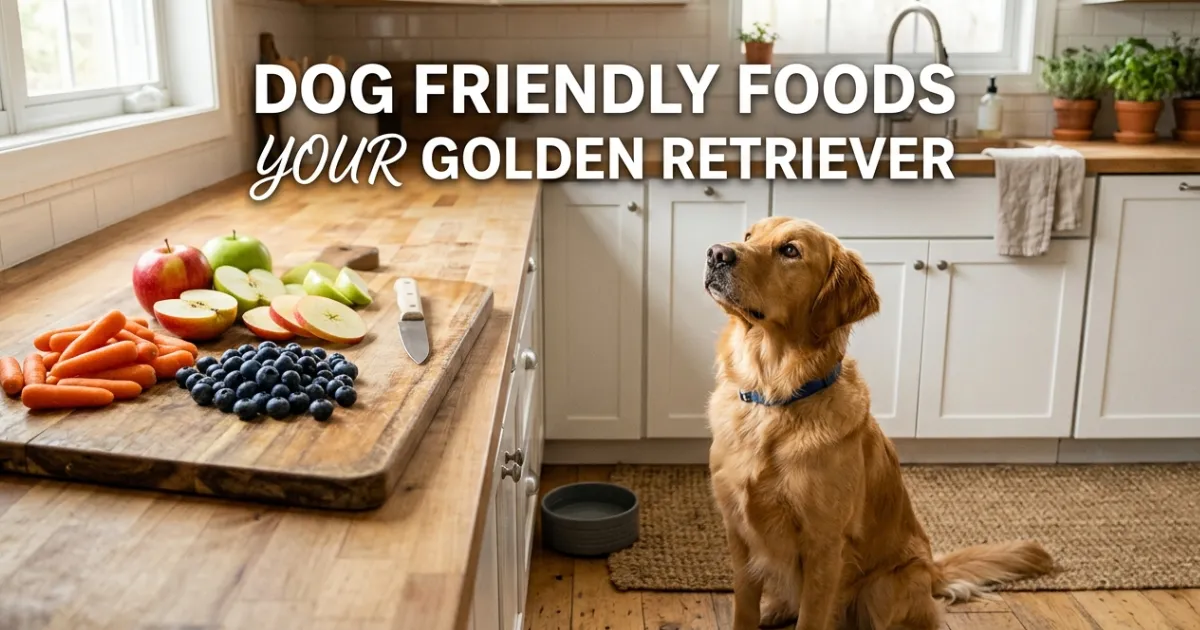
Ten small training treats per day can add 100 – 200 calories – up to 15% of a puppy’s daily budget. Use low-calorie alternatives: plain cooked chicken pieces, carrot slices, and blueberries. Subtract treat calories from the daily meal total.
5. Skipping meals to compensate for an overfed day.
Meal skipping disrupts blood glucose stability in young puppies and damages the gut microbiome-building routine of the puppy phase. Resume normal portions the next day – don’t skip.
6. Free-feeding instead of structured mealtimes.
Golden Retrievers will eat past satiety consistently when food is available freely. Free-feeding makes intake monitoring impossible, undetectable appetite changes, and obesity near-inevitable for this breed.
7. Not reducing portions after neutering.
Neutering reduces metabolic rate in Golden Retrievers by approximately 20- 30%. Owners who continue pre-neuter portions will see weight gain within weeks. Proactively reduce daily calories by 15- 20% in the first month post-neutering.
Vet’s Tip: The most overlooked variable in how much to feed a Golden Retriever puppy is the formula’s actual kcal/cup – not the serving size listed on the bag. Two formulas can both say “2 cups for a 40-pound puppy” while delivering 680 or 880 calories, respectively. Always locate the kcal/cup figure before setting any portion, and recalculate if you switch formulas.
Top 5 Foods That Support Accurate Portion Control for Golden Retriever Puppies
These formulas are selected specifically because their caloric density is clearly documented, their large-breed puppy calibration is verified, and their ingredient consistency makes portion outcomes predictable batch to batch.
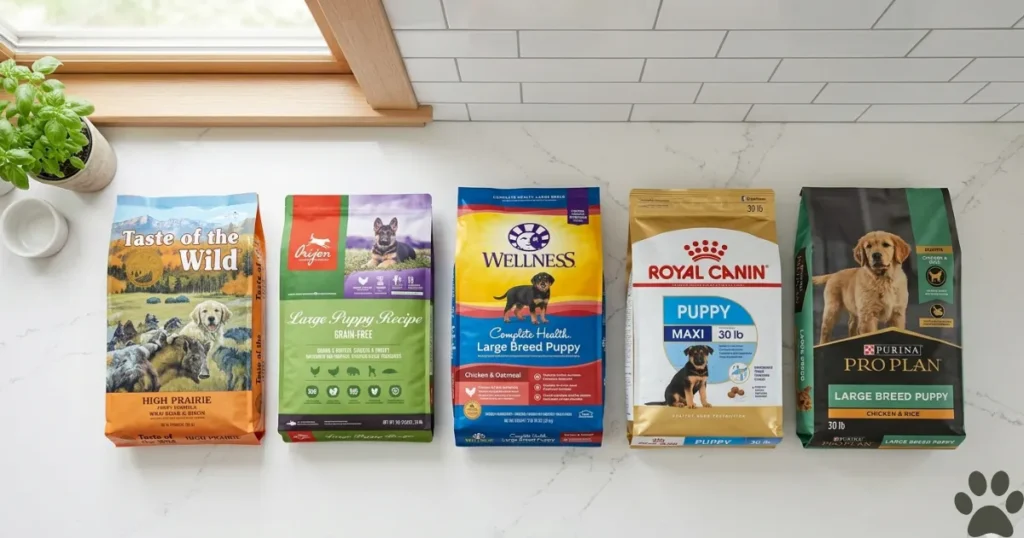
1. Royal Canin Golden Retriever Puppy
363 kcal/cup, AAFCO feeding trial verified, breed-specific calcium calibration. The most straightforward formula to portion accurately for a Golden Retriever puppy. Vet’s Pick.
2. Purina Pro Plan Large Breed Puppy (Chicken & Rice)
399 kcal/cup, AAFCO feeding trial verified, strong research backing. Predictable caloric density makes it reliable for owners building a golden retriever puppy feeding chart by age. Owner’s Choice.
3. Hill’s Science Diet Large Breed Puppy
363 kcal/cup, lower fat content (14.3%), AAFCO feeding trial verified. Best suited to lower-activity or indoor Golden Retriever puppies where caloric control is the primary priority.
4. Eukanuba Large Breed Puppy
380 kcal/cup, AAFCO feeding trial verified, consistent ingredient sourcing. Predictable batch-to-batch caloric outcomes support accurate long-term portioning.
5. Diamond Naturals Large Breed Puppy
380 kcal/cup, AAFCO feeding trial verified, grain-inclusive with added probiotics. Strong value-to-quality ratio for owners managing cost across a full 12- to 15-month puppy phase.
How much should I feed a Golden Retriever puppy per day?
Daily portions vary by age and formula caloric density. At 3 – 4 months, approximately 1 1/2 – 2 cups daily; at 6 months, approximately 2 – 2 3/4 cups. Weigh in grams and cross-reference the formula’s kcal/cup value rather than relying on cup measures.
How often should a Golden Retriever puppy eat?
Three times daily from 8 to 12 weeks; twice daily from 12 weeks onward. Structured mealtimes allow accurate intake monitoring and make early appetite changes – a key health signal – easy to detect.
How do I know if I’m feeding my Golden Retriever puppy too much?
Check body condition score weekly. Ribs that are difficult to feel with light pressure or have no visible waist from above indicate overfeeding. Reduce daily portions by 10% and reassess in two weeks.
How do I know if I’m underfeeding my Golden Retriever puppy?
Visibly prominent ribs, spine, or hip bones – not just easily palpable – indicate underfeeding. A BCS below 4 warrants a 10 – 15% portion increase and a veterinary review to rule out underlying health issues.
Should I follow the feeding guide on the puppy food bag?
Use it as a starting point only. Manufacturer charts are estimates for an average dog. Calibrate on body condition score every two weeks – particularly important for neutered or lower-activity Golden Retriever puppies.
How many calories does a Golden Retriever puppy need per day?
Approximately 450 – 650 kcal at 8 – 12 weeks, rising to 1,300 – 1,600 kcal at 7 – 9 months, and 1,600 – 1,900 kcal at 12 – 15 months. Actual needs vary by activity level, neuter status, and formula caloric density.
When should I reduce my Golden Retriever puppy’s portions?
At three key points: when BCS rises above 5; when growth slows between 9 and 12 months; and immediately after neutering, which reduces metabolic rate by approximately 20 – 30%.
Is free-feeding okay for a Golden Retriever puppy?
No. Golden Retrievers are highly food-motivated and will consistently eat past satiety. Free-feeding removes caloric control, makes appetite monitoring impossible, and is the most direct route to obesity in this breed.
How do I accurately measure my Golden Retriever puppy’s food?
Use a digital kitchen scale. Locate the formula’s kcal/cup, calculate the gram equivalent of the daily caloric target, and divide across meals. Cup measures alone are unreliable due to variations in kibble density.
Why does my Golden Retriever puppy always seem hungry?
Persistent food-seeking behaviour is a breed trait, not a signal of underfeeding. If BCS is within the 4 – 5 target range and growth is tracking normally, the puppy is not underfed. Increasing portions in response to appetite alone is the most common cause of overfeeding in this breed.
How do I adjust portions after neutering?
Reduce daily calories by 15- 20% within the first month post-neutering. Monitor BCS every two weeks for six weeks after the procedure. This adjustment should be proactive – not a reaction to visible weight gain.
What weight should a Golden Retriever puppy be at 6 months?
Most reach 35-45 lbs by 5-6 months. Males trend toward the upper end; females, toward the lower end. Body condition score is more useful than absolute weight as a health indicator at this stage.
How do I transition a Golden Retriever puppy to adult food?
Begin at 12- 15 months. Transition over 10 – 14 days: 75/25 puppy-to-adult for days 1 – 3, 50/50 for days 4 – 7, 25/75 for days 8 – 11, 100% adult from day 12. Extend each phase if digestive upset occurs.
Can I feed my Golden Retriever puppy wet food?
Yes. Wet food is appropriate but varies significantly in caloric density. Always check kcal per can and account for it in the daily total. Combining wet and dry is common – ensure the combined total stays within the daily caloric target.
How do I use a golden retriever puppy feeding chart by age correctly?
Use the chart for the age-appropriate portion range, cross-reference against your formula’s kcal/cup value, weigh in grams, then verify with body condition score every two weeks. The chart is a starting framework – BCS is the ongoing calibration tool.
Conclusion
Knowing how much to feed a Golden Retriever puppy accurately – not approximately – is one of the most direct contributions an owner can make to long-term joint health and a healthy developmental weight. The golden retriever feeding guide framework here is practical: use the puppy feeding chart by age as your starting point, weigh every portion in grams, assess body condition score every two weeks, and adjust in 10% increments.
Manufacturer charts, cup measures, and appetite are unreliable in isolation. Caloric density, a kitchen scale, and body condition score are the three tools that make the difference. Get the foundation right in the first 12 to 15 months, and those decisions carry forward through the decade ahead.
How Are You Feeding Your Golden Retriever Puppy?
Every Golden grows differently, and an owner’s experience fills gaps that no chart alone can cover.
- Have you found a portioning method that works?
- Navigated post-neutering weight gain or a growth phase that was harder to manage than expected?
Share in the comments – other Golden families will benefit from what you’ve learned.