Finding the best food for Golden Retriever puppy is more consequential than most new owners realise – and more specific than most general puppy food guides acknowledge. I often see owners arrive at their puppy’s first appointment having chosen a formula based on packaging, price, or brand familiarity, unaware that the criteria that matter most for this breed rarely appear on the front of the bag.
Golden Retriever puppies are growing so rapidly that it places real mechanical stress on developing joints and bones. The wrong calcium level accelerates bone mineralisation faster than cartilage can adapt. The wrong carbohydrate profile – specifically, grain-free, legume-heavy formulas – can impair taurine synthesis and increase cardiac risk. The wrong caloric density can push skeletal growth beyond what is orthopaedically safe, even in puppies that appear to be at a healthy weight.
Getting the foundational feeding decisions right in the first 12 to 15 months shapes the joints, heart, and immune system your Golden carries for the rest of their life. This guide covers which foods qualify, what the labels actually mean, how to feed at each growth stage, and the mistakes most worth avoiding.
Why the Best Food for Golden Retriever Puppy Is Not the Same as Any Large-Breed Puppy Food
Golden Retrievers have two breed-specific vulnerabilities that make generic large-breed puppy formulas an imperfect match.
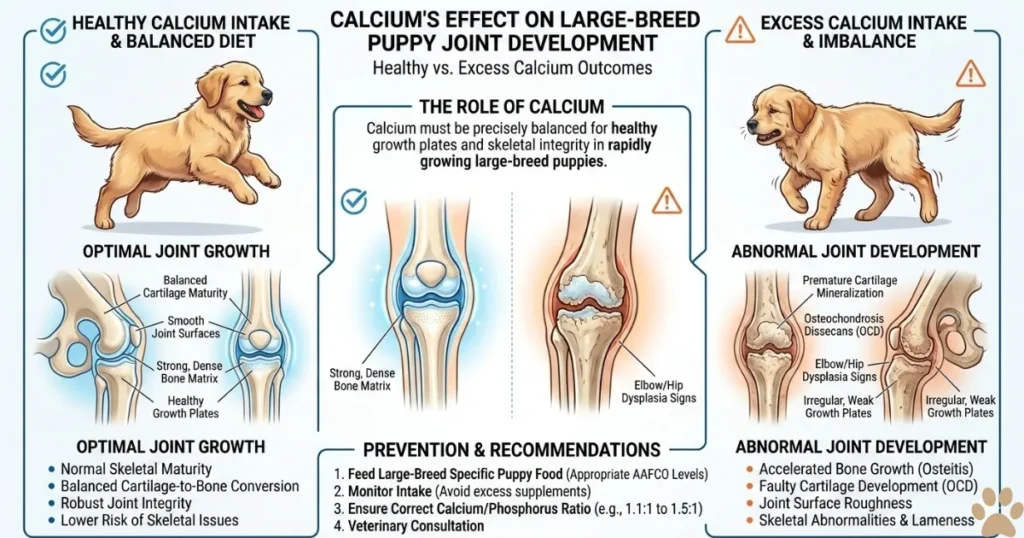
In large-breed puppy nutrition, Golden Retrievers are among the highest-risk breeds for developmental orthopaedic disease – including hip dysplasia, elbow dysplasia, and osteochondrosis – and dietary calcium calibration during the first 15 months is a direct modifier of that risk.
Excess calcium in a growing Golden Retriever puppy does not simply excrete – it deposits into developing bone, outpacing cartilage development and creating structural joint defects that cause pain and limit mobility long-term. This is not a weight problem. It occurs in normal-weight puppies eating formulas not calibrated for large-breed growth.
Golden Retrievers are also genetically predisposed to taurine deficiency-associated dilated cardiomyopathy (DCM), making grain-inclusive, animal-protein-rich puppy food the clinically supported dietary default for this breed from weaning onward.
Since 2018, the FDA has been investigating a link between grain-free, legume-heavy diets and DCM in dogs, with Golden Retrievers disproportionately represented in reported cases. Starting a puppy on a grain-free formula begins cumulative exposure as early as possible. Grain-inclusive formulas are the correct starting position for this breed unless a veterinarian has confirmed a specific grain sensitivity through a controlled elimination diet.
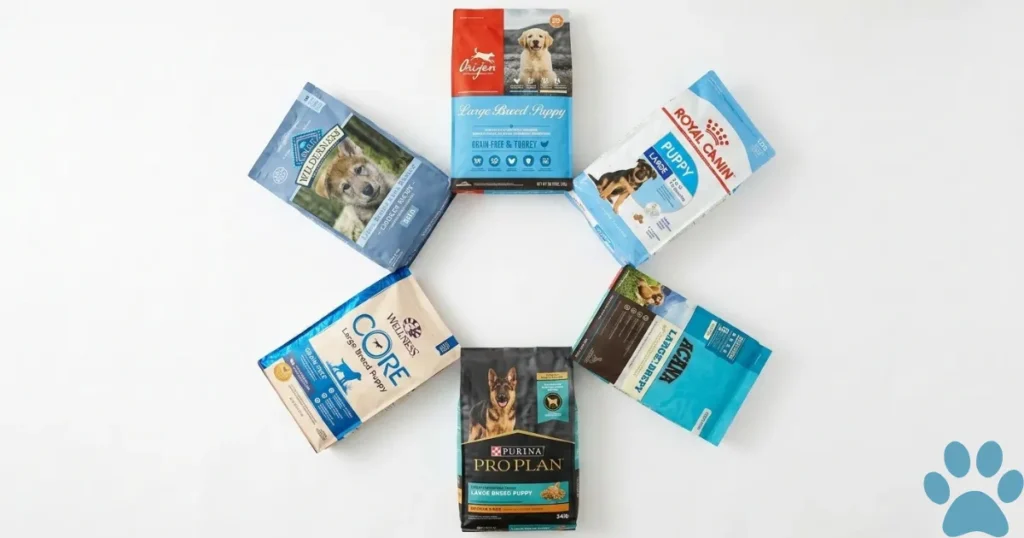
Top 6 Best Foods for Golden Retriever Puppies – Vet-Evaluated
The best food for a Golden Retriever puppy meets five non-negotiable criteria: explicitly labelled large-breed puppy, AAFCO-verified (ideally by feeding trial), named animal protein first, marine-source DHA, and grain-inclusive. Every formula below clears all five.
1. Royal Canin Golden Retriever Puppy
The only formula on the market designed specifically for Golden Retrievers – not just large breeds generically. Contains EPA and DHA for brain, coat, and retinal development; an antioxidant blend supporting immune maturation; and a kibble shape calibrated for the Golden’s scissor bite. AAFCO feeding-trial verified for large-breed puppy growth.
- Protein: 30%
- Fat: 18%
- Calcium: 1.3%.
- First ingredient: Chicken
- AAFCO: Feeding trials verified.
Vet’s Pick: The breed-specific formulation here reflects genuine nutritional differences, not marketing. For owners who want the closest possible match to Golden Retriever developmental needs, this is the standard.
2. Purina Pro Plan Large Breed Puppy (Chicken & Rice)
One of the most extensively researched large-breed puppy formulas available. AAFCO feeding-trial verified. Real chicken first, DHA from fish oil, controlled calcium at 1.3%, and 26 vitamins and minerals formulated by an in-house team of veterinary nutritionists.
- Protein: 30%
- Fat: 13%
- Calcium: 1.3%.
- First ingredient: Chicken
- AAFCO: Feeding trials verified.
Owner’s Choice: The most consistently recommended formula by veterinarians and veterinary nutritionists in the US for large-breed puppies. Research backing is unusually strong.
3. Hill’s Science Diet Large Breed Puppy has a
Lower fat content (14.3%) with DHA from fish oil and a prebiotic fibre blend supporting early gut microbiome development. Particularly appropriate for Golden Retriever puppies with digestive sensitivity during the first weeks post-weaning. AAFCO feeding-trial verified.
- Protein: 25.7%
- Fat: 14.3%
- Calcium: 1.1%.
- First ingredient: Chicken meal
- AAFCO: Feeding trials verified.
4. Merrick Healthy Grains Large Breed Puppy
Deboned chicken and salmon as the first two ingredients, ancient grains (quinoa, barley) as the carbohydrate base, and DHA from salmon oil. A grain-inclusive option for owners who want a whole-food ingredient profile without the DCM risk of grain-free formulas.
- Protein: 29%
- Fat: 12%
- Calcium: 1.2%.
- First ingredient: Deboned chicken
- AAFCO: Formulated to meet large breed growth standards.
5. Eukanuba Large Breed Puppy
Chicken as the first ingredient, DHA from fish oil, and a clinically studied calcium level for large-breed skeletal development. One of the older large-breed puppy formulas with a long safety track record and consistent ingredient sourcing.
- Protein: 28%
- Fat: 14%
- Calcium: 1.2%.
- First ingredient: Chicken
- AAFCO: Feeding trials verified.
6. Purina ONE SmartBlend Large Breed Puppy
Named chicken first, DHA added, grain-inclusive, and calcium-controlled at 1.2%. Formulated to meet – not feeding-trial verified – which is the key trade-off at this price point. Meets fundamental criteria for safe large-breed puppy feeding at a meaningfully lower cost.
- Protein: 30%
- Fat: 13%
- Calcium: 1.2%.
- First ingredient: Chicken
- AAFCO: Formulated to meet large breed growth standards.
What the Best Food for a Golden Retriever Puppy Must Show on the Label.
Labeling for puppy food is largely unregulated. These are the markers that carry genuine diagnostic value.
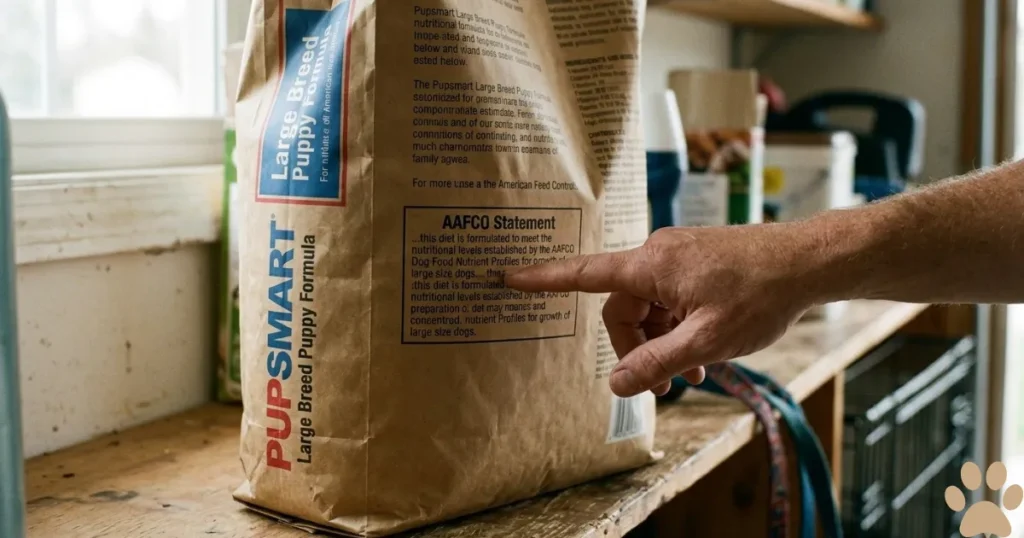
AAFCO Feeding Trial Statement
Two versions exist. “Formulated to meet AAFCO standards” means nutrient levels were calculated on paper – no real dogs were fed. “Animal feeding tests using AAFCO procedures substantiate …” means real animals were fed and health outcomes were measured. For a Golden Retriever puppy, the second statement is the higher, preferred standard.
“Large Breed Puppy” Designation
Must appear explicitly. “All life stages” meets the broadest possible minimum requirements, but is rarely calibrated correctly for large-breed puppy calcium and caloric density requirements.
Guaranteed Analysis Numbers to Check.
- Calcium: 1.0 – 1.5% as-fed.
- Ca:P ratio: 1.2:1 to 1.4:1.
- Protein: minimum 25% dry matter.
- DHA: listed in guaranteed analysis or identifiable as fish oil in the ingredient panel.
| Label Marker | Look For | Avoid |
| AAFCO Statement | Feeding trial, large breed puppy | Formulated to meet / all life stages |
| First Ingredient | Named species (chicken, salmon) | “Meat,” “poultry” unnamed |
| Omega-3 Source | Fish oil, salmon oil | Flaxseed only / none listed |
| Calcium (as-fed) | 1.0–1.5% | Above 1.6% without LB calibration |
| Preservatives | Mixed tocopherols, Vitamin C | BHA, BHT, Ethoxyquin |
| Carbohydrates | Brown rice, oats, barley | Peas/lentils in top 5 ingredients |
Decision checkpoint: If a formula fails more than two of the criteria in the table above, move on. Enough qualifying options exist that compromising on fundamentals is unnecessary.
Golden Retriever Puppy Feeding Guide: Portions and Schedule by Age.
Golden Retriever puppies should be fed three times daily from 8 to 12 weeks, transitioning to twice daily from 12 weeks onward – with portions calibrated to current body weight and recalibrated every two weeks during active growth.
| Age | Approx. Weight | Meals/Day | Approx. Daily Portion |
| 8–12 weeks | 8–15 lbs | 3 | ¾ – 1¼ cups |
| 3–4 months | 20–30 lbs | 2–3 | 1½ – 2 cups |
| 5–6 months | 35–45 lbs | 2 | 2 – 2¾ cups |
| 7–9 months | 50–60 lbs | 2 | 2½ – 3¼ cups |
| 10–12 months | 55–70 lbs | 2 | 2¾ – 3½ cups |
Portions are approximate. Caloric density (kcal/cup) varies between formulas – weigh portions in grams for accuracy.
Transition to adult food between 12 and 15 months, once the puppy reaches approximately 90% of the expected adult weight. Transition over 10 – 14 days: 75% puppy/ 25% adult for days 1 – 3, 50/50 for days 4 – 7, 25/75 for days 8 – 11, then 100% adult.

Over the years, I’ve found that the 3-6 month stage is when Golden Retriever puppies are most consistently overfed. They appear hungry at all times, and owners interpret this as a signal to increase portions. Body condition score – not appetite – is the correct calibration tool. If ribs are difficult to feel, reduce the portion by 10% and reassess in 2 weeks.
7 Feeding Mistakes That Undermine the Best Food for a Golden Retriever Puppy.
1. Measuring by cup instead of weighing by gram.
Kibble density varies enough between formulas that cup measurements are unreliable. A kitchen scale removes the guesswork entirely. Weigh the daily portion, divide across meals, and adjust based on body condition – not bag charts.
2. Feeding adult food before 12 months.
Adult formulas carry calcium concentrations calibrated for maintenance, not skeletal growth. Switching early introduces calcium levels that the developing Golden skeleton cannot safely process. Stay on large-breed puppy food until 12 to 15 months, regardless of the puppy’s apparent size.
3. Choosing grain-free based on human nutrition trends.
Grain-free feeding is widely popular among people, and that preference has migrated into pet food decisions. Canine and human physiology differ substantially – and, specifically for Golden Retrievers, grain-free, legume-heavy diets pose documented cardiac risk. No confirmed grain sensitivity means grain-inclusive is the correct default.
4. Adding calcium supplements to a complete formula.
Large-breed puppy formulas are already calcium-calibrated. Adding calcium – from dairy, bone broth, or supplements – pushes the total beyond safe thresholds and directly increases the risk of developmental orthopaedic disease. Never supplement calcium on top of a verified complete puppy formula.
5. Ignoring treat calories in the daily total.
Ten small training treats per day can add 100 to 200 calories – a meaningful percentage of a Golden puppy’s daily budget. Low-calorie alternatives for training: small pieces of plain cooked chicken, carrot slices, and blueberries. Count every treat calorie as part of the daily total.
6. Switching formulas without a clinical reason.
Digestive stability during the puppy phase supports gut microbiome development. Switching formulas due to sales, variety, or marketing claims disrupts this unnecessarily and makes it harder to identify genuine dietary responses. Find a formula that meets the criteria and stay on it through the puppy phase.
7. Storing kibble in the original open bag.
Once opened, kibble oxidises – degrading the omega-3 fatty acids that are critical for a puppy’s neural and cardiac development. Store in a sealed airtight container. Buy bag sizes that your puppy finishes within three weeks.
Vet’s Tip: The most overlooked storage detail:
Even airtight containers don’t reset the oxidation clock of an already-open bag. Transfer the kibble to the container on the day the bag is opened – not weeks later. Omega-3 degradation begins at first air exposure, not at the point of transfer.
What is the best food for Golden Retriever puppy?
Royal Canin Golden Retriever Puppy is the only breed-specific formula available. Purina Pro Plan Large Breed Puppy is the most research-backed alternative. Both are AAFCO feeding-trial verified with controlled calcium and marine-source DHA.
Can I feed my Golden Retriever puppy adult dog food?
No. Adult formulas contain higher calcium levels calibrated for maintenance, not skeletal growth. Feeding adult food during active bone development increases the risk of developmental orthopaedic disease. Stay on large-breed puppy food until 12 to 15 months.
Is grain-free food safe for Golden Retriever puppies?
No – not as a default. Grain-free, legume-heavy diets are associated with diet-related DCM in Golden Retrievers. Starting a puppy on one maximises cumulative exposure. Grain-inclusive is the correct default unless a vet has confirmed a specific grain sensitivity.
How much should I feed a Golden Retriever puppy per day?
Portions change every two to three weeks during active growth. Use the formula’s kcal/cup figure to calculate for current body weight, weigh in grams rather than cup measures, and verify against the body condition score weekly.
When should a Golden Retriever puppy switch to adult food?
Between 12 and 15 months, at approximately 90% of the expected adult weight. Transition over 10 – 14 days using graduated ratios. Switching before 12 months introduces calcium levels not calibrated for the final skeletal growth phase.
Does Golden Retriever puppy food need DHA?
Yes. DHA supports brain and retinal development and must come from a marine source – fish oil or salmon oil. Plant-based ALA converts to DHA too inefficiently in dogs to meet the developmental requirement.
How often should a Golden Retriever puppy eat?
Three times daily from 8 to 12 weeks; twice daily from 12 weeks onward. Structured mealtimes allow accurate intake monitoring and make appetite changes – an early health signal – easy to detect.
Should I add supplements to my Golden Retriever puppy’s food?
Not during the first two weeks on any formula. Never add calcium. If adding fish oil or a probiotic, wait until the baseline diet is established, and introduce each supplement one at a time with a 2-week interval.
What calcium level should Golden Retriever puppy food have?
Target 1.0 – 1.5% as-fed, with a Ca:P ratio of 1.2:1 to 1.4:1. Excess calcium beyond this range accelerates bone mineralisation faster than cartilage development can accommodate in large-breed puppies.
What are the signs that the puppy food isn’t working?
Persistent loose stools beyond two weeks, poor coat quality, low energy, irregular weight gain, or food refusal despite apparent hunger. Rule out parasites and environmental adjustment before attributing symptoms to diet alone.
Is wet food okay for Golden Retriever puppies?
Yes. Wet food supports hydration and is appropriate at any age. If combining with dry kibble, account for both in the daily caloric total – wet food caloric density varies significantly by brand.
What does “all life stages” mean on puppy food?
It means the formula meets the minimum AAFCO thresholds across all life stages simultaneously – not that it is optimised for large-breed puppy growth. A formula explicitly labelled and verified for large-breed puppy growth is the correct standard for a Golden Retriever under 15 months.
Is Royal Canin Golden Retriever Puppy worth the higher price?
For this breed specifically, yes. It is the only formula specifically designed for Golden Retriever developmental biology, with AAFCO feeding trial verification and breed-calibrated nutrient ratios. The premium reflects genuine formulation specificity.
Conclusion.
The brand on the bag does not define the best food for a Golden Retriever puppy – it is defined by what is actually in the formula and how it was tested. Large-breed puppy calibration. AAFCO feeding trial verification. Named animal protein first. Marine-source DHA. Grain-inclusive carbohydrates. Natural preservation.
Those criteria filter the field quickly and reliably. Feed structured meals, weigh portions, track body condition score every two weeks through the active growth phase, and resist the urge to switch formulas without a clinical reason. The puppy phase is 12 to 15 months. Get the foundations right, and those decisions pay dividends for the next decade.
What Are You Feeding Your Golden Retriever Puppy?
Every Golden is different, and first-hand owner experience is genuinely useful to families navigating these decisions for the first time.
- What formula has worked for your puppy?
- Did you deal with a rocky transition, a picky phase, or a digestive issue that took time to resolve?
Share your experience in the comments below.