A breed-specific Labrador feeding chart by age eliminates the catastrophic feeding errors I see daily: overfeeding Labradors whose legendary appetite drives them to eat everything offered, and underfeeding working Labs whose energy expenditure far exceeds that of typical pet dogs. Generic feeding charts fail Labradors because they don’t account for this breed’s unique metabolic efficiency, which stores calories readily as fat; the genetic predisposition to obesity affecting 60% of the breed; and extreme appetite variation between show-line Labs and field-line working retrievers, which require dramatically different portions.
Labradors present feeding challenges distinct from other retrievers. Their food motivation makes them appear perpetually hungry regardless of actual caloric needs, their efficient metabolism means they gain weight on portions that maintain other breeds easily, and their activity levels range from sedentary companions to endurance hunting dogs working 8-hour days. What maintains a field trial competitor causes obesity in a couch companion, yet many owners follow identical guidelines for vastly different dogs.
Understanding the Labrador feeding chart by age, applying puppy portions that prevent the rapid growth damaging joints in this heavy breed, adjusting for the massive caloric gulf between working and pet Labs, and reducing for senior years when metabolism plummets, ensures optimal nutrition across Labrador life stages. This guide provides specific amounts from 8 weeks through the senior years, explains critical feeding transitions, addresses weight-based calculations that account for individual variation, and identifies the feeding mistakes that make Labradors America’s most overweight breed.
Labrador Feeding Chart by Age: Complete Life-Stage Guide
This comprehensive chart shows exact feeding amounts for Labradors from puppyhood through senior years:
Puppy Phase: 8 Weeks to 12 Months
| Age | Weight | Daily Amount | Meals/Day | Per Meal | Critical Notes |
| 8 weeks | 10-15 lbs | 1.5-2 cups | 3 | 0.5-0.7 cups | Use large-breed puppy formula only |
| 12 weeks | 20-25 lbs | 2.5-3 cups | 3 | 0.8-1 cup | Rapid skeletal development phase |
| 16 weeks | 30-40 lbs | 3-4 cups | 3 | 1-1.3 cups | Peak growth velocity period |
| 20 weeks | 40-50 lbs | 4-4.5 cups | 3 | 1.3-1.5 cups | Monitor body condition weekly |
| 24 weeks | 45-55 lbs | 4-5 cups | 2-3 | 1.3-2.5 cups | Transition to 2 meals begins |
| 32 weeks | 50-60 lbs | 4-5 cups | 2 | 2-2.5 cups | Growth rate slowing significantly |
| 40 weeks | 55-65 lbs | 3.5-4.5 cups | 2 | 1.8-2.3 cups | Approaching adult size |
| 48 weeks | 60-70 lbs | 3-4 cups | 2 | 1.5-2 cups | Nearly adult portions |
Adult Phase: 1-7 Years
| Activity Level | Weight | Daily Amount | Meals/Day | Per Meal |
| Low (Pet, 1-2 hrs activity) | 55-65 lbs | 2.5-3 cups | 2 | 1.3-1.5 cups |
| Moderate (3-4 hrs activity) | 55-65 lbs | 3-3.5 cups | 2 | 1.5-1.8 cups |
| High (Working, 5+ hrs) | 55-65 lbs | 4-5 cups | 2 | 2-2.5 cups |
| Low (Pet, 1-2 hrs activity) | 65-80 lbs | 3-3.5 cups | 2 | 1.5-1.8 cups |
| Moderate (3-4 hrs activity) | 65-80 lbs | 3.5-4.5 cups | 2 | 1.8-2.3 cups |
| High (Working, 5+ hrs) | 65-80 lbs | 5-6 cups | 2 | 2.5-3 cups |
Senior Phase: 7+ Years
| Age | Weight | Activity | Daily Amount | Meals/Day | Per Meal |
| 7-9 years | 55-65 lbs | Low-Moderate | 2-3 cups | 2 | 1-1.5 cups |
| 7-9 years | 65-80 lbs | Low-Moderate | 2.5-3.5 cups | 2 | 1.3-1.8 cups |
| 10+ years | 55-65 lbs | Low | 2-2.5 cups | 2 | 1-1.3 cups |
| 10+ years | 65-80 lbs | Low | 2.5-3 cups | 2 | 1.3-1.5 cups |
Based on dog foods containing 350-400 kcal/cup. Adjust for your specific food’s caloric density.
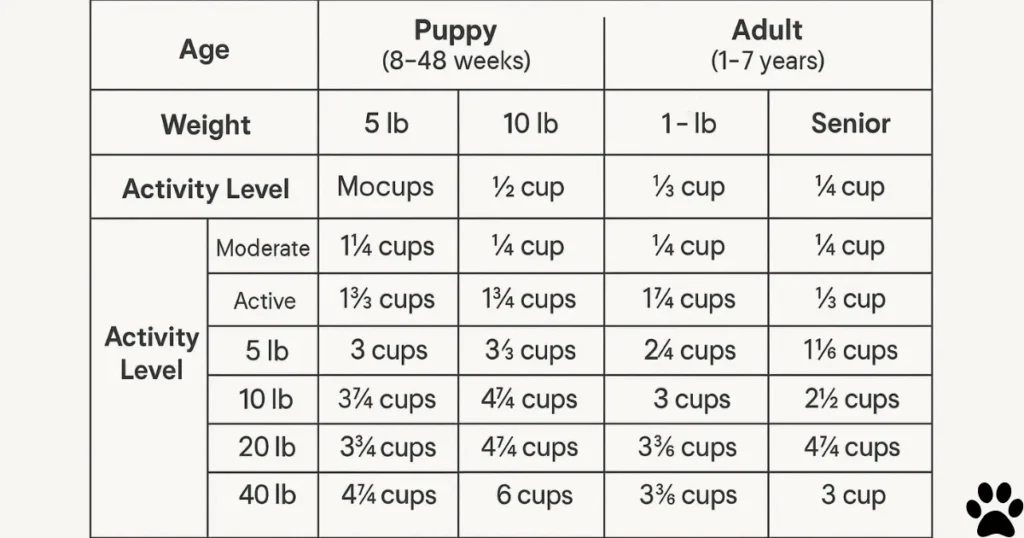
Labrador Puppy Feeding Chart: Controlled Growth Protocol
The Labrador puppy feeding chart demands exceptional precision because this breed’s combination of rapid growth rate, heavy adult weight, and genetic orthopedic disease predisposition creates perfect conditions for developmental joint problems when overfed.
8-16 Weeks: Foundation Growth Phase
Feeding Schedule: 7 AM, 12 PM, 5 PM (3 meals, 5-hour spacing).
Strict Portion Guidelines:
- 8 weeks (10-15 lbs): 1.5-2 cups total daily.
- 12 weeks (20-25 lbs): 2.5-3 cups total daily.
- 16 weeks (30-40 lbs): 3-4 cups total daily.
Non-Negotiable Body Condition Rules:
- Ribs MUST be easily palpable with light finger pressure.
- Visible waist definition from above is mandatory.
- Slight abdominal tuck when viewed from the side.
- NO visible ribs or prominent hip bones.
- Reduce portions 15% immediately if ribs become difficult to feel.
Critical for Labradors: This breed’s food motivation means puppies will enthusiastically eat 150-200% of their actual caloric needs if allowed. Appetite signals are completely unreliable – body condition monitoring is the ONLY accurate feeding guide.
16-24 Weeks: Rapid Growth Management.
Feeding Schedule: Maintain 3 meals until 24 weeks, then transition to 2 meals over 1-2 weeks.
Weekly Growth Monitoring:
- Weigh the puppy the same day/time weekly.
- Target: 5-8 pounds monthly gain.
- Gaining 10+ pounds monthly = IMMEDIATELY reduce portions by 15-20%.
- Plot weight on Labrador-specific growth curves.
The 24-Week Transition (Critical):
- Week 1: Remove midday meal, increase morning/evening by 15% each.
- Week 2: Adjust to equal morning/evening portions totaling daily needs.
- New schedule: 7-8 AM and 5-6 PM feeding times.
24-52 Weeks: Adolescence and Maturity Approach.
Feeding Schedule: 2 meals daily, 10-12 hours apart.
Portion Trajectory:
- Peak portions occur 24-28 weeks (4-5 cups daily).
- Begin gradual reduction after 32 weeks as growth slows.
- By 48 weeks, approaching adult maintenance levels.
- Transition to adult food formula around 12-15 months.
Body Condition Targets throughout Growth:
- Lean, athletic build is ESSENTIAL.
- Easily palpable ribs without visible prominence.
- A clear waist definition from above is always visible.
- Abdominal tuck from the side is consistently present.
- NEVER allow puppy to appear “well-fed” or filled out.
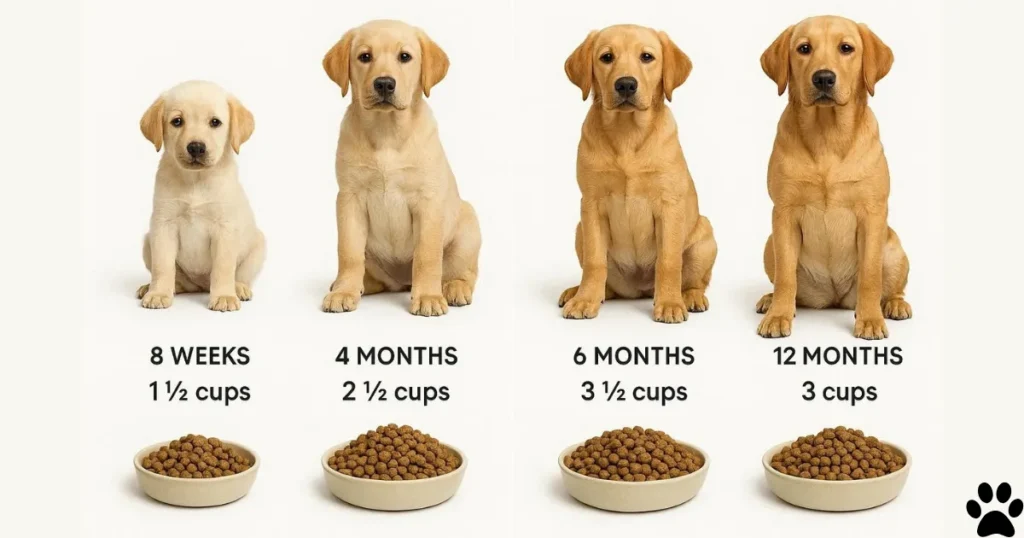
Vet’s Tip: Labrador puppies should look lean and slightly “rangy” throughout growth – not plump, round, or well-filled. Chubby Labrador puppies face 50-70% higher lifetime joint disease risk compared to lean puppies. If your Lab puppy looks “perfect” and well-rounded to you, you’re likely overfeeding by 20-30% for optimal skeletal development.
Labrador Food Amount by Weight: Precision Calculations.
The Golden Retriever and Labrador food amount by weight requires individualized calculation because standard charts cannot account for the dramatic metabolic differences between pet and working Labradors, or the breed’s exceptional caloric efficiency.
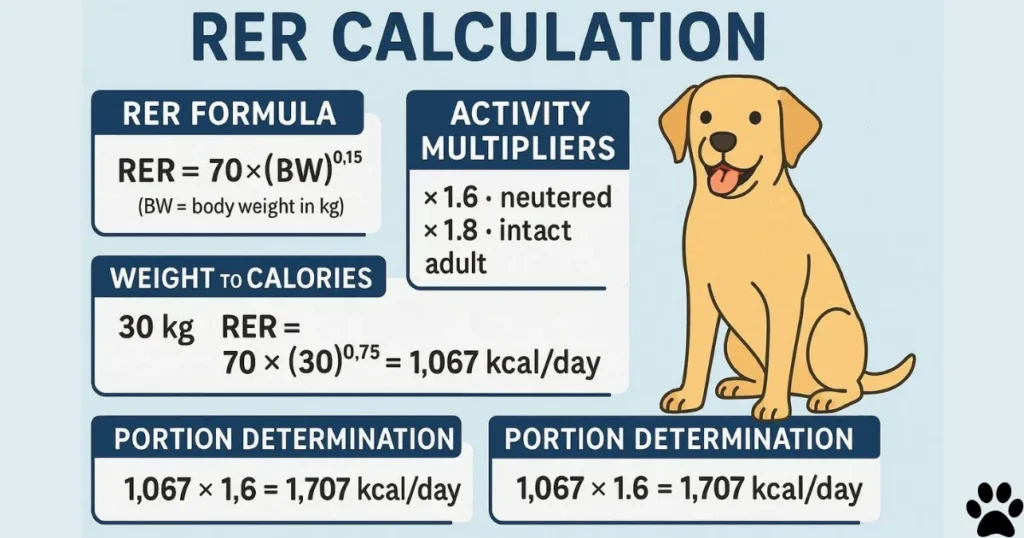
Calculate Resting Energy Requirements (RER).
RER Formula: 70 × (body weight in kg) ^ 0.75.
Example for 65-lb (29.5 kg) Labrador:
- RER = 70 × (29.5) ^ 0.75.
- RER = 70 × 14.9 = 1,043 calories.
Apply Life Stage & Activity Multipliers.
- Puppy (Growing, 8-24 weeks): RER × 2.5-3.0 = 2,608-3,129 calories
- Puppy (Late Growth, 24-48 weeks): RER × 2.0-2.5 = 2,086-2,608 calories
- Adult (Sedentary Pet): RER × 1.2-1.4 = 1,252-1,460 calories
- Adult (Moderate Activity): RER × 1.6 = 1,669 calories
- Adult (High Activity/Working): RER × 2.0-2.5 = 2,086-2,608 calories
- Senior (Low Activity): RER × 1.2 = 1,252 calories
- Neutered/Spayed: RER × 1.4-1.6 = 1,460-1,669 calories.
Convert Calories to Food Amount.
Daily Cups = Total Calories ÷ Food’s Calories per Cup.
65-lb moderate adult Labrador example (1,669 calories, food with 380 kcal/cup):
- 1,669 ÷ 380 = 4.4 cups daily.
- Split into 2 meals = 2.2 cups per meal.
Labrador Food Amount by Weight Quick Reference.
| Weight | Puppy (4-8 months) | Adult (Moderate) | Adult (Working) | Senior (Low) |
| 50 lbs | 3.5-4 cups | 3-3.5 cups | 4-5 cups | 2.5-3 cups |
| 55 lbs | 4-4.5 cups | 3-3.5 cups | 4.5-5.5 cups | 2.5-3 cups |
| 60 lbs | 4-5 cups | 3.5-4 cups | 5-6 cups | 3-3.5 cups |
| 65 lbs | 4.5-5 cups | 3.5-4.5 cups | 5-6.5 cups | 3-3.5 cups |
| 70 lbs | 5-5.5 cups | 4-4.5 cups | 5.5-7 cups | 3.5-4 cups |
| 75 lbs | 5-6 cups | 4-5 cups | 6-7.5 cups | 3.5-4.5 cups |
| 80 lbs | 5.5-6 cups | 4.5-5 cups | 6.5-8 cups | 4-4.5 cups |
Critical Adjustments for Labradors:
- Show-Line Labs (Heavier, Less Active): Reduce by 15-20% from moderate amounts.
- Field-Line Labs (Leaner, Working): May need 30-50% more than moderate amounts.
- Labs with Obesity History: Calculate based on target weight, not current weight.
- Post-Spay/Neuter: Reduce by 25% immediately and monitor closely.
Definitive Statements on Labrador Feeding.
In veterinary nutrition, Labradors demonstrate the highest caloric efficiency among sporting breeds, storing excess calories as fat more readily than other retrievers. This metabolic characteristic, combined with exceptional food motivation, creates the perfect obesity storm affecting 60% of pet Labradors.
The Labrador feeding chart by age shows that portions peak during late puppyhood (24-28 weeks) at 4-5 cups daily, despite continued body size increases afterward. This reflects the metabolic shift from growth-phase caloric demands to maintenance-phase efficiency as skeletal development completes.
Labrador puppy feeding charts must emphasize lean body condition throughout growth. Research shows that Labrador puppies maintained at a body condition score of 4/9 (lean) throughout growth develop 50-70% less severe hip and elbow dysplasia than those kept at a score of 6/9 (slightly overweight).
The Labrador food amount by weight for working field Labs may require 40-60% more calories than pet Labs of identical weight, due to sustained high-intensity activity that burns 2,000-3,000 calories during full hunting days. Generic feeding recommendations cause dangerous weight loss in working Labs.
Neutered and spayed Labradors face a double metabolic burden – breed-specific caloric efficiency PLUS a 25-30% metabolism drop from sterilization. This combination explains why spayed female Labs are especially prone to rapid weight gain post-surgery without aggressive portion reduction.
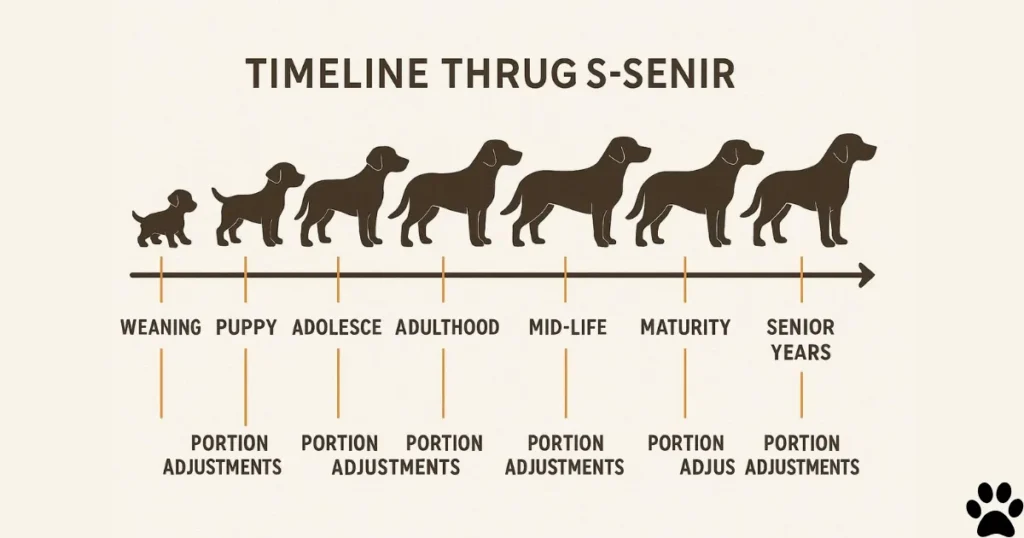
7 Critical Feeding Stages in Labrador Life.
1. Weaning to Large-Breed Puppy Food (6-8 Weeks).
Transition from mother’s milk to solid large-breed puppy formula. Feed 4 small meals daily initially, reducing to 3 meals by 8 weeks. Never use all-life-stages or small-breed puppy formulas.
2. Three Meals to Two Meals (24 Weeks).
The Labrador puppy feeding chart shows this transition at 6 months, when stomach capacity supports larger, less frequent meals. Gradual 1-2 week transition prevents digestive upset.
3. Puppy to Adult Food Formula (12-15 Months).
Use a 10-14-day gradual transition. Adult formulas typically have different caloric density, requiring portion recalculation. Many Labs need 30-40% less volume when switching due to the higher caloric density of adult food.
4. Post-Spay/Neuter Portion Reduction (Timing Varies).
Reduce portions 25% immediately after surgery. Labradors gain weight faster post-sterilization than other breeds. Monitor weight weekly for the first month, then biweekly for 6 months.
5. Activity Level Changes (Ongoing).
Working Labs entering retirement need a 40-50% reduction in their portion. Pet Labs beginning agility or field work need 30-40% increases. Reassess portions whenever activity changes persist for 2+ weeks.
6. Seasonal Activity Adjustments (Annual).
Hunting Labs in season (fall/winter) need 40-60% more than off-season. The swimming season (summer) increases demand by 20-30%. Adjust portions when seasonal activity patterns shift.
7. Senior Metabolism Decline (7+ Years).
Begin reducing portions by 10-15% around age 7 as metabolism slows. Continue gradual reductions based on body condition and activity. Most senior Labs need 25-35% less than prime adult amounts.
Common Labrador Feeding Mistakes by Life Stage.
The following are the Labrador feeding mistakes by life stage.
Puppy Phase Mistakes.
Overfeeding Based on Appetite:
Labrador puppies act ravenously hungry even when overfed. Their food motivation is genetic – appetite signals mean nothing. Body condition scoring is the only reliable guide.
Using Standard Puppy Food:
Regular puppy formulas promote too-rapid growth in large breeds. Labradors MUST eat large-breed puppy formulas with controlled calcium, phosphorus, and caloric density.
Free-Feeding:
Leaving food available all day guarantees obesity in food-motivated Labrador puppies. Measured meals at set times are non-negotiable for this breed.
Ignoring Show vs. Field Line Differences:
Show-line Labradors (heavier bone, less active) need 15-20% less than field-line Labs (leaner, more energetic) even as puppies.
Adult Phase Mistakes.
Never Reduce from Puppy Portions:
Some owners continue peak puppy amounts (4-5 cups) after growth has completed. Adult Labradors need 30-40% less, making this mistake catastrophic for weight management.
Treating All Labs Identically:
A working field Lab needs 50-80% more food than a pet Lab of identical weight. Generic portions cause either obesity (working dog portions fed to pets) or weight loss (pet portions fed to working dogs).
Not Compensating for Treats:
Training treats, dental chews, and table scraps add 200-400 calories daily in many Labs – equivalent to 0.5-1 cup of dog food. These MUST be subtracted from meals.
Believing “Big-Boned” Myth:
Labradors carrying excess weight are obese, not “big-boned.” A body condition score of 6+ indicates overfeeding, regardless of the dog’s size or the owner’s perceptions.
Senior Phase Mistakes.
Maintaining Adult Portions:
Senior Labrador metabolism drops 25-35% below adult levels. Continuing adult portions leads to insidious weight gain averaging 1-2 pounds per month over the years.
Not Monitoring Weight Monthly:
Labs’ thick coats hide weight gain. Monthly weighing catches trends before they become serious. Seniors should maintain a weight within ±3 pounds throughout the senior years.
Free-Feeding Senior Labs:
Older Labs’ reduced activity means constant access to food causes significant obesity. Measured meals remain essential regardless of age.
What is the Labrador feeding chart by age?
A Labrador feeding chart by age shows specific daily food amounts from 8 weeks through senior years: puppy portions (1.5-5 cups), adult portions (2.5-5 cups), and senior portions (2-4 cups), based on age, weight, and activity level.
How much should I feed my Labrador puppy using a feeding chart?
Use the Labrador puppy feeding chart: 8 weeks = 1.5-2 cups daily; 12 weeks = 2.5-3 cups; 16 weeks = 3-4 cups; 24 weeks = 4-5 cups; split into 3 meals until 6 months, then 2 meals.
What is the Labrador food amount by weight for adults?
Labrador food amount by weight for adults: 55 lbs = 3-3.5 cups daily, 65 lbs = 3.5-4.5 cups daily, 75 lbs = 4-5 cups daily (moderate activity). Adjust ± 20% for sedentary or working Labs.
How does the Labrador puppy feeding chart prevent joint disease?
The Labrador puppy feeding chart emphasizes lean body condition with controlled portions. Overfeeding causes rapid growth, which stresses joints and increases hip and elbow dysplasia severity by 50-70% compared to lean puppies maintained at controlled growth rates.
Do working Labradors need different amounts than pet Labs?
Yes, field Labs need 40-60% more than pet Labs, using the Labrador food amount by weight. A 65-lb working Lab may need 5-6 cups daily, while a 65-lb pet Lab may need 3-3.5 cups daily.
Should Labrador portions change after spaying or neutering?
Yes, reduce portions 25% immediately after surgery. Labradors gain weight faster post-sterilization than other breeds due to metabolic efficiency. The Labrador feeding chart by age must be adjusted for altered dogs to prevent rapid weight gain.
How much food for a senior Labrador by weight?
Senior Labrador amounts by weight: 55 lbs = 2-3 cups daily, 65 lbs = 2.5-3.5 cups daily, 75 lbs = 3-4 cups daily. Seniors need 25-35% less than adults due to reduced metabolism and activity.
What if my Labrador doesn’t match the feeding chart weight?
Mild variation (± 5 pounds) is normal. Being 10+ pounds off the expected weight requires veterinary evaluation. Calculate portions using actual weight if within normal range, or target weight if significantly overweight.
How often should I update feeding amounts using the chart?
Update portions every 2-4 weeks during puppyhood (8-24 weeks), monthly during late growth (24-52 weeks), every 3-6 months for adults, and monthly for seniors. Reassess immediately when activity changes.
Why do Labradors need less food than other retrievers?
Labradors have exceptional metabolic efficiency, storing excess calories as fat more readily than Golden Retrievers or other breeds. The Labrador feeding chart by age reflects this efficiency, with portions 15-20% lower than those of similarly sized retrievers.
How do I calculate Labrador food amount by weight for my specific dog?
Calculate RER: 70 × (weight in kg) ^ 0.75. Multiply by activity factor (1.2-2.5). Divide by your food’s kcal/cup. Example: 65-lb moderate Lab = 1,669 calories ÷ 380 kcal/cup = 4.4 cups daily.
What’s the difference between show-line and field-line feeding amounts?
Show-line Labs (heavier, less active) need 15-20% less than field-line Labs (leaner, more active) using the Labrador food amount by weight. A 65-lb show Lab needs 3 cups while a 65-lb field Lab needs 3.5-4 cups.
Conclusion.
The Labrador feeding chart by age shows that Labrador’s exceptional food motivation and metabolic efficiency require stricter portion control than those of other retriever breeds. Puppies need peak portions of 4-5 cups around 6 months; adults require 2.5-4.5 cups for pets or 4-6 cups for working dogs; and seniors need 2-4 cups – all significantly less than many owners expect, given Labs’ enthusiastic appetite.
Using the Labrador puppy feeding chart correctly means maintaining lean body condition throughout growth, which reduces the severity of hip and elbow dysplasia by 50-70% compared to overfeeding. The Labrador food amount by weight must account for dramatic differences between show-line pets (lower needs) and field-line working dogs (40-60% higher needs), plus the 25% reduction required after spay/neuter.
Critical transitions occur at 6 months (three to two meals), 12-15 months (puppy to adult food), immediately post-sterilization (25% reduction), and age 7+ (gradual senior reduction). The obesity affecting 60% of Labradors stems directly from missing these transitions and trusting appetite signals in a breed genetically programmed to eat everything offered, regardless of actual caloric needs.
What Feeding Amounts Work for Your Labrador at Each Life Stage?
Share your Labrador feeding experience to help other owners navigate portion control in this food-motivated breed.
Tell us about your Lab’s feeding journey:
- What portions does your Labrador eat at their current age?
- How have amounts changed from puppyhood through adulthood?
- Did you need to adjust chart amounts for your individual dog’s activity level?
- What feeding transitions were most challenging (puppy to adult, post-spay/neuter)?
- Any weight management struggles or successes to share?
Share your story in comments or tag us with #LabradorFeeding and #LabFeedingChart. Your experience helps other owners understand the unique feeding challenges of this exceptionally food-motivated breed.