A breed-specific golden retriever feeding chart by age eliminates the guesswork that leads to the two most common nutrition problems I see: overfeeding during critical growth phases, which can cause joint disease, and underfeeding during high-activity periods, which can cause poor body condition. Generic dog feeding charts fail Golden Retrievers because they don’t account for this breed’s unique growth timeline extending to 18-24 months, genetic predisposition to obesity requiring precise portion control, and dramatic caloric shifts between puppyhood’s rapid growth and senior years’ reduced metabolism.
Golden Retrievers present feeding challenges distinct from other breeds. Their enthusiastic appetite makes them eat whatever is offered regardless of actual caloric needs, their large-breed classification demands controlled growth to prevent orthopedic disease, and their energy levels vary dramatically from the hyperactive puppy phase through the mellower senior years. What works for a 3-month-old puppy causes obesity in a 10-year-old senior, yet many owners continue the same portions indefinitely.
Understanding the golden retriever feeding chart by age, applying puppy-specific portions that prevent rapid growth, adjusting for adult activity levels ranging from couch companions to working retrievers, and reducing for senior metabolism changes ensures optimal nutrition throughout your Golden Retriever’s entire life. This comprehensive guide provides specific feeding amounts for every age from 8 weeks through senior years, explains when and how to transition between life stages, addresses weight-based calculations for individual dogs, and identifies the critical feeding mistakes that compromise Golden Retriever health and longevity.
Golden Retriever Feeding Chart by Age: Complete Timeline
This comprehensive chart shows exact feeding amounts for Golden Retrievers from puppyhood through senior years:
Puppy Phase: 8 Weeks to 12 Months
| Age | Weight | Daily Amount | Meals/Day | Per Meal | Notes |
| 8 weeks | 10-15 lbs | 1.5-2 cups | 3 | 0.5-0.7 cups | Foundation growth phase |
| 12 weeks | 20-30 lbs | 2.5-3 cups | 3 | 0.8-1 cup | Rapid skeletal development |
| 16 weeks | 35-45 lbs | 3.5-4 cups | 3 | 1.2-1.3 cups | Peak growth velocity |
| 20 weeks | 45-55 lbs | 4-4.5 cups | 3 | 1.3-1.5 cups | Continued rapid growth |
| 24 weeks | 50-60 lbs | 4-5 cups | 2-3 | 1.3-2.5 cups | Transition to 2 meals |
| 32 weeks | 55-65 lbs | 4-5 cups | 2 | 2-2.5 cups | Growth rate slowing |
| 40 weeks | 60-70 lbs | 3.5-4.5 cups | 2 | 1.8-2.3 cups | Approaching maturity |
| 48 weeks | 65-75 lbs | 3-4 cups | 2 | 1.5-2 cups | Near-adult portions |
Adult Phase: 1-7 Years
| Activity Level | Weight | Daily Amount | Meals/Day | Per Meal |
| Low (2-3 hrs play) | 60-75 lbs | 2.5-3.5 cups | 2 | 1.3-1.8 cups |
| Moderate (3-4 hrs activity) | 60-75 lbs | 3-4 cups | 2 | 1.5-2 cups |
| High (4+ hrs, working) | 60-75 lbs | 4-5 cups | 2 | 2-2.5 cups |
| Low (2-3 hrs play) | 75-90 lbs | 3-4 cups | 2 | 1.5-2 cups |
| Moderate (3-4 hrs activity) | 75-90 lbs | 4-5 cups | 2 | 2-2.5 cups |
| High (4+ hrs, working) | 75-90 lbs | 5-6 cups | 2 | 2.5-3 cups |
Senior Phase: 7+ Years
| Age | Weight | Activity | Daily Amount | Meals/Day | Per Meal |
| 7-9 years | 60-75 lbs | Moderate | 2.5-3.5 cups | 2 | 1.3-1.8 cups |
| 7-9 years | 75-90 lbs | Moderate | 3-4 cups | 2 | 1.5-2 cups |
| 10+ years | 60-75 lbs | Low | 2-3 cups | 2 | 1-1.5 cups |
| 10+ years | 75-90 lbs | Low | 2.5-3.5 cups | 2 | 1.3-1.8 cups |
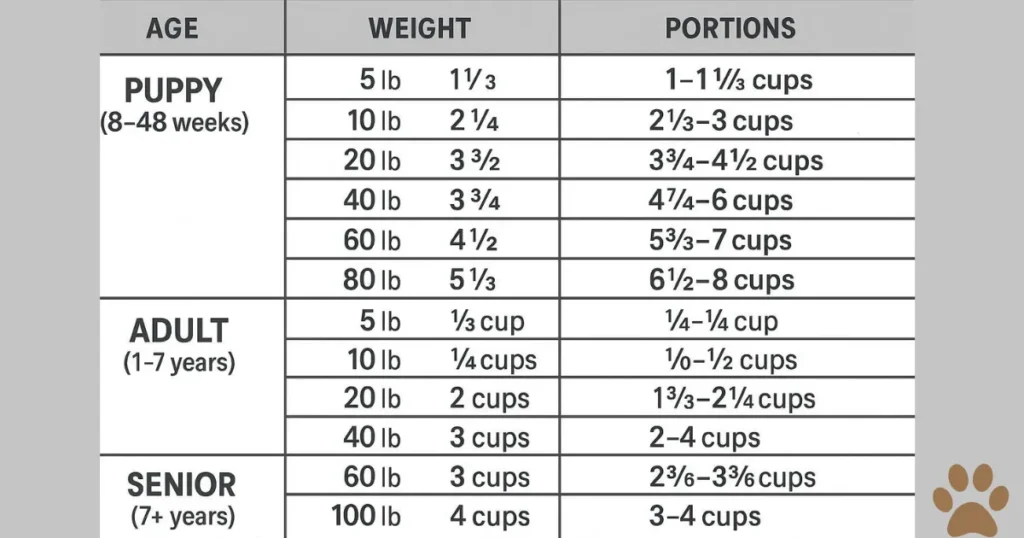
All amounts are based on foods containing 350-400 kcal/cup. Adjust for your specific food’s caloric density.
Golden Retriever Puppy Feeding Chart: Critical Growth Management
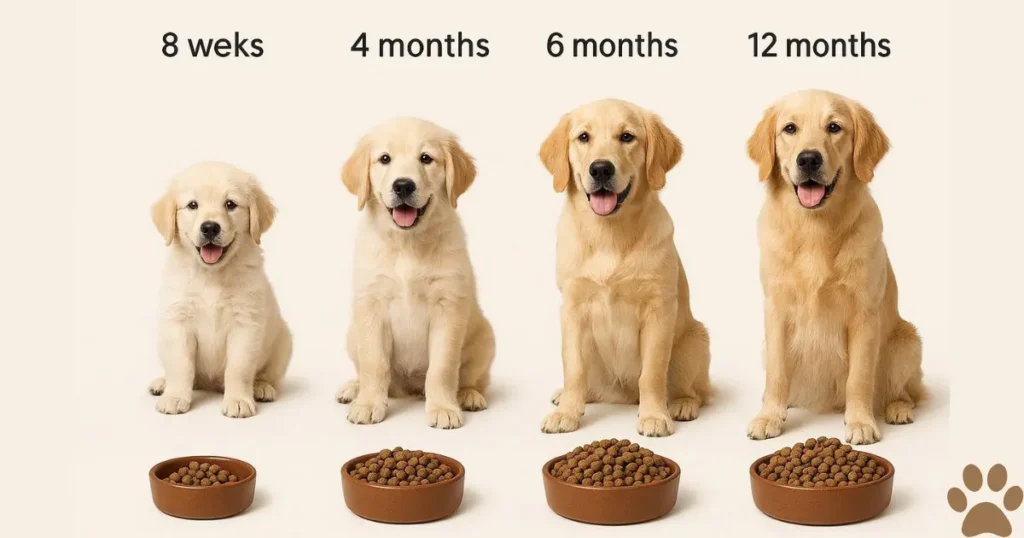
The golden retriever puppy feeding chart requires extra precision because overfeeding during growth increases hip dysplasia severity by 40-60% compared to control feeding. Here’s the detailed breakdown:
8-16 Weeks: Foundation Phase
Feeding Schedule:
- 7 AM, 12 PM, 5 PM (3 meals, 5 hours apart).
Portion Control:
- 8 weeks (10-15 lbs): 1.5-2 cups total daily.
- 12 weeks (20-30 lbs): 2.5-3 cups total daily.
- 16 weeks (35-45 lbs): 3.5-4 cups total daily.
Critical Rules:
- Ribs must remain easily palpable through light finger pressure.
- No visible ribs or prominent hip bones.
- Visible waist definition from above is mandatory.
- Reduce portions by 10-15% immediately if ribs become difficult to feel.
16-24 Weeks: Rapid Growth Phase.
Feeding Schedule: Maintain 3 meals until 24 weeks, then transition to 2 meals.
Growth Monitoring:
- Weigh weekly during this phase.
- Ideal gain: 5-8 pounds monthly.
- Gaining 10+ pounds monthly = reduce portions 15% immediately.
- Plot weight on Golden Retriever growth curves.
Transitioning to 2 Meals (Week 24-26):
- Week 1: Remove the smallest meal, increase the other two by 15% each.
- Week 2: Split the total daily amount into two equal portions.
- New schedule: 7-8 AM and 5-6 PM.
24-52 Weeks: Adolescence to Maturity.
Feeding Schedule: 2 meals daily, 10-12 hours apart.
Portion Adjustments:
- Portions peak around 24-28 weeks (4-5 cups daily).
- Begin reducing after 32 weeks as growth rate slows.
- By 48 weeks, portions approach adult maintenance levels.
- Transition to adult food around 12-15 months.
Body Condition Targets:
- Lean, athletic build throughout growth.
- Easily palpable ribs without visible prominence.
- A clear waist definition is always visible.
- Never allow a puppy to become pudgy or overweight.
Vet’s Tip: Golden Retriever puppies should look lean and slightly “gangly” during growth – not plump or filled out. Chubby puppies seem healthier but carry significantly higher orthopedic disease risk. If your puppy looks “perfect” and well-rounded, you’re likely overfeeding, which can hinder optimal skeletal development.
Golden Retriever Food Amount by Weight: Precise Calculations.
The golden retriever food amount by weight varies based on individual metabolism, activity level, and age. Use this formula for precision:
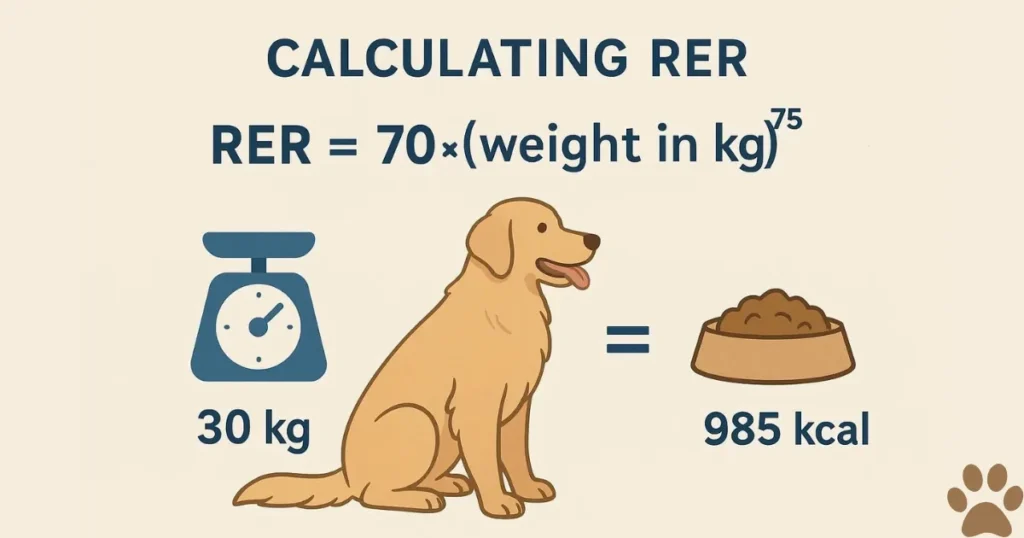
Calculate Resting Energy Requirements (RER).
RER = 70 × (body weight in kg) ^ 0.75.
Example for 70-lb (31.8 kg) Golden Retriever:
- RER = 70 × (31.8) ^ 0.75.
- RER = 70 × 15.8 = 1,106 calories.
Apply Activity & Life Stage Multipliers.
- Puppy (Growing): RER × 2.0-3.0 = 2,212-3,318 calories
- Adult (Low Activity): RER × 1.2-1.4 = 1,327-1,548 calories
- Adult (Moderate Activity): RER × 1.6 = 1,770 calories
- Adult (High Activity/Working): RER × 2.0-2.5 = 2,212-2,765 calories
- Senior (Low Activity): RER × 1.2 = 1,327 calories
- Neutered/Spayed Adult: RER × 1.4-1.6 = 1,548-1,770 calories.
Convert to Food Amount.
Daily Cups = Total Calories ÷ Food’s Calories per Cup.
70-lb moderate adult example (1,770 calories needed, food with 380 kcal/cup):
- 1,770 ÷ 380 = 4.7 cups daily.
- Split into 2 meals = 2.35 cups per meal.
Weight-Based Quick Reference:
| Weight | Puppy (4-8 months) | Adult (Moderate) | Senior (Low) |
| 50 lbs | 3.5-4 cups | 3-3.5 cups | 2.5-3 cups |
| 60 lbs | 4-4.5 cups | 3.5-4 cups | 3-3.5 cups |
| 70 lbs | 4.5-5 cups | 4-4.5 cups | 3.5-4 cups |
| 80 lbs | 5-5.5 cups | 4.5-5 cups | 4-4.5 cups |
| 90 lbs | 5.5-6 cups | 5-5.5 cups | 4.5-5 cups |
Definitive Statements on Golden Retriever Feeding.
In veterinary nutrition, Golden Retrievers should maintain a body condition score of 4-5 out of 9 throughout life, with easily palpable ribs and visible waist definition. Scores of 6 or higher increase orthopedic disease risk and reduce lifespan by 1-2 years.
The golden retriever feeding chart by age shows portions peak during late puppyhood (24-32 weeks) at 4-5 cups daily, then decrease to adult maintenance levels of 3-4 cups despite continued body size increases. This counterintuitive pattern reflects a slowing metabolic rate as growth velocity decreases.
Golden retriever puppy feeding charts must emphasize controlled growth rather than maximum growth. Puppies fed for rapid growth show 40-60% higher hip dysplasia severity than those fed for moderate growth rates, underscoring the critical role of lean body condition during puppyhood for lifelong joint health.
Neutered and spayed Golden Retrievers require 20-25% fewer calories than intact dogs due to metabolic changes from sterilization. Failing to reduce portions immediately post-surgery causes rapid weight gain, averaging 8-12 pounds within 6 months in Golden Retrievers.
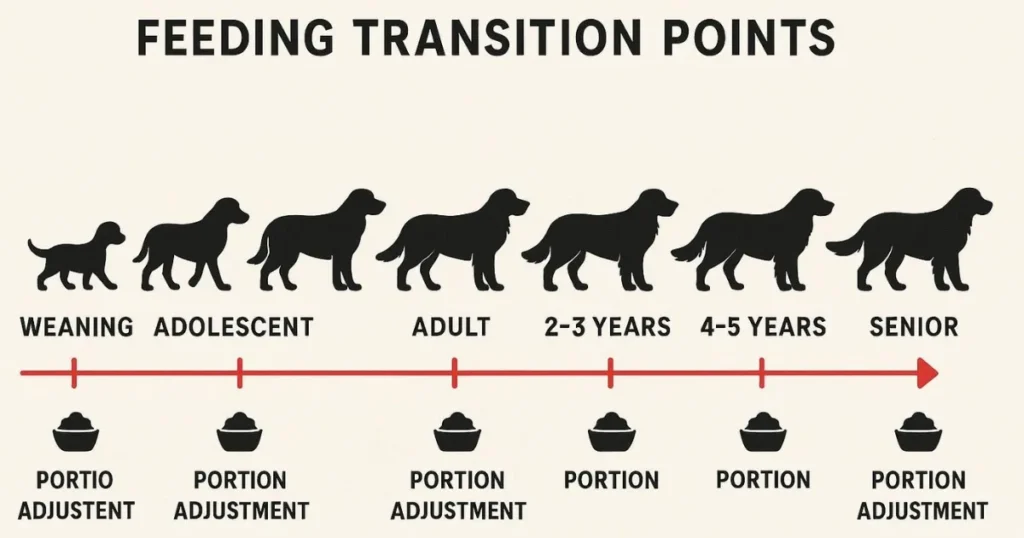
8 Critical Feeding Transitions in a Golden Retriever’s Life.
1. Weaning to Puppy Food (6-8 Weeks).
Transition from mother’s milk or puppy formula to solid large-breed puppy food. Feed small portions 4 times daily initially, reducing to 3 meals by 8 weeks.
2. Three to Two Daily Meals (24 Weeks).
The golden retriever puppy feeding chart shows this transition around 6 months, when stomach capacity increases, and the growth rate begins to slow. Make change gradually over 1-2 weeks.
3. Puppy to Adult Food (12-15 Months).
Use a 10-14 day gradual transition, mixing increasing amounts of adult food with decreasing amounts of puppy food. Recalculate portions as adult foods typically have different caloric density.
4. Post-Spay/Neuter Adjustment (Varies).
Reduce portions by 20-25% immediately after surgery. Most Golden Retrievers are neutered between 6 and 18 months. Monitor weight monthly for 6 months post-surgery.
5. Activity Level Changes (Ongoing).
Adjust portions by 15-20% when activity increases (starting agility, field work) or decreases (injury recovery, retirement from work). Reassess every 3-6 months.
6. Pregnancy and Lactation (If Breeding).
Pregnant Golden Retrievers need 25-50% increased calories in the final trimester. Nursing mothers require 2-4 times the normal amount, depending on litter size. Feed free-choice quality puppy food during lactation.
7. Senior Transition (7 Years).
Begin reducing portions by 10-15% around age 7 as metabolism slows. Continue reducing gradually through age 10+ based on body condition and activity levels.
8. Medical Diet Changes (As Needed).
Prescription diets for conditions like kidney disease, allergies, or joint disease have different caloric densities requiring portion recalculation. Follow veterinary guidance for medical diet transitions.
Common Golden Retriever Feeding Mistakes by Age.
Puppy Mistakes.
Overfeeding for “Healthy” Appearance:
Chubby puppies carry 40-60% higher orthopedic disease risk. Lean puppies with visible waist definition are healthier despite appearing “too thin” to many owners.
Following Small-Breed Guidelines:
Small-breed puppy foods promote too-rapid growth. Always use large-breed specific formulas with controlled calcium and calories.
Treating Hunger as an Indicator:
Golden Retriever puppies appear hungry regardless of their actual caloric needs. Body condition monitoring determines portions, not appetite signals.
Adult Mistakes.
Never Adjusting from Puppy Portions:
Some owners continue feeding puppy portions after growth has completed. Adult Golden Retrievers need 40-50% less than peak puppy portions, making adjustment essential.
Ignoring Activity Changes:
A Golden Retriever retiring from field work needs 30-40% less food than during working years. Failing to reduce causes rapid obesity.
Free-Feeding:
Leaving food available all day causes obesity in food-motivated Golden Retrievers. Measured meals at set times enable portion control.
Senior Mistakes.
Maintaining Adult Portions:
Senior metabolism drops 20-30% below adult levels. Continuing adult portions leads to gradual weight gain, stressing already-compromised joints.
Not Monitoring Weight:
Monthly weight checks reveal trends before visible changes occur. Seniors should maintain a stable weight within ±3 pounds throughout the senior years.
Ignoring Body Condition:
Thick coats hide weight gain. Hands-on assessment monthly ensures portions match reduced activity and metabolism.
What is the golden retriever feeding chart by age?
A golden retriever feeding chart by age shows specific daily food amounts from 8 weeks through senior years, including puppy portions (1.5-5 cups), adult amounts (3-5 cups), and senior portions (2-4 cups) based on age, weight, and activity level.
How much should I feed my Golden Retriever puppy using a feeding chart?
Use the golden retriever puppy feeding chart: 8 weeks = 1.5-2 cups daily; 12 weeks = 2.5-3 cups; 16 weeks = 3.5-4 cups; 24 weeks = 4-5 cups, all split into 3 meals until 6 months, then 2 meals.
What is the golden retriever food amount by weight for adults?
Golden retriever food amount by weight for adults: 60 lbs = 3.5-4 cups daily, 70 lbs = 4-4.5 cups daily, 80 lbs = 4.5-5 cups daily (moderate activity). Adjust ± 15% for low or high activity levels.
When should I transition my Golden Retriever from puppy to adult portions?
Transition from puppy to adult portions around 12-15 months when using the golden retriever feeding chart by age. Growth is substantially complete by this age, requiring a 40-50% reduction from peak puppy amounts.
How does the golden retriever puppy feeding chart prevent hip dysplasia?
The golden retriever puppy feeding chart emphasizes controlled growth with moderate portions keeping puppies lean. Overfeeding causes rapid growth, which stresses developing joints and increases hip dysplasia severity by 40-60% compared to controlled feeding.
Should Golden Retriever portions change after spaying or neutering?
Yes, reduce portions by 20-25% immediately after spaying or neutering. Metabolism drops 25-30% post-surgery. The golden retriever feeding chart by age must be adjusted for neutered dogs to prevent rapid weight gain.
How much food for a senior Golden Retriever by weight?
Senior Golden Retriever amounts by weight: 60 lbs = 2.5-3.5 cups daily, 70 lbs = 3-4 cups daily, 80 lbs = 3.5-4.5 cups daily. Seniors need 20-30% less than adults due to reduced metabolism and activity.
What if my Golden Retriever doesn’t match the feeding chart weight?
Mild variation (± 5 pounds) is normal. Being 10+ pounds off the expected weight requires veterinary evaluation. Calculate portions based on current weight if within the normal range, or on the target weight if significantly over- or underweight.
How often should I update feeding amounts using the chart?
Update portions every 2-4 weeks during puppyhood (8-24 weeks), monthly during late puppyhood (24-52 weeks), every 3-6 months for adults, and monthly for seniors. Reassess whenever activity level changes significantly.
Can I use the same feeding chart for male and female Golden Retrievers?
Yes, with minor adjustments. Males typically weigh 65-75 lbs while females average 55-65 lbs. Use the golden retriever food amount by weight appropriate for your dog’s actual size rather than assuming gender-based portions.
How do I calculate the Golden Retriever food amount by weight for my specific dog?
Calculate RER: 70 × (weight in kg) ^ 0.75. Multiply by activity factor (1.2-2.5). Divide the result by your food’s kcal/cup. Example: 70-lb moderate dog = 1,770 calories ÷ 380 kcal/cup = 4.7 cups daily.
What’s the difference between puppy and adult feeding chart amounts?
The golden retriever puppy feeding chart shows higher portions (4-5 cups at peak) than adults (3-4 cups) despite puppies being smaller, because growth requires 2-3x more calories per pound than adult maintenance.
Conclusion.
The golden retriever feeding chart by age demonstrates that proper nutrition changes dramatically throughout life. Puppies need peak portions of 4-5 cups daily around 6 months, despite weighing only 50-60 pounds, while adult Golden Retrievers weighing 70+ pounds need just 3-4 cups daily, and seniors require even less at 2.5-3.5 cups. This counterintuitive pattern reflects caloric needs driven by growth velocity and metabolism rather than body size alone.
Using the golden retriever puppy feeding chart correctly – maintaining lean body condition with easily palpable ribs throughout growth – reduces hip dysplasia severity by 40-60% compared to overfeeding for rapid growth. The golden retriever food amount by weight must be calculated individually using RER formulas and activity multipliers, then adjusted monthly based on body condition rather than rigidly following generic guidelines.
Critical feeding transitions occur at 6 months (three to two meals), 12-15 months (puppy to adult food), immediately post-spay/neuter (20-25% reduction), and age 7+ (senior reduction). Missing these transitions causes the obesity I see in 60% of adult Golden Retrievers, compromising joint health, reducing lifespan, and increasing disease risk. Print your age-appropriate chart, post it visibly, and update portions every 3-6 months based on body condition monitoring rather than appetite signals or assumptions that “more is better.”
What Feeding Amounts Work for Your Golden Retriever at Each Life Stage?
Share your Golden Retriever feeding experience to help other owners understand real-world portion needs throughout different life stages.
Tell us about your feeding journey:
- What portions does your Golden Retriever eat at their current age?
- How have amounts changed from puppyhood through adulthood?
- Did you need to adjust the chart amounts for your individual dog?
- What transitions were most challenging (3 to 2 meals, puppy to adult, etc)?
- Any feeding mistakes you learned from along the way?
Share your story in comments or tag us with #GoldenRetrieverInsight and #FeedingChartJourney. Your experience helps other owners navigate age-appropriate feeding with confidence and understand normal variation between individual Golden Retrievers.