Determining how much wet food to feed a dog confuses many Golden Retriever owners because wet food portions differ dramatically from dry kibble amounts. I’ve worked with countless owners who either vastly underfeed – unaware that wet food’s high water content means larger volumes are needed – or overfeed by treating wet food as a supplement to full dry kibble portions. The moisture content difference alone makes wet food appear much more voluminous than equivalent-calorie dry food, creating optical illusions that lead to portion errors.
Golden Retrievers present unique considerations for wet food feeding. Their large size requires substantial food volumes that become expensive with 100% wet feeding; their enthusiastic eating pace can cause digestive upset with moisture-rich foods, and their predisposition to obesity demands precise caloric control regardless of food form. Additionally, Golden Retrievers prone to dental disease may benefit from wet food’s softer texture, while those with sensitive stomachs often digest wet food more easily than dense kibble.
Understanding how much canned food to feed a dog requires calculating based on caloric density rather than volume, adjusting for wet-dry mixing ratios if combining food types, accounting for the 70-80% water content in wet food versus 10% in kibble, and modifying portions based on activity level and body condition. This guide provides specific wet food portions for Golden Retrievers by weight, explains the mathematics behind wet-dry conversions, addresses common mixing scenarios, and identifies when wet food offers advantages worth the higher cost and larger storage requirements.
How Much Wet Food to Feed a Dog: Basic Calculation
In veterinary nutrition, wet food and dry food portions must be calculated separately because their water content creates dramatic volume differences for equivalent calories.
Typical Caloric Density:
- Wet/Canned Food: 300-500 kcal per 13-oz can (average 380 kcal/can).
- Dry Kibble: 350-450 kcal per cup (average 380 kcal/cup).
Golden Retriever Daily Caloric Needs:
- 60-lb moderately active dog: | 1,600 calories.
- 70-lb moderately active dog: | 1,800 calories.
- 80-lb moderately active dog: | 2,000 calories.
Converting Calories to Wet Food Amount:
For a 70-lb Golden Retriever needing 1,800 calories daily, eating food with 380 kcal per 13-oz can:
- 1,800 ÷ 380 = 4.7 cans daily.
- Split into 2 meals = 2.35 cans per meal.
Volume Comparison:
- 100% Wet Food: 4.7 cans (approximately 61 ounces total).
- 100% Dry Food: 4.7 cups (approximately 21 ounces total).
The wet food weighs nearly three times as much as the dry food for the same number of calories, due to its higher water content. This explains why wet-fed dogs appear to eat “so much more” despite receiving equivalent nutrition.
How Much Canned Food to Feed a Dog: Weight-Based Guidelines
The exact amount depends on your dog’s weight, activity level, and the specific food’s caloric density. Here’s a precise breakdown:
For a 70-pound Golden Retriever eating 380 kcal/can food:
- Sedentary/Low Activity: 3.8-4.2 cans daily (1,450-1,600 calories)
- Moderate Activity: 4.5-5 cans daily (1,700-1,900 calories)
- High Activity: 5.2-5.8 cans daily (2,000-2,200 calories)
Critical Formula for How Much Canned Food to Feed a Dog:
- Determine daily caloric needs (use RER × activity factor)
- Check your specific food’s kcal per can (printed on label)
- Divide daily calories by kcal per can
- Split result into 2 meals
Example: 70-lb dog needing 1,800 calories, food with 400 kcal/can:
- 1,800 ÷ 400 = 4.5 cans daily
- 2 meals = 2.25 cans per meal
Many owners ask how much canned food to feed a dog without realizing caloric density varies dramatically. A 280 kcal/can food requires 6.4 cans daily for the same dog – 43% more volume than a 400 kcal/can food. This variance makes brand-specific calculation essential.
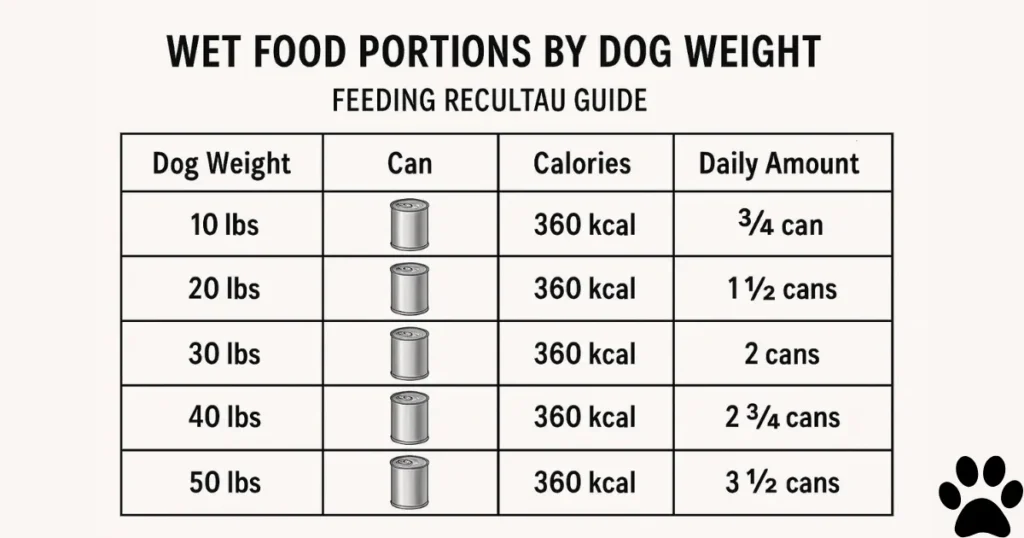
Complete Wet Food Feeding Guide by Weight.
This table shows how much canned food to feed a dog based on weight, assuming 380 kcal per 13-oz can:
| Dog Weight | Daily Calories | Daily Cans (100% Wet) | Cans Per Meal (2x Daily) |
| 50 lbs | 1,400 | 3.7 cans | 1.85 cans |
| 60 lbs | 1,600 | 4.2 cans | 2.1 cans |
| 70 lbs | 1,800 | 4.7 cans | 2.35 cans |
| 80 lbs | 2,000 | 5.3 cans | 2.65 cans |
| 90 lbs | 2,200 | 5.8 cans | 2.9 cans |
Critical Adjustments:
- Less Active Dogs: Reduce by 15-20%.
- Highly Active Dogs: Increase by 15-20%.
- Senior Dogs: Reduce by 10-15%.
- Overweight Dogs: Calculate based on target weight, not current weight.
Vet’s Tip: Always check YOUR specific wet food’s caloric content listed on the can or bag. Brands vary from 280-500 kcal per 13-oz can. A 500 kcal/can food requires 35% less volume than a 280 kcal/can food for equivalent nutrition – dramatic differences that make generic portions dangerously inaccurate.
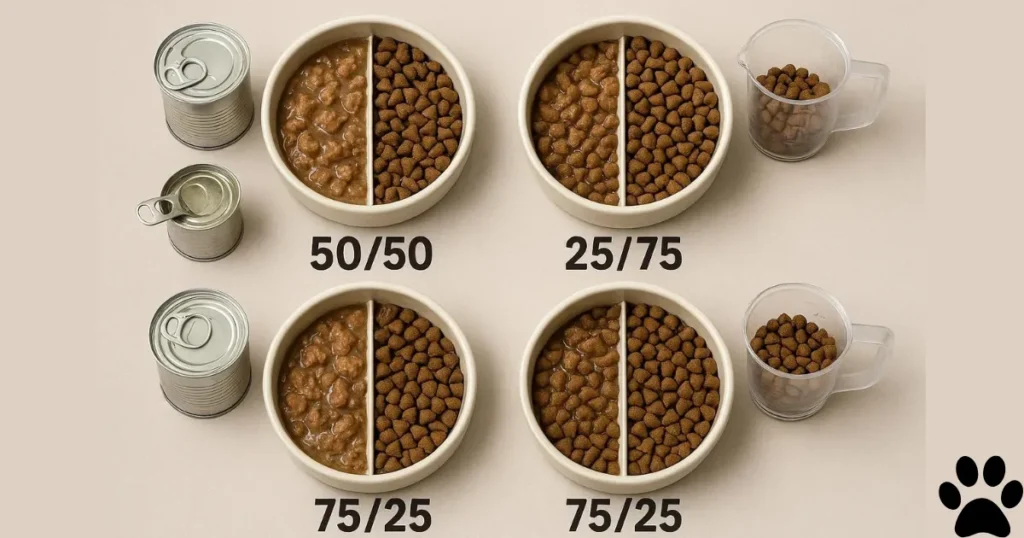
Mixing Wet and Dry Food: Combination Feeding Calculations.
Most Golden Retriever owners mix wet and canned food rather than feeding 100% wet due to cost and convenience. Here’s how much wet food to feed a dog when combining food types:
50/50 Wet-Dry Mix (Calories).
For a 70-lb dog needing 1,800 calories:
- 50% from wet = 900 calories = 2.4 cans (at 380 kcal/can).
- 50% from dry = 900 calories = 2.4 cups (at 380 kcal/cup).
- Per meal: 1.2 cans wet + 1.2 cups dry.
25/75 Wet-Dry Mix (Wet as Topper).
For a 70-lb dog:
- 25% from wet = 450 calories = 1.2 cans.
- 75% from dry = 1,350 calories = 3.6 cups.
- Per meal: 0.6 cans wet + 1.8 cups dry.
75/25 Wet-Dry Mix (Primarily Wet).
For a 70-lb dog:
- 75% from wet = 1,350 calories = 3.6 cans.
- 25% from dry = 450 calories = 1.2 cups.
- Per meal: 1.8 cans wet + 0.6 cups dry.
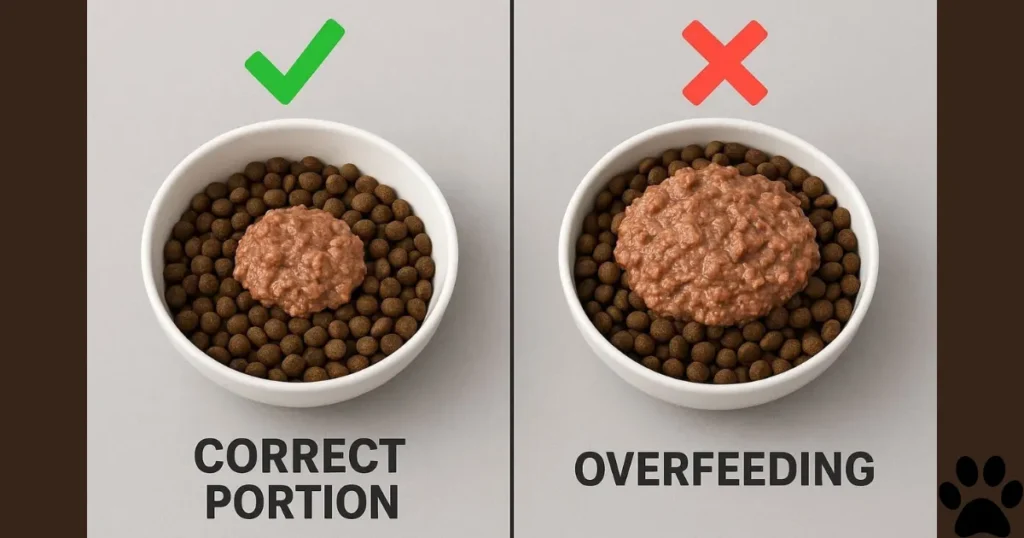
Common Mixing Mistake:
Adding full wet food portions ON TOP of full dry food portions creates 150-200% of caloric needs, guaranteeing rapid weight gain. Always calculate to maintain total daily calories – not volume.
Definitive Statements on Wet Food Feeding.
In canine nutrition, wet food contains 70-80% water compared to 10% in dry kibble, meaning wet food portions must be approximately 2.5-3 times larger by weight to deliver equivalent calories. This water content difference explains volume disparities that confuse owners.
How much wet food to feed a dog cannot be determined by volume alone – it requires calculating based on caloric density, which varies by 40-80% between wet food brands (280-500 kcal per 13-oz can). Generic portion recommendations fail without knowing the specific caloric content of your food.
Golden Retrievers transitioning from 100% dry to 100% wet food should make the change gradually over 10-14 days to prevent digestive upset from sudden increases in moisture content. Abrupt dietary changes cause diarrhea in 60-70% of dogs by disrupting the gut microbiome.
Mixing wet and dry food requires calculating each food type’s caloric contribution separately, then combining them to reach, but not exceed, daily caloric needs. Simply adding wet food to existing dry food portions results in overfeeding, averaging 140-180% of actual needs.
7 Advantages of Wet Food for Golden Retrievers.
1. Higher Moisture Content Supports Hydration.
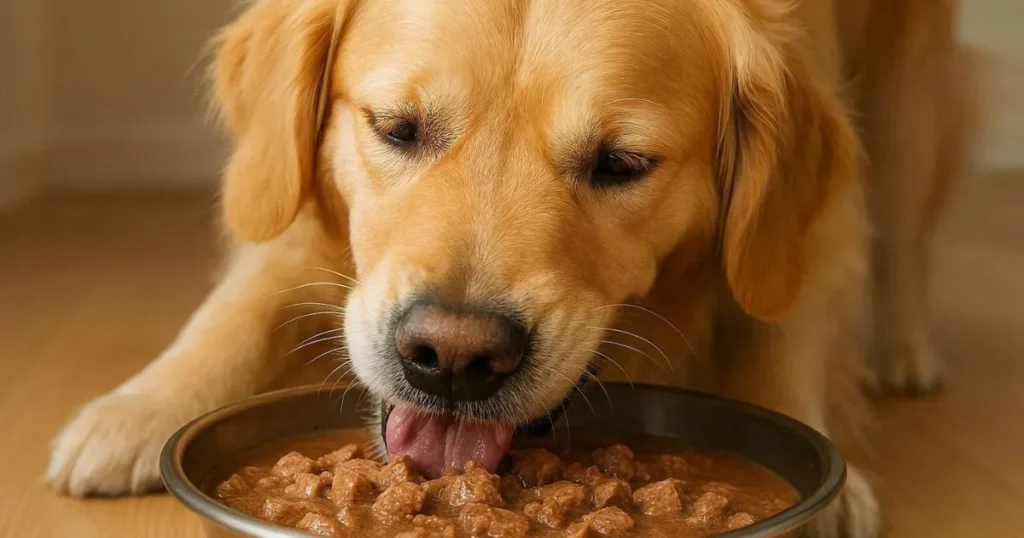
Wet food provides 8-10 ounces of water per 13-oz can, helping dogs who don’t drink adequately. Golden Retrievers with kidney disease, urinary crystals, or chronic dehydration benefit significantly from the passive hydration support of wet food.
2. Increased Palatability for Picky Eaters.
The stronger aroma and softer texture make wet food more appealing. Golden Retrievers recovering from illness, experiencing appetite loss, or simply being finicky often eat wet food enthusiastically when refusing kibble.
3. Easier Chewing for Dental Issues.
Senior Golden Retrievers with missing teeth, painful dental disease, or jaw problems manage wet food far more easily than hard kibble. The soft consistency requires minimal chewing effort.
4. Better Digestibility for Sensitive Stomachs.
Wet food’s higher moisture content and softer texture make digestion easier. Golden Retrievers with inflammatory bowel disease, pancreatitis recovery, or chronic GI sensitivity often tolerate wet food better than kibble.
5. Lower Carbohydrate Content Generally.
Many wet foods contain less carbohydrate than dry kibble formulas. Golden Retrievers needing lower carb intake for weight management or diabetes control benefit from wet food’s typically higher protein-to-carb ratios.
6. Enhanced Satiety from Volume.
Larger physical volume (despite equivalent calories) provides greater stomach fullness. This satiety benefit helps overweight Golden Retrievers feel satisfied on calorie-restricted portions.
7. Easier Medication Administration.
Mixing pills or liquids into wet food with a soft consistency is significantly easier than hiding medications in kibble. Golden Retrievers requiring multiple medications daily benefit from wet food’s concealment properties.
6 Disadvantages of Wet Food to Consider.
1. Significantly Higher Cost.
Wet food costs 2-4 times as much as equivalent-calorie dry food. Feeding a 70-lb Golden Retriever 100% wet averages $150-250 monthly versus $50-80 for quality kibble.
2. Reduced Dental Benefits.
Kibble provides mechanical cleaning through chewing action. Wet food offers no abrasive dental benefit, potentially increasing plaque and tartar accumulation in Golden Retrievers already prone to dental disease.
3. Storage and Spoilage Issues.
Opened cans must be refrigerated and used within 3-5 days. Wet food spoils rapidly at room temperature. Golden Retrievers who graze or eat slowly cannot free-feed wet food safely.
4. Messier Feeding Process.
Wet food sticks to bowls, faces, paws, and floors more than kibble. Golden Retrievers who eat enthusiastically create cleanup challenges with wet food that kibble doesn’t produce.
5. Less Convenient for Travel.
Cans are heavy, require can openers, and need refrigeration after opening. Traveling with wet food is substantially more challenging than bringing kibble for trips or boarding.
6. Potential for Overeating.
The palatability factor can cause some Golden Retrievers to overeat if portions aren’t strictly controlled. Combined with owners’ tendency to overfeed (thinking more volume = more nutrition), obesity risk increases.
Common Wet Food Feeding Mistakes.
Mistake 1: Not Reading Caloric Content.
Assuming all 13-oz cans contain the same number of calories leads to significant over- or underfeeding. Always check the kcal per can on your specific product.
Mistake 2: Adding Wet to Full Dry Portions.
Owners give full kibble amounts PLUS wet food, thinking wet is supplemental. This doubles caloric intake, causing rapid weight gain averaging 1-2 pounds weekly.
Mistake 3: Free-Feeding Wet Food.
Leaving wet food available all day leads to spoilage and prevents portion control. Wet food must be fed in measured meals and removed within 30 minutes.
Mistake 4: Not Adjusting for Less Activity.
Wet food’s enhanced palatability makes dogs eat full portions regardless of actual caloric needs. Less active Golden Retrievers need reduced wet food amounts, not standard portions.
Mistake 5: Ignoring Treat Calories.
Owners carefully measure wet food meals but give unlimited treats. With wet food’s already higher cost, treats should be minimal and subtracted from meal calories.
Mistake 6: Transitioning Too Quickly.
Switching from 100% dry to 100% wet overnight causes diarrhea in most dogs. Gradual 10-14 day transitions prevent digestive upset.
How much wet food should I feed my 70-pound Golden Retriever?
A 70-pound moderately active Golden Retriever needs approximately 4.5-5 cans daily (13-oz cans at 380 kcal each), split into two meals. Adjust based on your specific food’s caloric density and your dog’s activity level.
How much canned food should I feed a dog instead of dry food?
Feed approximately 2.5-3 times the volume when switching from dry to wet. A dog eating 4 cups dry (1,500 calories) needs roughly 10-12 cups wet or 4 cans (1,500 calories from wet food with similar caloric density).
Can I mix wet and dry dog food?
Yes, mixing is common and beneficial. Calculate each food type’s caloric contribution separately, adding them to the total, but do not exceed daily caloric needs. Common ratios are 50/50, 75/25, or 25/75 wet-to-dry by calories.
Is wet food better than dry food for Golden Retrievers?
Neither is universally “better” – each has advantages. Wet food provides hydration and palatability but costs more and lacks dental benefits. Dry food is economical and convenient, but less palatable and hydrating. Many owners combine both.
How many cans of wet food per day for a large dog?
Large dogs (60-80 lbs) typically need 4-6 cans daily, depending on exact weight, activity level, and the food’s caloric density. Always calculate based on your dog’s specific caloric needs and the kcal per can of your food.
How much wet food equals a cup of dry food?
Approximately 1.3-1.5 cans of wet food (13-oz cans) equals one cup of dry food calorically, assuming both contain | 380 kcal per serving. Volume differs dramatically – 1 can versus 1 cup – but calories match.
Should I feed wet food twice a day?
Yes, split daily wet food portions into two meals (morning and evening). This prevents spoilage, reduces the risk of bloat in Golden Retrievers, and provides better blood sugar stability than single daily feeding.
How much wet food for a Golden Retriever puppy?
Puppies need approximately 2-3 times the adult portions per pound of body weight due to growth demands. A 30-lb puppy might need 2.5-3 cans daily. Use large-breed puppy formula and adjust based on body condition.
Does wet food cause loose stools?
Wet food’s high moisture content can cause softer stools, but shouldn’t cause diarrhea if transitioned properly. Abrupt diet changes or low-quality wet foods cause digestive upset. Gradual transitions over 10-14 days prevent problems.
How long can wet dog food sit out?
Remove uneaten wet food after 30 minutes at the most. Bacteria multiply rapidly in moist food at room temperature. Refrigerate opened cans immediately and use within 3-5 days after opening.
Can I feed wet food in the morning and dry food at night?
Yes, this split feeding approach works well. Calculate each meal’s calories to total daily needs. Example: morning wet (900 calories) + evening dry (900 calories) = 1,800 daily calories for a 70-lb dog.
How much wet food for an overweight Golden Retriever?
Calculate portions based on target weight, not current weight. A 90-lb dog targeting 75 lbs should eat portions for a 75-lb dog (| 4.5 cans daily). Reduce by an additional 10-15% for weight loss.
How much canned food to feed a dog daily?
Daily canned food amounts depend on weight and activity. A 60-lb dog needs approximately 4.2 cans, a 70-lb dog needs 4.7 cans, and an 80-lb dog needs 5.3 cans daily, assuming 380 kcal per 13-oz can standard.
How much canned food to feed a dog instead of kibble?
Replace each cup of dry food with approximately 1.3-1.5 cans of wet food calorically. A dog eating 4 cups dry daily needs 5-6 cans wet food for equivalent calories, though volume appears much larger.
How much canned food to feed a dog with sensitive stomach?
Feed same caloric amounts as healthy dogs but use easily digestible wet food formulas. Sensitive stomach benefits from wet food’s higher moisture and softer texture. Split into 2-3 smaller meals for easier digestion.
Conclusion.
Understanding how much wet food to feed a dog requires calculating based on caloric density rather than volume. For Golden Retrievers, wet food portions appear dramatically larger than dry kibble – approximately 4-5 cans daily for a 70-pound dog versus 4 cups of dry food – despite delivering identical calories. This volume difference reflects wet food’s 70-80% water content compared to kibble’s 10%.
Determining how much canned food to feed a dog requires checking the kcal per can for your specific food, which varies from 280 to 500 kcal. Generic portions fail without this information. When mixing wet and dry, calculate each food type’s caloric contribution separately to reach but not exceed daily caloric needs. Simply adding wet food to existing kibble portions results in overfeeding, averaging 150% of actual needs.
Wet food offers legitimate benefits for Golden Retrievers – enhanced hydration, increased palatability for picky eaters, easier chewing for dental issues, and better digestibility for sensitive stomachs. However, significantly higher cost, reduced dental benefits, storage challenges, and messier feeding process make 100% wet feeding impractical for many owners.
Most Golden Retriever owners benefit from combination feeding – mixing wet and dry to capture the advantages of both while managing cost and convenience. A 50/50 wet-dry split provides palatability and hydration from wet food while maintaining dental benefits and affordability from kibble. Adjust ratios based on your dog’s individual needs, your budget, and practical feeding constraints.
What Wet Food and Canned Food Feeding Approach Works for Your Golden Retriever?
Share your experience with wet food feeding to help other owners make informed decisions about incorporating canned food into their Golden Retriever’s diet.
Tell us about your wet food routine:
- Do you feed 100% wet, 100% dry, or a mix?
- What ratio works best if you combine both?
- How much wet food does your Golden Retriever eat daily?
- How much canned food does your Golden Retriever eat daily?
- Have you noticed health benefits from wet food?
- Any cost management strategies for wet food feeding?
Share your feeding approach in comments or tag us with #GoldenRetrieverInsight and #WetFoodFeeding. Your practical experience helps other owners understand the real-world logistics and benefits of wet food feeding.