Determining how much food to feed a puppy ranks among the most critical decisions for Golden Retriever health and development. I’ve worked with hundreds of Golden Retriever puppies, and proper nutrition during the growth phase directly influences adult size, joint health, immune function, and lifelong well-being. The challenge is that Golden Retriever puppies grow rapidly – gaining 5-10 pounds monthly during peak growth – requiring precise portion adjustments every few weeks.
Golden Retrievers present unique feeding challenges as large-breed puppies. Their rapid growth rate increases orthopedic disease risk if overfed, their enthusiastic appetites make portion control difficult, and their genetic predisposition to hip dysplasia demands careful nutritional management. What many owners don’t realize is that overfeeding during puppyhood actually increases hip dysplasia severity – excess calories during skeletal development stress growing joints and exacerbate genetic predisposition.
Understanding how much to feed a puppy, using chart data to calculate based on current weight and age, and adjusting portions as growth progresses, prevents both underfeeding (causing developmental delays) and overfeeding (increasing orthopaedic disease risk). This guide provides specific feeding amounts by age and weight, explains how to read and apply the puppy feeding chart by weight age guidelines, identifies signs your portions are correct or need adjustment, and addresses the special nutritional needs of large-breed Golden Retriever puppies during critical development periods.
Puppy Feeding Chart by Weight Age: Complete Golden Retriever Guide
This comprehensive chart answers how much food to feed a puppy based on current age and weight:
| Age | Expected Weight | Daily Food Amount | Meals Per Day | Per-Meal Portion |
| 8 weeks | 10-15 lbs | 1.5-2 cups | 3 | 0.5-0.7 cups |
| 12 weeks | 20-30 lbs | 2-3 cups | 3 | 0.7-1 cup |
| 16 weeks | 35-45 lbs | 3-4 cups | 3 | 1-1.3 cups |
| 20 weeks | 45-55 lbs | 3.5-4.5 cups | 3 | 1.2-1.5 cups |
| 24 weeks | 50-60 lbs | 4-5 cups | 2-3 | 1.3-2.5 cups |
| 32 weeks | 55-65 lbs | 4-5 cups | 2 | 2-2.5 cups |
| 40 weeks | 60-70 lbs | 3.5-4.5 cups | 2 | 1.8-2.3 cups |
| 48 weeks | 65-75 lbs | 3-4 cups | 2 | 1.5-2 cups |
Based on large-breed puppy formulas containing 350-400 kcal/cup. Adjust for your specific food’s caloric density.
How to Use This Chart:
- Find your puppy’s current age row
- Check expected weight range (if significantly outside, consult your veterinarian).
- Use the daily food amount as your starting point.
- Divide by meals per day to get per-meal portions.
- Reassess and adjust every 2-4 weeks based on body condition.
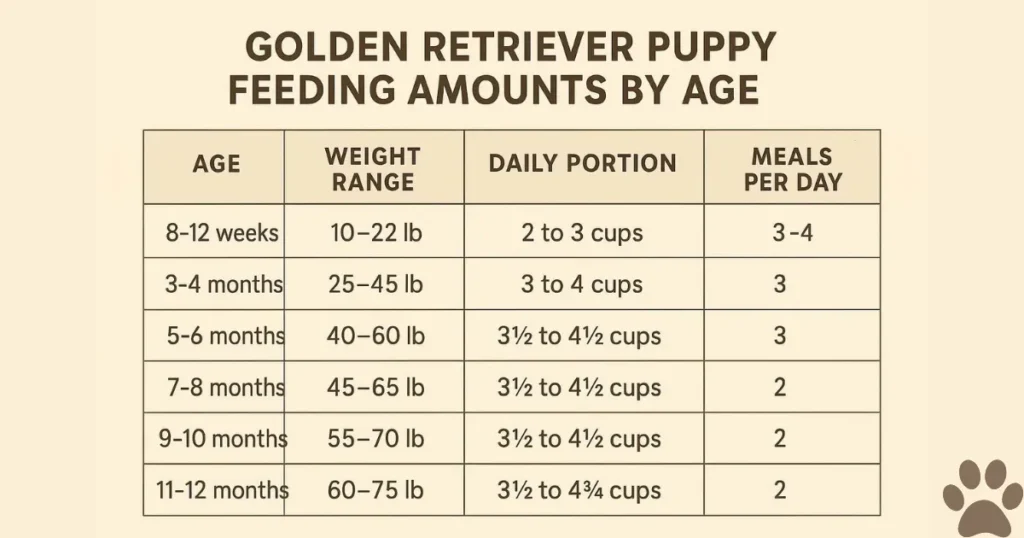
This puppy feeding chart by weight age provides baseline guidance. Individual puppies need 15-25% more or less, depending on metabolism, activity level, and growth rate. Monitor body condition weekly – you should easily feel ribs but not see them prominently.
How Much to Feed a Puppy Chart: Understanding Caloric Needs.
In veterinary nutrition, puppy caloric needs follow specific formulas based on Resting Energy Requirements (RER) multiplied by growth factors:
Puppy RER = 70 × (body weight in kg) ^ 0.75.
Growing Puppy Needs = RER × 2.0 to 3.0 (depending on age and growth rate).
For a 30-pound (13.6 kg) 12-week-old Golden Retriever puppy:
- RER = 70 × (13.6) ^ 0.75 = 70 × 7.1 = 497 calories.
- Growth Factor = 2.5 to 3.0 for the rapid growth phase.
- Total Daily Needs = 497 × 2.5 = 1,243 calories (minimum).
- To 497 × 3.0 = 1,491 calories (maximum).
If puppy food contains 380 kcal/cup:
- Minimum daily = 1,243 ÷ 380 = 3.3 cups.
- Maximum daily = 1,491 ÷ 380 = 3.9 cups.
This calculation explains how much to feed a puppy chart amounts are determined. The range accounts for individual variation – active, lean puppies need amounts toward the higher end, while less active puppies need less.
Critical for Large-Breed Puppies:
Golden Retrievers should NOT be fed maximum growth-promoting amounts. Large-breed puppies fed for maximum growth rate develop more severe orthopedic disease. Target moderate growth – steady weight gain without becoming pudgy.
8 Week to 6 Month Feeding Schedule: Critical Growth Phase.
The first six months represent the most critical period for decisions about how much food to feed a puppy.
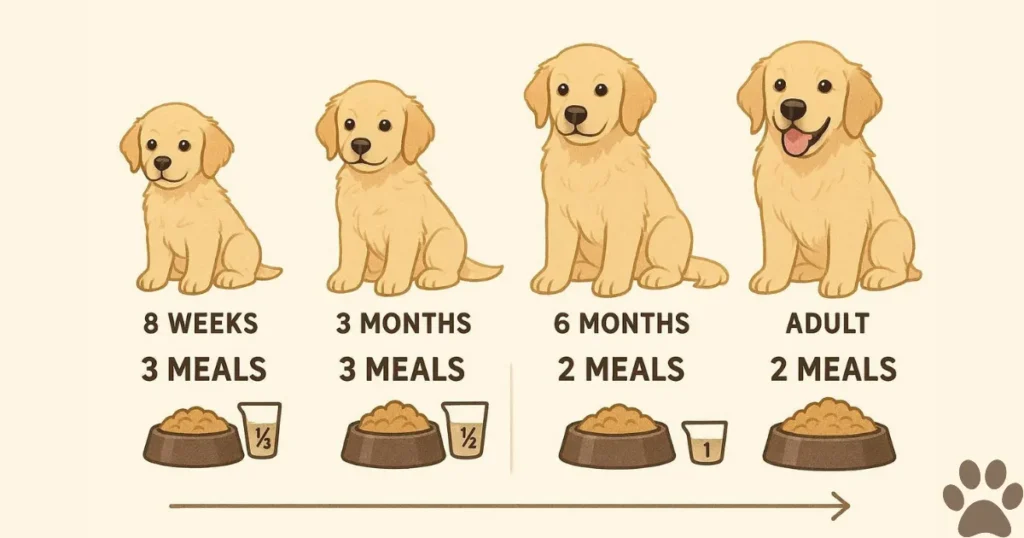
8-12 Weeks: Foundation Phase.
- Frequency: 3 meals daily at 7 AM, 12 PM, 5 PM
- Amount: 1.5-3 cups total daily (0.5-1 cup per meal)
- Focus: Establishing digestive routine, socialization, house-training.
Eight-week-old puppies need small, frequent meals to prevent hypoglycemia. Their small stomachs cannot handle large volumes, and rapid metabolism demands a consistent energy supply. Three meals spaced 5 hours apart support stable blood sugar and predictable elimination for house-training.
12-16 Weeks: Rapid Growth Phase.
- Frequency: 3 meals daily.
- Amount: 2-4 cups total daily (0.7-1.3 cups per meal).
- Focus: Supporting skeletal development, preventing overfeeding.
This phase shows the fastest growth rate – puppies may gain 8-12 pounds monthly. Monitor body condition weekly. Ribs should remain easily palpable. If ribs disappear under fat, reduce portions immediately. Excess weight during this phase causes lifelong joint problems in Golden Retrievers.
16-24 Weeks: Continued Growth.
- Frequency: 3 meals daily (transition to 2 meals around 24 weeks).
- Amount: 3-5 cups total daily (1-1.7 cups per meal if 3 meals, 1.5-2.5 cups if 2 meals).
- Focus: Maintaining lean body condition through adolescence.
Growth rate begins slowing but remains significant. Around 24 weeks (6 months), transition from 3 to 2 daily meals. Make this change gradually over 1-2 weeks to prevent digestive upset.
24-48 Weeks: Adolescence to Maturity.
- Frequency: 2 meals daily.
- Amount: 3-5 cups total daily (1.5-2.5 cups per meal).
- Focus: Completing skeletal growth, transitioning toward adult portions.
Growth rate continues declining. By 12 months, most Golden Retrievers have reached near-adult size, though continued filling out occurs through 18-24 months. Begin transitioning to adult food around 12-15 months.
Definitive Statements on Puppy Nutrition.
In veterinary nutrition, overfeeding large-breed puppies like Golden Retrievers during the growth phase increases severity of hip dysplasia and other developmental orthopedic diseases. A moderate growth rate produces healthier adult dogs than a maximum growth rate.
The answer to how much food to feed a puppy changes every 2-4 weeks during rapid growth phases. Static feeding amounts across puppyhood invariably result in either underfeeding or overfeeding as caloric needs shift dramatically with size and metabolism changes.
Large-breed puppy formulas should contain 22-24% protein and 12-15% fat – lower than small-breed puppy formulas. Excessive protein and calories promote too-rapid growth, stressing developing joints in Golden Retrievers predisposed to orthopedic disease.
How much to feed a puppy chart guidelines serve as starting points requiring individual adjustment based on body condition scoring. Puppies should maintain visible waist definition and easily palpable ribs throughout growth – never pudgy or ribby.
Vet’s Tip: Weigh your Golden Retriever puppy weekly through 6 months, then biweekly through 12 months. Document weight on a growth chart. Sudden acceleration in growth rate (gaining 12+ pounds monthly after 4 months) signals overfeeding, requiring immediate portion reduction.
7 Signs You’re Feeding the Right Amount.
Determining if current portions correctly answer how much food to feed a puppy requires monitoring these indicators:
1. Steady, Moderate Weight Gain.
- Ideal: 5-8 pounds monthly during peak growth (3-6 months).
- Too Fast: 10+ pounds monthly suggests overfeeding.
- Too Slow: <4 pounds monthly may indicate underfeeding.
Plot weight on growth charts. Golden Retriever puppies should follow smooth, consistent curves – not dramatic jumps or plateaus.
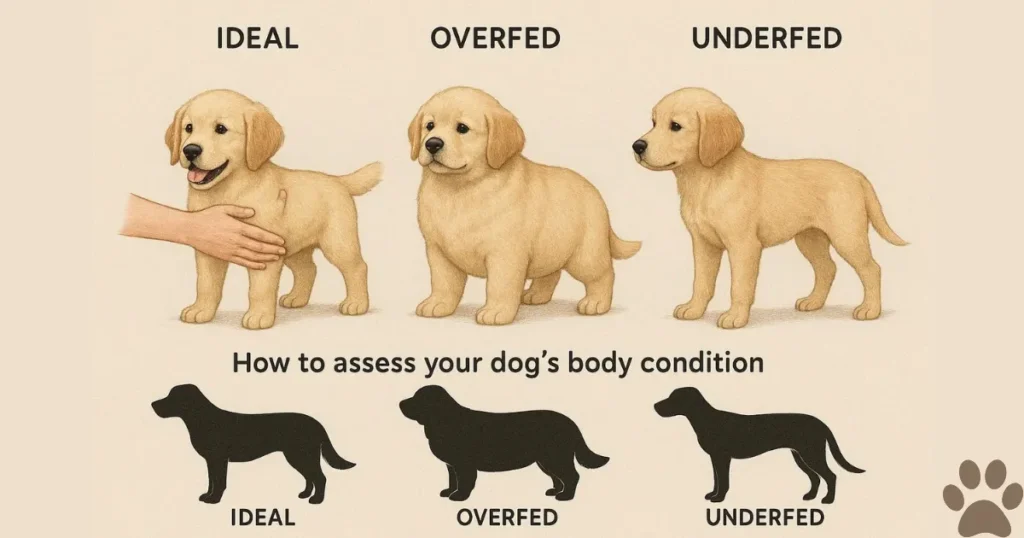
2. Visible Body Condition.
Perfect:
Ribs easily felt with light finger pressure, but not visible. Visible waist when viewed from above. Slight abdominal tuck when viewed from the side.
Overfed:
Ribs are difficult to feel. No waist definition. Round, pudgy appearance. Rolls of fat over the shoulders or hips.
Underfed:
Ribs, spine, and hip bones are prominently visible. Severe waist tuck. Bony appearance.
3. Appropriate Energy Levels.
Healthy:
Energetic and playful but able to settle. Enthusiastic about activities. Good sleep patterns.
Overfed:
Sluggish, reluctant to play. Excessive sleeping. Difficulty with normal puppy activities like climbing stairs.
Underfed:
Hyperactive, unable to settle. Obsessive food seeking. Scavenging behaviors.
4. Firm, Formed Stools.
- Ideal: 3-4 firm, formed stools daily (normal for puppies due to frequent feeding).
- Overfeeding: Very large volume stools. 5+ bowel movements daily. Soft or loose consistency.
- Underfeeding: Small, hard stools. Constipation. Infrequent defecation.
5. Healthy Coat Quality.
Proper Nutrition:
Soft, lustrous puppy coat. Healthy skin without excessive dryness or flaking.
Poor Nutrition:
Dull, brittle coat. Patchy fur. Dry, scaly skin. Excessive shedding beyond normal puppy coat changes.
6. Strong Skeletal Structure.
Healthy:
Straight legs with appropriate angulation. Normal gait without limping. Even weight distribution.
Concerning:
Bowed legs, knuckling over, or other structural abnormalities may indicate nutritional imbalances or excessive growth rate.
7. Meeting Developmental Milestones.
Properly fed Golden Retriever puppies reach predictable developmental milestones – teething, coordination improvement, training progression – on expected timelines. Dramatic deviations warrant nutritional assessment.
Common Feeding Mistakes with Golden Retriever Puppies.
Mistake 1: Free-Feeding.
Leaving food available all day prevents accurate portion monitoring and leads to overeating in food-motivated Golden Retrievers. Measured meals at set times enable precise control.
Mistake 2: Following Small-Breed Puppy Guidelines.
Small-breed and large-breed puppies have different nutritional needs. Golden Retrievers need large-breed-specific formulas with controlled calcium, phosphorus, and calories. Small-breed formulas promote too-rapid growth.
Mistake 3: Not Adjusting for Treat Calories.
Training treats, bully sticks, and chews add substantial calories. Puppies in training classes may receive 100-200 treat calories daily. Subtract an equivalent amount from meals or portions that become excessive.
Mistake 4: Overfeeding “Because They’re Always Hungry”.
Golden Retriever puppies have an enthusiastic appetite regardless of their actual caloric needs. Hunger signals aren’t reliable feeding guides – body condition monitoring determines appropriate amounts.
Mistake 5: Comparing to Other Puppies.
Individual puppies have different growth rates, metabolisms, and activity levels. Your puppy’s portions should be based on their body condition, not what the neighbor’s puppy eats.
Mistake 6: Switching Foods Too Frequently.
While exploring options, excessive food changes disrupt digestion and make monitoring growth patterns impossible. Select quality large-breed puppy food and maintain consistency through the growth phase.
Transitioning from Puppy to Adult Food.
Around 12-15 months, Golden Retrievers transition from puppy to adult food. This process requires careful management:
When to Transition:
- 12 months for dogs at a healthy weight growing appropriately.
- 15 months for larger males still filling out.
- Consult a veterinarian if uncertainty exists.
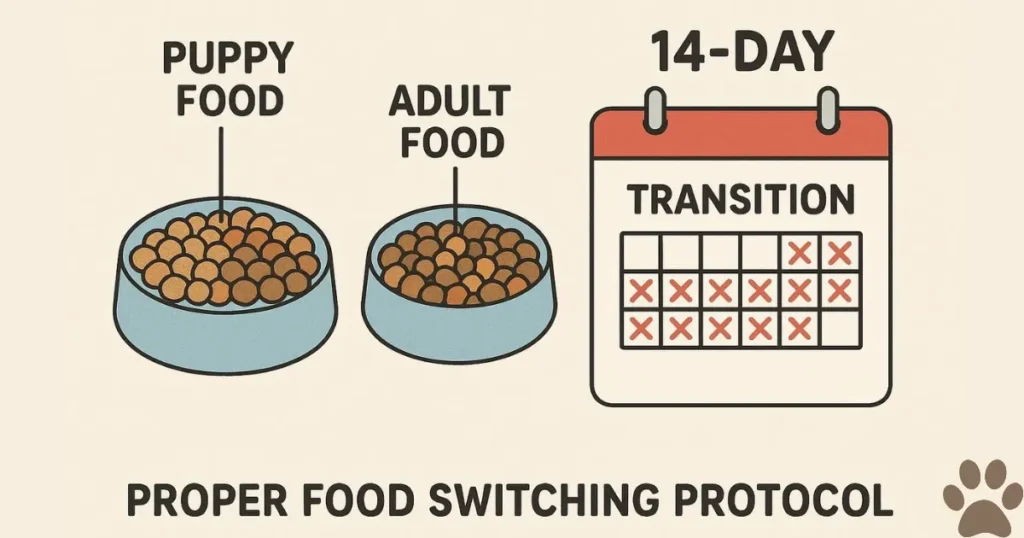
How to Transition: Follow standard 10-14 day gradual transition:
- Days 1-4: 75% puppy food, 25% adult food.
- Days 5-9: 50% puppy food, 50% adult food.
- Days 10-14: 25% puppy food, 75% adult food.
- Day 15+: 100% adult food.
Portion Adjustments: Adult foods typically have higher caloric density than puppy formulas. Recalculate portions based on adult food’s kcal/cup to prevent overfeeding during transition.
Special Considerations for Large-Breed Puppies.
Golden Retrievers, as large-breed puppies, need specific nutritional management.
Calcium and Phosphorus Control:
Excessive calcium accelerates bone growth faster than soft tissue development can support, increasing orthopedic disease risk. Large-breed puppy foods limit calcium to 1.0-1.8% (dry matter basis).
Controlled Energy Density:
Calories should support moderate (not maximum) growth. Target 3,200-4,000 kcal/kg food (dry matter).
Appropriate Protein Levels:
22-24% protein supports growth without excessive calories. Higher protein than needed comes with unnecessary calories, promoting rapid growth.
DHA for Development:
Docosahexaenoic acid (DHA) from fish oil supports brain and vision development. Quality large-breed puppy foods include guaranteed levels of DHA.
Joint-Supporting Nutrients:
Glucosamine and chondroitin supplementation during growth may support joint health in breeds predisposed to dysplasia, though evidence remains mixed.
How much food to feed a puppy at 8 weeks old?
Eight-week-old Golden Retriever puppies need 1.5-2 cups daily, divided into three meals. Use large-breed puppy formula and the puppy feeding chart by weight age as your guide. Adjust based on body condition – ribs should be easily palpable but not visible.
How much to feed a puppy chart: where do I start?
Start with the puppy feeding chart by weight age guideline for your puppy’s current age and weight. Monitor body condition weekly and adjust portions by 10-15% if the puppy appears too thin or too heavy. Reassess every 2-4 weeks.
What is a puppy feeding chart by weight age?
A puppy feeding chart by weight age shows recommended daily food amounts based on the puppy’s current age (in weeks or months) and weight (in pounds). It accounts for changing caloric needs during growth and provides age-appropriate portion guidance.
How often should I feed my Golden Retriever puppy?
Feed three meals daily from 8 weeks through 6 months (ages may vary by individual). Transition to two meals daily around 6 months. Maintain twice-daily feeding through adulthood to reduce bloat risk and support stable blood sugar.
Can I overfeed my Golden Retriever puppy?
Yes, and overfeeding is one of the most damaging nutrition mistakes for large-breed puppies. Excess calories during growth increase hip dysplasia severity and other orthopedic diseases. Keep puppies lean with visible waist definition throughout growth.
Should I feed my puppy based on its current or target adult weight?
Feed based on current weight and appropriate growth rate for that age. Target adult weight is too imprecise – individual puppies grow at different rates. Use body condition scoring to adjust portions based on how your individual puppy is developing.
How much food does a 3-month-old Golden Retriever need?
Three-month-old (12-week) Golden Retrievers typically weigh 20-30 pounds and need 2-3 cups daily, divided into three meals (approximately 0.7-1 cup per meal). Adjust based on your puppy’s body condition and activity level.
When should I reduce puppy food portions?
Reduce portions immediately if ribs become difficult to feel or your puppy develops a pudgy appearance. Continue reductions if weight gain exceeds 8-10 pounds monthly during peak growth (3-6 months). Large-breed puppies should never appear overweight.
My puppy acts hungry all the time – should I feed more?
Golden Retriever puppies are naturally food-motivated and will act hungry even when their actual caloric needs are met. Assess body condition, not hunger signals. If ribs are easily palpable and the puppy has appropriate energy, current portions are likely correct.
How do I transition between puppy food brands?
Follow standard 10-14 day gradual transition, mixing increasing amounts of new food with decreasing amounts of old food. Recalculate portions based on the new food’s caloric density – different formulas require different cup amounts for equivalent calories.
Should I add supplements to puppy food?
Quality large-breed puppy foods are nutritionally complete. Additional calcium or supplements may cause imbalances harmful to developing joints. Only supplement if the veterinarian identifies a specific deficiency. Adding extra nutrients “for good measure” often causes problems.
How long should puppies eat puppy food?
Golden Retrievers should eat large-breed puppy formula until 12-15 months. Males still filling out may benefit from puppy food through 15 months. Transition to adult food once growth plates close and the dog reaches mature size.
Conclusion.
Understanding how much food to feed a puppy requires using a puppy feeding chart by weight age guidelines as starting points, then adjusting for individual body condition and growth patterns. The comprehensive how much to feed a puppy chart shows Golden Retriever amounts change dramatically from 8 weeks (1.5-2 cups daily) through 48 weeks (3-4 cups daily), with peak portions around 24 weeks when growth remains rapid but efficiency improves.
The most critical principle for how much food to feed a puppy decisions is maintaining lean body condition throughout growth. Overfeeding increases hip dysplasia severity and orthopedic diseases – excess weight stresses developing joints and exacerbates genetic predispositions in large-breed puppies. Your Golden Retriever puppy should have easily palpable ribs and visible waist definition from 8 weeks through 12 months – never pudgy or overweight.
Monitor body condition weekly, weigh puppies biweekly through 6 months, and adjust portions every 2-4 weeks as caloric needs shift with size and metabolism. Feed three meals daily through 6 months, then transition to two meals through adulthood. Always use large-breed specific puppy formulas with controlled calcium and appropriate caloric density. Moderate, steady growth produces healthier adult Golden Retrievers than rapid maximum growth, and the investment in precise nutritional management during puppyhood pays dividends through reduced orthopedic disease risk and improved lifelong health.
What Feeding Schedule Works for Your Golden Retriever Puppy?
Real puppy feeding experiences help other owners understand normal variation and set realistic expectations. If you’ve successfully raised a Golden Retriever puppy, your practical insights are invaluable.
Share your puppy feeding experience:
- How much food did your puppy eat at different ages?
- Did you follow the chart guidelines or need to adjust?
- How many meals per day worked best at different stages?
- When did you transition from three to two daily meals?
- Any feeding challenges or tips you learned?
Drop your feeding schedule in the comments or tag us with #GoldenRetrieverInsight and #PuppyFeeding. Your real-world data helps other owners feel confident about their feeding decisions and understand that healthy puppies show natural variation in appetite and growth rates.