The question “how much food should I feed my dog” ranks among the most common I hear from Golden Retriever owners – and for good reason. Proper portion control directly influences your dog’s weight, energy levels, joint health, and longevity. I’ve seen Golden Retrievers suffer from obesity-related health problems because well-intentioned owners followed feeding guidelines that didn’t account for individual factors like activity level, metabolism, or life stage.
Golden Retrievers present unique feeding challenges compared to many breeds. Their enthusiastic appetites, genetic predisposition to obesity, high energy requirements during growth phases, and increased risk of joint disease from excess weight all demand precise nutritional management. What complicates matters is that bag feeding guidelines provide only starting points – actual needs vary dramatically between individual dogs.
Understanding how much dog food should i feed my dog requires calculating based on your Golden Retriever’s current weight, ideal weight, age, activity level, and metabolic efficiency. This guide provides specific formulas for determining daily food amounts, explains how feeding frequency impacts digestion and behavior, identifies signs of overfeeding and underfeeding, and addresses special considerations for puppies, adults, and seniors. Whether you’re feeding a 10-week-old puppy or a 10-year-old senior, these evidence-based guidelines help you provide exactly the right amount for optimal health.
How Much Should My Dog Eat: The Basic Calculation
In veterinary nutrition, daily caloric needs determine how much food should i feed my dog. The formula begins with Resting Energy Requirements (RER):
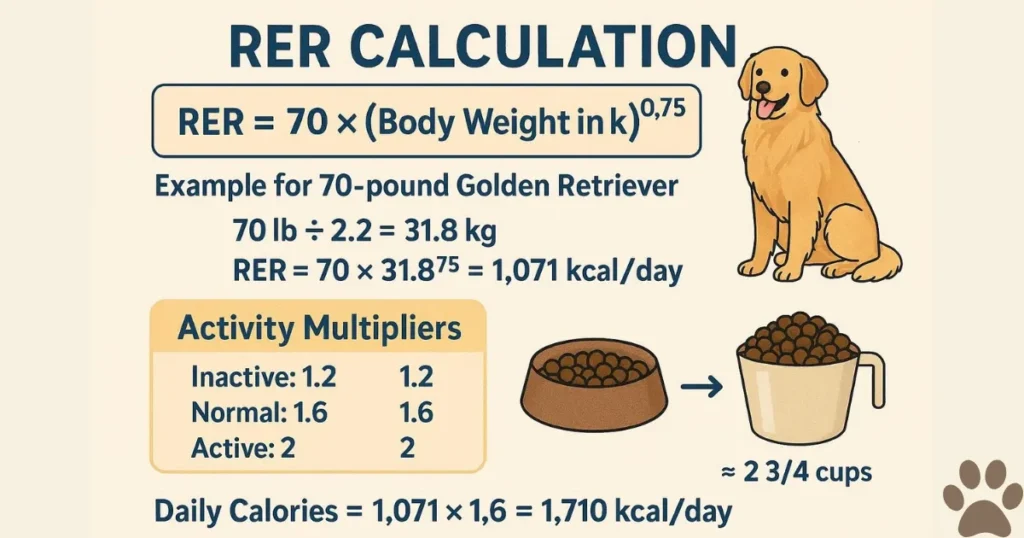
RER = 70 × (body weight in kg) ^ 0.75.
For a 70-pound (32 kg) adult Golden Retriever: RER = 70 × (32 )^ 0.75 = 1,155 calories.
This represents baseline calories. Actual needs depend on activity, requiring multiplication by activity factors:
- Inactive/Senior: RER × 1.2 = 1,386 calories
- Normal Adult: RER × 1.4 = 1,617 calories.
- Active Adult: RER × 1.6 = 1,848 calories.
- Highly Active: RER × 2.0 = 2,310 calories.
Convert to food amount using your formula’s caloric density (kcal/cup on bag):
Daily Cups = Total Daily Calories ÷ Calories per Cup.
Example: Food with 380 kcal/cup, moderately active dog needing 1,617 calories: 1,617 ÷ 380 = 4.25 cups daily.
This calculation provides mathematical precision. Adjust based on body condition – if gaining weight, reduce 10-15%; if losing, and increase the same amount.
Golden Retriever-Specific Feeding Amounts by Life Stage.
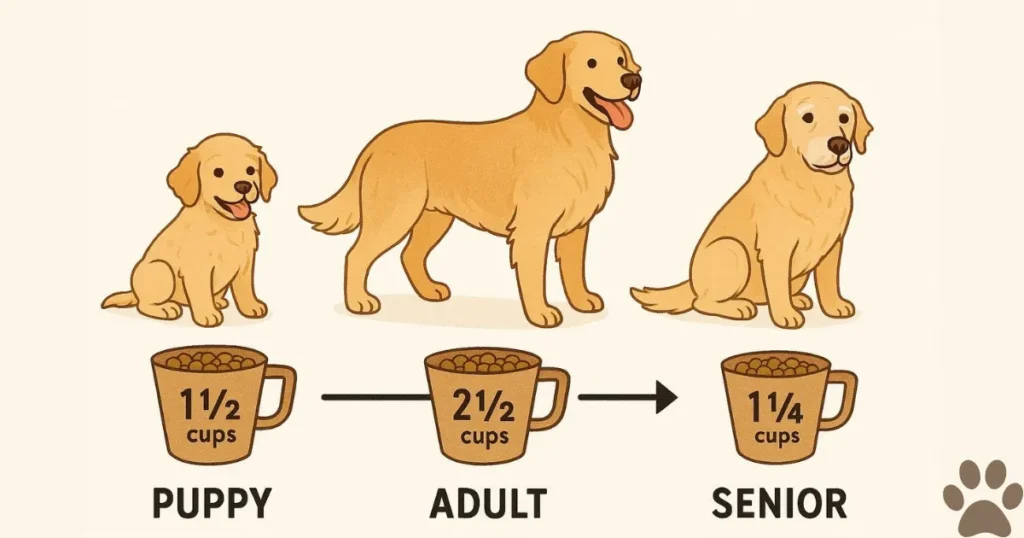
How much food should my dog eat changes dramatically across life stages:
Puppies (8 Weeks to 6 Months).
Puppies require substantially more calories per pound than adults – their rapid growth demands energy for tissue building alongside maintenance needs. For Golden Retriever puppies:
- 8-12 Weeks: 3 times adult RER (approximately 1.5-2 cups per meal, 3 meals daily)
- 3-6 Months: 2.5 times adult RER (approximately 2-2.5 cups per meal, 3 meals daily).
Specific amounts depend heavily on growth rate and individual metabolism. Monitor body condition weekly – you should feel ribs easily but not see them prominently. Puppies should look lean with visible waist definition. Overfeeding during growth increases obesity risk and exacerbates hip dysplasia predisposition in Golden Retrievers.
Adolescents (6-12 Months).
- Daily Amount: 2 times adult RER, divided into 2 meals.
- Typical Range: 4-5 cups total daily for most Golden Retrievers.
Growth rate slows, but energy needs remain elevated. Transition from 3 to 2 meals daily around 6 months. Continue monitoring body condition – adolescent Golden Retrievers should maintain lean physiques to support healthy skeletal development.
Adults (1-7 Years).
- Normal Activity: 3-4 cups daily (split into 2 meals).
- High Activity: 4-5 cups daily (split into 2 meals).
- Low Activity: 2.5-3.5 cups daily (split into 2 meals).
These ranges assume foods with 350-400 kcal/cup. Adjust for your specific formula’s caloric density. Golden Retrievers with desk jobs (couch dogs) need significantly less than working or sporting dogs. Reassess portions every 3-6 months based on body condition.
Seniors (7+ Years).
Daily Amount: RER × 1.2-1.3 (approximately 2.5-3.5 cups daily).
Senior Golden Retrievers have slower metabolisms and reduced activity levels. Many gain weight easily on adult maintenance portions. Switch to senior formulas with lower caloric density and increased joint-supporting nutrients. Monitor weight monthly – even modest gains stress already compromised joints in ageing Golden Retrievers.
How Often Should Dogs Eat: Feeding Frequency Guidelines.
How often should dogs eat impacts digestion, blood sugar, and behavior as significantly as the total amount.
Puppies (8 Weeks to 6 Months): 3 Meals Daily.
Timing: 7 AM, 12 PM, 5 PM (adjust to your schedule but maintain 5-hour intervals).
Frequent meals prevent hypoglycemia in rapidly growing puppies. Small, regular meals support steady energy levels and reduce gastrointestinal stress. Three meals also simplifies house-training – predictable feeding creates predictable elimination.
Adolescents and Adults: 2 Meals Daily.
Timing: Morning and evening, 10-12 hours apart.
Two meals daily represent the optimal frequency for adult Golden Retrievers. Benefits include:
- Reduces bloat risk compared to single large meals.
- Maintains stable blood sugar and energy.
- Supports digestive health through regular meal patterns.
- Facilitates portion control and monitoring.
Some owners feed once daily, but this increases bloat risk in deep-chested breeds like Golden Retrievers. The single large meal also causes dramatic blood sugar fluctuations, affecting energy and behavior.
Seniors: 2 Meals Daily (Smaller Portions).
Maintain twice-daily feeding but reduce total amounts. Some seniors benefit from 3 smaller meals if digestive efficiency declines or medications require food administration multiple times daily.
Vet’s Tip: Feed at consistent times daily. Dogs’ digestive systems optimize around predictable schedules. Variable meal timing can cause digestive upset and anxious food-seeking behaviors in Golden Retrievers.
7 Signs You’re Feeding the Wrong Amount.
Determining if your current portions answer “how much should my dog eat” correctly requires monitoring these indicators:
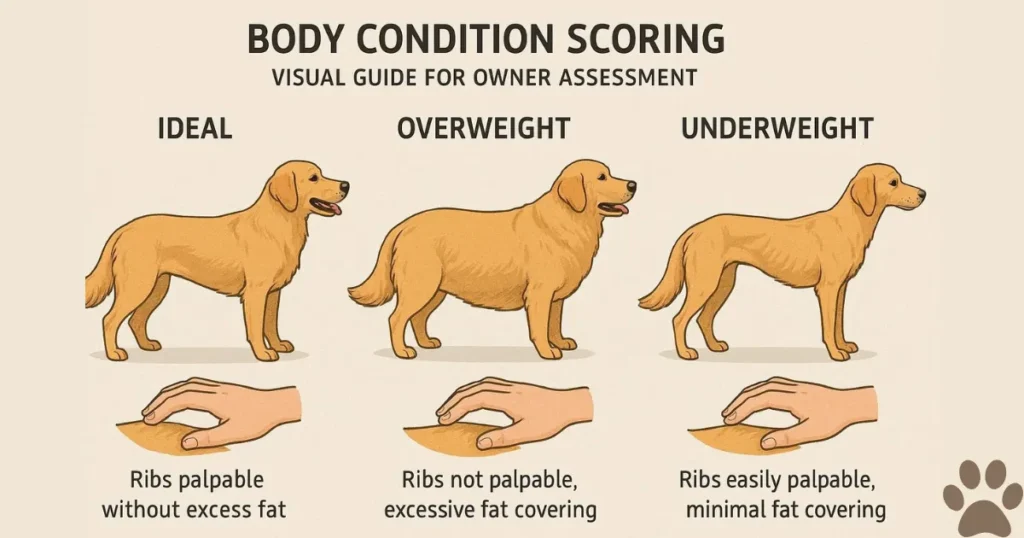
1. Weight Gain or Loss.
Monthly weight checks reveal portion accuracy. Gaining more than 2-5 pounds monthly (depending on age/size) indicates overfeeding. Losing weight suggests underfeeding unless a disease is present. For adult Golden Retrievers, weight should remain stable within a 3-5 pound range.
2. Visible Ribs or Invisible Ribs.
Too Little:
Ribs, spine, and hip bones are prominently visible. Severe waist tuck. Muscle wasting in the back and hips.
Just Right:
Ribs easily felt with light pressure but not visible. Visible waist when viewed from above. Abdominal tuck when viewed from the side.
Too Much:
Ribs are difficult to feel through the fat layer. No waist definition. Abdominal distension or sagging.
Use hands-on assessment weekly – visual assessment alone misses early weight changes under Golden Retrievers’ thick coats.
3. Energy Level Changes.
Overfeeding:
Sluggishness, reluctance to exercise, sleeping excessively. Excess weight creates discomfort during movement.
Underfeeding:
Hyperactivity, food obsession, scavenging behaviors, difficulty settling. Insufficient calories drive constant food-seeking.
Dramatic energy changes warrant portion reassessment and veterinary evaluation to rule out medical causes.
4. Stool Quality and Frequency.
Ideal:
1-2 firm, formed stools daily. Easy to pick up. Minimal odor.
Overfeeding:
Large volume stools, multiple bowel movements daily, soft or loose consistency. Excessive food overwhelms digestive capacity.
Underfeeding:
Small, hard stools. Constipation. Infrequent defecation. Insufficient fiber and bulk.
5. Coat Condition.
Proper Nutrition:
Shiny, lustrous coat with minimal shedding beyond seasonal norms. Healthy skin without dryness or scaling.
Nutritional Issues:
Dull, brittle coat. Excessive shedding. Dry, flaky skin. While multiple factors affect coat quality, inadequate nutrition is common. Both overfeeding (leading to selective eating of favorite pieces, missing nutrients) and underfeeding (insufficient calories for coat maintenance) degrade coat quality.
6. Constant Begging or Food Obsession.
Golden Retrievers are naturally food-motivated, but extreme begging, counter surfing, garbage raiding, or stool eating suggest insufficient portions. Well-fed dogs show interest in food but aren’t consumed by it.
7. Body Condition Score.
Veterinarians use 1-9 body condition scoring:
- 1-3: Underweight (ribs/bones prominent).
- 4-5: Ideal (ribs palpable, visible waist).
- 6-9: Overweight to obese (ribs difficult to feel, no waist).
Golden Retrievers should maintain 4-5/9 throughout life. Scores of 6 or higher require immediate portion reduction. Obesity in Golden Retrievers accelerates joint disease, reduces lifespan by 1-2 years, and increases cancer risk.
Adjusting Portions: When and How to Change Feeding Amounts.
How much food should my dog eat changes throughout life, requiring periodic adjustments.
After Spaying/Neutering.
Metabolic rate decreases 25-30% post-sterilization. Reduce portions by 20-25% immediately after surgery to prevent rapid weight gain. Most Golden Retrievers need about 15-20% less food lifelong after spaying or neutering compared to intact dogs.
Seasonal Activity Changes.
Dogs exercising less in winter may need a 10-15% portion reduction. Summer swimming and hiking increase needs by similar amounts. Adjust gradually over 1-2 weeks to match activity changes.
During Growth Spurts.
Monitor puppies weekly. During rapid growth phases (typically 3-6 months), caloric needs may increase temporarily. If ribs become more prominent despite current portions, increase by 10-15%. Reassess weekly.
Senior Transition.
Begin reducing portions around age 7 as metabolism slows and activity decreases. Senior Golden Retrievers typically need 20-30% fewer calories than adults. Make changes gradually – reduce by 10% and monitor body condition for 4-6 weeks before additional adjustments.
Training and Treat Compensation.
Training treats should comprise no more than 10% of daily calories. If using substantial treats, reduce meal portions by equivalent calories. Many Golden Retriever training programs use 50-100 calories daily in treats – subtract this from regular meals to prevent overfeeding.
Feeding Amount Calculator for Golden Retrievers.
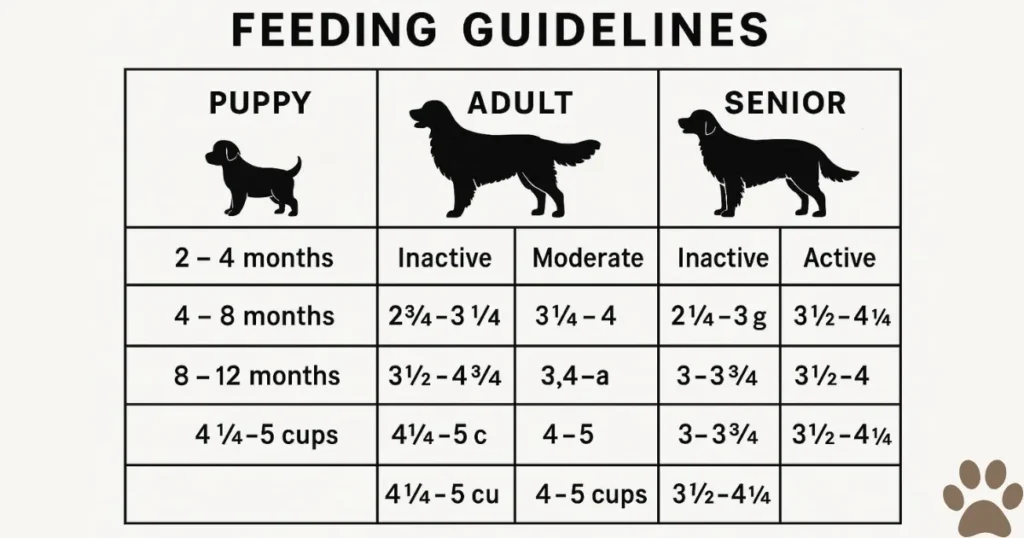
This practical chart answers how much dog food should i feed my dog based on common scenarios:
| Life Stage | Weight | Activity Level | Approximate Daily Amount |
| Puppy 8-12 weeks | 15-20 lbs | Growing | 1.5-2 cups × 3 meals |
| Puppy 3-6 months | 30-45 lbs | Growing | 2-3 cups × 3 meals |
| Puppy 6-12 months | 50-65 lbs | Growing | 2-2.5 cups × 2 meals |
| Adult | 60-75 lbs | Low activity | 2.5-3 cups × 2 meals |
| Adult | 60-75 lbs | Moderate activity | 3-4 cups × 2 meals |
| Adult | 60-75 lbs | High activity | 4-5 cups × 2 meals |
| Senior 7+ years | 60-75 lbs | Low activity | 2.5-3 cups × 2 meals |
Based on foods containing 350-400 kcal/cup. Adjust for your specific formula’s caloric density.
Definitive Statements on Dog Feeding Amounts.
In canine nutrition, individual metabolism varies by 20-30% between dogs of identical breed, age, and activity level. This variation explains why feeding guidelines serve only as starting points requiring adjustment.
Golden Retrievers should be maintained at a body condition score of 4-5 out of 9 throughout life. Excess weight increases the risk of hip dysplasia, cruciate tears, and various cancers while reducing lifespan.
How much food should i feed my dog and how much dog food should i feed my dog cannot be answered with single numbers – they require ongoing body condition assessment, energy monitoring, and stool quality checks with portions adjusted every 3-6 months.
Feeding frequency matters nearly as much as total amount when determining how often should dogs eat. Two meals daily reduces bloat risk in deep-chested Golden Retrievers compared to single daily meals while supporting better blood sugar stability.
6 Common Feeding Mistakes Golden Retriever Owners Make.
1. Following Bag Guidelines without Adjustment.
Bag guidelines assume average activity levels and metabolism. Many Golden Retrievers need 15-30% less than the listed amounts. Start with bag guidelines, but adjust based on body condition within 2-4 weeks.
2. Free-Feeding (Leaving Food Out All Day).
Free-feeding prevents accurate portion control and leads to obesity in food-motivated Golden Retrievers. Measured meals at set times enable monitoring intake and maintaining an ideal weight.
3. Not Accounting for Treats and Snacks.
Training treats, dental chews, bully sticks, and table scraps add substantial calories. A large dental chew may contain 100-150 calories – equivalent to 0.5 cup of dog food. Track all food sources or your calculations for how much dog food should i feed my dog become meaningless.
4. Using Volume Instead of Weight.
Measuring cups vary widely. A “cup” of kibble can range from 3-5 ounces, depending on cup size and how tightly packed. Weighing food on a kitchen scale provides accuracy that volume measurements cannot match.
5. Ignoring Body Condition.
Some owners feed specific amounts indefinitely without reassessing body condition. Monthly hands-on evaluations and weight checks reveal whether current portions remain appropriate or need adjustment.
6. Feeding Puppy Portions to Adults.
Some owners continue puppy feeding amounts after growth completes. Adult Golden Retrievers need 50-60% fewer calories than growing puppies. Failure to reduce portions at maturity guarantees obesity.
Special Considerations for Working Golden Retrievers.
Working or performance dogs have dramatically different needs for how much should my dog eat:
Competition Days:
2.5-3 times the normal portions. High-intensity work requires massive caloric input.
Training Days:
1.5-2 times normal portions on days with 2+ hours vigorous activity.
Rest Days:
Return to maintenance levels. Many handlers maintain high portions year-round, causing off-season obesity.
Working Golden Retrievers may require 2,500-3,500 calories daily versus 1,400-1,800 for companion dogs. This massive difference demonstrates why understanding individual circumstances is critical.
Transitioning Between Foods and Portion Adjustments.
When changing food brands or formulas, portion amounts almost certainly change due to different caloric densities:
- Step 1: Check the new food’s caloric content (kcal/cup on bag).
- Step 2: Calculate daily caloric needs using the formulas provided earlier.
- Step 3: Determine new daily amount: Total Calories ÷ New Food’s Calories per Cup.
- Step 4: Transition gradually over 10-14 days to prevent digestive upset.
Many owners continue feeding the same cup amount when changing foods – but a food with 450 kcal/cup versus 350 kcal/cup delivers 30% more calories at identical volume. This calculation error causes gradual weight gain over months until obesity develops.
How much food should I feed my dog each day?
Daily amount depends on weight, age, and activity level. Adult Golden Retrievers (60-75 lbs) typically need 2.5-4 cups daily, split into two meals, but calculate based on your dog’s specific needs using RER formulas and adjust by body condition.
How much dog food should I feed my dog per meal?
Divide the total daily amount by the number of meals. Adults eating twice daily receive half their daily portion per meal. Puppies eating three times daily receive one-third per meal. For a dog needing 4 cups daily: 2 cups per meal if feeding twice.
How much should my dog eat if she’s overweight?
Reduce current portions by 20-25% and reassess body condition monthly. For gradual weight loss, aim for 1-2% body weight loss per week. A 75-pound dog should lose 0.75-1.5 pounds weekly. Calculate target weight needs and feed accordingly.
How much food should my dog eat after being spayed or neutered?
Reduce portions by 20-25% immediately post-surgery as metabolism drops 25-30%. Monitor body condition closely for 3-6 months as many dogs gain weight rapidly after sterilization without portion reduction.
How often should dogs eat to maintain a healthy weight?
Adult dogs should eat twice daily, 10-12 hours apart. Puppies under 6 months need three daily meals. Two meals daily supports stable blood sugar, reduces bloat risk, and enables better portion control than single daily feeding.
How much should my dog eat during pregnancy or nursing?
Pregnant dogs need 25-50% increased calories in the final trimester. Nursing dogs require 2-4 times the normal amount, depending on litter size. Feed free-choice quality puppy food during lactation – caloric demands exceed normal feeding schedules.
How do I know if my dog is eating the right amount?
Monitor body condition: ribs easily felt but not visible, visible waist from above, abdominal tuck from the side. Stable weight, normal energy, 1-2 firm stools daily, and a healthy coat indicate appropriate portions.
How much food should my dog eat if they are very active?
Highly active Golden Retrievers need 1.6-2 times resting energy requirements – typically 4-5 cups daily or more for working dogs. Calculate using activity multipliers and adjust based on body condition and performance.
Should I feed my dog the same amount every day?
Yes, unless activity or life circumstances change significantly. Consistent portions maintain a stable weight. Adjust only for seasonal activity changes, after spay/neuter, during transitions between life stages, or if body condition changes.
How much should my dog eat: wet food vs dry food?
Wet food contains 70-80% water versus 10% in dry food, so volume amounts differ dramatically. Always calculate based on calories rather than cup measurements. Wet food may require 3-4 times the volume of dry food for equivalent calories.
How much food should my dog eat when switching to senior food?
Calculate based on caloric needs rather than matching previous cup amounts. Senior formulas often have lower caloric density, requiring similar or slightly increased volume despite reduced caloric needs. Use RER × 1.2-1.3 for senior calculations.
How often should dogs eat to prevent bloat in Golden Retrievers?
Feed twice daily rather than once to reduce bloat risk. Avoid exercise immediately before or after meals. Use slow-feed bowls if your dog eats rapidly. Elevated bowls do NOT prevent bloat and may increase risk.
Conclusion.
The question “how much food should I feed my dog?” has no single answer – it requires calculating based on your Golden Retriever’s weight, age, activity level, and metabolism, then adjusting based on body condition monitoring. Bag guidelines provide starting points, but actual needs vary by 20-30% between individual dogs.
How much dog food should I feed my dog changes throughout life. Puppies need 2-3 times the adult amounts for growth. Adults require maintenance levels adjusted for activity – sedentary dogs need 20-30% less than highly active ones. Seniors need 20-30% reductions as metabolism slows.
Understanding how often should dogs eat matters as much as total amount. Two meals daily reduces bloat risk and stabilizes blood sugar better than single daily feeding. Puppies need three meals until they are six months old.
Most importantly, how much should my dog eat and how much food should my dog eat require ongoing assessment – not set-and-forget feeding. Monthly body condition scoring and weight monitoring reveal whether portions maintain ideal condition. Adjust by 10-15% whenever body condition drifts from target 4-5 out of 9, and reassess every 3-6 months. This proactive approach supports your Golden Retriever’s longevity and quality of life.
How Much Do You Feed Your Golden Retriever?
Real-world feeding amounts from actual owners provide a valuable perspective. Every Golden Retriever has unique needs – sharing your experience helps others find their starting point.
Tell us about your feeding routine:
- How much food does your Golden Retriever eat daily?
- How often do you feed (meals per day)?
- Has your dog maintained ideal body condition on this amount?
- Did you need to adjust to the bag guidelines? By how much?
- Any feeding challenges or tips you’ve learned?
Share your feeding approach in the comments or tag us with #GoldenRetrieverInsight and #DogFeeding. Your practical experience helps other owners develop effective feeding strategies and understand the normal range of variation between individual Golden Retrievers.