
When Golden Retriever owners express interest in homemade feeding during clinic visits, my first concern always centers on nutritional completeness – well-intentioned recipes often lack critical nutrients, causing serious health problems over time. After years of experience reviewing homemade diets and treating nutritional deficiencies, I’ve learned that truly nutritionally complete homemade dog food recipes require far more than simply cooking meat, rice, and vegetables together.
Complete nutrition demands understanding AAFCO standards, calculating precise macronutrient ratios, incorporating essential supplements, and balancing vitamins and minerals Golden Retrievers need for optimal health. The difference between “homemade dog food” and nutritionally complete homemade dog food recipes separates recipes that merely fill your dog’s stomach from formulations supporting long-term vitality, preventing deficiencies, and addressing breed-specific health concerns.
This comprehensive veterinary guide provides scientifically formulated, AAFCO-compliant recipes ensuring your Golden Retriever receives every essential nutrient in proper proportions, along with the knowledge to understand why each component matters for your dog’s wellbeing.
Understanding Nutritional Completeness in Homemade Dog Food
Before diving into nutritionally complete homemade dog food recipes, understanding what “complete and balanced” truly means prevents common deficiencies I frequently diagnose.
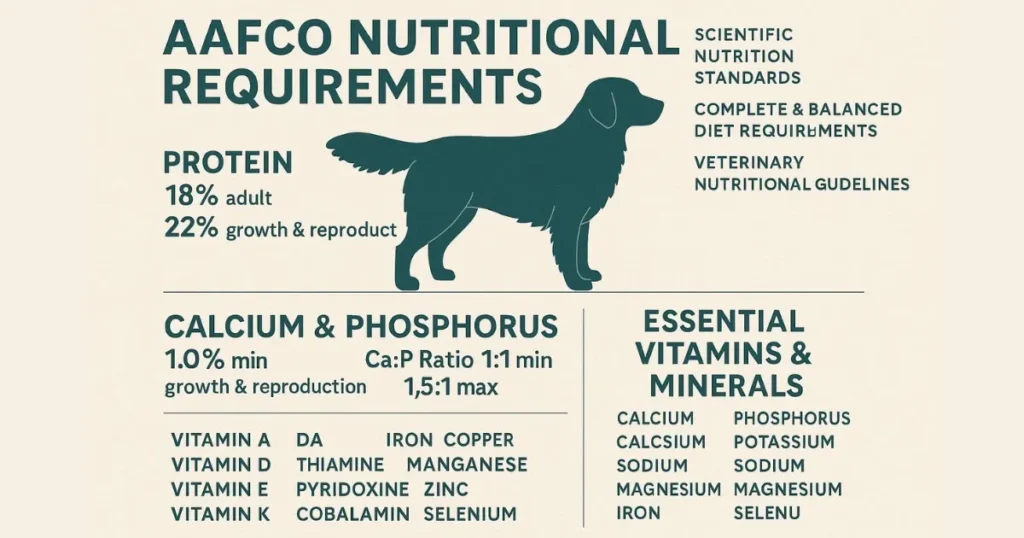
AAFCO Standards: The Foundation of Complete Nutrition
The Association of American Feed Control Officials (AAFCO) establishes minimum nutritional requirements for dog foods. Nutritionally complete homemade dog food recipes must meet these standards:
Essential macronutrients:
- Protein: Minimum 18% for adult maintenance (22% for growth/reproduction).
- Fat: Minimum 5.5% for adults (8.5% for growth).
- Specific amino acids: 10 essential amino acids in adequate amounts.
- Essential fatty acids: Linoleic acid (omega-6) and appropriate omega-3 levels.
Critical minerals (per 1000 kcal):
- Calcium: 1.25-6.25 g (most critical in homemade diets).
- Phosphorus: 1.0-4.0 g.
- Calcium: phosphorus ratio: 1:1 to 2:1.
- Sodium, potassium, magnesium, iron, copper, manganese, zinc, iodine, selenium: All in specific ranges.
Essential vitamins:
- Fat-soluble: A, D, E, and K.
- Water-soluble: B-complex (thiamin, riboflavin, niacin, B6, B12, pantothenic acid, folic acid), choline.
In my clinic, I’ve treated many Golden Retrievers suffering from calcium deficiency, copper deficiency anemia, and thiamin deficiency – all from well-intentioned but incomplete homemade diets.
Common Nutritional Deficiencies in Homemade Diets.
Research findings: Studies analyzing homemade dog food recipes (including those from veterinary textbooks) found that 95% lacked adequate nutritional completeness, with most deficient in multiple essential nutrients.
Most frequent deficiencies:
- Calcium and vitamin D: Causes skeletal abnormalities, fractures, and weakened bones.
- Essential fatty acids: Results in poor coat quality, skin problems, and impaired healing.
- Zinc and copper: Lead to immune dysfunction, anemia, and poor growth.
- Vitamin E: Causes muscle degeneration, immune problems.
- B vitamins (especially thiamin): Results in neurological issues, appetite loss.
- Iodine: Causes thyroid dysfunction, metabolic problems.
Vet’s Tip: Never rely on “meat, rice, and vegetables” alone for long-term feeding. Even the highest-quality whole foods cannot provide nutritionally complete homemade dog food recipes without proper supplementation – its biochemically impossible.
Why Whole Foods Alone Falls Short.
Calcium-phosphorus imbalance:
Meat contains high phosphorus but virtually no calcium (ratio approximately 1:15 -20). Without calcium supplementation, severe skeletal disease develops within months.
Missing micronutrients:
No single whole food provides all vitamins and minerals in adequate amounts. Variety helps, but doesn’t guarantee completeness.
Bioavailability concerns:
Some nutrients in plant sources are less bioavailable to dogs than synthetic supplements (iron, zinc, and certain B vitamins).
The solution:
Nutritionally complete homemade dog food recipes combine quality whole food ingredients with targeted supplementation, ensuring every nutrient reaches adequate levels.
Essential Supplements for Nutritionally Complete Recipes.
Creating nutritionally complete homemade dog food recipes requires specific supplements to bridge gaps that whole foods cannot fill.

Calcium Supplementation: The Critical Foundation.
Why it matters:
Calcium deficiency represents the single most common and serious problem in homemade diets. Without adequate calcium, Golden Retrievers develop:
- Nutritional secondary hyperparathyroidism.
- Pathologic fractures (bones breaking during normal activity).
- Severe skeletal pain and lameness.
- Dental problems.
- Muscle tremors and seizures.
Calcium requirements:
- Adult Golden Retrievers: 50-90 mg calcium per kg body weight daily.
- 70-pound (32 kg) Golden: 1,600-2,880 mg calcium daily.
- Practical target: 1,000-1,800 mg calcium per pound of prepared food.
Best calcium sources:
- Calcium carbonate powder: 40% elemental calcium, inexpensive, widely available.
- Calcium citrate: 21% elemental calcium, better absorbed but more expensive.
- Bone meal powder: Natural source, provides calcium and phosphorus (verify lead-free).
- Eggshell powder: Natural alternative (1/2 teaspoon ground eggshell = | 900mg calcium).
Calculation example: If the recipe yields 10 cups and your Golden eats 7 cups daily:
- Target: 12,000-15,000 mg calcium for entire batch.
- Using calcium carbonate (40% elemental): 30-37.5 grams (approximately 2-2.5 tablespoons).
Comprehensive Multivitamin Supplements.
Pre-formulated veterinary multivitamins ensure micronutrient completeness:
Recommended products:
Balance IT Canine Supplement:
- Specifically designed for homemade dog food.
- Available in different formulations (with/without calcium, various protein levels).
- Provides vitamins, minerals, and essential fatty acids.
- Recipes can be customized through their website.
- Cost: $15-25 per month for a 70-pound Golden.
Rx Vitamins Nutritional Support:
- Comprehensive vitamin/mineral blend.
- Available through veterinarians.
- Provides micronutrients missing from whole foods.
NuVet Plus:
- Contains antioxidants, vitamins, and minerals.
- Immune system support.
- Cost: $40-50 per month.
DIY multivitamin approach (if using individual supplements):
- Vitamin E: 100-400 IU daily.
- B-complex: Full spectrum B vitamins.
- Vitamin D: 10 IU per kg body weight daily.
- Zinc: 15-20 mg per 1000 kcal.
- Copper: 1.5-2 mg per 1000 kcal.
- Iodine: Iodized salt (1/4 teaspoon per 10 pounds of food provides iodine).
Essential Fatty Acid Supplementation.
Omega-3 fatty acids (EPA/DHA):
- Support joint health, reduce inflammation, and promote heart and cognitive function.
- Fish oil: 1,000 mg combined EPA/DHA per 30 pounds body weight.
- Wild-caught salmon, sardine, or anchovy oil preferred.
- Refrigerate to prevent rancidity.
Omega-6 fatty acids:
- Usually adequate from meat and certain oils.
- Linoleic acid is essential for skin and coat health.
Vitamin E supplementation with fish oil:
- Fish oil oxidizes vitamin E.
- Add an extra 100 IU of vitamin E when using fish oil.
Trace Minerals and Additional Considerations.
Iodine:
- Often deficient in homemade diets.
- Use iodized salt (1/4 teaspoon per 10 pounds of prepared food).
- Critical for thyroid function.
Taurine:
- While dogs can synthesize taurine, supplementation is beneficial for Golden Retrievers.
- 500-1,000 mg daily supports cardiac health.
- Particularly important in diets low in organ meats.
Chondroitin and glucosamine:
- Not required for AAFCO completeness, but valuable for Golden Retrievers prone to joint disease.
- 1,500 mg glucosamine + 750 mg chondroitin daily for a 70-pound Golden.
Proven Nutritionally Complete Homemade Dog Food Recipes.
These veterinary-formulated recipes meet AAFCO standards and provide complete nutrition for adult Golden Retrievers.

Complete Chicken and Brown Rice Formula.
Ingredients:
- 2.5 pounds boneless, skinless chicken thighs (or combination breast/thighs).
- 2.5 cups cooked brown rice.
- 1.5 cups cooked sweet potato, diced.
- 1 cup steamed carrots, diced.
- 1 cup steamed green beans.
- 4 ounces chicken liver (critical for vitamin A, iron, copper).
- 3 tablespoons fish oil.
- 2.5 tablespoons calcium carbonate powder (10,000 mg elemental calcium).
- 1/4 teaspoon iodized salt.
- Balance IT Canine Supplement OR comprehensive multivitamin.
- 400 IU vitamin E.
Preparation:
- Cook chicken thoroughly to 165 ° F internal temperature.
- Cook chicken liver until no longer pink (don’t overcook – nutrients degrade).
- Dice chicken and liver into appropriate bite-sized pieces.
- Cook brown rice according to package directions.
- Steam vegetables until tender but not mushy.
- Bake sweet potato until soft, dice into chunks.
- Combine all ingredients in a large mixing bowl.
- Add fish oil, calcium powder, salt, and vitamin E.
- Mix thoroughly, ensuring even distribution.
- Add a multivitamin supplement per product directions.
- Cool completely before serving.
- Portion into meal-sized containers.
Yield:
- Approximately 10-11 cups (feeds a 70-pound Golden Retriever 4-5 days).
Nutritional analysis (approximate per 1000 kcal):
- Protein: 28%.
- Fat: 15%.
- Calcium: 2,500 mg.
- Phosphorus: 1,800 mg.
- Ca:P ratio: 1.4:1.
- Complete vitamin and mineral profile when supplemented as directed.
Why this is nutritionally complete:
- Adequate protein from chicken (complete amino acid profile).
- Liver provides vitamin A, iron, copper, and B vitamins.
- Calcium carbonate corrects the meat’s calcium deficiency.
- Fish oil supplies omega-3 fatty acids.
- Multivitamin fills remaining micronutrient gaps.
- Iodized salt provides essential iodine.
- Vitamin E protects against oxidation.
Complete Beef and Oatmeal Recipe.
Ingredients:
- 2 pounds lean ground beef (90% lean).
- 3 cups cooked oatmeal.
- 2 cups cooked butternut squash, mashed.
- 1 cup steamed broccoli, finely chopped.
- 0.5 cup steamed spinach, chopped.
- 4 ounces beef liver or heart.
- 3 tablespoons fish oil.
- 2.5 tablespoons calcium carbonate powder.
- 1/4 teaspoon iodized salt.
- Balance IT supplement or multivitamin.
- 400 IU vitamin E.
- Optional: 1 teaspoon kelp powder (additional iodine, trace minerals).
Preparation follows a similar method:
- Cook all ingredients thoroughly, combine, add supplements, mix well, and portion.
Nutritional advantages:
- Beef provides higher iron than chicken.
- Beef liver is extremely nutrient-dense (vitamin A, B12, folate, iron, copper).
- Oatmeal offers soluble fiber for digestive health.
- Butternut squash is rich in beta-carotene.
- Complete AAFCO profile when properly supplemented.
Ideal for:
- Golden Retrievers need higher iron (anemia recovery).
- Dogs with chicken sensitivities.
- Adding dietary variety through protein rotation.
Complete Turkey and Quinoa Formula.
Ingredients:
- 2.25 pounds ground turkey (93% lean).
- 2 cups cooked quinoa.
- 1.5 cups cooked sweet potato.
- 1 cup steamed green beans.
- 0.75 cup steamed carrots.
- 0.5 cup blueberries (antioxidants).
- 4 ounces turkey or chicken liver.
- 3 tablespoons fish oil.
- 2.5 tablespoons calcium carbonate powder.
- 1/4 teaspoon iodized salt.
- Comprehensive multivitamin.
- 400 IU vitamin E.
Special benefits:
- Quinoa provides complete plant protein with all essential amino acids.
- Lower fat is appropriate for weight management.
- Blueberries offer antioxidants that potentially reduce cancer risk.
- Turkey’s high selenium content provides additional antioxidant protection.
Yield:
- Approximately 10-11 cups.
This represents one of the most nutritionally complete homemade dog food recipes for Golden Retrievers, managing weight while maintaining muscle mass.
Complete Fish and Sweet Potato Recipe.
Ingredients:
- 1.75 pounds fresh salmon or whitefish (deboned).
- 2.5 cups cooked white rice.
- 2 cups cooked sweet potato, mashed.
- 1 cup steamed zucchini.
- 0.5 cup steamed spinach.
- 1 whole egg with shell (ground into powder for calcium).
- 2 tablespoons additional fish oil (beyond fish in recipe).
- 2 tablespoons calcium carbonate powder (adjust if using eggshell).
- 1/4 teaspoon iodized salt.
- Multivitamin supplement.
- 400 IU vitamin E.
Fish-based advantages:
- Extremely high omega-3 content (beyond supplemental fish oil).
- Beneficial for Golden Retrievers with joint disease.
- Alternative protein for dogs with poultry/beef sensitivities.
- Rich in selenium, vitamin D, and B vitamins.
Considerations:
- More expensive than chicken/turkey recipes.
- Some dogs with true fish allergies cannot use this formula.
- Store carefully – fish spoils faster than meat.
Complete Rotational Variety Recipe System.
Concept:
Rotating between nutritionally complete homemade dog food recipes provides nutritional diversity while preventing food boredom.
4-week rotation example:
- Weeks 1-2: Chicken and brown rice complete formula.
- Week 3: Beef and oatmeal complete formula.
- Week 4: Turkey and quinoa complete formula.
- Return to Week 1.
Rotation benefits:
- Broader amino acid profiles from different proteins.
- Varied micronutrient sources.
- Reduced risk of developing protein sensitivities.
- Maintains meal interest.
- Nutritional “insurance” if one recipe has minor inadequacy.
Rotation guidelines:
- Each recipe must be individually complete (don’t rely on rotation to balance inadequate recipes).
- Transition between recipes over 2-3 days to prevent digestive upset.
- Monitor stool quality with each new protein.
- Maintain consistent supplementation across all recipes.
Calculating Portions for Nutritionally Complete Recipes.
Even nutritionally complete homemade dog food recipes cause problems if incorrectly portioned.
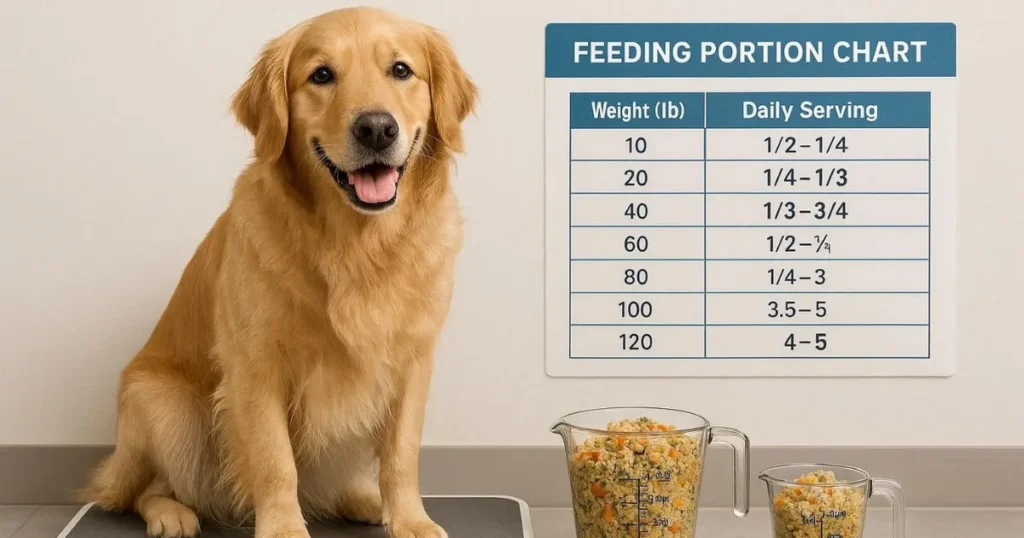
Determining Daily Caloric Needs.
Basic calculation:
- Resting Energy Requirement (RER) = 70 × (body weight in kg) ^ 0.75.
Activity multipliers:
- Neutered adult: RER × 1.6.
- Intact adult: RER × 1.8.
- Active/working: RER × 2.0-2.5.
- Senior (7+ years): RER × 1.2-1.4.
- Weight loss: RER × 1.0-1.2.
- Weight gain: RER × 1.7-2.0.
Example: 70-pound (32 kg) neutered adult Golden:
- RER = 70 × (32) ^ 0.75 = 1,093 kcal.
- Daily needs = 1,093 × 1.6 = 1,749 kcal.
Portion Size Chart.
| Dog Weight | Activity Level | Daily Calories | Cups of Complete Recipe* |
| 55-65 lbs | Moderate | 1,400-1,650 | 5-6 cups |
| 65-75 lbs | Moderate | 1,650-1,900 | 6-6.5 cups |
| 75-85 lbs | Moderate | 1,900-2,150 | 6.5-7.5 cups |
| 55-65 lbs | Active | 1,700-2,000 | 6-7 cups |
| 65-75 lbs | Active | 2,000-2,300 | 7-8 cups |
| 75-85 lbs | Active | 2,300-2,600 | 8-9 cups |
* Based on approximately 280-300 calories per cup of prepared complete recipe.
Feeding schedule:
- Divide daily portions into 2 meals for adult Golden Retrievers.
- Helps prevent bloat (gastric dilatation-volvulus).
- Maintains stable energy levels throughout the day.
- Example: 7 cups daily = 3.5 cups twice daily.
Monitoring and Adjusting Portions.
Body Condition Score (BCS) system (1-9 scale):
- 1-3: Underweight (ribs, spine, hip bones prominently visible).
- 4-5: Ideal (ribs easily palpable, visible waist, tucked abdomen).
- 6-7: Overweight (ribs difficult to feel, no waist, abdominal sagging).
- 8-9: Obese (massive fat deposits, no palpable ribs, severe abdominal distension).
Adjustment guidelines:
- If BCS drops below 4, increase portions by 10-15%.
- If BCS rising above 5: Decrease portions by 10-15%.
- Weigh weekly initially, then monthly once stable.
- Reassess caloric needs every 6 months or with life changes.
Professional Formulation Resources.
While the nutritionally complete homemade dog food recipes provided meet AAFCO standards, professional consultation ensures optimal customization.
Board-Certified Veterinary Nutritionists.
American College of Veterinary Nutrition (ACVN):
- Directory available at acvn.org.
- Specialists trained specifically in clinical nutrition.
- Can create fully customized recipes for individual Golden Retrievers.
- Particularly valuable for dogs with health conditions requiring therapeutic diets.
- Cost: $200-400 for initial consultation and recipe formulation.
When to consult a nutritionist:
- Puppies or growing dogs (precise calcium control essential).
- Golden Retrievers with kidney disease, liver disease, and heart disease.
- Food allergies requiring limited-ingredient formulations.
- History of nutritional deficiencies.
- Desire for completely customized, laboratory-analyzed recipes.
Balance IT Recipe Formulation Service.
Website: balanceit.com.
How it works:
- Select protein sources, carbohydrates, and vegetables you want to use.
- Website generates recipes meeting AAFCO standards.
- Purchase their proprietary supplement blend formulated for your specific recipe.
- Follow the recipe exactly using their supplement.
Advantages:
- Takes the guesswork out of supplementation.
- Recipes computer-analyzed for completeness.
- Supplement specifically formulated for your chosen ingredients.
- Professional backing and support.
Cost:
- Recipe formulation: Free online.
- Supplement: $20-30 per month for a 70-pound Golden Retriever.
UC Davis Veterinary Medical Teaching Hospital.
Services:
- Provides formulation services through their Clinical Nutrition Service.
- Can analyze existing recipes for nutritional adequacy.
- Offers consultations for complex cases.
Contact:
- Through the UC Davis School of Veterinary Medicine website.
Common Mistakes Compromising Nutritional Completeness.
Understanding errors helps ensure your recipes remain truly complete.
Critical Mistakes to Avoid.
Assuming whole foods provide complete nutrition:
- No combination of meat, grains, and vegetables provides adequate calcium.
- Multiple micronutrients are missing from whole food-only recipes.
- Long-term feeding causes severe deficiencies.
Using human multivitamins:
- Formulated for human needs, not canine requirements.
- Often contain iron levels too high for dogs.
- Missing key canine nutrients (proper calcium levels, choline, etc).
Inconsistent supplementation:
- Skipping supplements to “save money”.
- Forgetting to add calcium to batches.
- Irregularly including supplements.
Recipe modification without recalculating:
- Changing protein amounts affects calcium needs.
- Substituting ingredients alters the nutritional profile.
- Adding extra vegetables dilutes nutrient density.
Over-reliance on single recipes:
- Even complete recipes benefit from occasional rotation.
- Provides nutritional insurance.
- Prevents potential long-term imbalances.
Feeding growing puppies adult recipes:
- Puppies require different calcium: phosphorus ratios.
- Higher protein and calorie needs.
- Growth-related mistakes cause permanent skeletal damage in large breeds.
Long-Term Health Monitoring.
Regular assessment ensures nutritionally complete homemade dog food recipes maintain your Golden’s health.

Recommended Veterinary Monitoring Schedule.
Initial bloodwork (before starting homemade diet):
- Complete blood count (CBC).
- Comprehensive metabolic panel.
- Calcium and phosphorus levels.
- Establishes baseline for comparison.
3-month recheck:
- Repeat bloodwork.
- Verify nutritional adequacy.
- Adjust recipes if needed.
- Assess body condition.
6-month monitoring:
- Complete blood panel.
- Urinalysis.
- Body condition evaluation.
- Coat and skin assessment.
Annual monitoring:
- Comprehensive wellness exam.
- Full bloodwork.
- Cardiac evaluation (Golden Retrievers are prone to heart disease).
- Joint assessment.
- Nutritional review.
Key Health Indicators.
Optimal markers:
- Stable, ideal body weight and condition.
- Shiny, full coat without excessive shedding.
- Healthy skin (no dryness, flaking, or irritation).
- Firm, well-formed stools.
- Strong teeth with minimal tartar.
- Clear, bright eyes.
- Consistent energy appropriate for age.
- Good muscle tone and condition.
Warning signs requiring veterinary attention:
- Unexplained weight loss or gain.
- Coat quality deterioration.
- Skeletal pain or lameness.
- Changes in stool quality.
- Decreased appetite.
- Lethargy or behavior changes.
- Increased thirst/urination.
What makes nutritionally complete homemade dog food recipes different from regular homemade dog food?
Nutritionally complete homemade dog food recipes meet all AAFCO standards for essential nutrients through proper supplementation. Regular homemade food typically lacks adequate calcium, vitamins D and E, zinc, copper, and B-vitamins. Complete recipes include calcium supplements (1,000-1,800 mg per pound of food), comprehensive multivitamins, fish oil, and iodized salt, ensuring every required nutrient reaches adequate levels.
Can I create nutritionally complete homemade dog food recipes without supplements?
No, it’s biochemically impossible to create nutritionally complete homemade dog food recipes using only whole foods. Meat contains virtually no calcium while being high in phosphorus, creating dangerous imbalances. Multiple essential vitamins and minerals cannot be provided in adequate amounts through food alone. Proper supplementation is non-negotiable for complete nutrition meeting AAFCO standards.
How much do supplements cost for nutritionally complete recipes?
Essential supplements for nutritionally complete homemade dog food recipes cost approximately $25-40 monthly for a 70-pound Golden Retriever. This includes calcium carbonate ($ 5-8), a comprehensive multivitamin ($ 15-25), fish oil ($ 8-12), and vitamin E ($ 3-5). Balance IT custom supplement service costs $20-30 monthly and simplifies supplementation with formula-specific blends.
Are nutritionally complete homemade dog food recipes better than commercial dog food?
Both can be excellent when properly formulated. Nutritionally complete homemade dog food recipes offer ingredient control, customization for health conditions, and fresh whole foods. Quality commercial foods provide convenience, consistent nutrition, and extensive feeding trial data. The best choice depends on your commitment, time availability, and Golden’s individual needs. Both must meet AAFCO standards.
Can puppies eat nutritionally complete homemade dog food recipes for adults?
No, puppies require different formulations. Growing Golden Retrievers need precisely controlled calcium: phosphorus ratios (1:1 to 1.8:1), higher protein (22-28%), and specific calorie density preventing developmental orthopedic disease. Adult nutritionally complete homemade dog food recipes don’t meet puppy requirements. Always consult a board-certified veterinary nutritionist for puppy recipe formulation, preventing permanent skeletal damage.
How do I know if my nutritionally complete homemade dog food recipes are working?
Monitor body condition (ideal BCS 4-5/9), coat quality (shiny, full), energy levels (appropriate for age), stool quality (well-formed), and overall health. Schedule veterinary bloodwork at 3 months, 6 months, and annually, checking calcium, phosphorus, complete blood count, and metabolic panel. Stable weight, excellent coat, and normal bloodwork confirm nutritional adequacy.
What’s the most common mistake with nutritionally complete homemade dog food recipes?
The most critical error is inconsistent or inadequate calcium supplementation. Meat-based diets without proper calcium cause nutritional secondary hyperparathyroidism, leading to pathologic fractures, severe skeletal pain, and irreversible bone damage. Always add 1,000-1,800 mg calcium per pound of prepared food. Other common mistakes include skipping multivitamins, using human supplements, and modifying recipes without recalculating nutritional profiles.
Should I rotate between different nutritionally complete homemade dog food recipes?
Yes, rotation provides nutritional diversity and “insurance” against potential minor inadequacies. Alternate between 2-4 different protein sources (chicken, beef, turkey, and fish) on 2-4 week cycles. Each individual recipe must be complete – don’t rely on rotation to balance inadequate formulations. Rotation offers broader amino acid profiles, varied micronutrient sources, and prevents protein sensitivities from constant exposure to single sources.
Conclusion.
After years of experience formulating diets and treating nutritional deficiencies in Golden Retrievers, I cannot emphasize enough that truly nutritionally complete homemade dog food recipes require far more than good intentions and quality ingredients. The recipes provided in this guide represent scientifically sound, AAFCO-compliant formulations incorporating essential supplementation that whole foods alone cannot provide – meeting every nutritional requirement your Golden Retriever needs for optimal health, longevity, and vitality.
Successfully feeding nutritionally complete homemade dog food recipes demands understanding that “complete” means more than protein, carbohydrates, and vegetables – it requires precise calcium supplementation, comprehensive multivitamins, essential fatty acids, trace minerals, and appropriate proportions maintaining biochemical balance. Whether you choose chicken, beef, turkey, or fish as your primary protein, the completeness comes not from the base ingredients but from proper supplementation, ensuring every AAFCO-required nutrient reaches adequate levels.
Remember that convenience and good intentions cannot replace nutritional science. The difference between incomplete homemade food and nutritionally complete homemade dog food recipes literally determines whether your Golden Retriever thrives or develops preventable deficiencies, causing serious health consequences. Regular veterinary monitoring, consistent supplementation, appropriate portioning, and occasional recipe rotation ensure your homemade feeding approach supports rather than compromises your beloved companion’s wellbeing.
Your Golden Retriever’s health depends on receiving complete, balanced nutrition every single day. By committing to these scientifically formulated recipes, maintaining proper supplementation, and partnering with your veterinarian through regular monitoring, you’re providing the foundation for a long, healthy, vibrant life. The extra effort required to ensure true nutritional completeness reflects the depth of care and commitment that defines exceptional Golden Retriever ownership.
Share Your Nutritionally Complete Recipe Success! Are you feeding nutritionally complete homemade dog food recipes to your Golden Retriever? We’d love to hear about your experience! What recipes are you using? Have you worked with a veterinary nutritionist for custom formulations? What improvements have you noticed in your Golden’s health, coat quality, energy levels, and overall wellness since transitioning to complete homemade nutrition?