
Throughout my years of experience treating Golden Retrievers, I’ve learned that understanding dog food ingredients represents one of the most powerful tools owners have for making informed nutritional decisions. The ingredient list tells you exactly what you’re feeding your Golden, yet most owners find these labels confusing, misleading, or overwhelming. Knowing how to evaluate the best diet dog food requires decoding ingredient lists, understanding what various components contribute nutritionally, and recognizing which ingredients benefit versus harm your dog’s health.
In my clinic, I regularly counsel owners who’ve selected food based on marketing claims rather than actual dog food ingredients, only to discover their Golden isn’t thriving despite premium pricing. I’ve also treated dogs with food sensitivities where ingredient analysis revealed problematic components owners didn’t recognize on labels.
Today, I’ll share comprehensive veterinary guidance on dog food ingredient analysis for Golden Retrievers (and Goldendoodle food for owners of these popular Golden Retriever crosses), including how to read labels, identify quality ingredients, spot red flags, and select the best diet dog food based on ingredient quality rather than advertising promises.
Understanding Dog Food Label Regulations
Before analyzing dog food ingredients, I explain how labels are regulated and what information they must – and don’t have to – provide to consumers.
AAFCO and Label Requirements
The Association of American Feed Control Officials (AAFCO) establishes pet food labeling standards, ensuring consistency and basic transparency. Understanding these regulations helps decode dog food ingredients accurately.
Ingredient listing requirements:
- Descending order by weight: Ingredients listed from highest to lowest amount pre-cooking
- Generic terms allowed: “Meat by-products,” “animal fat” permitted without species specification
- Weight includes moisture: Fresh meat weighs more due to water content, affecting list position
- No quantity disclosure: Labels show order but not actual percentages of each ingredient
- Minimum/maximum guarantees: Crude protein, fat, fiber, moisture percentages listed separately
Reading between the Lines
Dog food ingredients lists require interpretation and understanding of industry practices:
“Chicken” vs “Chicken Meal”:
Fresh chicken contains 70% water, so 10 lbs of fresh chicken yields 3 lbs of dried protein. Chicken meal is already dehydrated, providing concentrated protein. Both have value but represent different actual protein amounts.
Splitting ingredients:
Manufacturers sometimes list grain components separately (ground corn, corn gluten meal, corn bran), making each appear lower on the list, though combined corn might exceed the meat content.
“Natural flavors”:
Vague term meaning any flavoring from plant or animal sources – could be high-quality or minimal-value depending on manufacturer standards.
“By-products”:
Technically includes nutrient-dense organ meats (liver, kidney) but also lower-value parts like feet, beaks – quality varies dramatically by manufacturer.
Vet’s Tip: Focus on the first 5-7 ingredients comprising 80-90% of the food by weight. A food listing great ingredients in positions 15-20 provides minimal amounts of those components. The best diet dog food features quality proteins and whole foods in top positions.
Essential Dog Food Ingredients for Golden Retrievers
Understanding which dog food ingredients matter most for Golden Retriever health helps prioritize what to look for when selecting the best diet dog food.
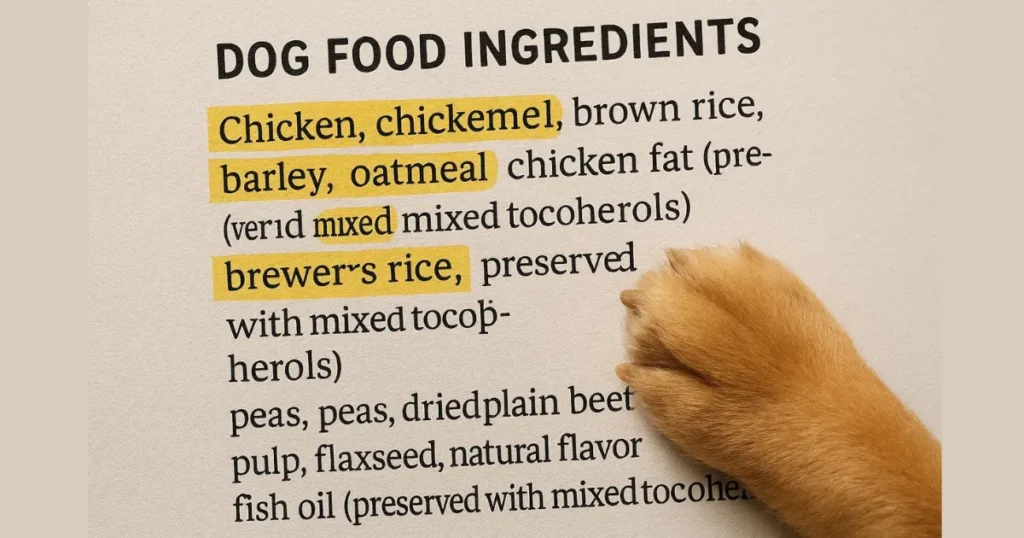
Protein Sources: The Foundation
Named animal proteins should dominate early ingredient positions:
Whole meats (chicken, beef, turkey, and lamb, salmon):
Provide complete amino acid profiles with high digestibility. Contain 70% moisture, so the actual protein content is | 30% of the listed weight.
Meat meals (chicken meal, beef meal, salmon meal):
Dehydrated meat with moisture removed, providing concentrated protein (| 65% protein). Actually provides more protein per pound than fresh meat despite sounding less appealing.
Fish (salmon, whitefish, herring):
Excellent protein plus omega-3 fatty acids (EPA/DHA) supporting Golden Retriever joint, skin, brain, and cardiac health.
Eggs:
Complete protein with perfect amino acid balance and high digestibility – an exceptional ingredient when listed.
Avoid:
Generic terms like “meat meal,” “poultry meal,” and “animal fat” lack species specification, indicating lower quality control standards.
Carbohydrate Sources: Energy and Fiber
Quality carbohydrates in dog food ingredients provide digestible energy, fiber, vitamins, and minerals:
Whole grains (brown rice, oatmeal, barley):
Digestible complex carbohydrates, fiber, B vitamins. Despite grain-free trends, whole grains offer nutritional benefits for most dogs.
Starchy vegetables (sweet potatoes, potatoes, peas):
Digestible carbohydrates, vitamins, antioxidants. Often used in grain-free formulas.
Avoid:
Corn gluten meal, wheat middlings, soy hulls, rice bran – these are low-quality by-products from human food processing, providing minimal nutrition.
Fat Sources: Essential Fatty Acids
Fats in dog food ingredients provide concentrated energy and essential fatty acids:
Named fat sources (chicken fat, salmon oil, flaxseed oil):
Species-specific fats with known fatty acid profiles and quality standards.
Fish oil:
Provides omega-3 fatty acids (EPA/DHA) with anti-inflammatory benefits critical for Golden Retrievers prone to joint issues, allergies, and skin problems.
Avoid:
Generic “animal fat,” “poultry fat” lacking species specification, suggesting inconsistent sourcing and lower quality standards.
Fruits and Vegetables: Antioxidants and Phytonutrients
While not required, quality dog food ingredients include produce providing vitamins, minerals, and antioxidants:
Beneficial additions:
Blueberries, cranberries, carrots, spinach, pumpkin, and apples – provide naturally occurring vitamins, minerals, and phytonutrients with antioxidant properties.
Marketing vs. nutrition:
Some “superfood” ingredients appear in such small amounts (position 30+ on list) that they provide negligible nutrition – primarily marketing value.
Red Flag Dog Food Ingredients to Avoid
Certain dog food ingredients indicate lower quality formulations, potentially compromising Golden Retriever health or representing poor value for money spent.
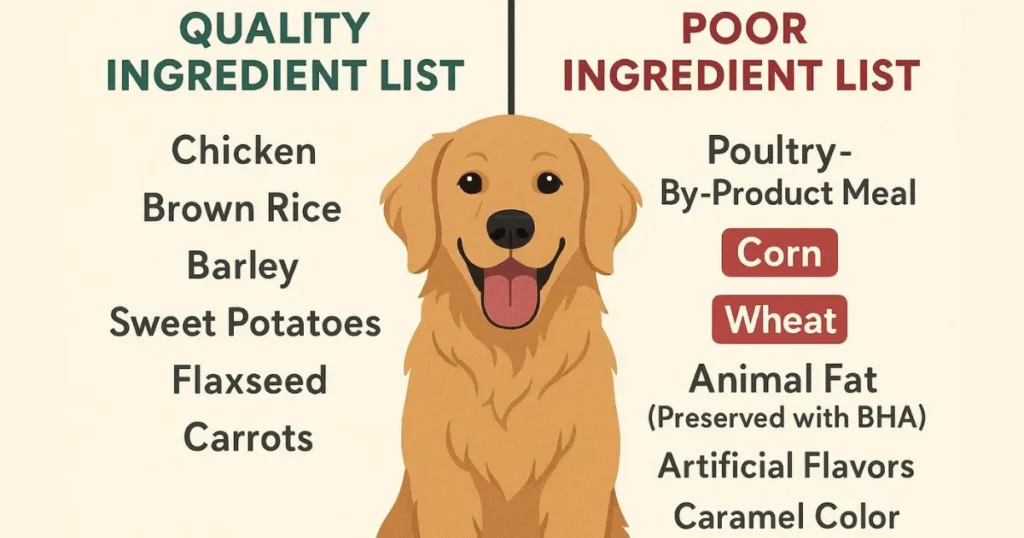
Problematic Protein Sources
Generic meat terms:
“Meat meal,” “meat by-products,” “animal digest” without species specification
Excessive plant proteins:
Corn gluten meal, soy protein concentrate, pea protein as primary proteins lacking complete amino acid profiles
Rendered products:
While rendering is necessary for meat meals, ambiguous sourcing raises quality control concerns
Low-Quality Fillers
Corn products (when dominant):
Corn gluten meal, ground corn, corn bran, corn germ meal, used extensively as cheap fillers
Wheat products (excessive amounts):
Wheat middlings, wheat mill run – by-products from flour production with minimal nutritional value
Soy products (primary ingredients):
Soybean meal, soy flour – cheaper protein sources often triggering sensitivities in Golden Retrievers
Artificial Additives
Synthetic preservatives:
BHA (butylated hydroxyanisole), BHT (butylated hydroxytoluene), ethoxyquin – chemical preservatives with potential health concerns
Artificial colors:
Red 40, Yellow 5, Blue 2 – serve zero nutritional purpose, purely cosmetic
Artificial flavors:
Generic “artificial flavors” suggesting base ingredients lack palatability, requiring chemical enhancement
The best diet dog food avoids these ingredients, using natural preservatives (mixed tocopherols, vitamin E), no artificial colors (dogs don’t care about color), and relying on quality ingredients for natural palatability.
Analyzing Specific Ingredient Lists
Let me walk through real-world dog food ingredients examples showing how to evaluate quality based on actual labels.
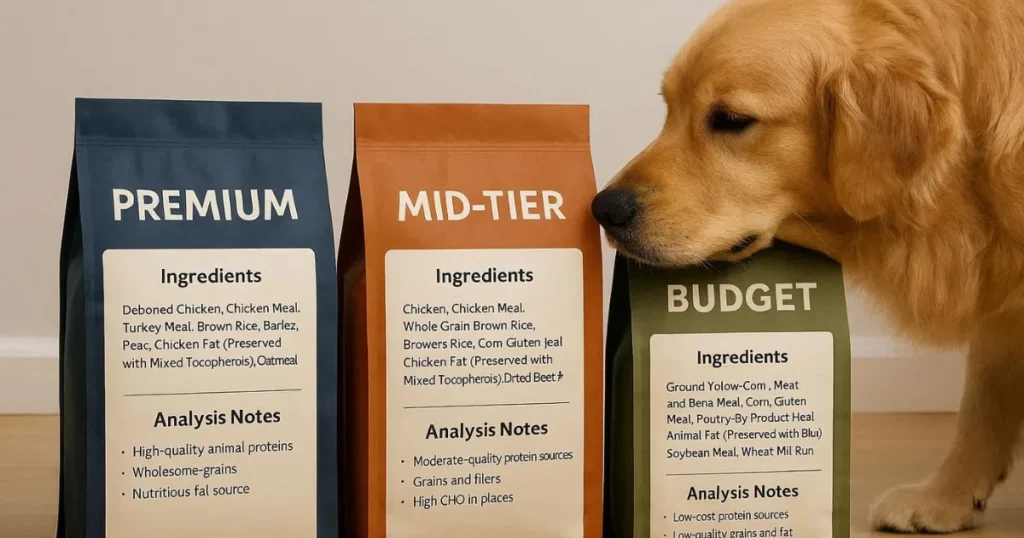
Example 1: Premium Quality Ingredient List
Ingredients:
Deboned chicken, chicken meal, brown rice, oatmeal, barley, chicken fat (preserved with mixed tocopherols), flaxseed, natural flavor, dried egg product, fish oil, dried blueberries, carrots, spinach, glucosamine hydrochloride, chondroitin sulfate, vitamins and minerals.
Analysis:
Excellent quality. Named proteins (deboned chicken, chicken meal) dominate. Whole grains provide digestible carbs. Named fat source (chicken fat) with natural preservation. Beneficial additions (flaxseed, fish oil, vegetables). Joint support (glucosamine, chondroitin). This represents the best diet dog food ingredient quality.
Example 2: Mid-Tier Quality Ingredient List
Ingredients:
Chicken, chicken by-product meal, corn, wheat, soybean meal, chicken fat (preserved with BHA), natural flavor, dried beet pulp, vitamins and minerals.
Analysis:
Acceptable but not optimal. Real chicken is listed first, but followed by by-product meal (quality varies). Heavy grain presence (corn, wheat). Soybean meal as a protein supplement. Synthetic preservation (BHA). Meets basic nutritional needs but contains lower-quality dog food ingredients compared to premium options.
Example 3: Budget-Tier Quality Ingredient List
Ingredients:
Ground corn, meat and bone meal, soybean meal, animal fat (preserved with BHA), corn gluten meal, wheat middlings, artificial colors, natural and artificial flavors, vitamins and minerals.
Analysis:
Poor quality. No named meat protein – generic “meat and bone meal.” Corn dominates. Plant proteins are primary (soybean meal, corn gluten meal). Generic fat. Artificial colors serve no purpose. This budget-tier food meets minimum AAFCO standards but uses the lowest-quality dog food ingredients.
Best Diet Dog Food for Weight Management
Many Golden Retrievers struggle with obesity, making weight management formulas featuring specific dog food ingredients essential for health maintenance.

Key Ingredients in Weight Management Foods
Increased protein (28-32% dry matter basis):
Preserves lean muscle during weight loss, increases satiety, supports metabolism
Reduced fat (8-12% dry matter basis):
Lowers caloric density while maintaining essential fatty acids for health
Enhanced fiber (6-10%):
Promotes fullness, slows digestion, provides bulk without calories
L-carnitine:
An Amino acid supporting fat metabolism and energy production during caloric restriction
Recommended Weight Management Options
Hill’s Science Diet Perfect Weight:
Precisely formulated best diet dog food for weight loss with clinically proven results
Royal Canin Weight Care:
Veterinary-developed formula with optimal fiber and protein balance
Purina Pro Plan Weight Management:
Research-backed ingredients supporting gradual, sustainable weight loss
These weight management formulas feature dog food ingredients specifically selected for satiety, muscle preservation, and healthy weight reduction in overweight Golden Retrievers.
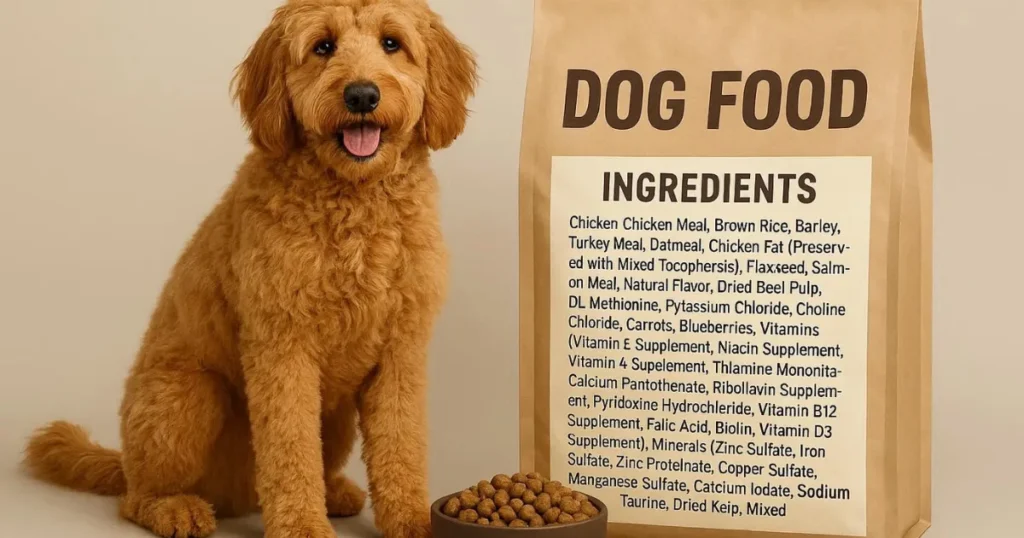
Goldendoodle Food Considerations
Since many readers search for Goldendoodle food, I’ll address nutritional needs for these popular Golden Retriever/Poodle crosses.
Understanding Goldendoodle Nutritional Needs
Goldendoodles inherit traits from both parent breeds, requiring dietary considerations:
Size variation:
Miniature (15-30 lbs), medium (30-45 lbs), standard (45-100 lbs). Goldendoodles have different caloric needs
Coat characteristics:
Goldendoodle coats benefit from omega fatty acids, supporting skin health and reducing matting
Activity levels:
Generally, high-energy dogs require an appropriate caloric density
Potential sensitivities:
Some Goldendoodles inherit Golden Retriever skin sensitivities, requiring careful ingredient selection
Goldendoodle Food Recommendations
Life stage formulas:
Select puppy, adult, or senior formulas matching your Goldendoodle’s age, using appropriate size categories (small/medium breed vs. large breed based on individual dog size).
Quality ingredients:
Apply same dog food ingredients evaluation criteria – named proteins, whole grains or quality carbs, beneficial fats, minimal fillers.
Coat support:
Choose Goldendoodle food with omega-3 and omega-6 fatty acids supporting their unique coat texture.
Size-appropriate kibble:
Smaller Goldendoodles need smaller kibble; standards handle large-breed kibble comfortably.
The best diet dog food for Goldendoodles follows Golden Retriever nutritional principles adjusted for individual size category.
Special Diet Dog Food Ingredients.
Certain Golden Retrievers require specialized dog food ingredients addressing specific health conditions I diagnose regularly.
Limited Ingredient Diets.
For food-allergic Golden Retrievers, limited ingredient dog food ingredients reduce allergen exposure:
Single protein source:
Novel proteins (venison, duck, rabbit, kangaroo) that the dog hasn’t eaten previously.
Limited carbohydrate:
Single digestible carb (sweet potato, potato) rather than multiple grains.
Minimal additives:
No unnecessary colors, flavors, or ingredients beyond essential nutrition.
Examples: Natural Balance L.I.D., Blue Buffalo Basics, Wellness Simple.
Prescription Diets.
Some Golden Retrievers need prescription best diet dog food with therapeutic ingredients:.
Kidney support:
Reduced phosphorus, enhanced omega-3s, and controlled protein (Hill’s k/d, Royal Canin Renal Support).
Joint support:
Enhanced glucosamine, chondroitin, omega-3s (Hill’s j/d, Royal Canin Mobility Support).
GI support:
Highly digestible proteins, prebiotics, specific fiber blends (Hill’s i/d, Royal Canin Gastrointestinal).
Cardiac support:
Reduced sodium, enhanced taurine and L-carnitine (Hill’s h/d, Royal Canin Cardiac).
These prescription formulas feature dog food ingredients precisely balanced for disease management under veterinary supervision.
Ingredient Quality across Price Points.
Understanding how dog food ingredients vary by price point helps set realistic expectations when selecting the best diet dog food within budget constraints.
Premium Tier ($ 4-6+ per pound).
- Protein: Named fresh meats first, supplemented with quality meat meals.
- Carbs: Whole grains, sweet potatoes, exotic grains (quinoa, millet).
- Fats: Named sources with optimal omega ratios.
- Additions: Probiotics, glucosamine, superfoods, novel proteins.
- Examples: Orijen, Acana, Fromm Gold.
Mid-Tier ($ 2-3 per pound).
- Protein: Named meats and meals, generally good quality.
- Carbs: Brown rice, oatmeal, standard vegetables.
- Fats: Named sources, adequate omega support.
- Additions: Basic joint support, some probiotics.
- Examples: Blue Buffalo, Wellness, Natural Balance.
Budget Tier ($ 1-2 per pound).
- Protein: Mix of named meats and generic meals.
- Carbs: Corn, wheat, basic grains.
- Fats: May include generic “animal fat”
- Additions: Minimal supplementation.
- Examples: Diamond Naturals, Purina ONE, Kirkland.
All tiers can provide complete nutrition meeting AAFCO standards, but dog food ingredients quality and supplementation vary considerably, affecting long-term health outcomes.
Making Ingredient-Based Decisions.
Armed with dog food ingredients knowledge, here’s how to apply this information when selecting the best diet dog food for your Golden Retriever.
Step-by-Step Ingredient Analysis.
Step 1:
Check the AAFCO statement, ensuring the food meets nutritional standards for the appropriate life stage.
Step 2:
Identify the first 5-7 ingredients comprising the bulk of the formula.
Step 3:
Verify named animal proteins appear in the top 3 positions.
Step 4:
Assess carbohydrate quality (whole grains/vegetables vs. fillers).
Step 5:
Confirm named fat sources with natural preservation.
Step 6:
Check for beneficial additions (omega-3s, glucosamine, and probiotics).
Step 7:
Scan for red flag ingredients (generic meats, artificial additives, excessive fillers).
Step 8:
Compare dog food ingredients across similar-priced options, selecting the best quality for the budget.
When Ingredients Don’t Tell the Whole Story.
While dog food ingredients analysis is valuable, other factors matter:
Digestibility:
Two foods with identical ingredients may have different digestibility based on processing.
Quality control:
Manufacturing standards affect ingredient consistency and food safety.
Individual response:
Your Golden may thrive on one formula but not another despite similar ingredients.
Palatability:
Quality ingredients mean nothing if your dog refuses to eat the food.
The best diet dog food combines quality dog food ingredients with your dog’s individual response and tolerance.
What are the most important dog food ingredients to look for?
Most important dog food ingredients include named animal proteins in the top 3 positions (chicken, beef, salmon – not generic “meat”), whole-food carbohydrates (brown rice, sweet potato, oatmeal), named fat sources (chicken fat, fish oil), and beneficial additions (omega-3s, glucosamine, probiotics). Avoid generic terms (” meat meal,” “animal fat”), artificial additives (BHA, artificial colors), and excessive fillers (corn gluten meal, wheat middlings).
What makes the best diet dog food for Golden Retrievers?
Best diet dog food features quality dog food ingredients: named proteins first (chicken, beef, fish), digestible whole grains or vegetables, named fats with omega-3s, joint support (glucosamine, chondroitin), and no artificial additives. Must meet AAFCO standards for the appropriate life stage. For weight management, look for increased protein (28-32%), reduced fat (8-12%), enhanced fiber (6-10%), and L-carnitine supporting healthy weight loss.
What food is best for Goldendoodles?
Goldendoodle food follows the same principles as Golden Retriever nutrition, adjusted for size: use small/medium breed formulas for mini/medium Goldendoodles, large-breed formulas for standards. Prioritize quality dog food ingredients, including named proteins, omega fatty acids supporting coat health, appropriate life-stage nutrition, and size-appropriate kibble. Apply ingredient analysis, evaluating proteins, carbs, and fats, just as you would for purebred Golden Retrievers.
How do I know if dog food ingredients are high quality?
High-quality dog food ingredients show named animal proteins (chicken, not “poultry”) in the top 5 positions, whole grains or digestible vegetables (not by-products), named fats (chicken fat, not “animal fat”), natural preservation (mixed tocopherols, not BHA/BHT), and beneficial additions (fish oil, glucosamine). Generic terms (” meat meal,” “by-products”), artificial additives, and excessive fillers indicate lower quality ingredients.
Should I choose grain-free dog food based on ingredients?
Not necessarily. Grain-free dog food ingredients substitute grains with potatoes, peas, and legumes. Following FDA investigations into grain-free diets and dilated cardiomyopathy, grain-inclusive options with whole grains often represent safer choices for Golden Retrievers. Choose grain-free only if your dog has been diagnosed grain allergy (rare). Evaluate overall ingredient quality – protein sources, fat quality, additives – rather than just grain presence/absence.
What dog food ingredients cause allergies in Golden Retrievers?
Common allergen dog food ingredients include beef, dairy, wheat, chicken, soy, and corn. However, individual dogs react to different proteins. True food allergies require elimination diets, identifying specific triggers. Don’t assume ingredients cause problems without a proper diagnosis. Many perceived “allergies” are environmental sensitivities unrelated to diet. Work with a veterinarian conducting elimination trials if food sensitivity is suspected.
Are expensive dog foods always better based on ingredients?
Not always. While premium dog food ingredients often show higher quality (named fresh meats, exotic proteins, superfoods), mid-tier brands frequently provide excellent nutrition at lower cost. Evaluate actual ingredients rather than price – some expensive foods charge for marketing/packaging rather than superior nutrition. Best diet dog food balances quality ingredients that your budget sustains long-term while meeting AAFCO standards and your Golden’s individual needs.
How often should dog food ingredients change or rotate?
Don’t frequently rotate dog food ingredients unless medical necessity requires it. Once you’ve found food with quality ingredients your Golden tolerates well, maintain consistency. Constant ingredient changes cause digestive upset and prevent evaluating whether any single formula truly suits your dog. Change ingredients only when transitioning life stages (puppy to adult, adult to senior) or addressing diagnosed health issues under veterinary guidance.
Conclusion.
Understanding dog food ingredients empowers Golden Retriever owners to make informed decisions based on nutritional quality rather than marketing claims or price alone. Throughout my years treating Goldens, I’ve learned that reading ingredient lists critically – identifying quality proteins, recognizing whole-food carbohydrates, noting beneficial fats, and spotting red flag additives – helps owners select the best diet dog food supporting their dog’s health throughout all life stages.
Whether evaluating standard Golden Retriever nutrition or Goldendoodle food for these popular crosses, ingredient analysis principles remain consistent: prioritize named animal proteins, choose digestible whole-food carbohydrates, select named fat sources with omega-3 support, seek beneficial additions like joint supplements and probiotics, and avoid generic ingredients, artificial additives, and excessive fillers.
Remember that while dog food ingredients analysis provides crucial information, it represents one tool among several for selecting optimal nutrition. Combine ingredient evaluation with AAFCO compliance verification, your Golden’s individual response, veterinary guidance for specific health conditions, and practical budget considerations, ensuring sustainable long-term feeding.
Whether choosing premium-tier foods with exceptional dog food ingredients, mid-tier options balancing quality and value, or budget-tier products meeting minimum standards, informed ingredient analysis helps you select the best diet dog food your budget allows while understanding exactly what you’re feeding your Golden Retriever every single day.
Share Your Dog Food Ingredients Experience! How do you evaluate dog food ingredients when selecting food for your Golden Retriever or Goldendoodle? I’m eager to hear about your experiences reading labels, identifying quality ingredients, discovering the best diet dog food through ingredient analysis, and how ingredient-based decisions have affected your dog’s health!