Throughout my years of experience treating Golden Retriever puppies, I’ve counseled countless owners about selecting the best canned dog food for puppies to support healthy growth during this critical developmental phase. Canned puppy food offers unique advantages – enhanced palatability, higher moisture content, easier digestibility, and softer texture – making it particularly valuable for young Goldens transitioning from mother’s milk, teething puppies experiencing mouth discomfort, or picky eaters refusing kibble.
In my clinic, I’ve observed excellent health outcomes in Golden Retriever puppies eating the quality best canned dog food for puppies either exclusively or combined with kibble. However, I’ve also treated puppies suffering from nutritional imbalances when owners select inappropriate formulas lacking proper large-breed puppy nutrition or feed excessive portions, causing rapid growth.
Today, I’ll share comprehensive veterinary guidance on the best canned dog food for puppies, including top recommendations, feeding guidelines, large-breed-specific requirements, and practical implementation strategies based on nutritional science and clinical experience with hundreds of Golden Retriever puppies.
Understanding Puppy Nutritional Requirements
Before selecting the best canned dog food for puppies, I explain what makes puppy nutrition unique and why Golden Retriever puppies have specific requirements preventing developmental problems I diagnose frequently.
Why Puppies Need Special Nutrition
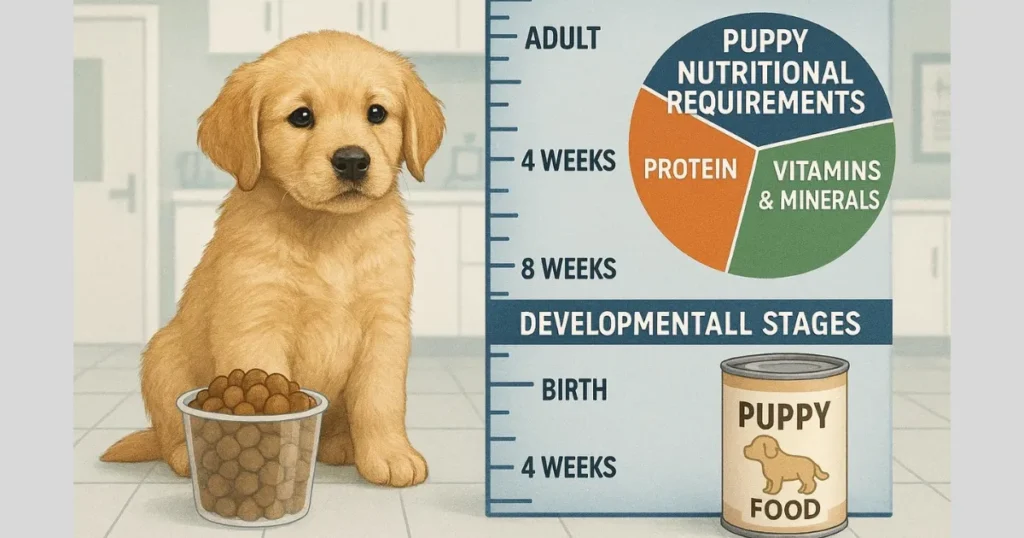
Puppies aren’t simply small adult dogs – they’re rapidly growing animals with dramatically different nutritional needs. Golden Retriever puppies grow from 10-15 pounds at 8 weeks to 55-75 pounds by 12 months, requiring precise nutrition supporting this extraordinary development.
Higher protein requirements (minimum 22.5% AAFCO standard versus 18% for adults) provide amino acids for tissue building, organ development, and immune system maturation. The best canned dog food for puppies provides 25-30% protein on a dry matter basis.
Increased caloric density fuels rapid growth and high energy levels. Puppies need approximately twice the calories per pound of body weight compared to adult dogs of similar size.
Precise calcium and phosphorus ratios prove critical for skeletal development. This is where many puppy foods fail Golden Retrievers specifically – I’ll explain why shortly.
Enhanced DHA (docosahexaenoic acid from fish oil) supports brain and vision development during critical growth windows. Quality puppy formulas include DHA specifically for cognitive and neurological maturation.
Large-Breed Puppy Considerations
Golden Retrievers are large-breed dogs requiring specialized nutrition to prevent developmental orthopedic diseases – hip dysplasia, elbow dysplasia, osteochondrosis – that I diagnose frequently in improperly fed puppies.
Controlled calcium levels (1.2-1.8% dry matter basis) prevent excessive skeletal growth, causing joint malformation. Many standard puppy foods contain 2.0-2.5% calcium – too high for large breeds.
Appropriate calcium-to-phosphorus ratios (1:1 to 1.8:1, ideally 1.2:1 to 1.4:1) ensure proper bone mineralization without abnormal development. I’ve treated puppies eating imbalanced diets.
Moderate caloric density supports steady controlled growth rather than rapid weight gain, increasing orthopedic disease risk. The best canned dog food for puppies of large breeds provides appropriate calories without promoting excessively fast growth.
Vet’s Tip: Never feed small-breed puppy food, “all life stages” formulas, or adult maintenance food to Golden Retriever puppies. These lack appropriate large-breed nutrition and cause serious developmental problems I’ve treated throughout my career.
Benefits of Canned Dog Food for Puppies
Understanding why the best canned dog food for puppies offers advantages helps owners decide whether wet feeding suits their Golden puppy’s needs.

Enhanced Palatability
Puppies transitioning from mother’s milk or those experiencing teething discomfort often refuse kibble but eagerly eat canned food. The aroma, flavor, and texture of wet food significantly exceed kibble’s appeal, encouraging proper food intake during critical growth phases.
In my practice, I’ve successfully resolved eating reluctance in numerous Golden puppies simply by incorporating the best canned dog food for puppies into their feeding regimen, ensuring adequate caloric intake supporting healthy development.
Superior Hydration Support
Canned food contains 70-80% moisture versus kibble’s 6-10%, significantly contributing to daily hydration needs. While puppies typically drink adequate water, the moisture content in wet food provides additional hydration, supporting metabolic processes during rapid growth.
I’ve observed better hydration markers in puppies eating primarily canned food compared to kibble-only diets, particularly beneficial during hot weather or in households where water bowl access may be inconsistent.
Easier Digestibility
Young digestive systems function less efficiently than mature adult systems. Canned food’s soft texture and moisture content require less digestive effort while delivering superior nutrient absorption – critical during growth phases when nutritional demands peak.
Golden Retriever puppies with sensitive stomachs often tolerate best canned dog food for puppies better than kibble, showing reduced digestive upset, less gas, and more consistent stool quality within 1-2 weeks of transition.
Ideal for Teething Puppies
Between 3-6 months, puppies lose baby teeth and develop adult dentition – a process causing mouth discomfort, making hard kibble painful to eat. Soft canned food allows comfortable eating during this challenging phase without compromising nutritional intake.
I regularly recommend temporary or permanent best canned dog food for puppies, inclusion for teething Golden puppies showing decreased appetite or food avoidance related to dental development.
Top Veterinary Recommendations: Best Canned Dog Food for Puppies
Based on nutritional analysis, AAFCO compliance for growth, clinical outcomes, and large-breed appropriateness, here are my evidence-based recommendations for the best canned dog food for puppies.

Vet’s Pick # 1: Hill’s Science Diet Puppy Large Breed
This formula consistently delivers excellent results in my Golden Retriever puppy patients through research-backed nutrition and large-breed-specific formulation.
Why I recommend it:
- Precisely controlled calcium (1.35% dry matter basis) prevents excessive skeletal growth
- Balanced calcium-to-phosphorus ratio (1.3:1) supports proper bone development
- Real chicken as the primary protein provides complete amino acids
- DHA from fish oil supports brain and eye development
- 26% protein, 16% fat (dry matter basis) provides appropriate growth support
- AAFCO feeding trials verify nutritional adequacy for large-breed puppies
I’ve followed numerous Golden puppies on Hill’s from 8 weeks through 12 months, observing steady controlled growth, excellent body condition, healthy bone development verified through orthopedic examinations, and outstanding coat quality.
Vet’s Pick # 2: Royal Canin Puppy Large Breed in Loaf
Royal Canin’s breed-size-specific approach makes this excellent best canned dog food for puppies destined for large adult sizes like Golden Retrievers.
Why I recommend it:
- Adapted calcium and phosphorus levels for large-breed skeletal development
- Enhanced antioxidant complex supports the developing immune system
- Highly digestible proteins and prebiotics support intestinal health
- Soft loaf texture appeals to puppies transitioning from milk or during teething
- DHA supports neurological development
- 27% protein, 14% fat (dry matter basis) provides balanced nutrition
The formula’s digestibility makes it particularly valuable for Golden puppies with sensitive stomachs – a common issue I address during puppy wellness visits.
Vet’s Pick # 3: Blue Buffalo Wilderness Puppy Chicken Recipe
For owners preferring grain-free options (though I counsel about cardiac considerations), Blue Buffalo provides quality best canned dog food for puppies with a natural ingredient focus.
Why it makes the list (with caveats):
- Real chicken as the first ingredient provides quality protein.
- DHA and ARA support brain and eye development.
- LifeSource Bits provide antioxidants, vitamins, and minerals.
- No by-product meals, corn, wheat, or soy.
- 30% protein, 16% fat (dry matter basis).
Important consideration:
Given FDA investigations into grain-free diets and dilated cardiomyopathy, I recommend ensuring adequate taurine intake and considering cardiac monitoring if feeding grain-free long-term, particularly for Golden Retrievers with breed-specific cardiac vulnerabilities.
Vet’s Pick # 4: Purina Pro Plan Focus Puppy Large Breed.
Purina’s research-backed approach and accessible pricing make this the practical best canned dog food for puppies for budget-conscious families.
Why I recommend it:
- Real chicken as the first ingredient.
- DHA from omega-rich fish oil supports brain development.
- Calcium and phosphorus levels are appropriate for large breeds.
- Antioxidants support the developing immune system.
- 28% protein, 15% fat (dry matter basis).
- Excellent value without compromising essential nutrition.
Many clients appreciate Pro Plan’s widespread availability and consistent formulation, providing reliability important for long-term puppy feeding throughout the growth phase.
Owner’s Choice: Wellness CORE Grain-Free Puppy.
Wellness offers premium natural ingredients appealing to owners prioritizing whole-food nutrition as the best canned dog food for puppies.
Why owners choose it:
- Deboned turkey and chicken provide quality protein.
- Grain-free formula uses potatoes and sweet potatoes.
- DHA supports cognitive development.
- Probiotics support digestive health.
- 32% protein, 18% fat (dry matter basis).
While I appreciate the quality ingredients, the higher fat content requires careful portion control, preventing excessive weight gain in Golden puppies.
Feeding Guidelines for Canned Puppy Food.
Selecting the best canned dog food for puppies is only half the equation – proper feeding management ensures optimal growth without developmental problems.

Determining Appropriate Portions.
Canned food contains significantly more moisture than kibble, requiring different portion calculations. Never simply follow package guidelines without adjusting for your puppy’s individual needs.
Calculation method:
- Determine your puppy’s ideal adult weight (60-75 lbs for females, 65-80 lbs for males).
- Calculate daily caloric needs using puppy growth calculators or veterinary guidance.
- Check the can label for kcal per can/cup.
- Divide daily calories by the food’s caloric density.
Example: 12-week-old Golden puppy (25 lbs, projected 70 lb adult).
- Daily caloric needs: | 1,400 calories.
- Best canned dog food for puppies providing 400 kcal per 13 oz can.
- Daily amount: 3.5 cans divided into 3-4 meals.
Feeding Frequency by Age.
| Age Range | Meals Per Day | Reasoning |
| 8-12 weeks | 4 meals | Small stomach capacity, high energy needs |
| 3-6 months | 3 meals | Increased capacity, sustained energy |
| 6-12 months | 2 meals | Approaching adult feeding pattern |
Never free-feed puppies. Scheduled meals with controlled portions prevent rapid growth and allow monitoring of appetite and eating behavior – important health indicators I assess during wellness exams.
Mixed Feeding Approach.
Many owners successfully combine canned and dry puppy food, balancing the benefits of both formats while managing costs.
Effective strategies:
- 50/50 split: Feed half daily calories from canned, half from kibble.
- Kibble with topper: Use primarily kibble with 2-4 tablespoons best canned dog food for puppies as topper.
- Alternating meals: Feed canned for one meal, kibble for another.
Ensure both the canned and dry components meet large-breed puppy requirements. Mixed feeding should provide complete nutrition, not create imbalances through incompatible formulas.
Monitoring Growth and Adjusting Portions.
Weekly weighing during puppyhood helps track growth rate and adjust the best canned dog food for puppies portions, maintaining appropriate development.
Healthy growth indicators:
- Steady weight gain (2-4 lbs weekly after 12 weeks).
- Lean body condition (ribs easily palpable, visible waist).
- Appropriate energy levels (playful but not hyperactive).
- Normal digestion (formed stools 2-3 times daily).
If weight gain exceeds 4 lbs weekly consistently, reduce portions by 10-15%. If the gain is insufficient or the puppy appears thin, increase by 10-15%. Reassess weekly and consult your veterinarian if concerns arise.
Common Mistakes with Canned Puppy Food.
Throughout my career, I’ve identified recurring errors owners make when feeding the best canned dog food for puppies to Golden Retrievers.
Mistake # 1: Feeding Small-Breed or Adult Formulas.
Small-breed puppy food contains excessive calcium for large breeds, while adult maintenance food lacks nutrients supporting growth. Both cause developmental problems I’ve treated.
Always verify the label states: “Complete and balanced for growth of large breed puppies” or similar AAFCO statement specifically mentioning large breeds.
Mistake # 2: Overfeeding Based on Package Guidelines.
Package feeding guides provide starting points only and often overestimate needs. I regularly treat overweight Golden puppies whose owners followed package recommendations without adjusting for individual metabolism.
Use body condition scoring and weekly weighing, adjusting portions based on actual growth rather than blindly following guidelines.
Mistake # 3: Abrupt Diet Changes.
Switching foods too quickly causes digestive upset. When transitioning to or between the best canned dog food for puppies options, implement a 7-10 day gradual transition, mixing increasing amounts of new food with decreasing amounts of current food.
Mistake # 4: Inadequate Food Safety.
Canned food requires refrigeration after opening and use within 3-5 days. I’ve treated puppies with bacterial infections from spoiled wet food left at room temperature or stored too long after opening.
Mistake # 5: Continuing Puppy Food Too Long.
Transition to adult food at 12-15 months when growth plates close. Continuing puppy food beyond this point provides excessive calories and calcium, contributing to obesity and potential skeletal issues.

Special Considerations for Golden Retriever Puppies.
Selecting the best canned dog food for puppies for this specific breed requires addressing Golden-specific vulnerabilities and health concerns.
Hip and Elbow Dysplasia Prevention.
Golden Retrievers face a high genetic predisposition to developmental orthopedic diseases. While genetics play the primary role, nutrition significantly influences expression and severity.
Nutritional factors I emphasize:
- Controlled growth rate (never rapid weight gain).
- Appropriate calcium levels (1.2-1.8% dry matter maximum).
- Ideal body condition throughout growth (lean, never chubby).
- Proper exercise (avoid excessive jumping, long runs until skeletal maturity).
The best canned dog food for puppies, combined with portion control and appropriate exercise, minimizes orthopedic disease risk, though genetic factors remain beyond nutritional control.
Cancer Risk Considerations.
Golden Retrievers tragically face approximately 60% lifetime cancer incidence – the highest among dog breeds. While puppy nutrition cannot prevent cancer, supporting optimal immune development may influence long-term health.
Quality best canned dog food for puppies with antioxidants, DHA, and balanced omega fatty acids supports developing immune systems. While evidence linking puppy nutrition to adult cancer risk is limited, I recommend avoiding artificial preservatives, colors, and unnecessary additives when possible.
Food Allergies and Sensitivities.
Golden puppies occasionally develop food sensitivities, manifesting as skin issues, ear infections, or digestive problems. If sensitivity signs appear, the best canned dog food for puppies may need to be a limited ingredient or novel protein formula.
I’ve successfully managed puppy food sensitivities using limited ingredient canned diets (single protein, limited carbohydrate) while maintaining growth-appropriate nutrition under close veterinary monitoring.
Teething and Dental Development.
Between 3-6 months, puppies experience significant mouth discomfort during tooth replacement. Soft canned food allows comfortable eating during this phase without nutritional compromise.
I recommend temporary increased the best canned dog food for puppies during peak teething (4-5 months) if puppies show decreased appetite or difficulty eating kibble, transitioning back to the preferred feeding method once adult teeth fully erupt.
Cost Considerations and Budgeting.
The best canned dog food for puppies costs significantly more per calorie than kibble, creating budget concerns for families raising large-breed puppies.
Monthly Cost Estimates.
For a growing Golden Retriever puppy (average across growth phase):
- Exclusive canned feeding: $180-300 monthly.
- Mixed feeding (50/50): $100-180 monthly.
- Premium kibble only: $60-100 monthly.
These estimates vary by brand and puppy age (younger puppies eat less, costs increase as they grow).
Cost Management Strategies.
- Mixed feeding approach: Balances wet food benefits with kibble economy.
- Strategic canned usage: Use canned during teething (4-5 months) when most beneficial, returning to kibble after.
- Buy in bulk: Case purchases reduce per-unit costs 10-15%.
- Auto-ship discounts: Online retailers offer 5-10% savings on recurring deliveries.
- Choose mid-tier quality: Excellent options exist at $2-3 per can versus $4-6 premium pricing.
Never compromise proper large-breed puppy nutrition for cost savings. Developmental problems from inappropriate feeding cost far more in veterinary bills than quality food investment. If the budget is severely limited, premium large-breed puppy kibble provides better value than inferior canned options.
Transitioning from Canned Puppy to Adult Food.
Around 12-15 months, Golden Retrievers reach skeletal maturity, requiring a transition from puppy to adult formulations.
When to Transition.
Physical indicators:
- Growth rate slows significantly.
- Adult proportions achieved.
- Growth plates closed (verified radiographically if uncertain).
Age guidelines:
- Females: 12-14 months typically.
- Males: 13-15 months typically (larger, mature slightly later).
Consult your veterinarian determining optimal transition timing based on individual development.
Transition Protocol.
- Day 1-3: 75% puppy food, 25% adult food.
- Day 4-6: 50% puppy food, 50% adult food.
- Day 7-9: 25% puppy food, 75% adult food.
- Day 10+: 100% adult food.
Monitor digestion during transition. Slight stool softening is normal; severe diarrhea requires slowing the transition pace.
Adult Food Selection.
Continue the best canned dog food for puppies quality level into adulthood by selecting premium adult large-breed formulas from the same manufacturer or comparable brands.
Adult Golden Retrievers thrive on mixed feeding (kibble base with canned topper), exclusive canned feeding (higher cost), or quality kibble with occasional canned supplementation.
What is the best canned dog food for puppies that are Golden Retrievers?
Best canned dog food for puppies must meet AAFCO large-breed growth standards with controlled calcium (1.2-1.8% dry matter basis), appropriate protein (25-30%), and DHA for development. Top options include Hill’s Science Diet Puppy Large Breed, Royal Canin Puppy Large Breed, and Purina Pro Plan Focus Puppy Large Breed. Always verify labels specify large-breed puppy nutrition, not just generic “puppy” formulas.
Can I feed my Golden Retriever puppy only canned food?
Yes, exclusive canned feeding provides complete nutrition when using quality large-breed puppy formulas meeting AAFCO standards. However, it costs significantly more ($ 180-300 monthly versus $60-100 for kibble) for growing Golden puppies. Many owners successfully use mixed feeding (50% canned, 50% kibble), balancing benefits and costs. Ensure proper portions, preventing rapid growth regardless of food format.
How much canned dog food should I feed my Golden Retriever puppy?
Amounts vary by age, but for a 12-week-old 25-pound Golden puppy, feed approximately 3-3.5 cans (13 oz each) daily, divided into 3-4 meals, adjusting for the specific formula’s caloric density. Use body condition scoring and weekly weighing to adjust portions – puppies should gain 2-4 pounds weekly after 12 weeks while maintaining lean body condition with easily palpable ribs.
Is canned puppy food better than dry kibble for Golden Retrievers?
Each offers advantages. Canned provides higher moisture content, enhanced palatability, easier digestibility, and softer texture, benefiting teething puppies. Kibble offers dental benefits, cost-effectiveness, and convenience. The “better” choice depends on individual puppy needs, owner budget, and lifestyle. Many Golden puppies thrive on quality kibble; others benefit from canned or mixed feeding approaches.
When should I stop feeding canned puppy food to my Golden?
Transition from puppy to adult food at 12-15 months when growth plates close and skeletal maturity is reached. This timing varies individually – females typically transition at 12-14 months, males at 13-15 months. Consult your veterinarian using physical development indicators and growth rate to determine optimal transition timing for your specific Golden Retriever.
Can I mix canned puppy food with dry kibble?
Yes, mixed feeding works excellently. Feed 50/50 by calories, use canned as kibble topper (2-4 tablespoons), or alternate canned and kibble meals. Ensure both components meet large-breed puppy nutritional requirements. Mixed feeding balances canned benefits (palatability, moisture) with kibble advantages (cost, dental benefits) while providing complete nutrition supporting healthy growth.
Does canned puppy food cause soft stools in Golden Retriever puppies?
High-quality canned puppy food shouldn’t cause persistent soft stools. During the initial transition, temporary stool softening is normal (7-10 days). If soft stools persist beyond 2 weeks, the formula may not suit your puppy’s digestion, portions may be excessive, or underlying issues may exist. Consult your veterinarian for proper diagnosis and dietary adjustments if needed.
Is grain-free canned puppy food safe for Golden Retrievers?
Exercise caution with grain-free formulas. FDA investigations suggest potential links between grain-free diets and dilated cardiomyopathy in dogs. Golden Retrievers face breed-specific cardiac risks, making grain-free choices potentially concerning. Unless your puppy has a diagnosed grain allergy (rare), grain-inclusive large-breed puppy formulas provide safer nutrition. If choosing grain-free, ensure adequate taurine and consider cardiac monitoring.
Conclusion.
Selecting the best canned dog food for puppies for your Golden Retriever requires understanding large-breed-specific nutritional requirements, appropriate feeding guidelines, and individual puppy needs throughout the critical growth phase. Throughout my years treating Golden puppies, I’ve witnessed how proper nutrition – including quality canned puppy food when appropriate – supports healthy development, prevents orthopedic diseases, and establishes the foundation for long-term health.
The best canned dog food for puppies provides controlled calcium levels (1.2-1.8% dry matter), appropriate protein (25-30%), enhanced DHA for brain development, and complete nutrition verified through AAFCO large-breed puppy feeding trials. Whether choosing Hill’s Science Diet, Royal Canin, Purina Pro Plan, or Blue Buffalo, prioritize large-breed-specific formulations over generic puppy foods lacking appropriate nutrition for Golden Retrievers.
Remember that even optimal best canned dog food for puppies requires proper feeding management – portion control based on body condition rather than package guidelines, frequent meals matching puppy age, monitoring growth rate weekly, and transitioning to adult food at appropriate skeletal maturity. Combined with regular veterinary wellness visits, appropriate exercise, and socialization, quality nutrition ensures your Golden Retriever puppy develops into a healthy, well-proportioned adult enjoying the active, joyful life these remarkable dogs deserve.
Share Your Canned Puppy Food Experience! What’s the best canned dog food for puppies that worked well for your Golden Retriever? I’m eager to hear about your experiences feeding canned puppy food – which brands you chose, how your puppy responded, and health outcomes you observed during the growth phase!